RECYCLING PAPER WITH REPAPEL

When Bruce and I first committed to traveling to the Dominican Republic (the DR) aboard the Adonia and participating in Fathom’s Impact Travel program, our vision was locked on Chocal.  Volunteering at the cacao plantation and chocolate factory was what I had my heart set on, and Bruce was pleased with the plan.

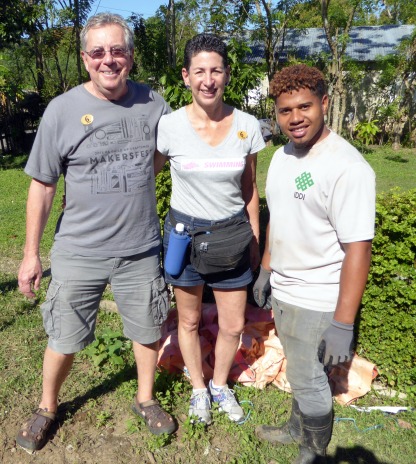
Once aboard ship, though, our cohort leader, Colin, persuasively talked us into signing up to volunteer at the paper recycling co-op.  RePapel is a women’s entrepreneurship initiative which turns wasted paper from the local community into recycled paper products that are sold to consumers.

We told Colin there was no way we would give up one of our Chocal activities, though, and RePapel was booked solid for our only available time—the Friday morning before the Adonia would set sail for her return to Miami.  Sitting at 7th and 8th on the waitlist didn’t look promising; so, we opted on Friday to see if there were some no shows out at the RePapel bus.

As it turned out, we were in luck!  A lady on our Chocal bus the previous day overheard us talking about our plan.  At breakfast on Friday morning, she came over to our table to say her husband didn’t want to go; so, she wouldn’t go either.  Would we like her tickets?  Heck yeah!

Off we went to RePapel where we would help produce paper beads for jewelry and recycled paper for handicrafts to be sold by the women.

By working with the women of RePapel, we would help the ladies generate more income for their families.  The co-op allows for flexible work schedules, so the women can spend more time at home caring for their children.  Fathom’s website states, “Unemployed or underemployed local residents are able to transition to self-supporting entrepreneurs, proving that community-driven economic initiatives empower and sustain communities.”

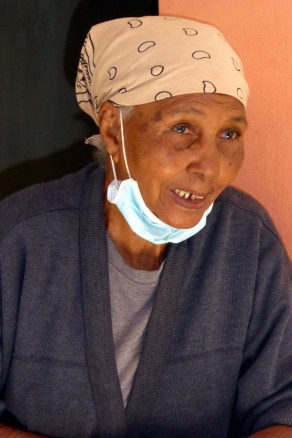
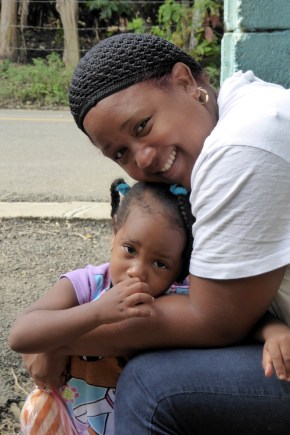
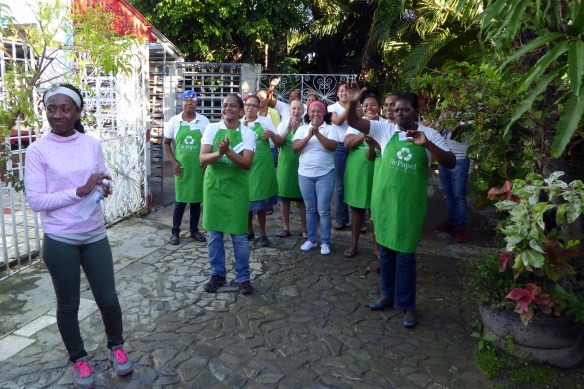
Upon arrival at RePapel, we could hear the ladies singing.  Our group of volunteers broke out in big smiles, looked at each other, and laughed.  These ladies were having FUN!  They were very happy to see us and gave us a warm welcome, as we made our way to the courtyard where we were split up into small groups.
152.JPG

Bruce and I were first sent to the jewelry workshop where we used strips of colorful paper that had been torn out from discarded magazines.  We were shown how to make paper beads; however, Bruce and I were old pros at this task, since we had taught the handicraft in arts and crafts classes aboard Royal Caribbean Cruise Line cruises.

Next, we were given a piece of cord to string a necklace from the paper beads and a variety of other beads made from dried tree seeds.  These necklaces would be sold in their gift shop.  Time was quite limited at this station, so I quickly assembled this necklace before our group was transferred to the paper recycling station:

The first step in this process is separating the clean portions of used paper from the portions with ink.  We sat on the patio in a circle with one of the ladies while we tore sheets of the paper apart to separate these portions into different bins.  While we worked, our guide answered questions about life in the DR.

155.JPG

The next step in their paper recycling process was to mix the small bits of torn paper with water in a washing machine to begin breaking down the fibers in the paper.

The wet, pulpy mixture is then scooped out of the machine and dumped in a blender (yes, the same kind you have at home to make your smoothies) to further break apart the fibers.

158.JPG

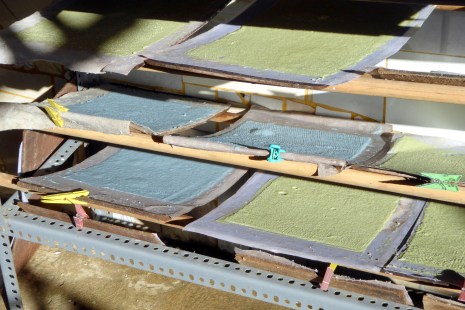
The fun part in the process came next.  We were given a wooden-framed screen to use as a sifter to extract the cleaned recycled paper pulp from a huge sink where it was dumped from the blender. We then took it over to a table where we turned the screen over onto a piece of cardboard, pressed the screen, and then carefully lifted the screen off the wet paper.  The newly-created paper was transferred to the cardboard to dry on racks out in the sun.

159.JPG

162.JPG

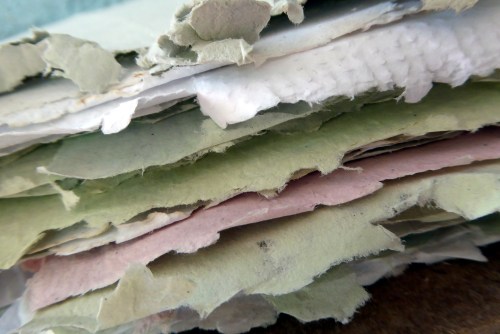
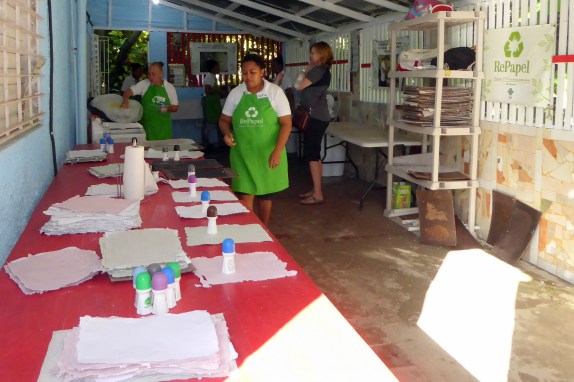
Once the paper is dried, it is removed from the cardboard and stacked onto another table.  Here, used roll-on deodorant bottles get a second life as a manual “iron” to smooth out the screen pattern marks and wrinkles in the paper.  This required some muscle—a great dryland workout to keep my swimmers’ shoulders and arms in shape!
163

164

165.JPG

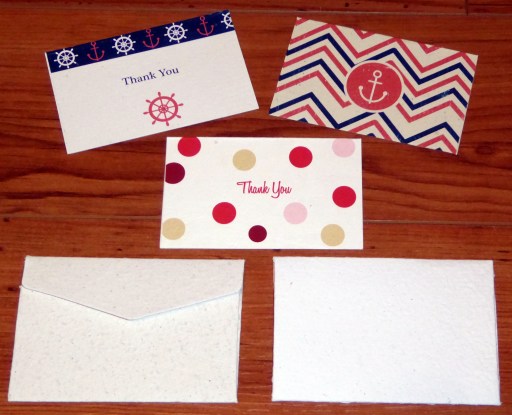
These sheets of paper were ready for the women to make stationary, greeting cards, and other handicrafts for sale.  I bought a five-pack of some cute little greeting cards with matching envelopes.
166

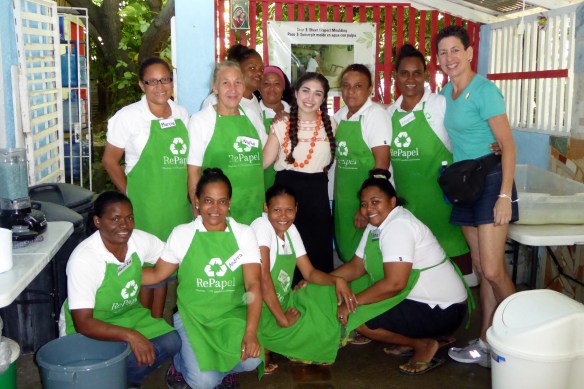
The entire time we worked side-by-side with the ladies, they sang and danced.  From what I read from another blog, this isn’t their usual workday routine.  When the Fathom volunteers come to help (for a couple of days every other week), though, they are just so happy to have us there!
167.JPG

Bruce and I were happy to be there to help these entrepreneurial women, and we were thankful we had the opportunity to do one last Impact Travel activity before the ship set sail for home.

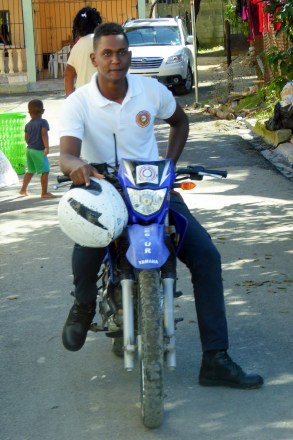
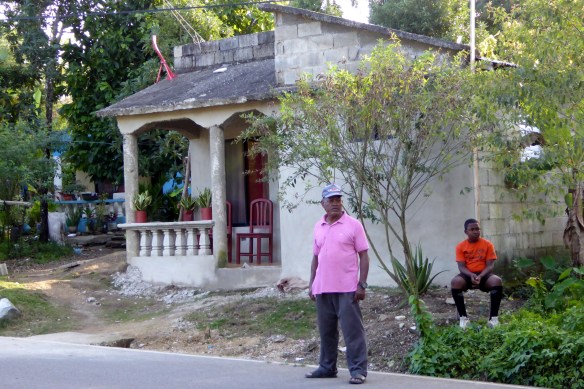
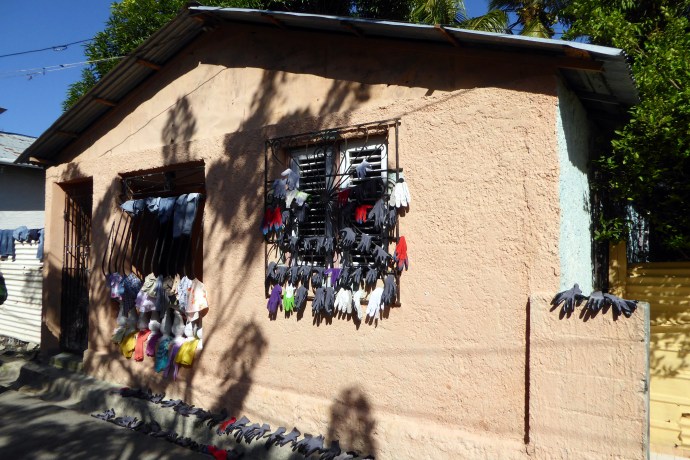
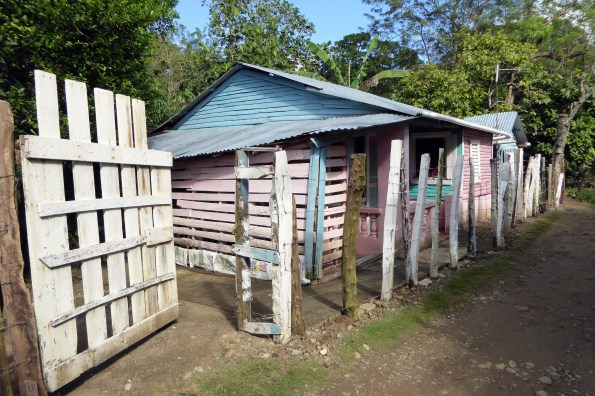
The following are scenes from the neighborhood around RePapel:
168.JPG

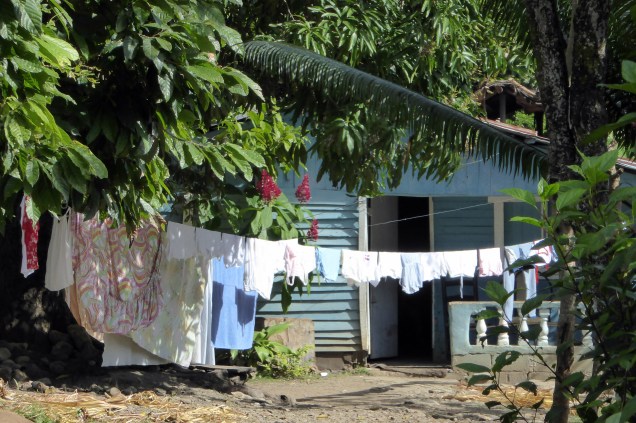
Just outside of the co-op where they were drying work gloves and clothes out in the sun.

169.JPG

170.JPG

171.JPG

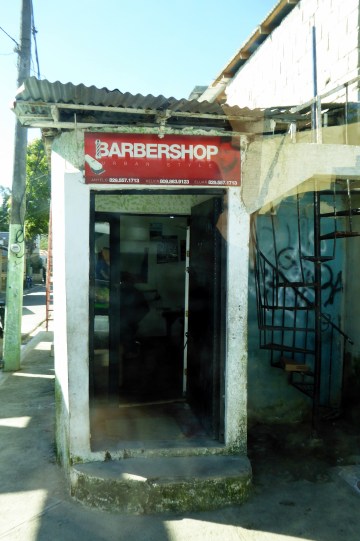
I photographed this cute little barbershop from the bus window.
 

CHOCAL: FROM BEAN TO BAR

In my previous post, I described the first steps in making chocolate, and mentioned how I talked my way into a factory tour for the following day.

Orlando made good on his promise to arrange a factory tour during our second day at Chocal.  After Bruce and I worked for awhile at separating cocoa beans, Orlando escorted us to the machines off the back patio where we met up with one of the ladies.  As she explained (in Spanish) the chocolate-making process and showed us the machines, Orlando translated as I attempted to record the information on my digital recorder.  As I sit here trying to listen to Orlando’s translation, the background noise of the loud machinery is making it very difficult to hear him!  Note to self:  Purchase ear plugs for the workers, because they aren’t using any, and they are going to lose their hearing!

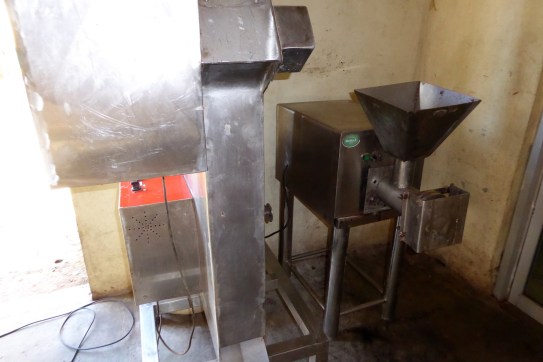
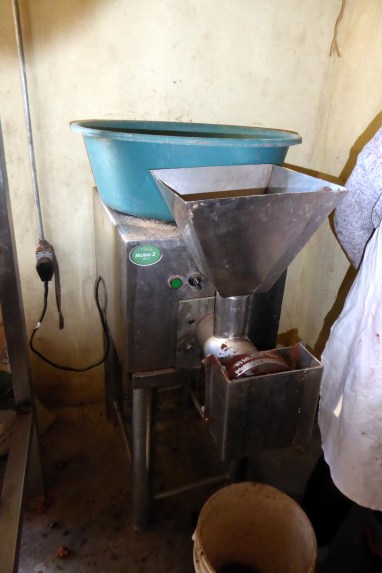
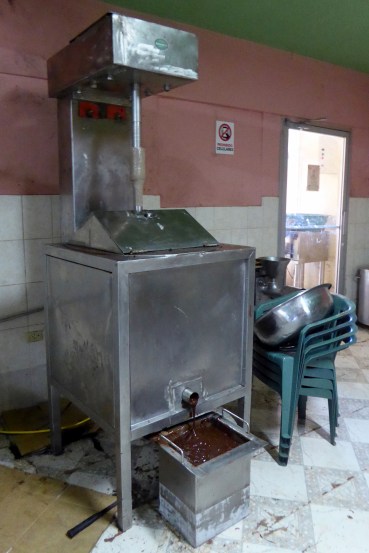
Picking up where we left off previously, the next step in the chocolate-making process is for those cocoa nibs to be ground up in a grinding machine to liquefy the cocoa butter and produce what is now called chocolate liquor or chocolate liquid.

Next, the chocolate liquor goes through a second refining process to further reduce the particle size of the cocoa mass.  Cocoa nibs contain approximately 53 percent cocoa butter (depending on the cacao species); so, it is during this second refining process that the percentage is either increased or decreased, depending on the desired finished product.  For chocolate bars, cocoa butter needs to be added, so the chocolate liquor is transferred to another machine where it will be combined with additional cocoa butter and other ingredients.  This process is described below.  For cocoa powder, the cocoa butter content must be reduced.  At Chocal, they use a syringe to remove as much as possible.  Next, the chocolate liquor is pressed to remove more of the cocoa butter.  Baking soda is added to the remaining cocoa and the “press cake” is cooled, pulverized, and sifted to form cocoa powder.
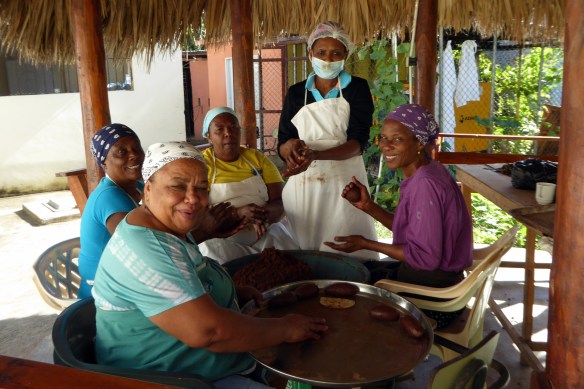
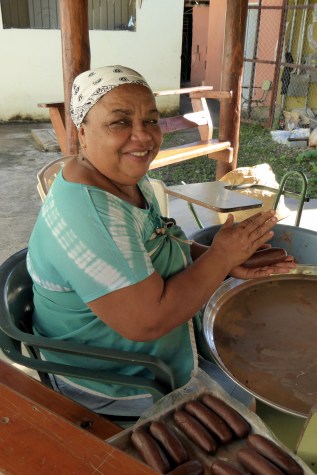
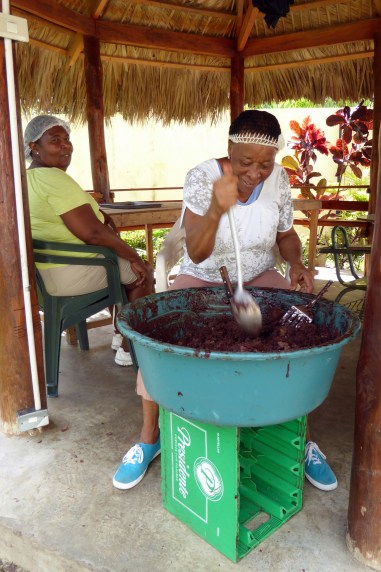
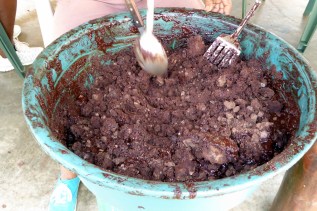
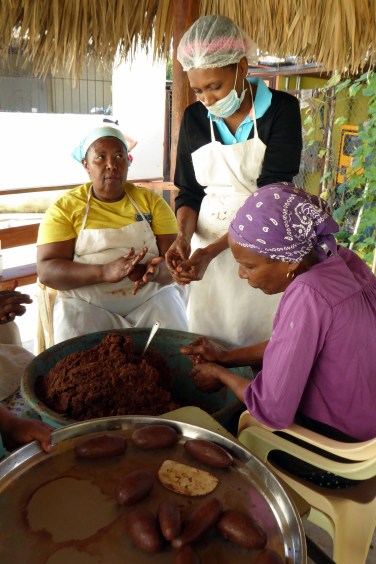
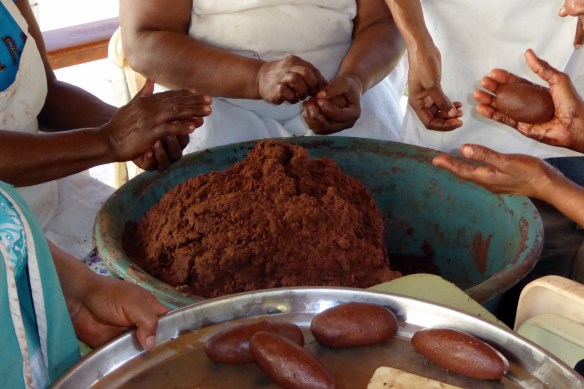
“Press cake” is also used to form cocoa balls for hot cocoa drinks.  This is what the ladies are making in the photo later in this post (and in the photos in my last post).

To produce eating chocolate,  extra cocoa butter is added to the chocolate liquor in a mixing machine, along with sugar and other ingredients, depending on the type of chocolate being made at the time.  In all, cocoa butter accounts for about 25 percent of the weight of most chocolate bars.

For milk chocolate, milk powder is used at Chocal, whereas fresh milk is used at Cadbury.  (If you have seen a Cadbury Milk Chocolate label, you will notice the logo showing that a “glass-and-a-half” of milk goes into each block.

After the chocolate is mixed, it is transferred to another machine to refine it.  Next the chocolate goes into a conching machine.  Conching is a kneading process that develops the flavor of the chocolate, releases some of the bitterness, and gives the resulting chocolate a smooth texture.  In general, the longer chocolate is conched, the smoother the texture will be.  It can take anywhere from a few hours to a few days.  Chocal conches their chocolate for just a few hours; however, the entire mixing process takes a full day between the three machines.

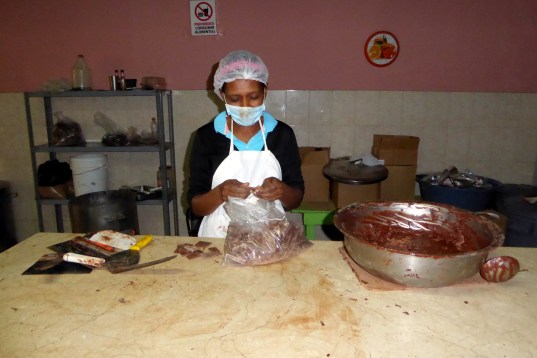
After the chocolate is conched, it must be tempered before it gets poured into chocolate bar molds.  Friction during the conching process naturally heats up the chocolate.  That liquid is then brought down to temperature using a marble table that remains cold due to the air conditioning in the room.  The women spread the chocolate on the table using metal spatulas, mix the chocolate around, and fold it inwards to cool the chocolate quickly.

Tempering is a stabilizing process that helps keep the chocolate crystals from clumping together, which would give the chocolate a grainy texture.  It also gives the chocolate a smooth, glossy appearance and prevents the cocoa butter from separating out.  If done correctly, the chocolate bar will shine on the outside and make a snapping sound when broken in half.

Once the chocolate is tempered, it is poured into molds.  The women at Chocal do this by hand and tap the molds to remove any remaining air bubbles.

Finally, the chocolate is cooled and then removed from the molds for packing.

It was fantastic getting to see how the entire chocolate-making process is done, from bean to bar.  The machines were so much smaller and different than the ones I had seen in the large, modern factories; so, at times, it was a bit confusing trying to figure out which machine was doing what.  Some of it got lost in translation, and much of it just got lost due to not being able to hear!  I’m still not exactly clear on which of these machines do which job, but I figured it out for the most part:

110-roast

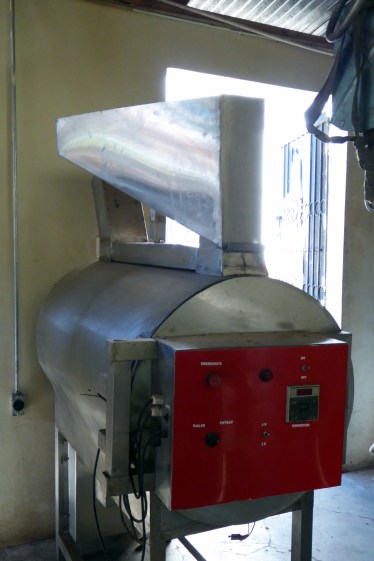
I believe this is where the cacao beans are roasted.

111-winnow

After the beans are roasted, they go through a winnower to separate the cocoa nibs from the shells.  I think that is the job of these machines.

112-cocoa powder machine.JPG

Once all shells are removed from the cocoa nibs, the nibs are gound in this machine.

113.JPG

This is the pressing machine where the nibs are pressed to make chocolate liquor for chocolate bars.  The remaining “press cake” that is separated from the liquor is used to make cocoa balls for hot chocolate and cocoa powder for baking.  Here, a syringe is used to remove the cocoa butter from the press cake, so the remaining cocoa can be used for cocoa balls and cocoa powder.

p1100099

114-PressMachine.JPG

I’m not sure about the purpose of this machine, but it may have been to further process the “press cake” for powder.

115

This worker was using the smaller machine to produce fine cocoa powder.

116-Refine1.JPG

In this machine, sugar, milk powder, and additional cocoa butter is added to the cocoa liquor and mixed.

117-Refine2.JPG

Here, the mixture from the first machine is further mixed and refined.

118-conch

This where the magic happens!  The refined mixture is placed in this conching machine to grind it to a homogeneous consistency.  The full mixing and conching process takes one day.

119.JPG

This is the marble table where the chocolate is tempered.

120.JPG

Finally, the chocolate is poured into molds for chocolate bars and cooled.

121.JPG

Nidia, our tour guide

At the conclusion of the tour, we returned to our group to assist with packaging the chocolate.  After we finished, the others made their chocolate purchases while Bruce and I went to see what the ladies were up to on the patio.  This time, when we said, “Hasta manana!” they believed us and flashed us big smiles.  We would be returning the next day for one last time.

122.JPG

123

Milagros, the factory manager

124.JPG

When we arrived for our final day at Chocal, the woman in the photo above (with the green blouse) ran up to me and gave me a big hug!  Our tour guide, Nidia, did as well.  We were pleased they were happy to see us once again.

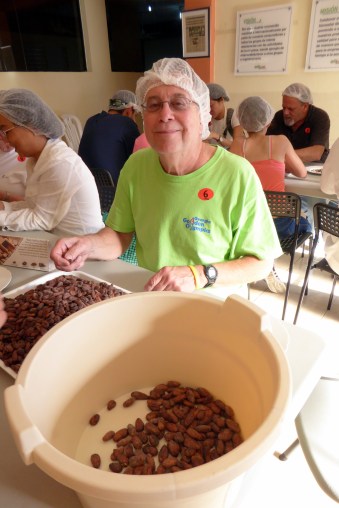
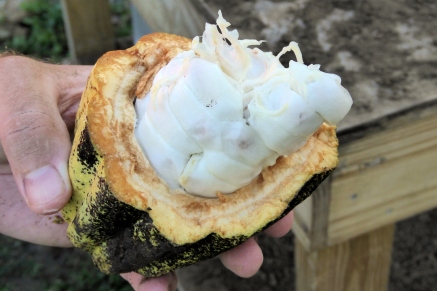
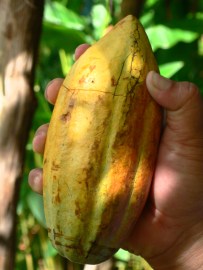
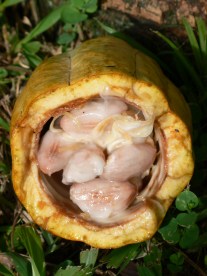
After we completed our work inside, Bruce and I joined the ladies while our group hit the gift shop.  Instead of making cocoa balls, the ladies were sorting beans, so I joined in.  My new friend opened up a fresh cacao pod and shared the beans with me.  Although the beans are very bitter, the pulp is sweet and delicious!  The idea is to suck on the beans, and then spit it out without biting into the bean itself.  Yum!


p1090939

These beans sell for $2/lb.

129.JPG

While we were working, some local farmers stopped by to sell their beautiful vegetables.  Nidia ran back to call out to the others, and some of the ladies ran up to make a purchase.

p1090942

P1090976.JPG

The time came to say “Adios!” and “No, no manana” to the women, give them hugs, and make our way to the bus for our final ride back down the mountain from Altamira.  As I gazed out the bus window during the bus ride, I knew I wanted to return.  Bruce did, too, and the wheels in our minds started turning…  (More details will follow in a future post.)

In my next post, I’ll show you around RePapel, a women’s co-op that recycles paper and makes beautiful stationary and jewelry for sale.

Meanwhile, here are additional photos shot at and around Chocal:

 136.JPG
137.JPG

142.JPG

143.JPG
144.JPG

145.JPG

146.JPG

147.JPG

148.JPG

149.JPG

150.JPG

A local farmer spread his cacao beans out in the sun to dry.

P1090917.JPG

CHOCAL: MANY HANDS MAKE LIGHT WORK

89.JPG

90.JPG

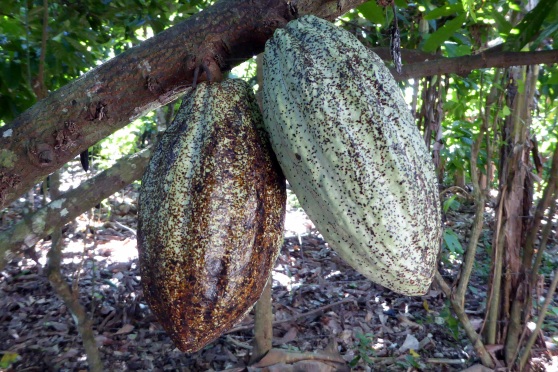
My last post about Chocal focused on the cacao plantation before the beans get transferred to the factory.  Those little seedlings we planted will take approximately 3-1/2 years to grow before the cacao pods are ready to be harvested for production.  May to July is the biggest harvest period each year, and a smaller harvest is done each November.

Each cacao pod yields 50-80 beans.  Four pods will yield 1-2 pounds of beans, which in turn yields one pound of chocolate.

91.JPG

Marcia translates for Naomi, the vice president of Chocal Women’s Co-op, while she explains the chocolate-making process.

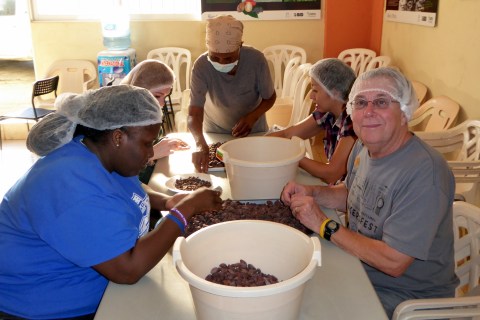
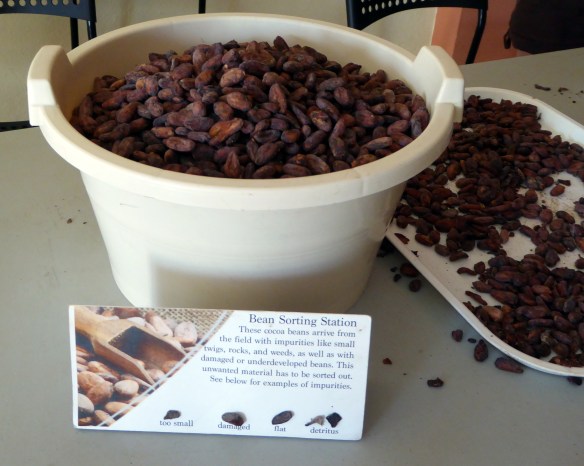
Once the beans are dried over at the nursery, they are ready to be sorted at the factory.  That was a job I nailed!  We were shown what “bad” beans look like, and which ones should be tossed aside onto a plate.  The good ones were to be thrown into the bucket.  While others got caught up contemplating whether each bean they had picked up was “good” or “bad,” I decided to look for the best beans and pick them up simultaneously with both hands.  Once I got two handfuls of beans, I tossed them into the bucket.  For me, this was so much easier and quicker, because a majority of the beans were “good.”

92

93

On Day 2, Bruce worked on filling a new bucket, sorting good beans from bad.

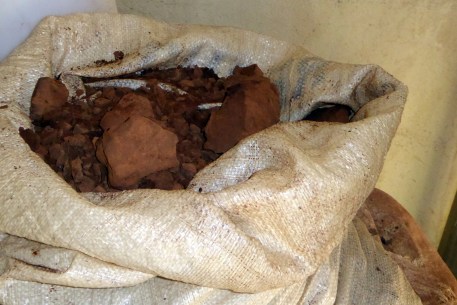
The buckets of good beans went on to the next step in the chocolate-making process:  roasting.  This is done for 20 minutes, and during this process, the shell of the cocoa bean separates from the bean kernel, and is removed.  The cracked beans—now called cocoa nibs– are then transferred to the winnower where 85% of the shells get separated from the cocoa nibs.  Next, the nibs are spread out on pans to be manually examined for any remaining shell fragments.

94.JPG

Steven explains how to remove the shell fragments from the cocoa nibs as Erin (right) looks on.

While some of our group worked on sorting the beans, others picked out shell fragments from the cocoa nibs.  After a while, the groups switched stations.

As good as I was at sorting beans, I was awful at picking out the shell fragments from the nibs.  My below-average dexterity, and my even worse patience with this task left me frustrated and hopping back over to “crash” the group at the sorting table.  I was there to work, not waste time getting frustrated over shell fragments!

While the co-op workers (including the sons of a few of the women) took our sorted beans and nibs to be processed (more on that in my next post), we were ushered into a room to learn how to mold chocolate.  Molding chocolate effectively requires expertise, so we didn’t actually mold the chocolate to be sold.  Instead, the process was demonstrated by one of the co-op women, and we were given an opportunity to make chocolates for our own consumption during the bus ride back to the ship.  The best part, though, was getting to sample the warm chocolate after we were finished.  Chocolate was spooned into our gloved hands for some good ol’ finger-lickin’ fun!

Finally, we finished our work in the packaging room.  During our three days, Bruce and I attached bar code stickers to the cocoa ball packages and stamped expiration dates on the chocolate bar labels, while others in our group packaged the bars for sale.

While we were in the packaging room, we could see the various chocolate processing machines and tables of molded chocolate bars through the glass windows.  I also had poked my head into the room off the back patio to see what the workers were doing with the machines there.  I was this close to the inner workings of a third-world chocolate factory—nothing like the modern Cadbury factories I had toured in Tasmania, Australia or Dunedin, New Zealand!

It was at that moment the idea was hatched to request a tour and explanation of the factory processes.

I explained to Orlando, one of the IDDI facilitators, that I am so passionate about chocolate and Chocal, that I would be returning with Bruce two more days to volunteer.  Could he possibly arrange for a tour of the factory for the following day during our visit?  We would be willing to skip out on the molding demonstration if we could just have a quick tour and interview with one of the women.  Oh, and could he translate, too?

Orlando promised he would arrange it for us, and he made good on that promise when we returned the following day.

Meanwhile, after we were dismissed from the packaging room, I made a beeline for the gift shop to make a quick purchase before the remainder of the group followed.  I was anxious to get back out on the patio and spend some time watching the women make cocoa balls, before it was time to return to the ship.

104

Preparing the pressed cocoa, so it can be shaped into balls to be used for hot cocoa

105

It was at this point I felt most frustrated at not having learned Spanish beyond a few basics.  I had so many questions I wanted to ask the women about their life in the DR, their families, and work at Chocal.  Instead, I made do with plenty of smiles and my extremely limited Spanish vocabulary.

106.JPG

107

When it was time to leave, Bruce and I said, “Hasta manana!” and smiled at the women.  They responded with a confused look on their face, and “Adios!”  “See you tomorrow?  Really?  I don’t think so!” was what I’m sure they were all thinking—and saying to each other after we left.

108

Milagros (left), and the women of Chocal make cocoa balls.

As Bruce and I happily savored our chocolates during the bus ride back, we expressed to each other how we were already looking forward to our return.

109.JPG

~ MANY HANDS MAKE LIGHT WORK ~

CHOCAL: MAKING A DIFFERENCE AT THE CACAO NURSERY

57.JPG

58.JPG

59.JPG

60

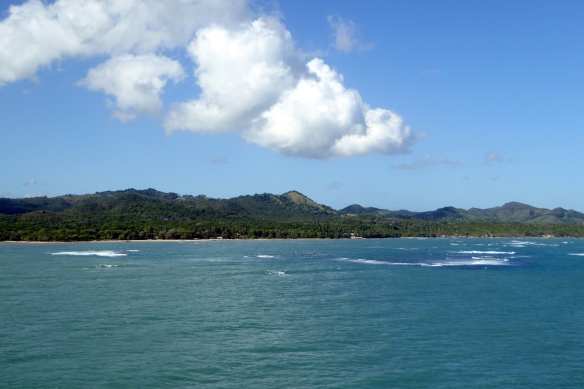
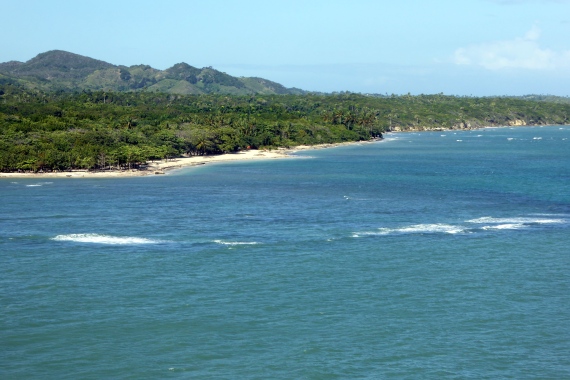
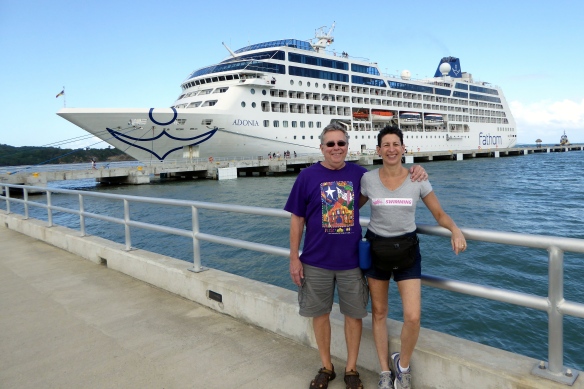
61As Adonia cruised into Amber Cove, Bruce and I admired the gorgeous tropical scenery of Puerto Plata, Dominican Republic (aka “the DR”).  We were eager to start the day, so we were among the first to disembark after our arrival.  It was too early to board the bus for Chocal; so, we explored Amber Cove, the $90 million-dollar port completed a year ago by Carnival Cruise Lines.  I took several photos of the attractive complex; however, I am eager to write about Chocal.  Amber Cove will have to wait…

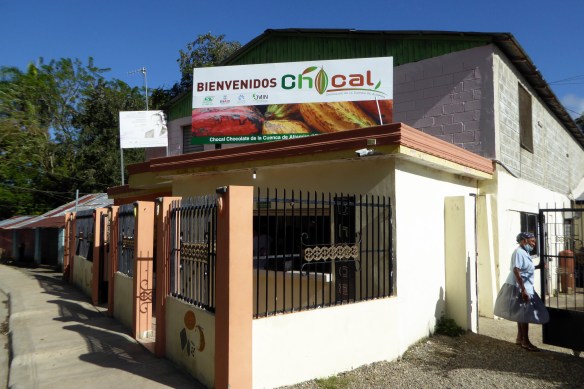
In my first post about Fathom Impact Travel, I mentioned we would be helping Chocal with their cacao and chocolate production.  It is a women’s cooperative currently employing thirty women (as well as some of their adult children); however, their goal is to grow the cooperative and thrive.  Helping them to succeed will enable Chocal to hire more local women, and bring more income into their community.

62.JPG

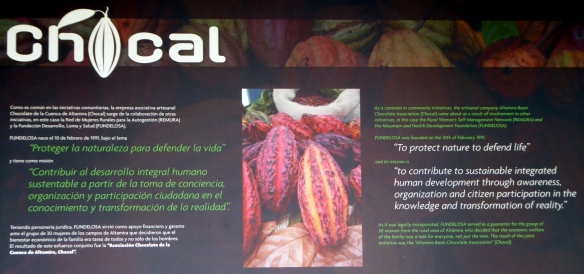
During the bus ride to Chocal, Leurys, a representative of IDDI (Dominican Institute for Integral Development), prepared us for our upcoming morning at the cacao plantation and chocolate factory.  In addition to learning about Chocal’s creation in 2008 (detailed in the photo above), the entire chocolate-making process was explained, from cacao seedling to chocolate bar.  We would be contributing to many of those processes to help increase production.

I was curious how these women learned the business of producing chocolate.  We were told a consultant from Switzerland was hired to teach them the entire process, and educate them on the special equipment needed to process the cacao.  After the co-op obtained a loan from the U.S.A., the machines were built to specification and delivered to the factory.

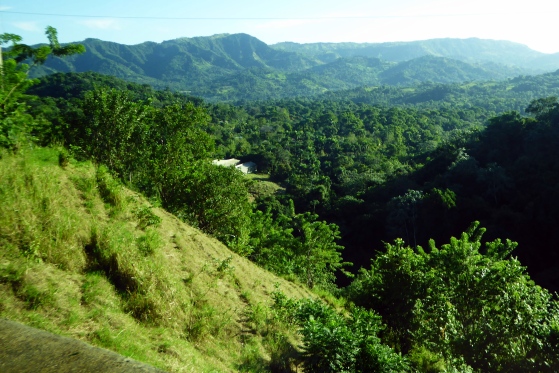
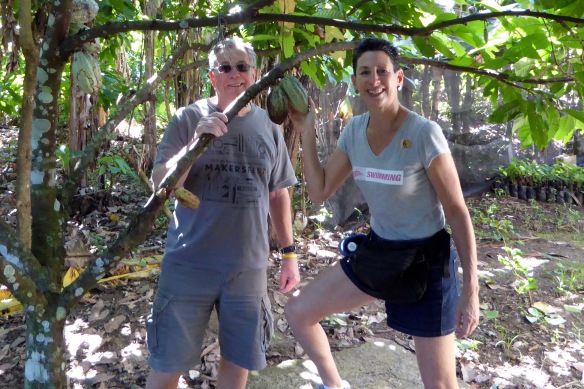
Chocal is located high up in the mountains in the town of Altamira (Spanish for “high view”) where cacao grows naturally and abundantly, along with mango and other tropical fruits.  Many local farmers belong to a farming cooperative and make their living by harvesting their cacao and selling the cacao beans.

P1090933.JPG

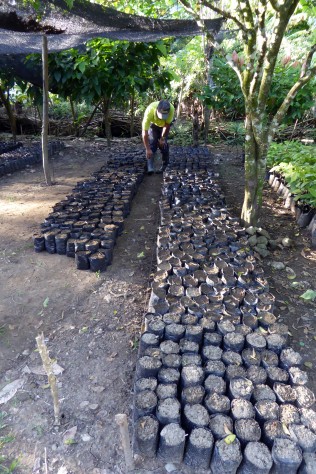
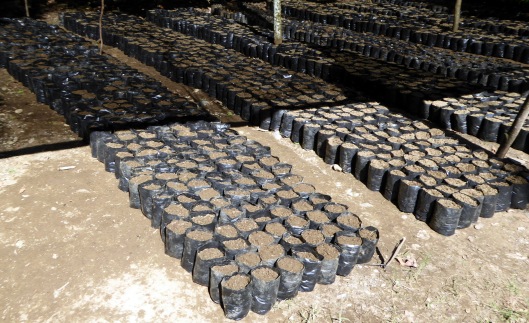
Having Chocal in their community provides another buying source for their cacao beans.  When Chocal is in need of more cacao than their own trees produce, they buy from the farmers in their community.  In turn, when those farmers need additional cacao trees for their land, they can purchase young trees from Chocal at cost.  The farmers provide compost for the seedlings, and pay the equivalent of ten cents for each two-foot tall tree they purchase.  This covers the cost of the bag, and the (free) labor is provided by us volunteers.  IDDI representatives work with Fathom and Chocal to facilitate the volunteer process.

It was in the nursery where we ended each of our three volunteer days at Chocal; however, it is where I will begin our tour here, since this is the origin of chocolate.  It all begins with cacao.

P1100120.JPG

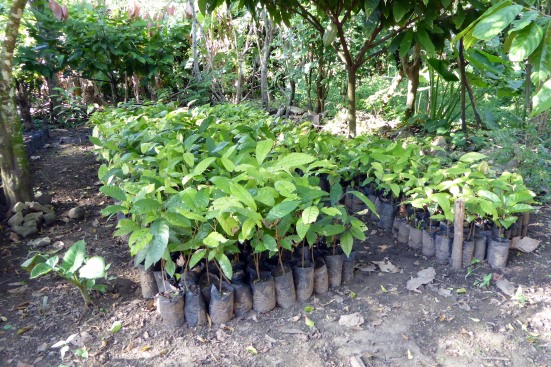
Once the teams were in place at the bag filling station, bag brigade, and seedling planting station; we rocked!  I never noted how much time we spent in production mode (perhaps one hour); but, whatever the time period, we produced.  Our bus load of +/- thirty volunteers filled bags and planted 504 seedlings our first day, and 584 the second day. Our group had less time to work on the third day; however, we still managed to complete 403 bags.  That’s teamwork!

65.JPG

66-Erin,Bruce,Jessica,Len,Erin-resized.jpg

We met Jessica, age 9, and her dad, Len, during the first night aboard ship.  They were wonderful table mates, and became fast friends.  Erin and Erin were college friends who we met during the bus ride.

67.JPG

Leurys explained how the bags should be filled to the top and compacted.  Next, a hole is inserted in the soil and a cacao seedling is planted.

68.JPG

Carola (right), helps plant the seedlings.  She was our table mate on another night aboard ship.

69.JPG

Gumarcindo lines up the seedlings on our first day.  Our group planted 504!

70.JPG

By Day 3, Gumarcindo was trying to figure out where to put them all!

71.JPG

These little cacao trees will be sold to area farmers at cost– about ten cents per tree.

72.JPG

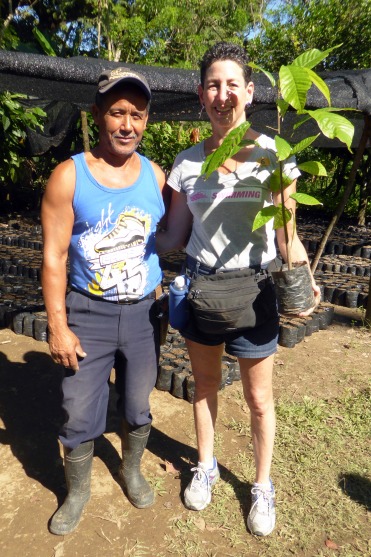
My new amigo, Gumarcindo.

73.JPG

87.JPG

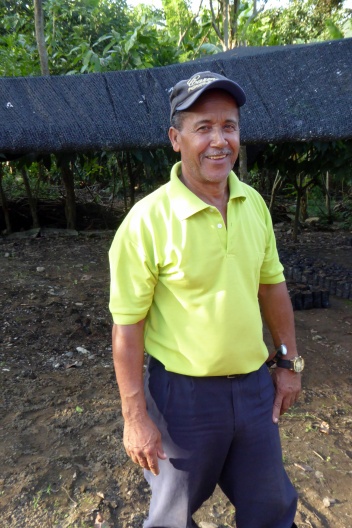
After our work was completed, Gumarcindo, the nursery manager, showed us how the beans are processed at the nursery, before they are taken next door to the factory.

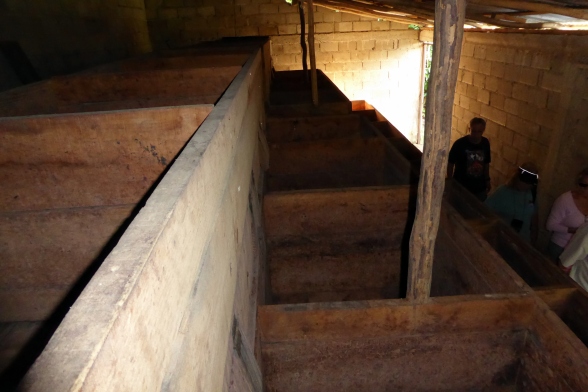
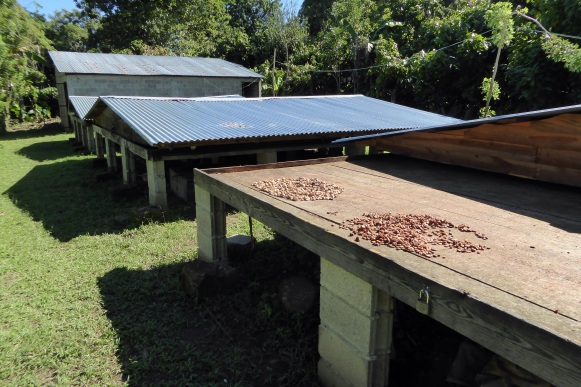
First, the cacao pods are carefully removed from the trees, and then manually cut open within 7-10 days of harvest.  The beans and pulp are scooped out from the pod and placed into the top level of boxes in the fermenting room.  After two days at the top level, they are dumped down into the middle level for another two days of fermenting.  Finally, they are transferred into the bottom level where they ferment for an additional two days before being spread out in the sun to dry.

75.JPG

76.JPG

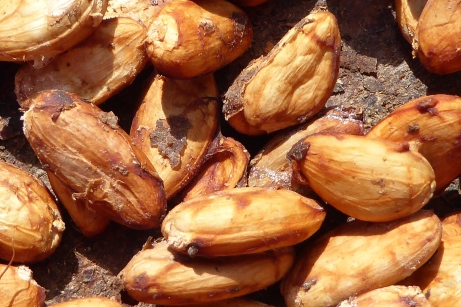
Although many cacao growers skip the fermenting step before drying their beans, the Swiss consultant explained to the co-op members that fermented beans would make for better-tasting chocolate.

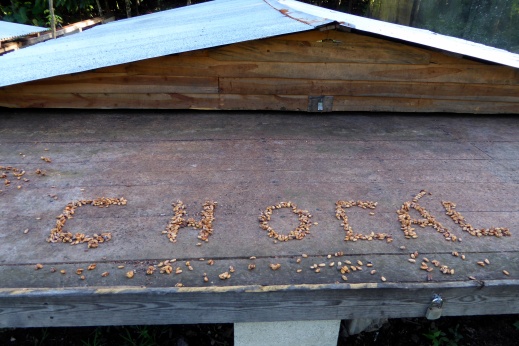
After the fermentation process is complete, the beans are left in the sun to dry to reduce the moisture content from about 60% to 7.5%.  If it looks like it’s going to rain, the roofs are pulled over the bean tables to keep the beans dry.

77.JPG

78.JPG

79.JPG

The drying process is done carefully and slowly to ensure that off-flavors are not developed.  If the beans are dried too quickly, some of the chemical reactions started in the fermentation process are not allowed to complete their work.  This causes the beans to become acidic and taste bitter.  If the drying is done too slowly, however, mold can develop.

To ensure an even drying process, the beans are spread out in the sun and raked or turned periodically.  In all, the drying process takes about six days.

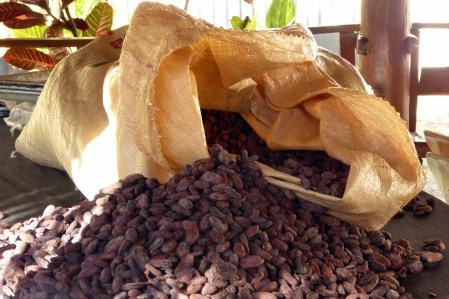
Once dried, the beans are packed in large sacks and stored in Chocal’s warehouse that is kept cool and dry.  Under these conditions, the cacao beans can be stored for years.

My next post will be about those cacao beans that are processed to become delicious chocolate!

Meanwhile, as our tour came to an end, we said “Hasta manana!” (See you tomorrow!”) to Gumarcindo and the IDDI facilitators helping out at the nursery.  All of them gave us a funny look, because nobody comes back tomorrow if they are on a Fathom cruise.  As a matter of fact, the Fathom website doesn’t allow for registering for multiple Impact activities at the same location.  Besides, most people opt for a variety of volunteer opportunities rather than just one.  Not me.  Between my passion for all things chocolate and my strong belief in the women’s co-op; I was determined to spend as much time as possible at Chocal. Bruce was fine with it, so I called Fathom’s headquarters as soon as we signed up for the cruise and pleaded my case.  Happily, the gal I spoke with empathized and did a manual override of their computer system to sign us up for to volunteer at Chocal all three full days in the DR.

When Bruce and I returned the following day, we found Gumarcindo and greeted him with, “Hola, Gumarcindo!  Que lo que?”  (“Hello, Gumarcindo!  What’s up?”)  (“Que lo Que” is a special DR greeting that is very much appreciated by the locals, so we enjoyed using that greeting often!)

A big grin and a fist bump greeted us back!

On the third day, I was sad to have to tell Gumarcindo, “No hasta manana.”  I didn’t know if or when we would ever be back…

88.JPG

Next up:

CHOCAL:  MANY HANDS MAKE LIGHT WORK

FATHOM:  PREPARING TO MAKE AN IMPACT

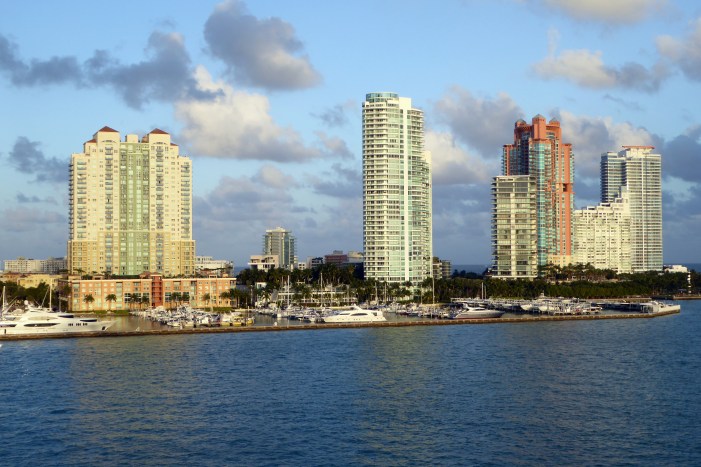
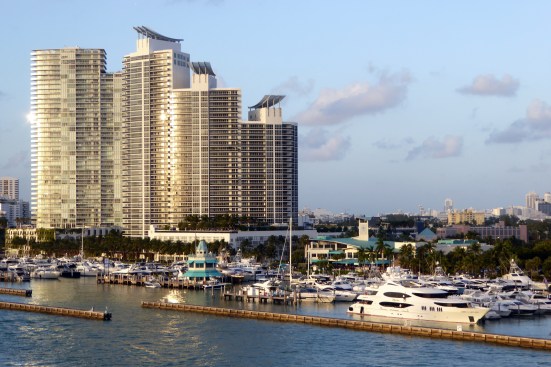
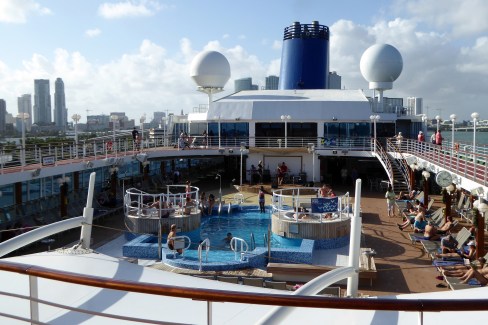
Fathom’s Adonia departed Miami for Puerto Plata, Dominican Republic on New Year’s Day during the early evening while golden light of the warm sun reflected off the condo towers. The view from our spot on the top deck was beautiful, and we enjoyed the sail-away before joining in on the first activity.

47

48.JPG

49.JPG

50.JPG

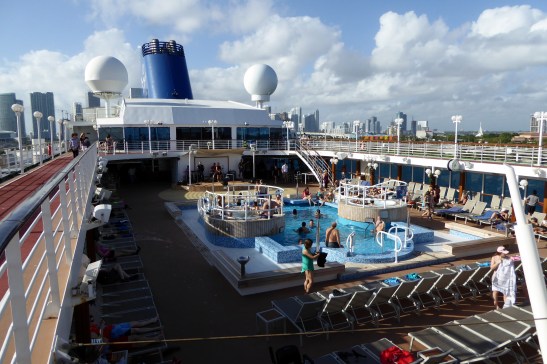
It was then we discovered this would be nothing like a typical party cruise.  Waiters weren’t hawking expensive cocktails, and the poolside activities were much different than I had ever seen before.

For those who chose to participate, we were given a “passport” and instructed to look for five stations that were scattered around the two poolside decks.  At each station, we did the required activity and earned a stamp in our passport.  One station was posted at the railing of the upper deck.  The end of a string was tied to the railing, and the other end was tied to the pool railing across the deck below.  We were instructed to take an index card, and write an inspiring message to a random passenger below.  We were given a metal bell to attach to our card and asked to tie it in a loop around the string.  A good push sent the bell and message down the string to the waiting hands of another Impact Staff member below who untied the message and gave it to a random sunbather on the pool deck.  Smiles and laughs spread throughout the pool area.
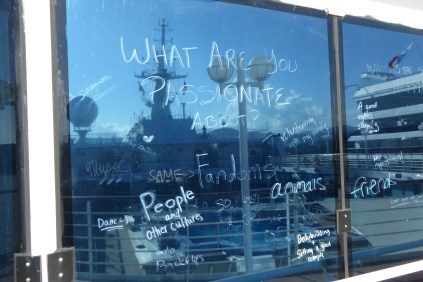
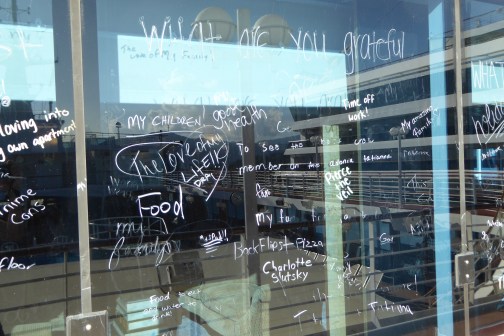
At another station, questions were posted on glass window panels, and we were instructed to respond to any or all of them.  “What are you grateful for?” and “What is your passion?” were two questions that I liked, as was “What is your favorite inspirational quote?”  I chose to answer that one with, “Believing in your dreams can be far more rewarding than living by your limitations.”  I previously wrote a blog post about the origin of that quote.

51.JPG

52.JPG

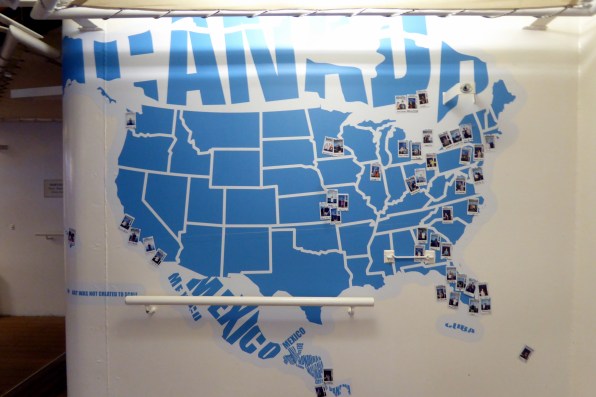
The final station was clever.  We were photographed and given a Polaroid mini photo and asked to write our name and city on the picture.  We then placed the photo (with a magnet attached to the back) on the huge map located on the metal wall of the pool deck.  Mine joined several others from the state of Georgia where we live now.   (Georgia ultimately won over my beloved home state of California where I instinctively went to place my photo.)

53.JPG

As the photos collected, it was interesting to see where other passengers were from.  Many had traveled from faraway states and countries!

All of these details are to say this wasn’t shaping up to be your typical Caribbean party cruise!

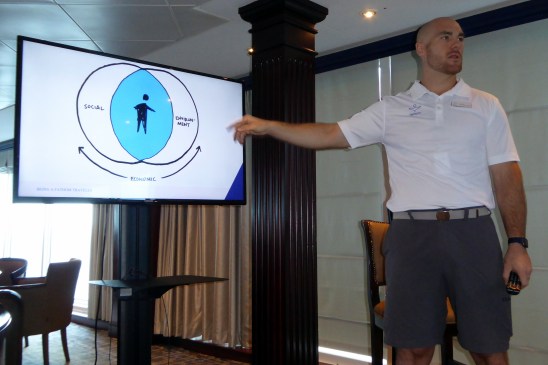
During the following full day at sea, many workshops were offered to prepare us for upcoming Impact Travel activities.  We were assigned to small “cohort” groups where we would meet with the same passengers and facilitator for two preparation workshops and one wrap-up session, and there were several optional workshops we could attend as well.  For those who would be teaching English, there was an additional required session.

We were fortunate to have Colin as our “cohort” leader.  A former professional football player with the Cincinatti Bengals, he didn’t look the stereotype of someone who deeply cared about other people and making a difference in the world.  This environmentally conscious, Whole Foods-loving do-gooder had the looks of the Mr. Clean Man!  He was hilarious, though, and I’m sure our cohort group laughed far more than any other.

54.JPG

The purpose of the “Getting to Know the Dominican Republic” workshop was to orient us to the customs and culture of the “the DR,” learn about its history, and build a community with our fellow travelers as we prepare for our on-ground impact experience.

The workshop entitled, “Being a Fathom Traveler” is described on Fathom’s website as, Fathom Travel is about transformative experiences through connecting to locality and place with an open heart and mind. Being a Fathom Traveler sets you up with valuable insights, tools and knowledge that will help you get the most out of your experience.”

55.JPG

56

Colin’s final cohort workshop, “Fathom What’s Next,” will be detailed in a later post.

I also attended a couple of “Social Innovation” workshops that helped prepare us for our on-ground experience by learning skills for authentic interactions with others.  These workshops were designed by Ashoka and Ashoka Fellows (www.ashoka.org), and they were quite interesting!

The ultimate goal of these workshops was to help us integrate the week’s experience into our lives going forward.

Coming up next: 

CHOCAL:  MAKING A DIFFERENCE AT THE WOMEN’S CHOCOLATE COOPERATIVE NURSERY

FATHOM- A UNIQUE WAY TO GIVE BACK

24.JPG

There are so many different ways to open your heart, and give back to society.  Whether it’s through volunteering in your own community, joining an overseas mission with a church, or opening up your wallet; it all helps make our world a better place.

Carnival Cruises presented a unique opportunity to give back by launching Fathom, their one-ship (“Adonia”) cruise line and presenting the concept of “Impact Travel,” Carnival’s trademarked name for cruising with a purpose.

Taking the focus off the “it’s all about me” attitude of passengers that cruise companies cater to, most people who book a Fathom cruise do so with the purpose of participating in several of the Impact Travel volunteer opportunities available on shore in the Dominican Republic.  Although volunteering is not required, typically 95% of the passengers on most of the cruises have done so, since Fathom launched in April 2016.  (Unfortunately, though, as I explained in my previous post, Fathom will cease to exist at the end of May this year.  More details will follow in a later post.)

Once aboard ship, we discovered a “feel” among the passengers unlike anything we had previously experienced during our years as guest lecturers/ craft instructors.  Instead of an attitude of entitlement (“What’s in it for me?”), many of the passengers we talked to were eager to arrive in Puerto Plata, in the Dominican Republic (“the DR”) and volunteer during each of our 3-1/2 days in port.  For those who didn’t sign up online ahead of time for the available volunteer activities, they were disappointed to learn many of them were booked full.  (All opportunities were located a bus ride away from the port, requiring buses to transport volunteers to their activities.)

Wait lists were started for the various activities, but the lists grew longer as passengers came back after the first day of volunteering and shared their excitement about the impact they had made through their efforts.

In addition, passengers were only permitted to sign up online in advance for three activities– one for each full day; however, groups were dispatched in the morning and afternoon allowing for doubling up each day in some cases.  As enthusiasm grew for volunteering, several passengers added to their three activities; so, they could make more of a positive impact on this impoverished country.

This is the attitude of the typical Fathom passenger.  Most didn’t care about the lack of over-the-top amenities and entertainment now standard on the newest mega-ships.  Instead, passengers lingered over coffee in the dining room after dinner and shared their experiences of the day.  The most common question asked was, “What ‘Impact’ activity did you do today?”  That was often followed by asking, “How was it?”  Passengers eagerly spoke proudly of the impact their group made that day.  For those who worked at Chocal, we shared the all-important numbers:  pounds of cacao beans sorted, pounds of cacao nibs sorted from shell fragments, quantity of chocolate bars wrapped or packaged; and, at the nursery, the quantity of bags filled with dirt and seedlings planted.  (When those numbers were revealed during the bus ride back to ship, the passengers broke out in applause and cheers.)

Think back on the last cruise you took, if you have taken an ocean cruise.  Does any of this sound familiar to you?  I didn’t think so…

Next up:  PREPARING TO MAKE AND IMPACT

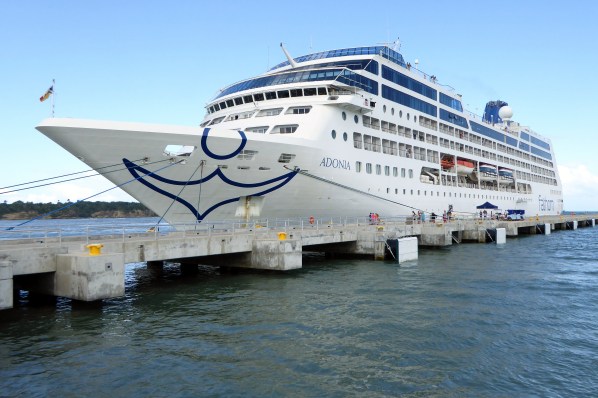
Adonia, as we depart Miami:

25.JPG

The Adonia was a former Renaissance cruise ship and has a capacity of 704 passengers.

26

28.JPG

29.JPG

30.JPG

31

32.JPG

The Ocean Grill was an alternative dining room with a $25pp charge.

33.JPG

34.JPG

35.JPG

36.JPG

This very cool huge photo of a diver was on the stairway landing wall on the way to the gym and spa.

37.JPG

38.JPG

39.JPG

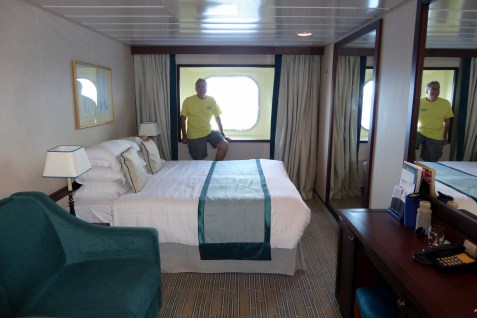
We were given a free upgrade to an outside cabin.  The large window was nice to have!  Behind me are the closets and bathroom.

41

Miami

42.JPG

Notice the backed-up traffic heading towards the beach.  Ugh!

43.JPG

44.JPG

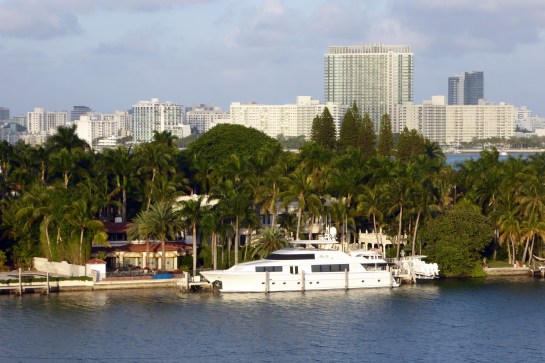
This bridge leads to homes of the 1%-ers.

45.JPG

It takes a 1%-er to own a house and yacht like that!

46.JPG

Ditto!

Impact Travel: A New Adventure

After a few dozen big ship cruises as a guest lecturer (mostly travel photography) and crafts instructor, I was ready for a different cruising experience.  Back in 2002, my mom had wanted to take a river cruise on the waterways of Belgium and Holland, so we paired up for a non-working cruise and headed to Europe.  One time on an intimate riverboat was all it took; I was hooked and never thought I would return to the big ships again.

That all changed when some friends bounced an idea off us that was different than the typical big ship cruising experience:  impact travel.  I had never heard of the concept in cruising, but Fathom, a one-ship cruise line launched by Carnival Cruises last April, had done just that.

Fathom’s 704-passenger former Renaissance ship, Adonia, made headlines by being the first cruise ship to take American passengers to Cuba; but, what I didn’t know was that the ship sails to Puerto Plata, Dominican Republic for one-week impact travel cruises on alternate weeks.

Puerto Plata wasn’t on the top of my bucket list for destinations—I had been there before as a teenager on a family cruise—but this opportunity intrigued me.  After hearing David and Melody’s excitement about the concept and their idea of having us experience it together, I did some further research.  Bruce and I both loved what we discovered, so we signed on.  After visiting them in Vero Beach, we’ll drive down to Miami and hop aboard Adonia together.

Now, before I explain further and (possibly) get you excited about the concept of impact travel, I recently learned from two different USA Today articles that Fathom will cease operations in spring of this year.  The ship has been sailing far under capacity, and the cruise line is losing money.  Unless you book your cruise and travel soon, you will be out of luck.

We got an affordable deal– $850 for BOTH of us, including port fees and taxes, for a one-week cruise.  Even at this great price, it is doubtful the ship will sail anywhere near capacity.

On our day of departure, we will set sail from Miami to Puerto Plata.  During our transit, we will participate in workshops to learn about the culture and prepare us for our chosen volunteer activities.  While the ship stays docked at Amber Cove in Puerto Plata, passengers will have the option of being tourists, volunteering, or both.  Those of us who will be volunteers will spend three days immersing ourselves in the local culture and collaborating with local volunteers on community projects that will have an impact on education, environment, economy, and more.

The need in Dominican Republic is tremendous.  The poorest half of their population receives less than one-fifth of the country’s annual GDP, and most of them live below the poverty line.  Job prospects for women are especially scarce.

While looking over the various choices of how we could help make an impact, one option stood out above and beyond the rest:  Chocal, a women’s cooperative that cultivates organic cacao plants and produces chocolate from bean to bar.

Under the guidance of Dominican Institute for Integral Development (IDDI), Chocal has been successful in creating jobs, providing local cacao growers with an outlet to sell their plants, and generating income from the sales of their organic chocolate.  Along the way, the women have learned new skills and have been afforded the opportunity to continue their education.  Flexible work hours have allowed the women to do all this while still caring for their families.

08-21              08-22

As volunteers, we will participate in the complete cacao production cycle:  from planting and cultivating the organic cacao trees, to sorting cacao beans, to molding chocolate, and packaging the final product for sale in their gift shop and aboard Adonia.

According to Fathom’s website, by helping to improve production and increase sales, we will be helping Chocal to thrive, so it can hire more local women and provide more income to the region.

This is a win-win!  Visiting a full-production cacao plantation was on my bucket list; however, trying to incorporate it as part of a vacation with my husband was proving to be difficult.  Bruce is totally on board with this and has even enthusiastically agreed with my idea of volunteering all three available days at Chocal rather than choosing two other activities.  Our friends will also be joining us on one of the days at Chocal, and then spending another day making clay water filters.  I’m sure we’ll have a lot of stories to share that evening over dinner back onboard ship!

Stay tuned for more on this upcoming adventure!*

*Unfortunately, thieves have gotten smarter and figured out how to prey on travel bloggers, so for security reasons (even though we live in a guarded community and have a house sitter), our travel dates will not be noted, and future posts will not be published until after we return. 

RIVER VOYAGER IN REVIEW

P1060307.JPG

P1050656.JPG

P1050880

P1050882

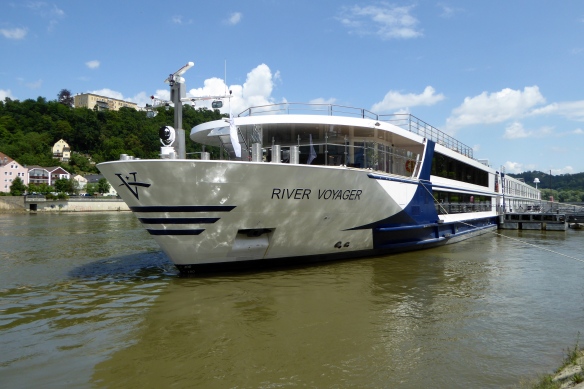
The previous three Vantage Deluxe World Travel river cruises I had taken in Europe were with my mom, and they were on boats that have since been retired from their fleet.  Vantage had three new boats built, and we boarded the newest of the fleet in Budapest.  Introduced into service this year, we were about to embark on the 14th sailing of the River Voyager.

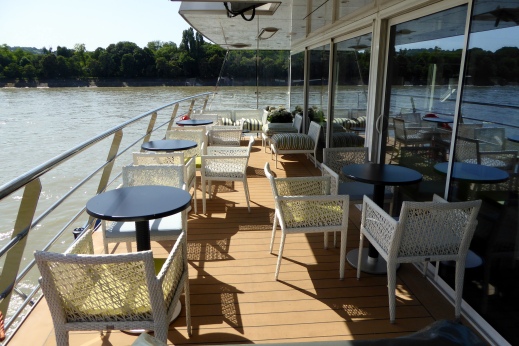
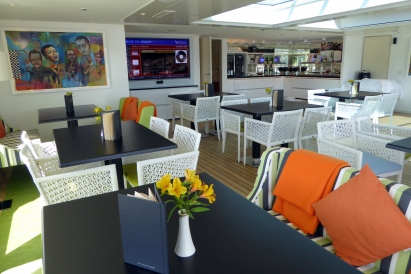
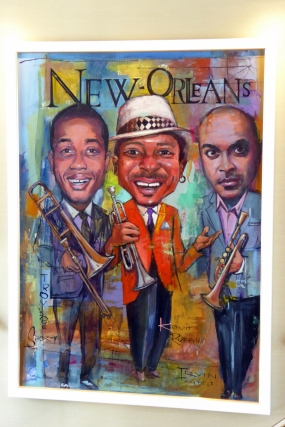
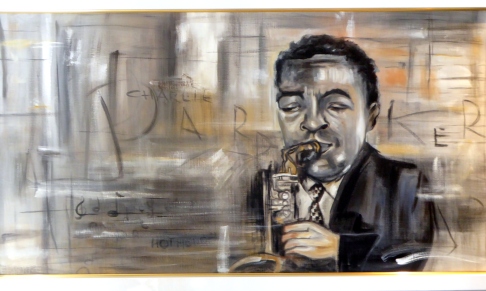
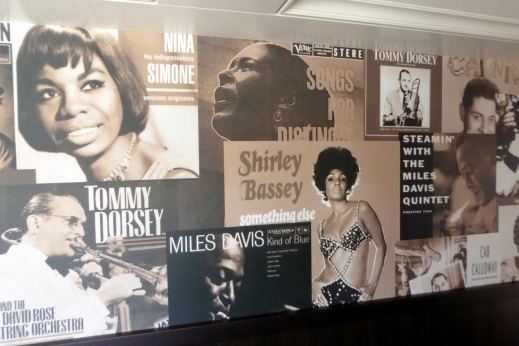
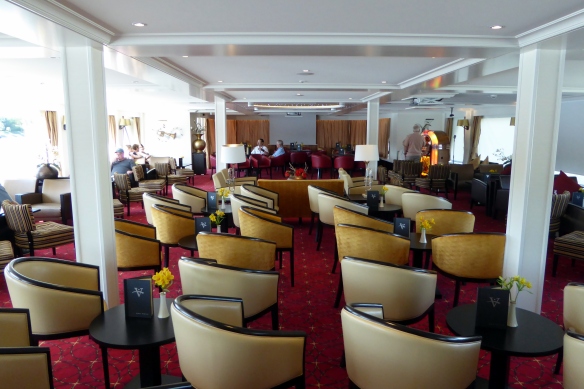
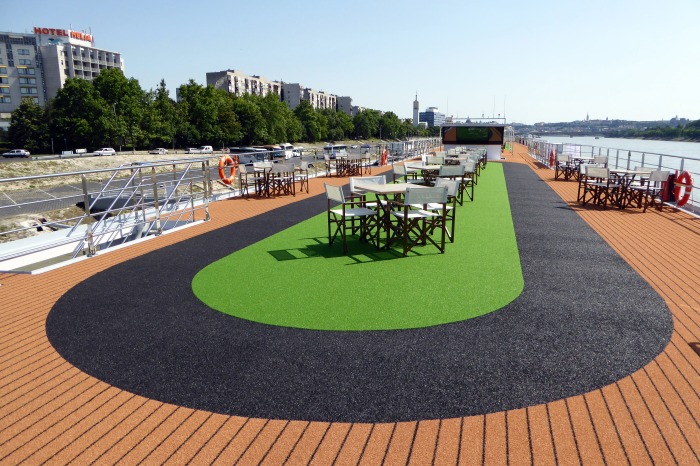
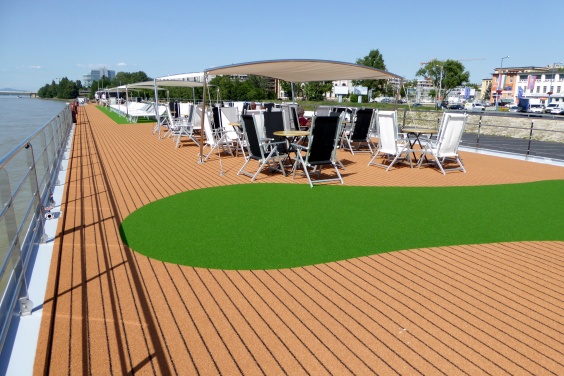
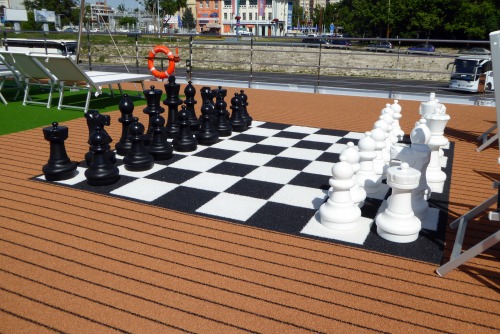
At first, I wasn’t sure what I thought about the new, modern feel of this boat; but, once we had a good look around, it was love at first sight.  The jazz theme of the décor definitely hit a soft spot in my jazz-loving heart, and the additional outdoor seating in front of the forward Blue Note Lounge as well as behind the Cotton Club café was a nice surprise.  (In retrospect, given the high water level in the rivers these extra outdoor lounge areas on the lower decks were a huge benefit, because the captain had to close down the top sun deck of the boat while cruising under low bridges.)

P1050651.JPG

Aft deck of Cotton Club Cafe

P1050650.JPG

Cotton Club Cafe

P1050653

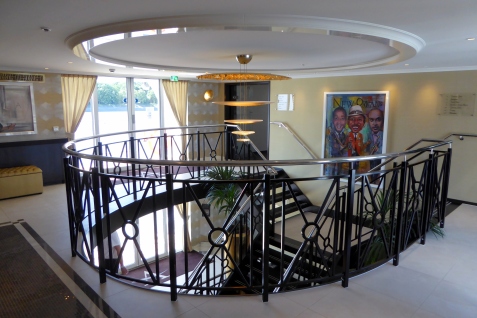
Mid-ship stairway

P1050646

P1050647

P1050659

Along the wall leading into the Blue Note Lounge

P1050660.JPG

At the far end of the lounge, there were floor-to-ceiling windows looking out onto the forward deck.  The drapes were closed at this moment in preparation for a lecture.

P1050655

The top deck of the ship was closed during portions of the cruise due to low overhead bridges.

P1050658.JPG

P1050657.JPG

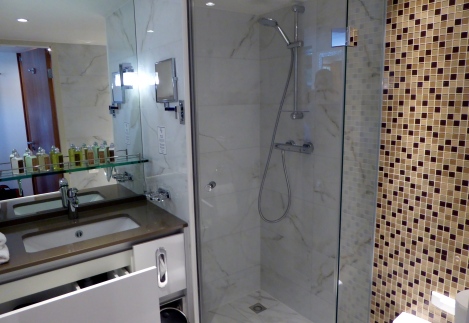
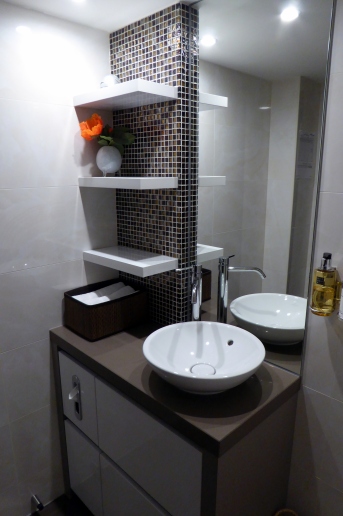
The cabins were wonderfully appointed, and the bathrooms were actually larger than those on the older boats.

P1050645.JPG

I didn’t photograph the cabin; however, I did get this (distorted!) shot of the bathroom.  The lower right is a very large drawer with a pull-out trash can beside it.  There was plenty of counter space  (on the left), and a shelf full of wonderful toiletries.  There was plenty of room in the shower, and I loved the adjustable shower head and glass door.  The toilet was to the right, and towel racks were located on the walls to the left.  It was actually quite roomy in there!

P1060153

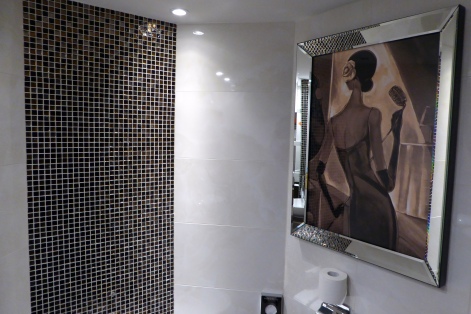
This is a public restroom located mid-ship.  Nice!

P1060154

The other side of the same public restroom.

Technologically, the River Voyager was very modern, and a great WI-FI system was accessible from anywhere on board.  The front desk staff even loaned out iPads at no charge as well as brand new bicycles with saddle bags and helmets.

The staff on board was fabulous!  Not only were they unfailingly friendly and warm, the service was outstanding.

P1070655.JPG

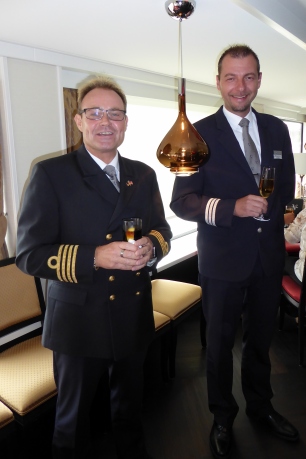
Captain Ziggy & Hotel Manager, Enio (and Renata’s husband)

P1070656.JPG

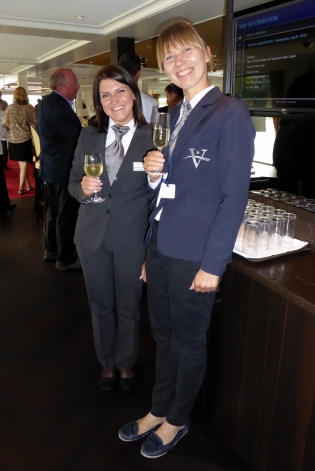
Concierge, Renata (Enio’s wife) & Tour Director, Vicky

P1070748.JPG

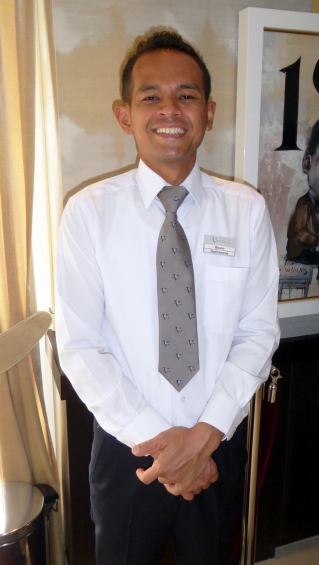
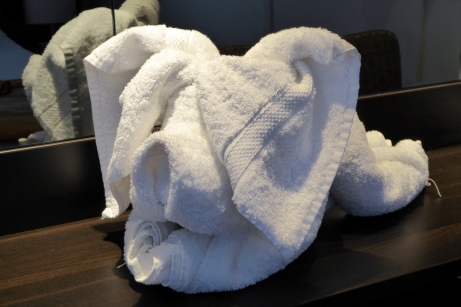
Our cabin steward, Bowo.  We named our towel dog after him and kept him throughout the cruise.

P1060804.JPG

P1070670.JPG

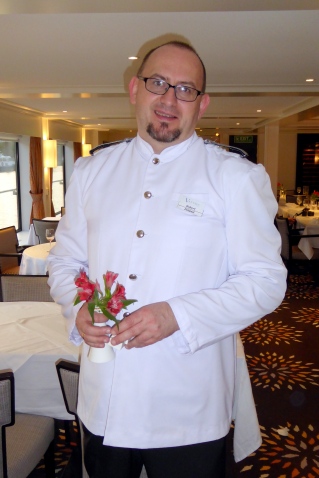
The dining room had open seating, so we always gravitated to Robert’s section, because he was our favorite waiter.

P1070747.JPG

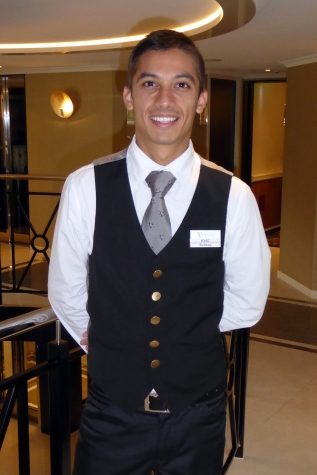
Our favorite assistant waiter, Halil

P1070459.JPG

A well-deserved break for the crew!  That’s the head chef on the far end.

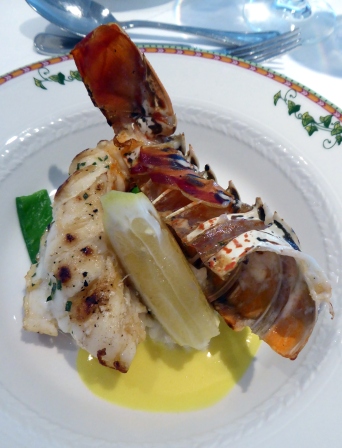
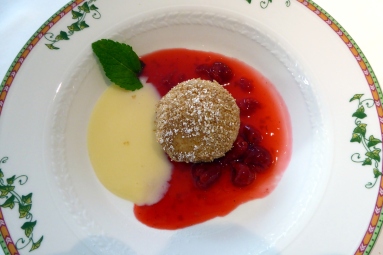
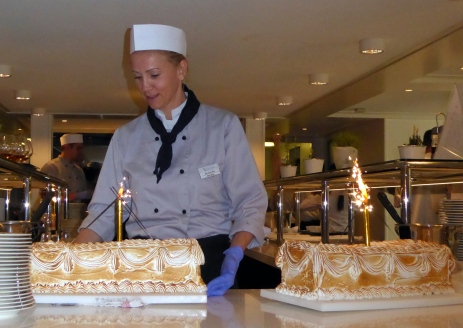
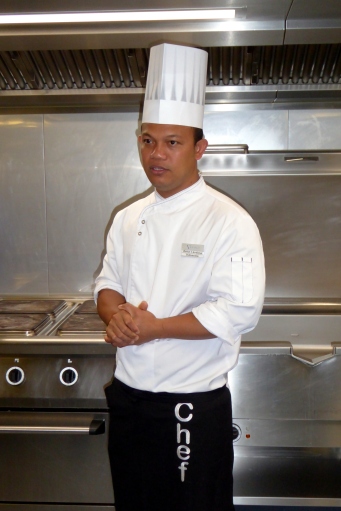
The food?  Fantastic!  Our Balinese chef did a wonderful job with his staff in his surprisingly small kitchen, and we found ourselves raving at every dinner over the food and presentation.

P1050662.JPG

P1070658

P1060355

P1070659

P1060173

P1070662

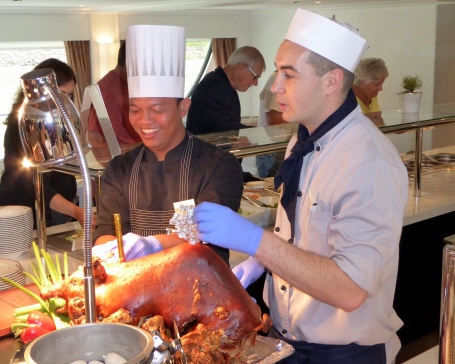
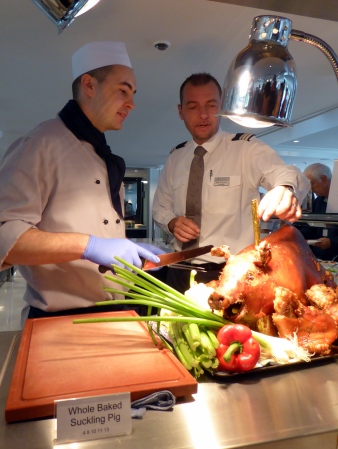
Chef Ketut (“Chef”) had a great sense of humor, too, as well as a wide, cheerful smile.  Later in the cruise during the galley tour, when asked how long it took to cook the whole pig they brought out during our traditional Bavarian lunch buffet, he replied, “Cooking the pig wasn’t the problem, it was catching it!”

P1060128.JPG

P1060130.JPG

P1060151.JPG

As it turned out, that lunch was quite a highlight!  Complete with soft pretzels graciously handed out by Chef, flowing beer served by the staff, and a buffet of sausages of every description (with sauerkraut, of course!); it was fabulous!  (Thinking back, I don’t think I had eaten sausages and sauerkraut since my last cruise in 2011!  Meat isn’t a normal part of my daily diet, but as they say, “When in Rome…”)

Although the previous river cruises were on ships with a maximum capacity of 145 and the River Voyager could cruise with 175 passengers, I would say that is the only negative of the newer river boats.  I like the intimacy and quaintness of small boats, but the trend is going towards larger boats (and larger ships) for economic reasons.  Still, I wouldn’t hesitate to book a cruise on this very same boat again!

As for the passengers, in general, I have found them to be much more experienced travelers than mega-ship cruisers.  Conversations over meals or around the ship were always lively and interesting with plenty of travel stories to go around.  I especially enjoyed hearing about other river cruise experiences, and the advice we received about itineraries was very helpful.

Marg-Wendell

Marg & Wendell, our dining partners for lunch in Heidelberg, and a few times on the ship.

Betsy-Mary

We first met Betsy and Mary on our pre-cruise tour, and then in Vienna, Betsy and I ended up going to the hospital together with Renata as our escort and interpreter.

Betsy-Renata-Elaine2.JPG

Betsy, Renata, and Me at the hospital

P1070657

Partying it up during the Captain’s farewell cocktail party.

Over all, I can’t say enough good things about our experience.  The best part?  Seeing Bruce enjoy it so much that he already has our next Vantage river cruise picked out!


CONCLUDING OUR CRUISE IN COLOGNE

P1070714

Our cruise didn’t actually conclude in Cologne, but it was the last city we visited on our journey before cruising to Bonn for disembarkation.  We had one last day in Germany, so like most of our “port” days, the morning was spent on a walking tour, and we enjoyed the afternoon on our own.

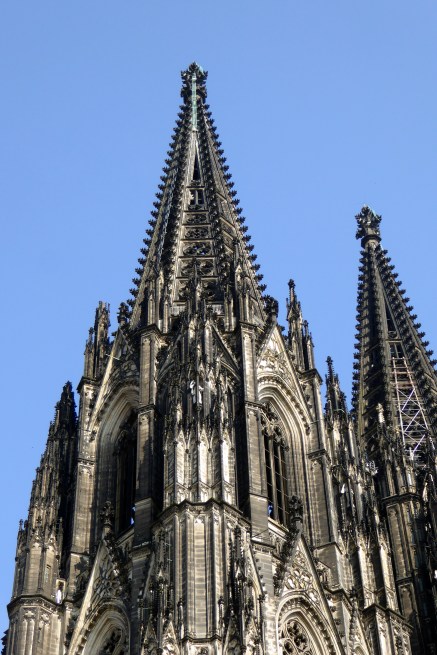
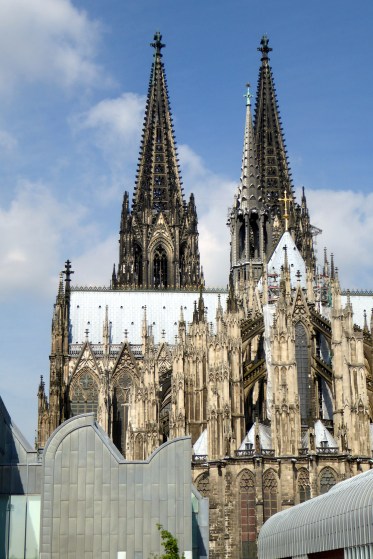
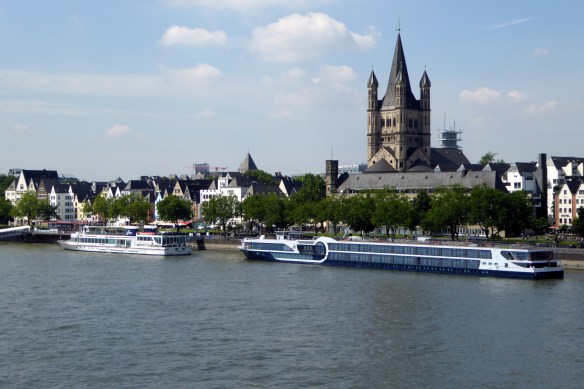
Cologne was different than many of the towns and cities we visited in that it (mostly) had a modern feel and look to it.  Being that 90% of the city was destroyed during World War II, there wasn’t much left standing in Germany’s most-destroyed city.  Cologne Cathedral did survive the bombing, though, and it is now the most-visited German landmark with an average of 20,000 visitors entering its doors each day!

Although construction of Cologne Cathedral began in 1248, work was halted in 1473 leaving it unfinished.  Work restarted in the early 1800’s, and it was finally completed in 1880.  As it stands now, it is the largest Gothic cathedral in Northern Europe and has the second-tallest spires.

P1070677.JPG

P1070676

P1070684

P1070680.JPG

P1070681.JPG

P1070683.JPG

P1070722

P1070723.JPG

The city of Cologne is so proud of those tall spires that building restrictions require other buildings in the city center to be shorter in height than those spires.  As a result, the cathedral can be seen from all around the city.

Like all old cathedrals in Europe, it is constantly undergoing renovation; so, there is a permanent workshop on site and 65 full-time employees doing the work.  I’m quite sure their jobs are very secure…
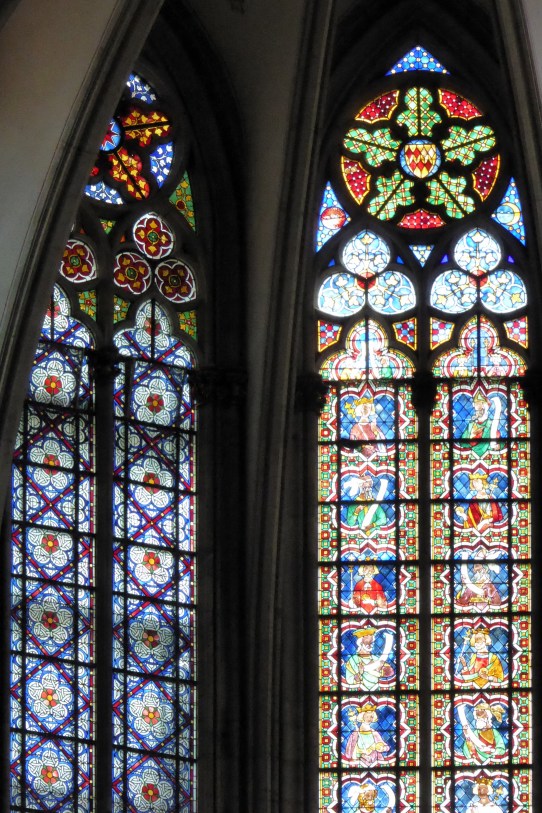
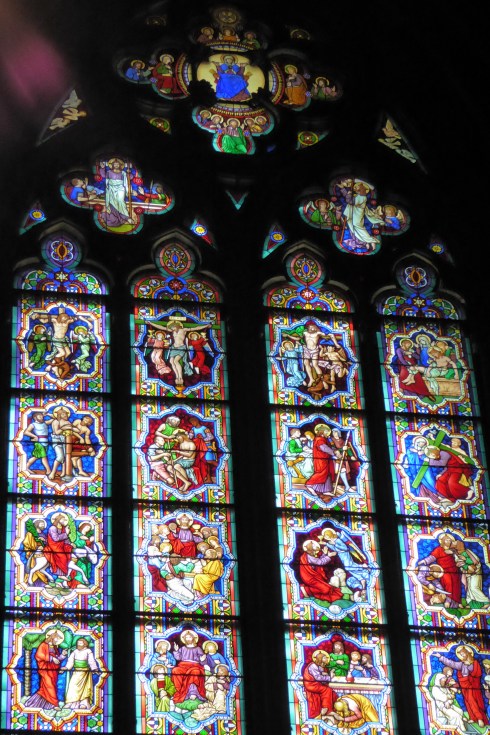
Speaking of “65,” the cathedral still has 65% of its original stained glass windows, and they are absolutely stunning when the sun shines through!

P1070725.JPG

P1070703.JPG

Beyond the cathedral, Cologne is a TV and media hub for Germany as well as an important cultural center.  It is also home to one of the oldest and largest universities in Europe.

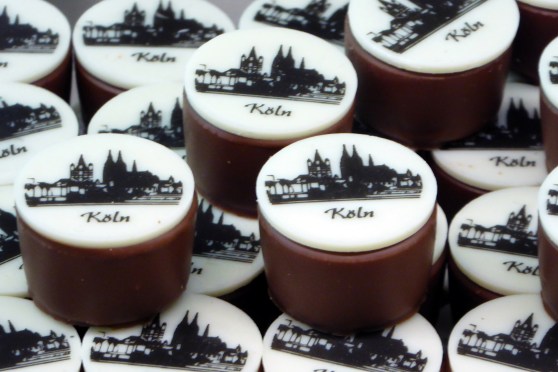
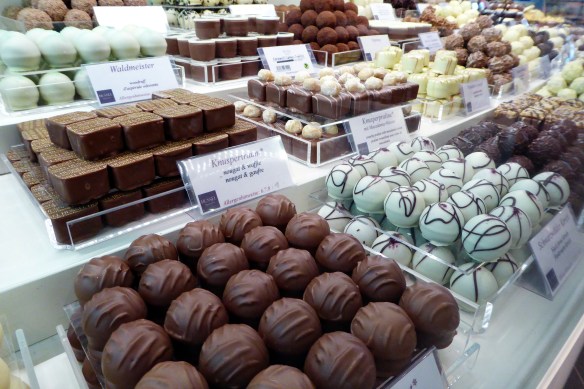
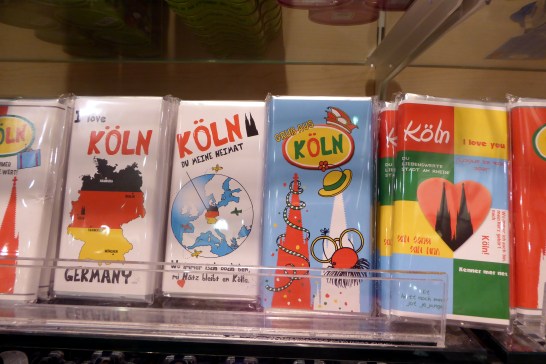
On a personal note, one of my favorite things about Cologne is the Lindt Chocolate Museum.  When my mom and I visited Cologne on our 2011 river cruise, we spent a very rainy afternoon there, and it was fabulous!  It was a gorgeous day during this visit, so Bruce and I opted for just a quick look in the café and gift shop.

P1070733P1070736P1070737P1070739P1070742

The remainder of our afternoon was spent walking and taking in the sights.

P1070690

P1070692.JPG

P1070744.JPG

P1070743

P1070729

P1070715.JPG

P1070712

P1070719

P1070699.JPG

P1070694.JPG

P1070704

P1070728

P1070727

We were a bit sad it was our last day of the cruise!  Our day in Cologne ended with enjoying the sunset on deck and sharing a last evening with our new shipboard friends, Margaret and Bill.

P1070675

My next and final cruise post will be about life aboard our ship, River Voyager.  Stay tuned!

ROMANTIC RHINE RIVER

August 7, 1986; I remember it like yesterday.  Thirty years ago, Bruce took me on our first date.  We dined in Del Mar, California, at Bella Via and listened to the Bruce Cameron Jazz Ensemble.  It was a perfect night.

Three years later, we bought a house (coincidentally!) down the street from Bruce and Betty Cameron, and we married three years after that.

It has been a wonderful thirty years!

What better way to celebrate our thirty years together than cruising the romantic Rhine River through the Middle Rhine Valley?  Rolling hills of lush wine vineyards, fairy-tale castles, quaint towns—there isn’t anybody else in the world I would have rather shared it with than my amazing husband and best friend, Bruce.

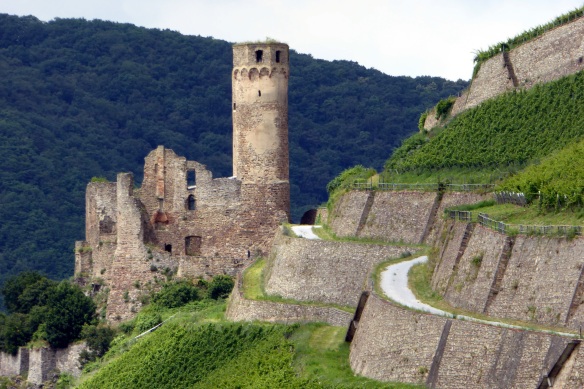
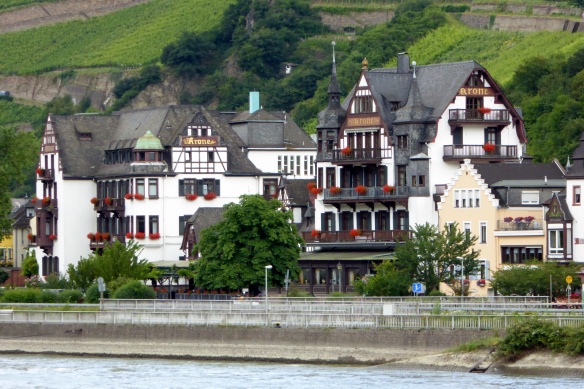
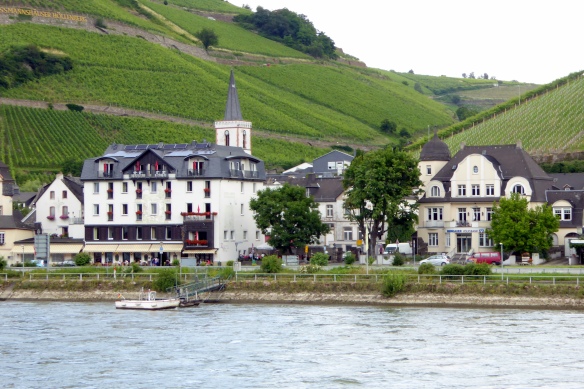
After departing Rudesheim, we spent our afternoon on deck enjoying the beautiful scenery along the Rhine Gorge on our way to Cologne.  Castles dating back to the year 1000 amazed us, and the twists and turns of the Rhine delighted us.  It was a day to remember…

P1070545

Ehrenfels Castle (now in ruins) dates back to 1208.

P1070547

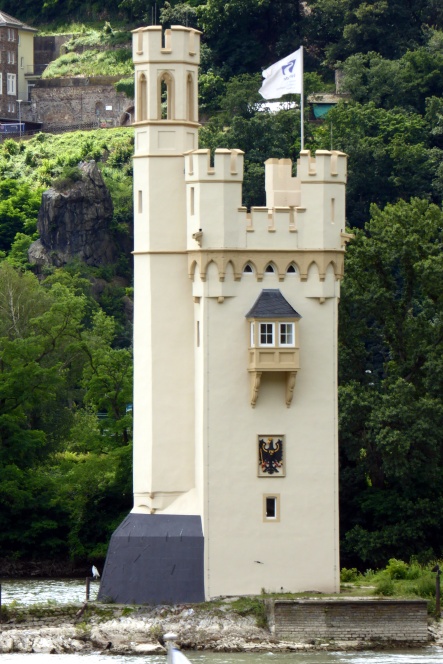
Mauserturm, 14th Century

P1070550

P1070551

P1070555

P1070561

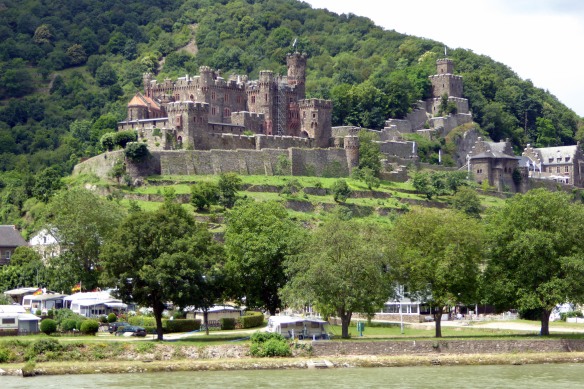
Reichenstein Castle was first built in 1100 and rebuilt in 1900.

P1070564

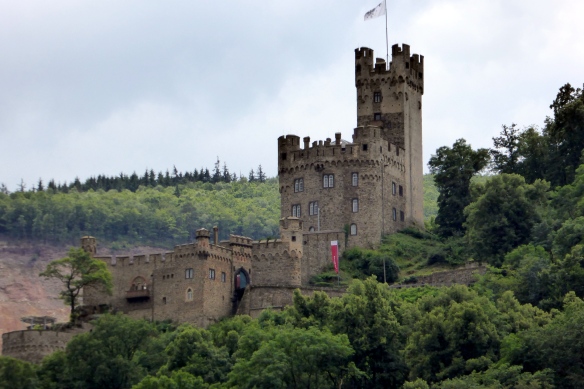
Sooneck Castle dates back to the late 1200’s.

P1070567-RuineFurstenberg.JPG

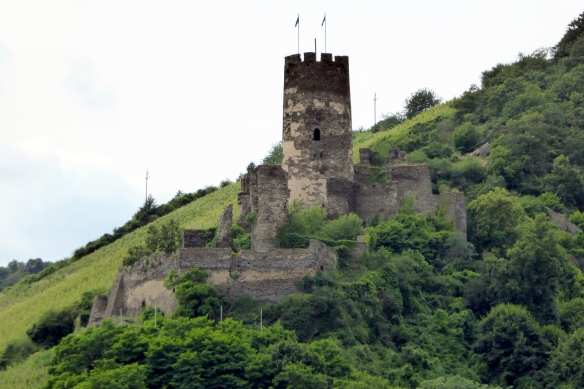
Furstenberg Castle (now in ruins) was built in 1219.

P1070569.JPG

P1070570-BurgStahleck.JPG

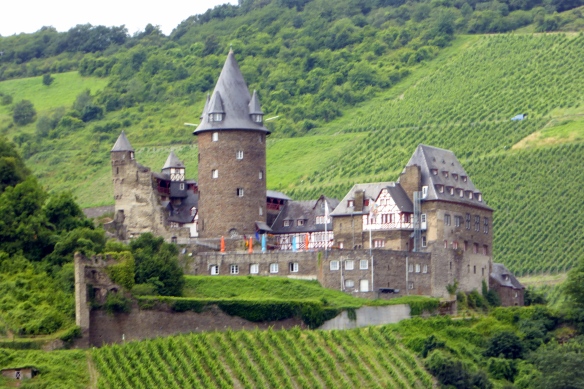
Stahleck Castle was originally built in 1135!

P1070573.JPG

P1070579.JPG

P1070583-Pfalzgrafenstein.JPG

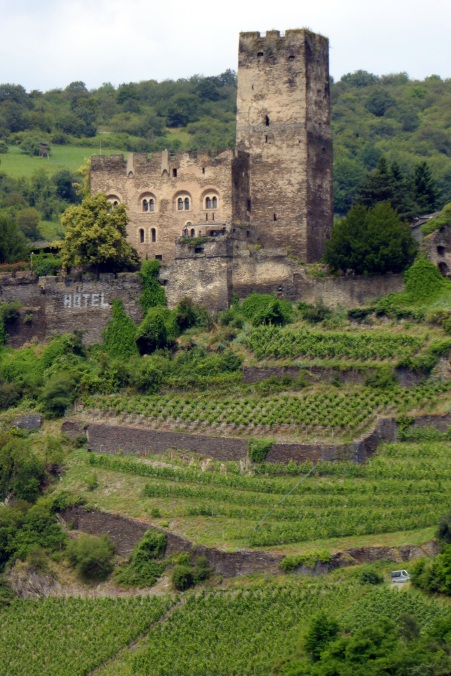
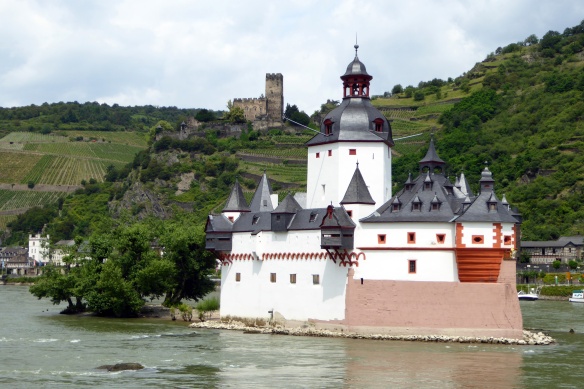
This was one of my favorites!  Pfalzgrafenstein Castle sits on the tiny island of Pfalz, and its sole purpose back in the day (early 1300’s!) was to generate revenue from boats traveling along the river.  Notice the castle in the background:  Gutenfels Castle.

P1070587.JPG

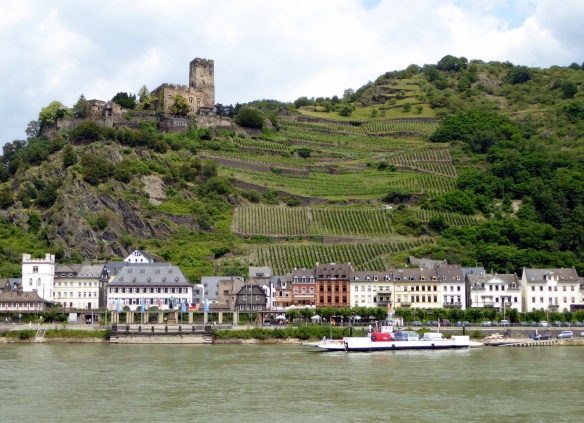
Another view of Gutenfels Castle

P1070588.JPG

P1070589-BurgGutenfels.JPG

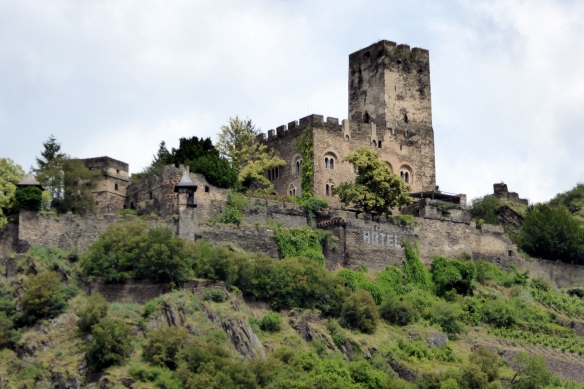
A closer look at Gutenfels Castle

P1070590.JPG

P1070592-Shonburg

Shonburg Castle, located above the town of Oberwesel (known as the “City of Towers”), is a bit of a mix of architectural styles.  Originally built in 1149, the castle was destroyed in 1689.  Since 1885, it has been built bit by bit into its current condition.  The newer section houses a famous hotel.

P1070598-Oberwesel.JPG

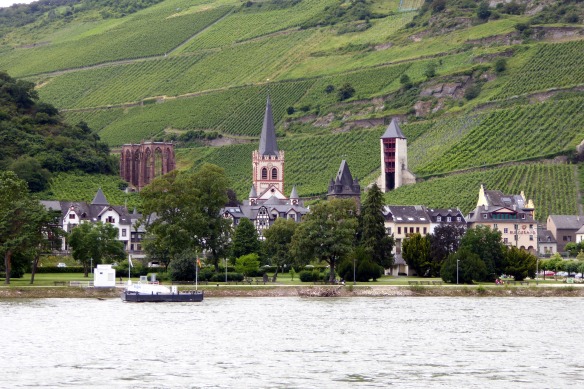
Oberwesel, the “City of Towers” has 16 towers!

P1070603.JPG

P1070609-BurgKatz.JPG

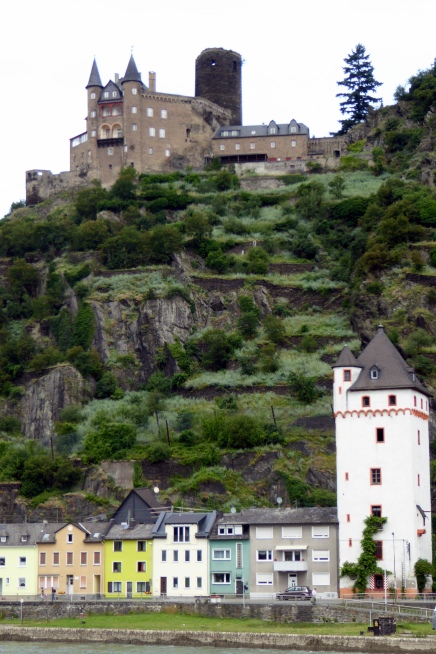
Katz Castle is located above the town of St. Goarshausen.  It was first built in 1371; however, it was bombarded by Napolean in 1806.  it was rebuilt in the late 1800’s and is now privately owned and not open for visitors.

P1070617.JPG

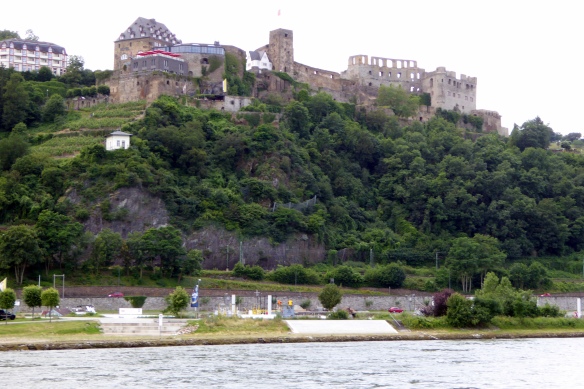
Started in 1245 (and expanded several times since), Rheinfels Castle is the largest castle on the Rhine.  At one time, the castle covered five times its current area; however, most of it now is a ruin.  The other part includes a luxury hotel, wellness center, and restaurant.

P1070626-BurgMaus.JPG

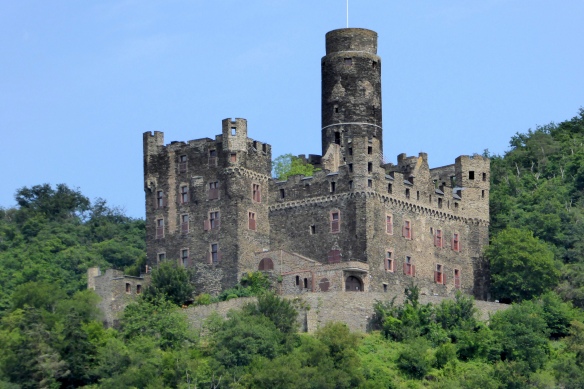
Maus (meaning “mouse”) Castle is located above the village of Wellmich and dates back to 1356.

P1070632.JPG

P1070635.JPG

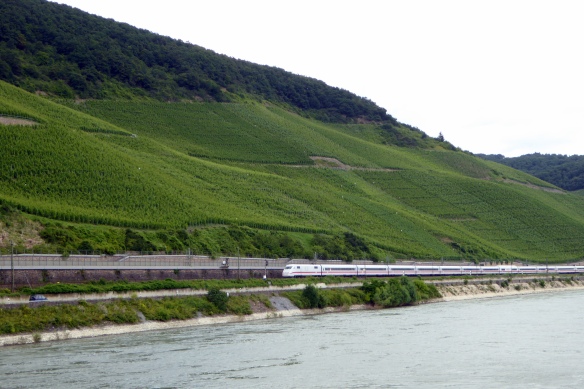
Vineyards blanket the landscape along the Rhine.

P1070638-Marksburg.JPG

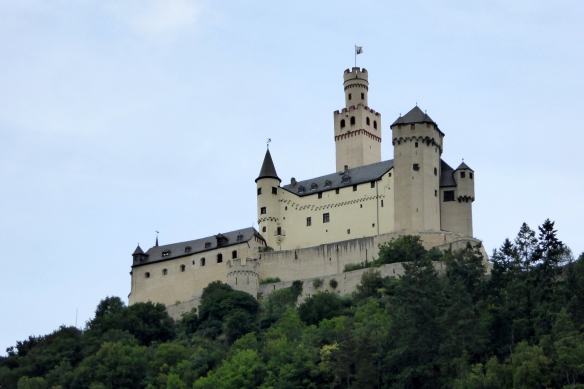
Marksburg has the distinction of never having been destroyed.  Built in 1117, this castle was used for protection rather than as a residence for royal families.  Located above the town of Braubach, it is one of the principal sites for the UNESCO World Heritage Rhine Gorge.

P1070641-Martinsburg.JPG

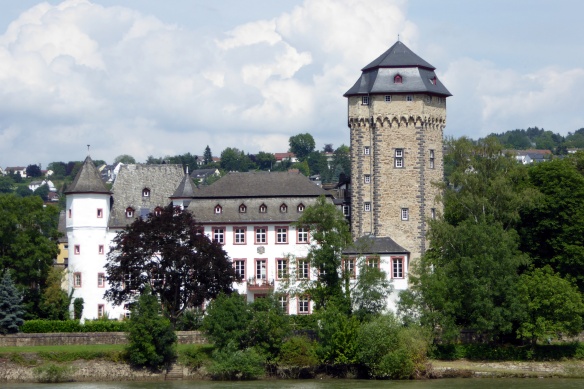
Located in Oberlahnstein, Martinsubrg Castle was built in the late 1300’s.

P1070643-SchlossStolzenfels.JPG

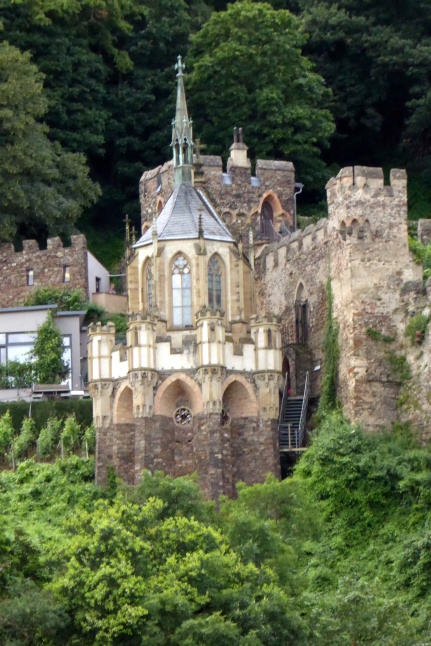
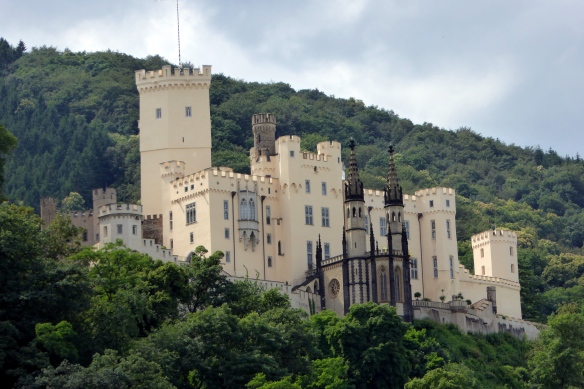
Schloss Stolzenfels (Stolzenfels Castle), located in Koblenz, is a former medieval fortress castle.  It was a ruined 13th-century castle gifted to Frederick William in 1823, and he had it rebuilt as a 19th-century palace in Gothic Revival style.  Today, it is part of the UNESCO World Heritage Site Upper Middle Rhine Valley.

P1070645-BurgLahneck.JPG

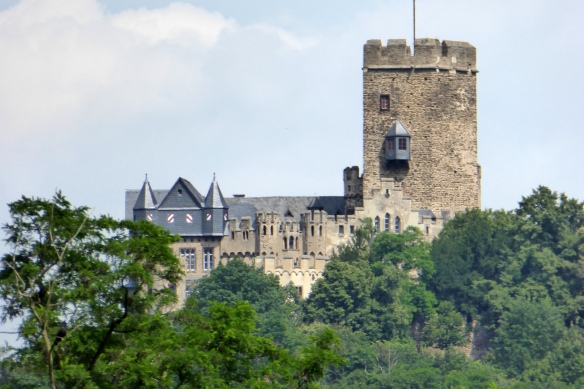
Lahneck Castle, built in 1226,  is a medieval fortress located in the city of Lahnstein, south of Koblenz.  The 13th-century castle stands above the confluence of the Lahn River with the Rhine, opposite Stolzenfels castle.

P1070646.JPG

P1070649

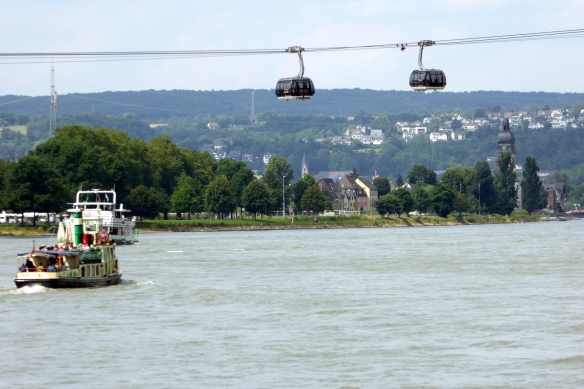
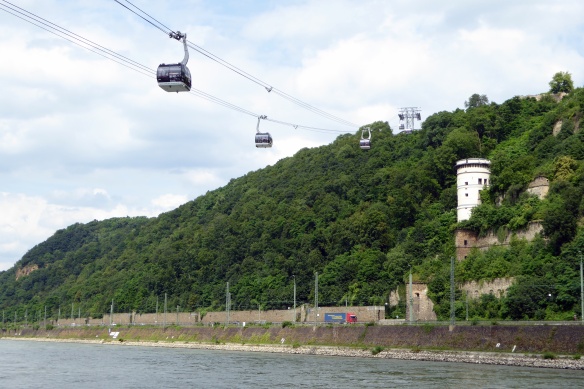
The Koblenz Cable Car crosses the Rhine where it meets the Mosel River.

P1070652

We completed our cruising journey for the day in Cologne where our ship tied up for the night and following day.  Check back for my next post on Cologne!