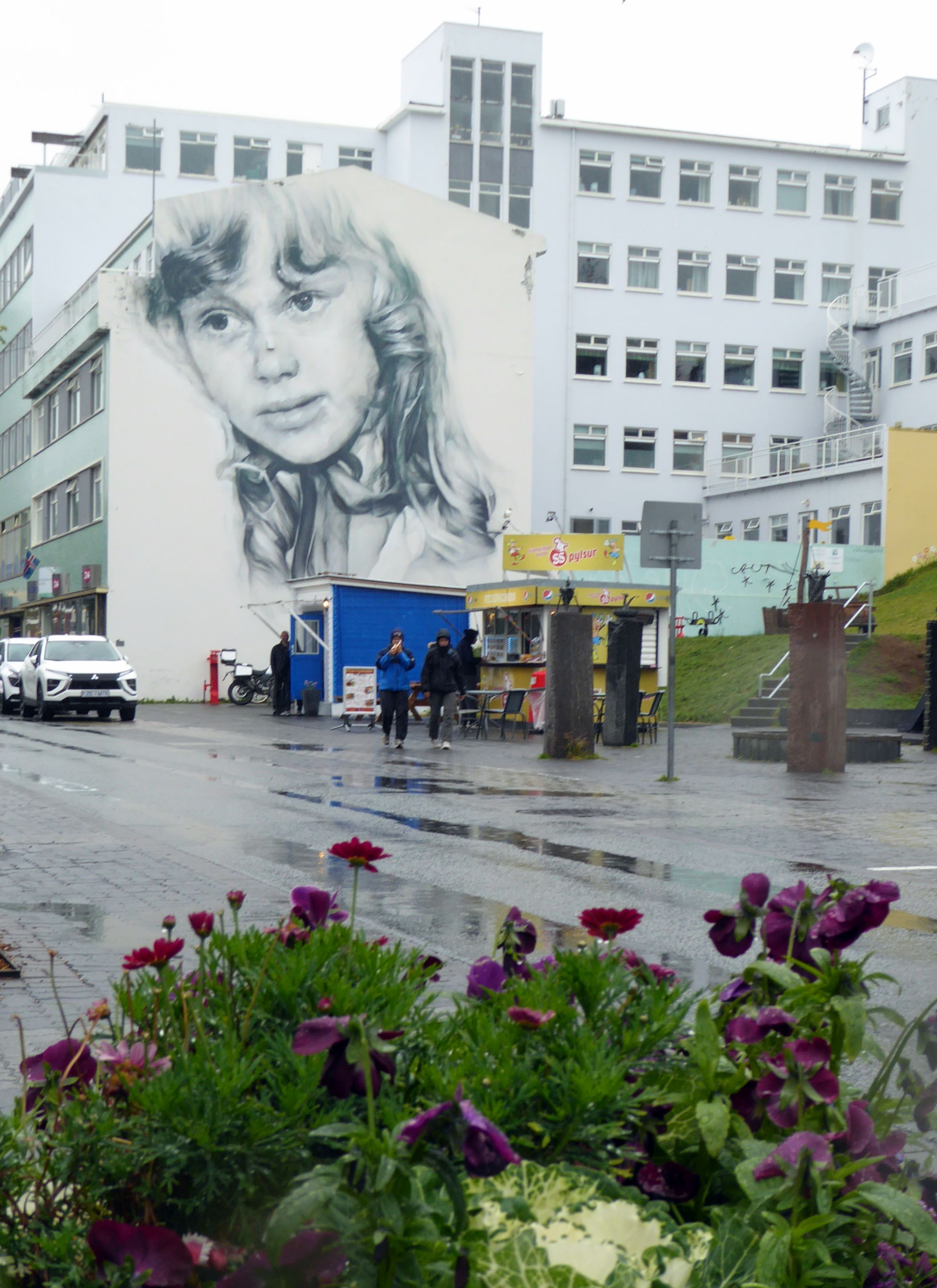
Our afternoon arrival to Akureyri was a rainy one, just as it had been much of the day, on and off. Fortunately, it never rained hard, so we donned our waterproof gear and carried on.
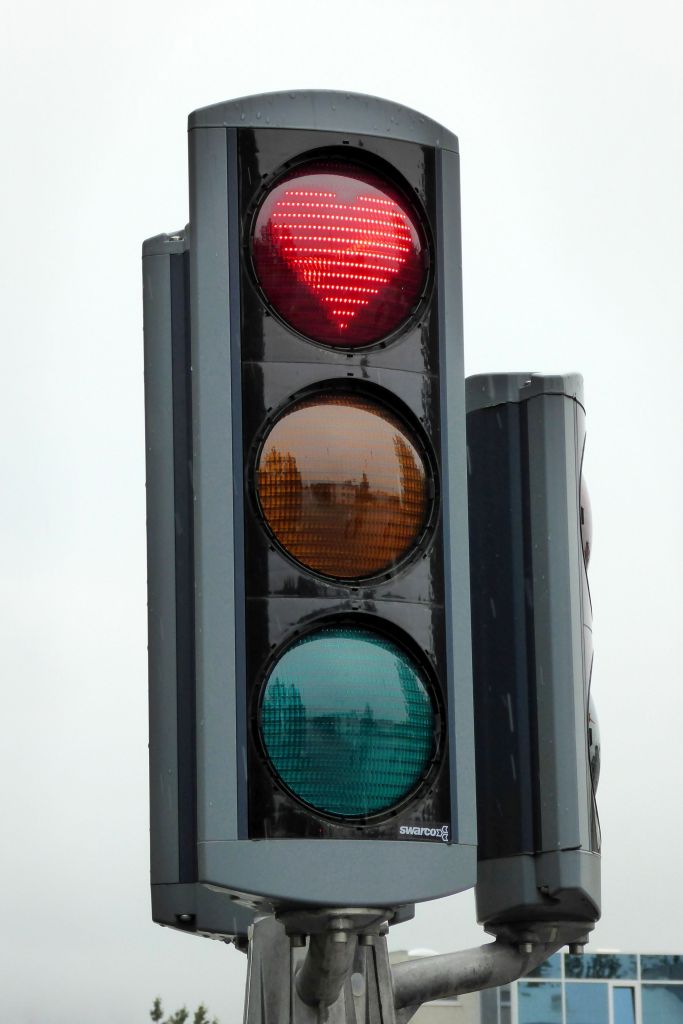
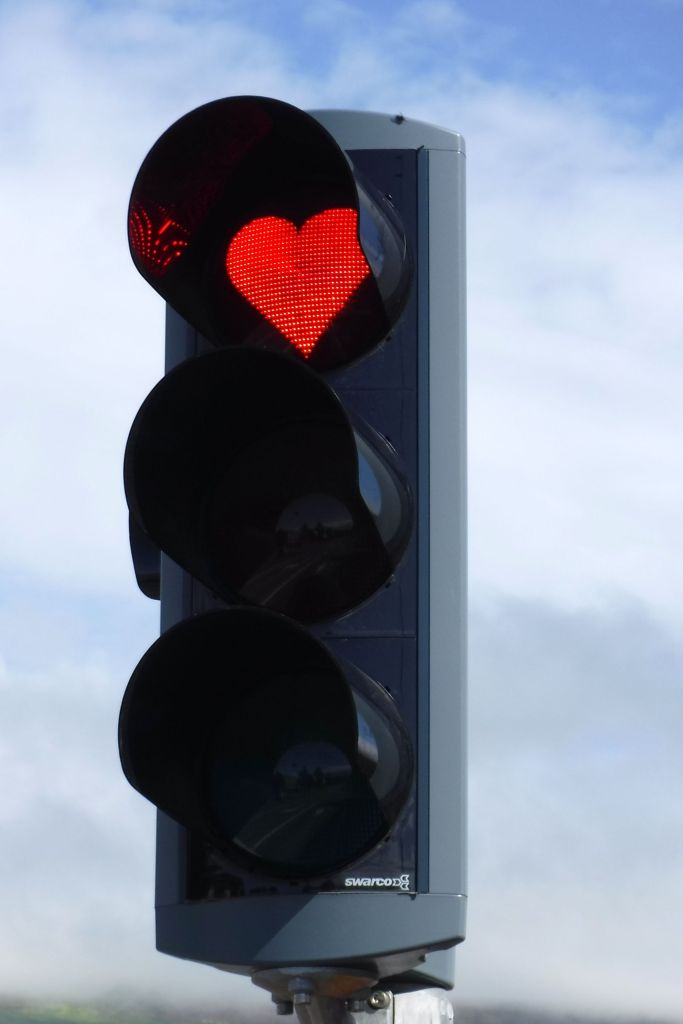
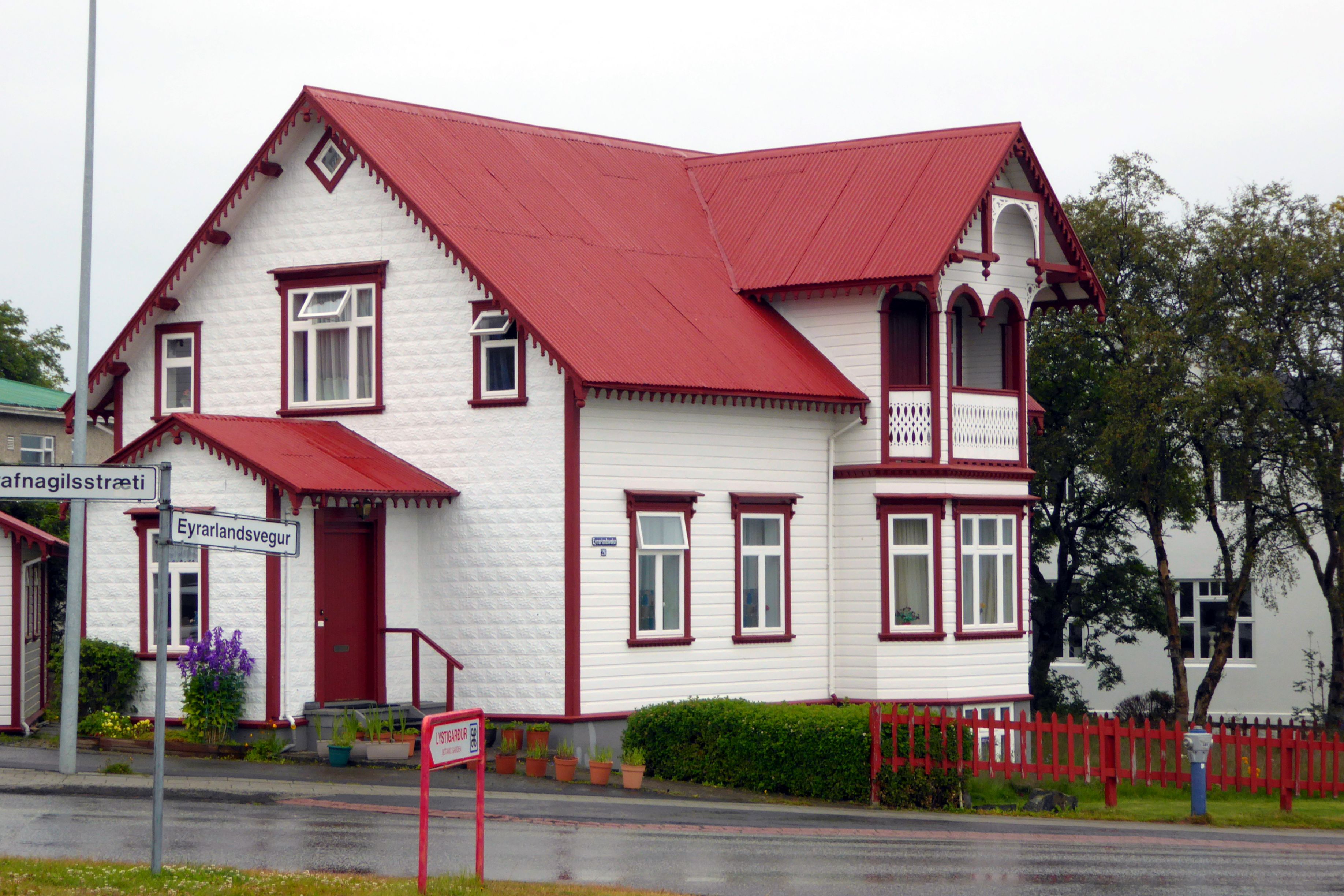
I found Akureyri appealing, regardless of the weather. As we drove into town along the waterfront, I gazed out the bus window and did a double-take as we stopped at this red light. (I photographed another one the next day by the pool, since it was a bright, sunny day!)
Awww; it was love at first sight! What a clever idea and a warm welcome to Iceland’s fifth-largest city, and the largest city in North Iceland. Still, it only has just a bit over 19,000 residents.
Nicknamed the “Capital of North Iceland,” Akureyri is an important port and fishing center. Surprisingly, given how far north it is, the climate is relatively mild. They don’t get much sun, but the temperatures are not extreme. The harbor is even ice-free in the winter, which is a huge advantage for the fishing industry.
Although the waterfront is flat, the topography becomes quite steep and hilly just a short distance from the main part of town. This added visual interest and character; I quite liked it. (Besides, it was a great workout for the legs while walking back up to our hotel up on the hill!)
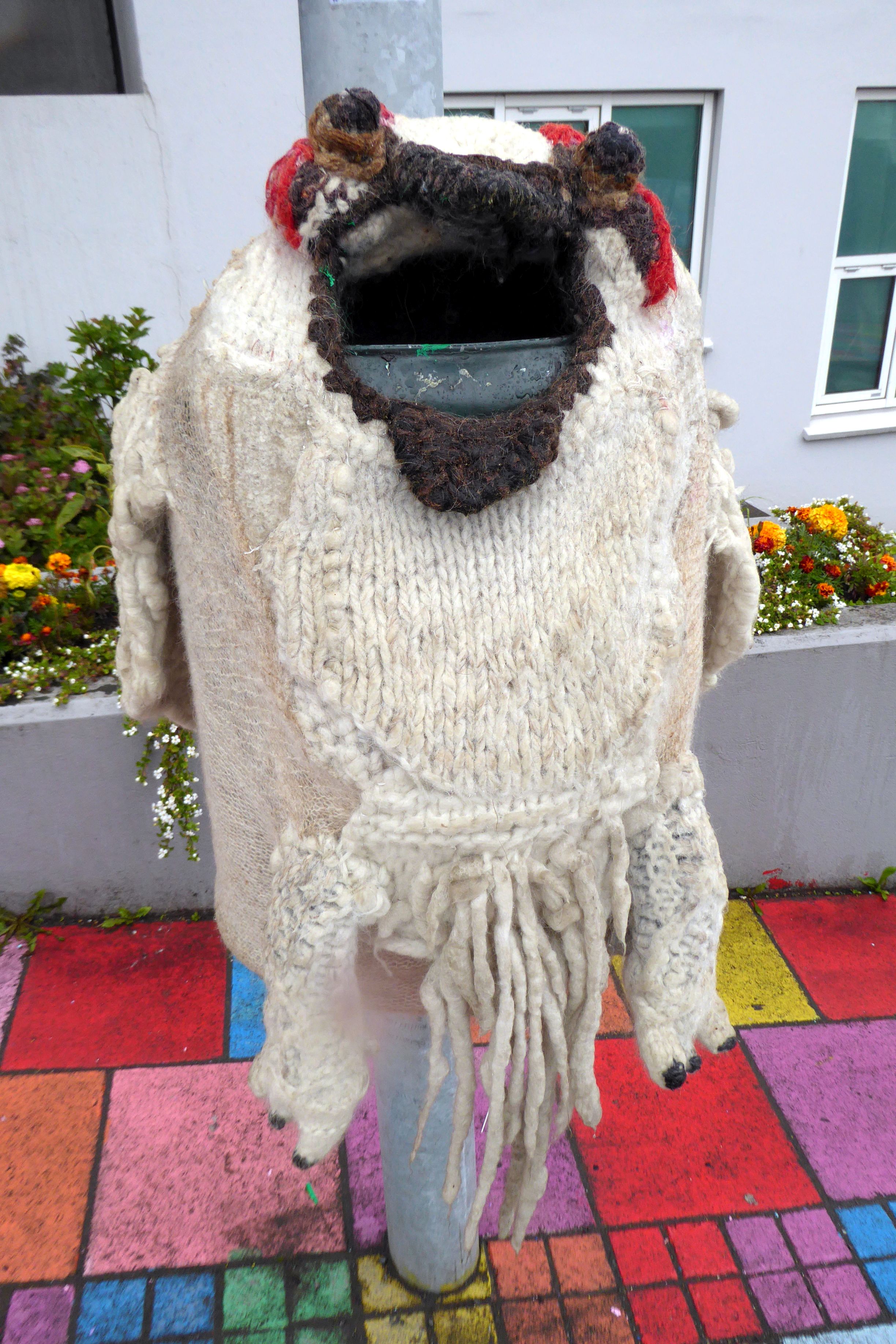
Akureyri has an active cultural scene—especially folk culture. I liked the artsy vibe of the town, especially these quirky knitted trash receptacle covers around town:
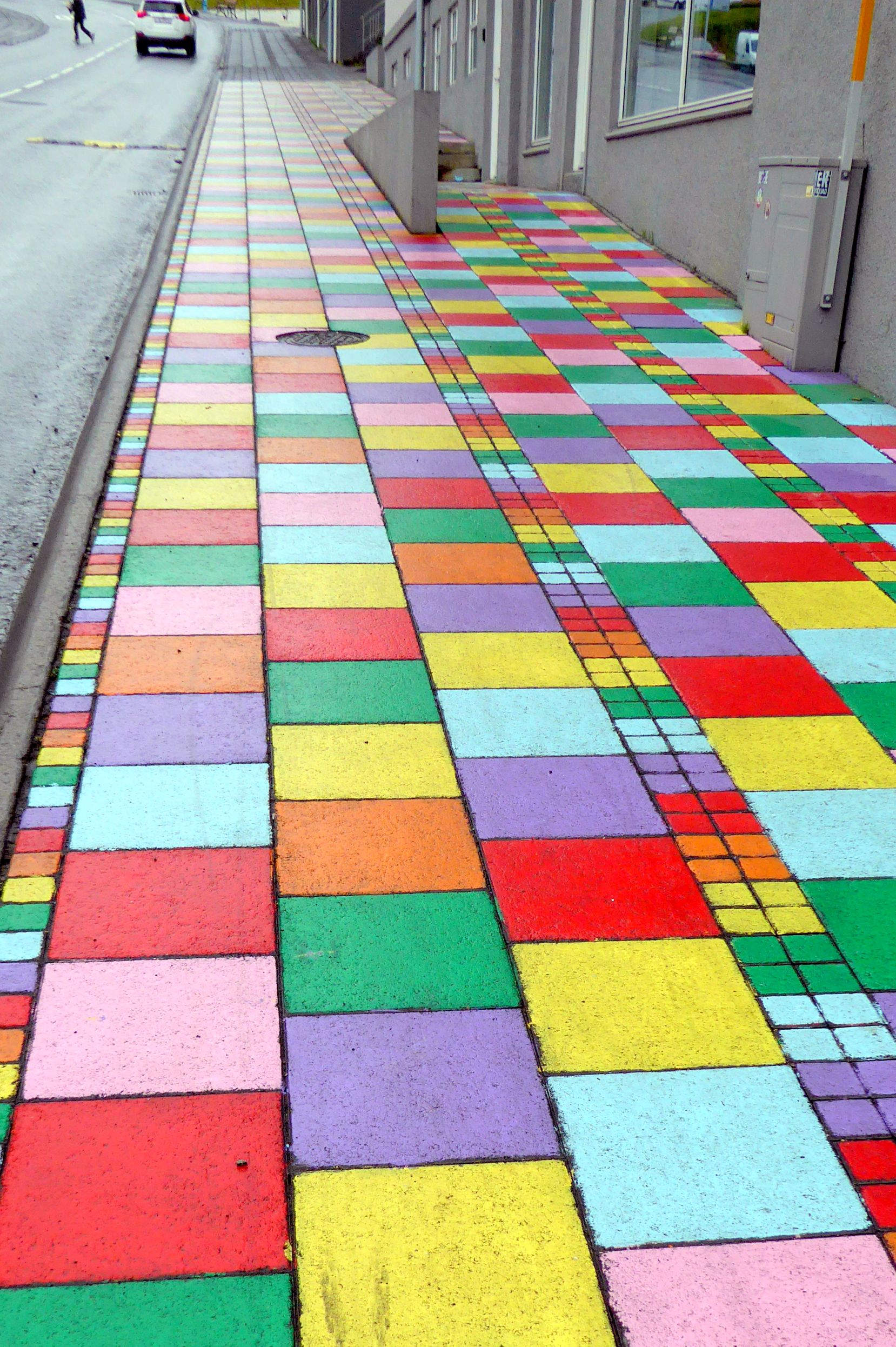
I also loved this splash of rainbow colors to brighten up an otherwise boring concrete sidewalk:
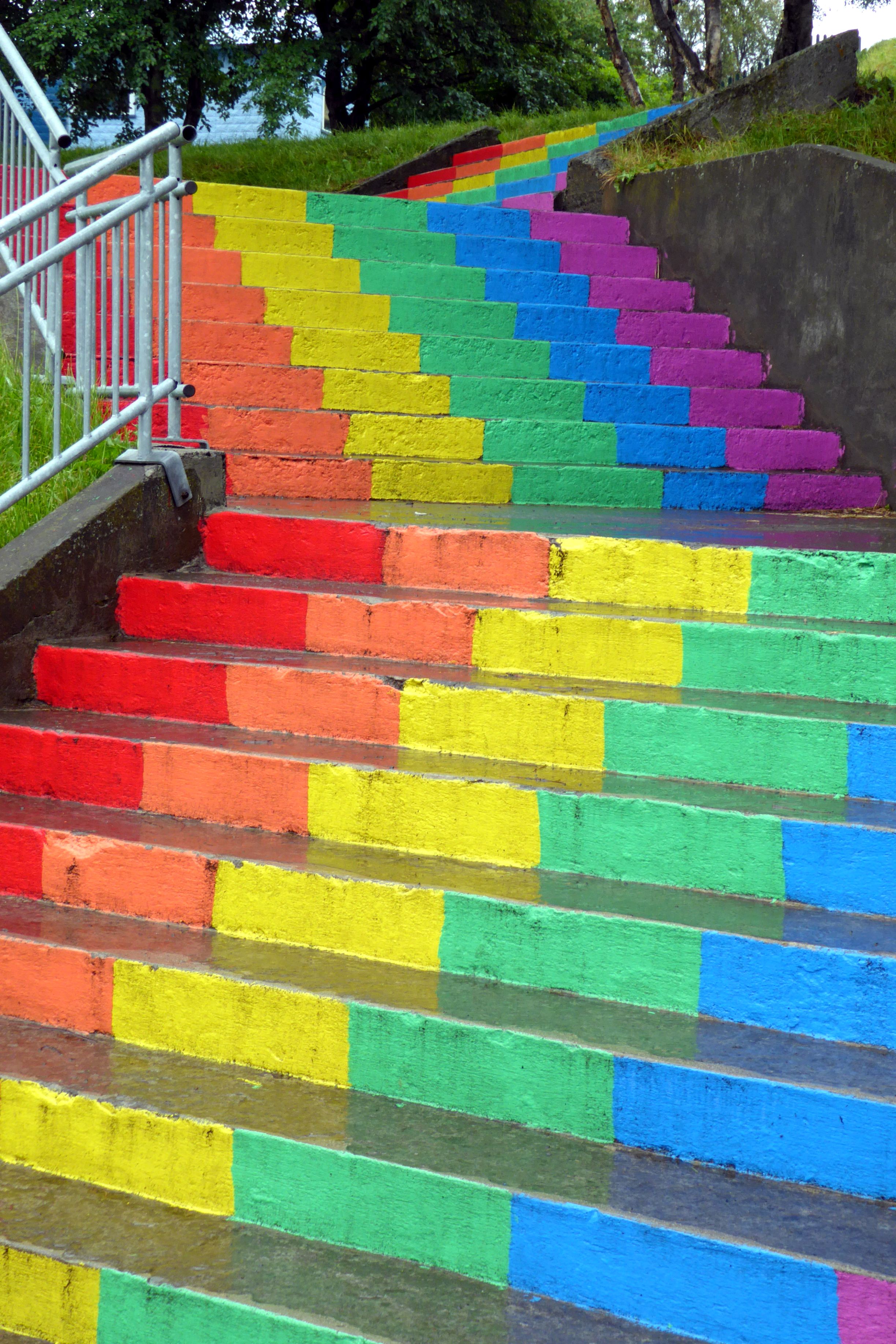
The same for the rainbow stairs. Good on Iceland for being inclusive!
After we settled in at the hotel, Thorunn took us on an orientation walking tour of the town. Just across the street from the hotel was this awesome swimming facility I wrote about in my first Iceland blog post:
Nearby, we took a brief walk through the Akureyri Botanical Garden, established in 1912 by a group of local women who had founded the Park Association, two years earlier, to beautify their city.
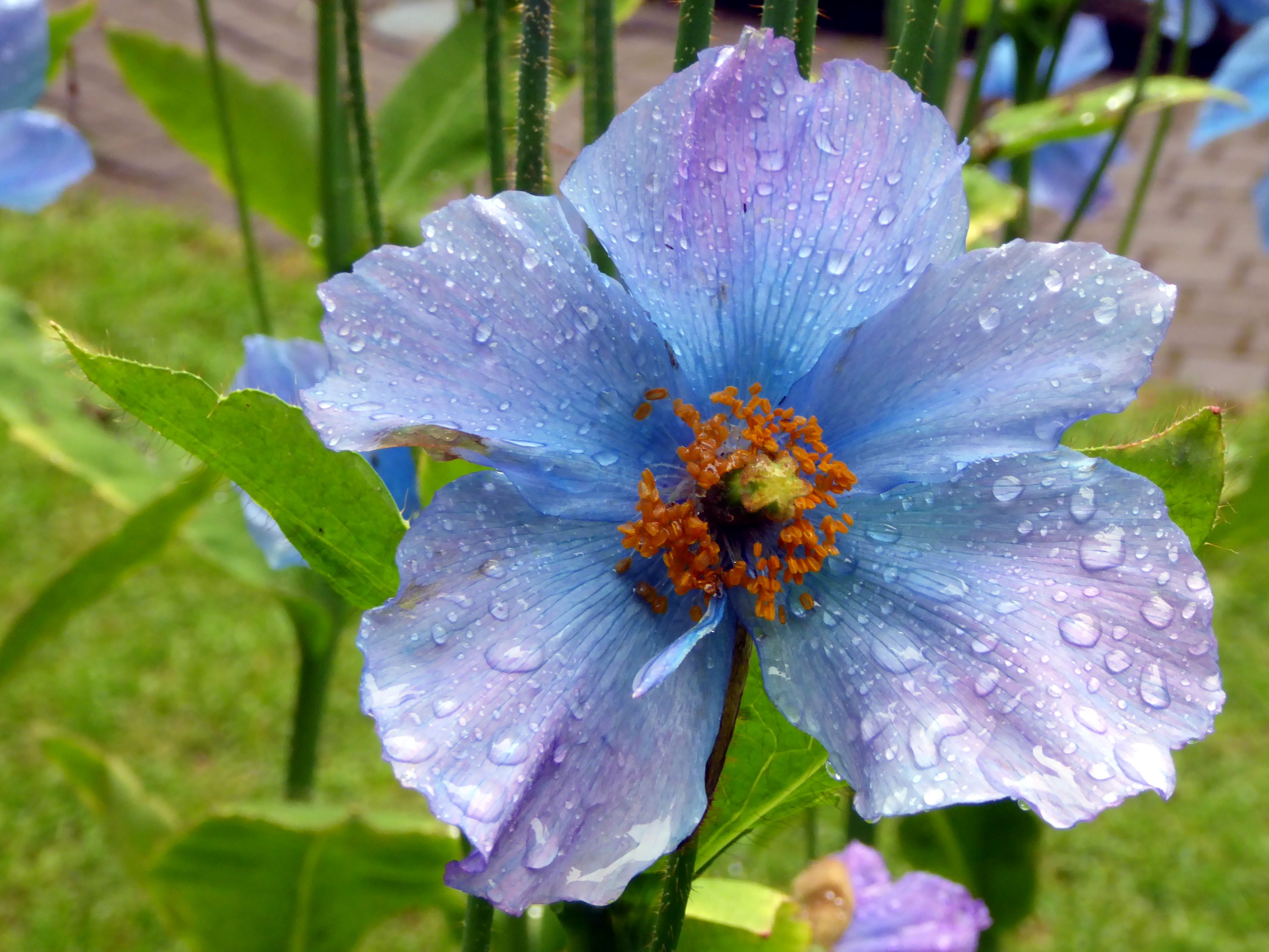
I fell in love with these Himalayan blue poppies!
Rather than returning to the hotel with the group, we headed back down to town to do some exploration on our own before joining our group at the hotel for dinner.
A window display in a folk art gallery
Coming up next: More of North Iceland’s Natural Wonders & A Home-Hosted Dinner
(For all pictures, click on the image to see full screen view.)Note: If small group travel is of interest to you, I highly recommend Overseas Adventure Travel (OAT). Although Bruce and I travel together, they do not charge a single supplement for those who travel on their own. Singles also get their own room at hotels. If you book, you can get $100 off your trip by providing my name and customer number (Elaine Krugman, #3018126) as the person who referred you. I will also get $100 off fut
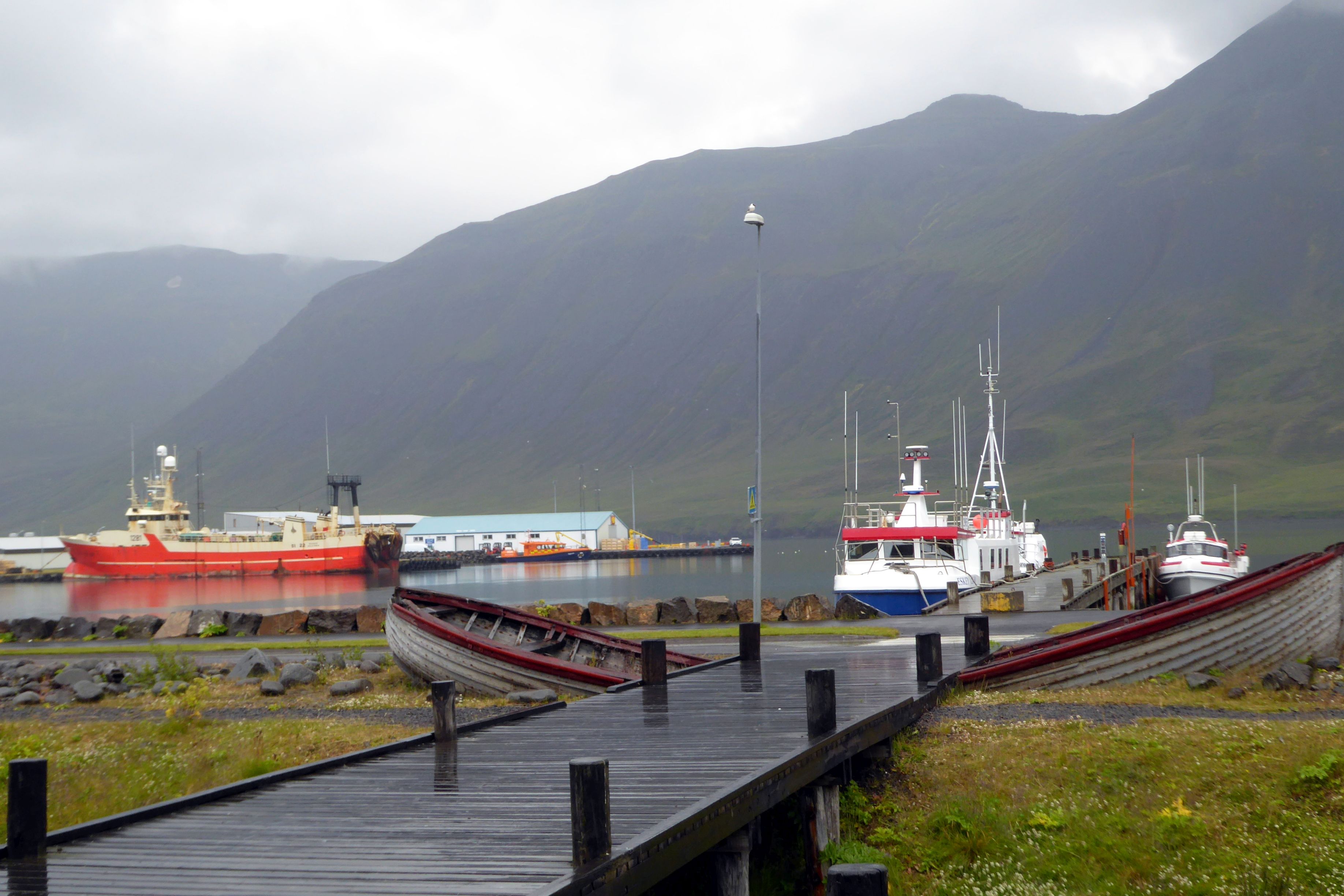
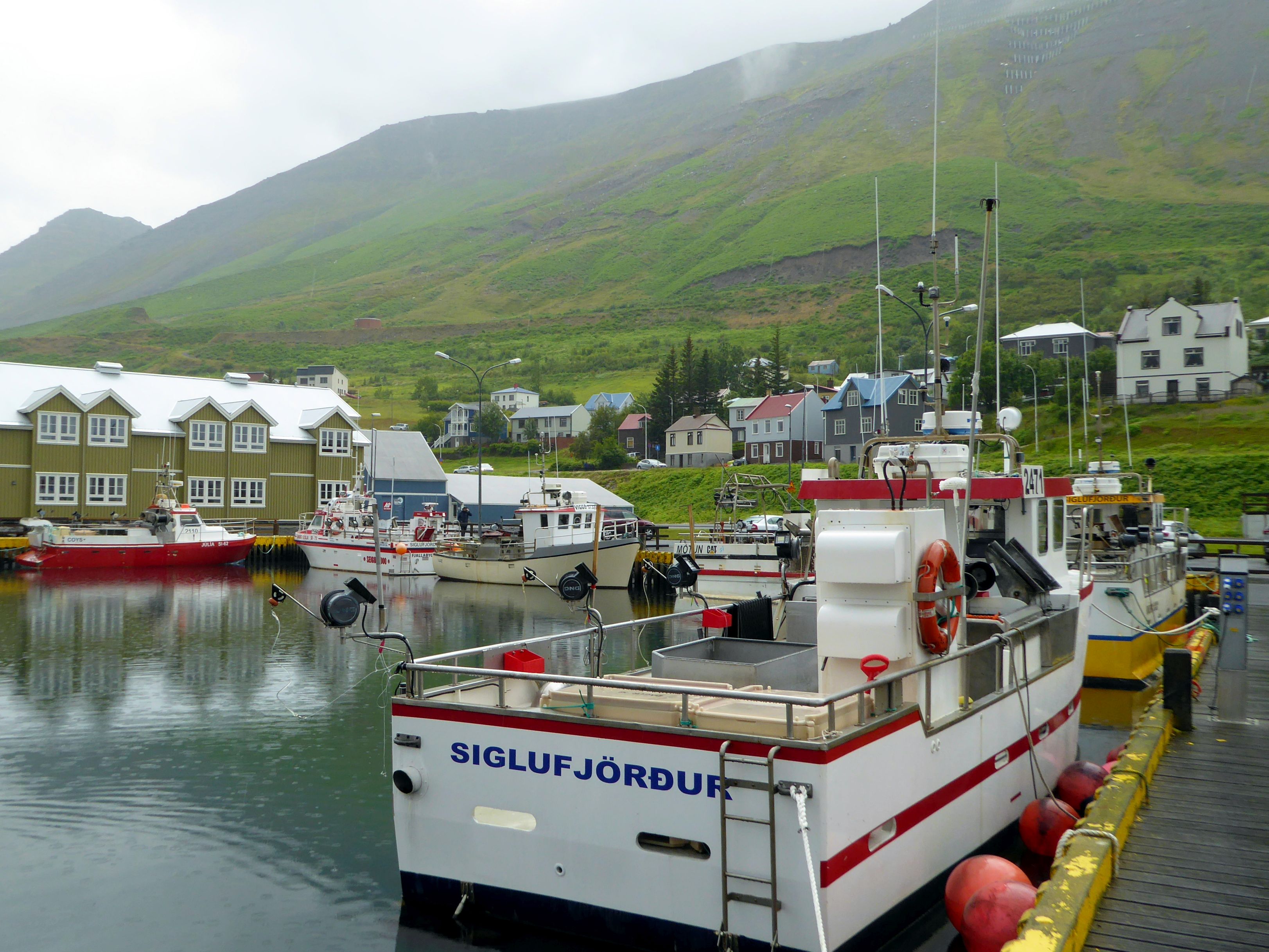
The next town on our tour of North Iceland, Siglufjordur, put us just 14 miles from the Arctic Circle. This was as far north as we got in Iceland and perhaps as close to the Arctic Circle I will ever get.
(For all pictures, click on the image to see full screen view.)
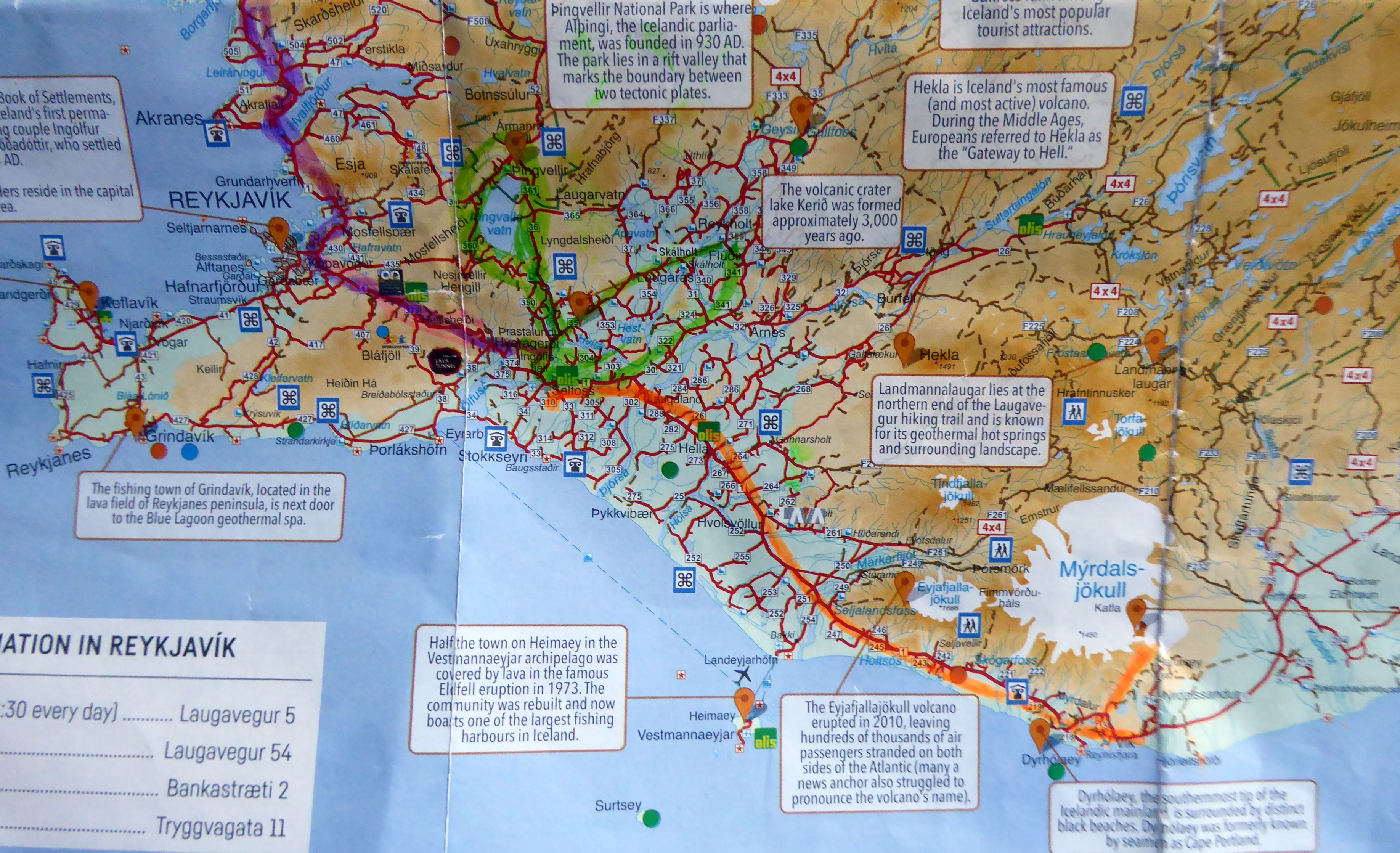
North Iceland: Each color represents a different day. Siglufjordur is the furthest north we got.These are the places we traveled before heading north. We returned to Reykjavik for the last three days.
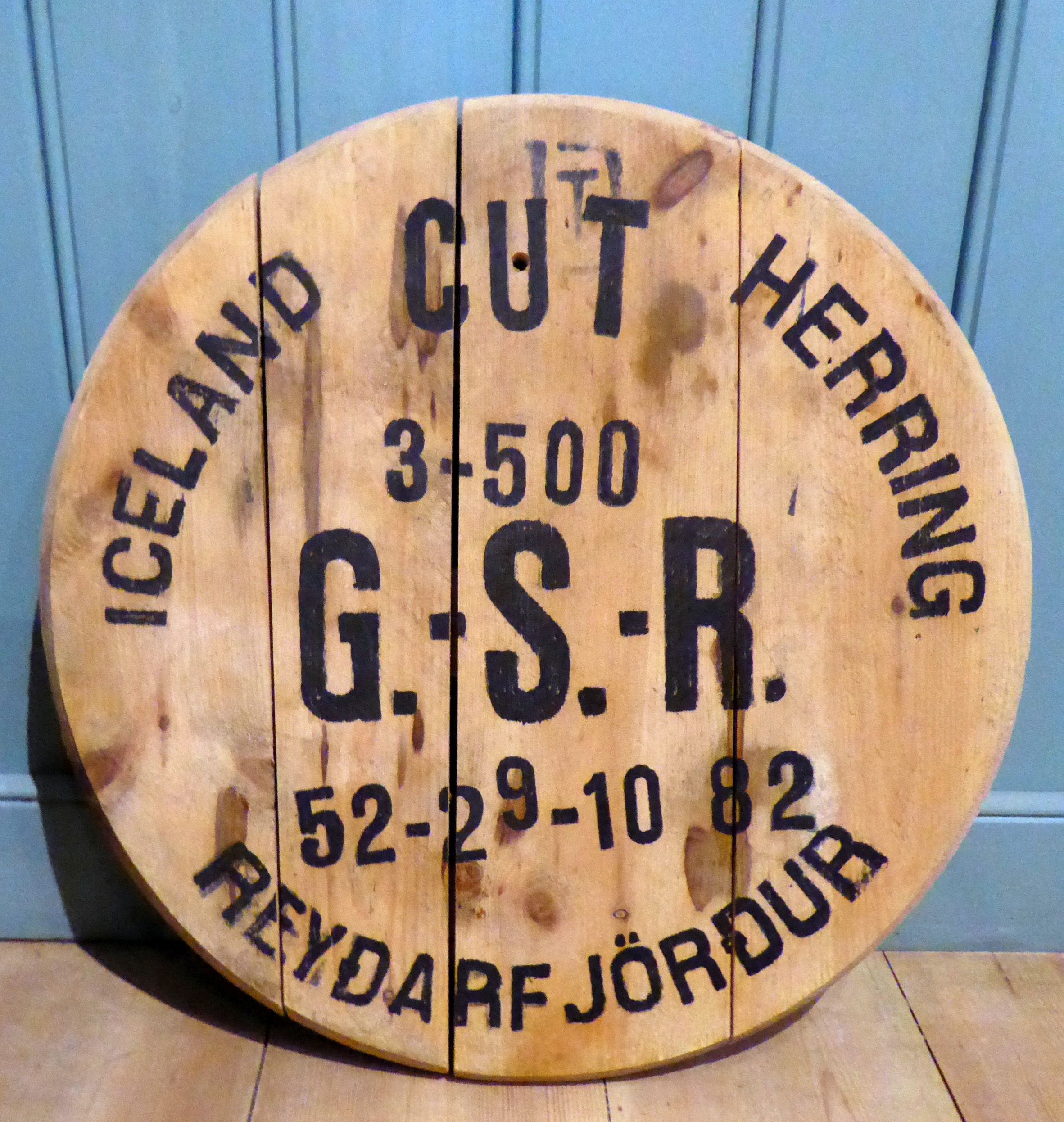
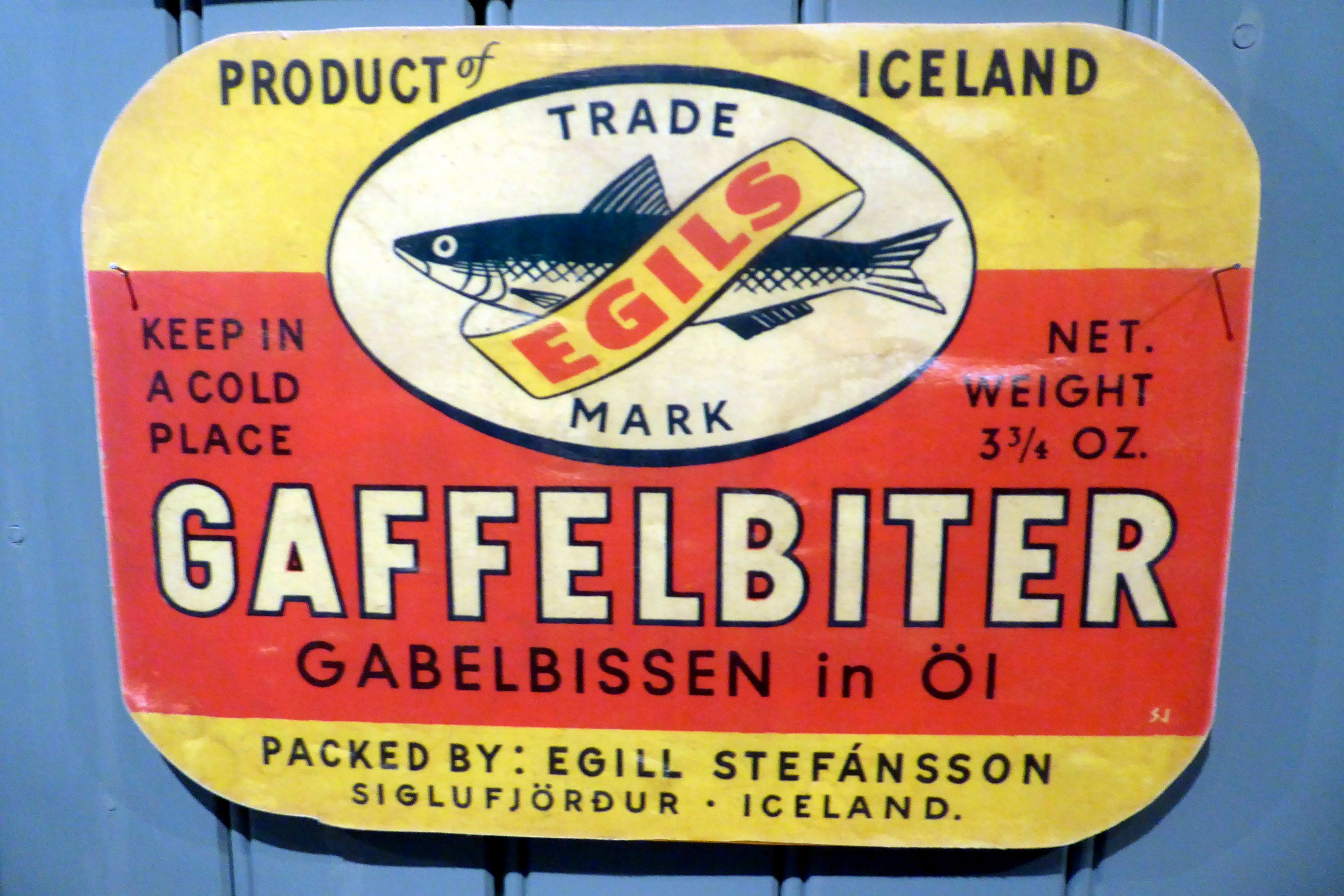
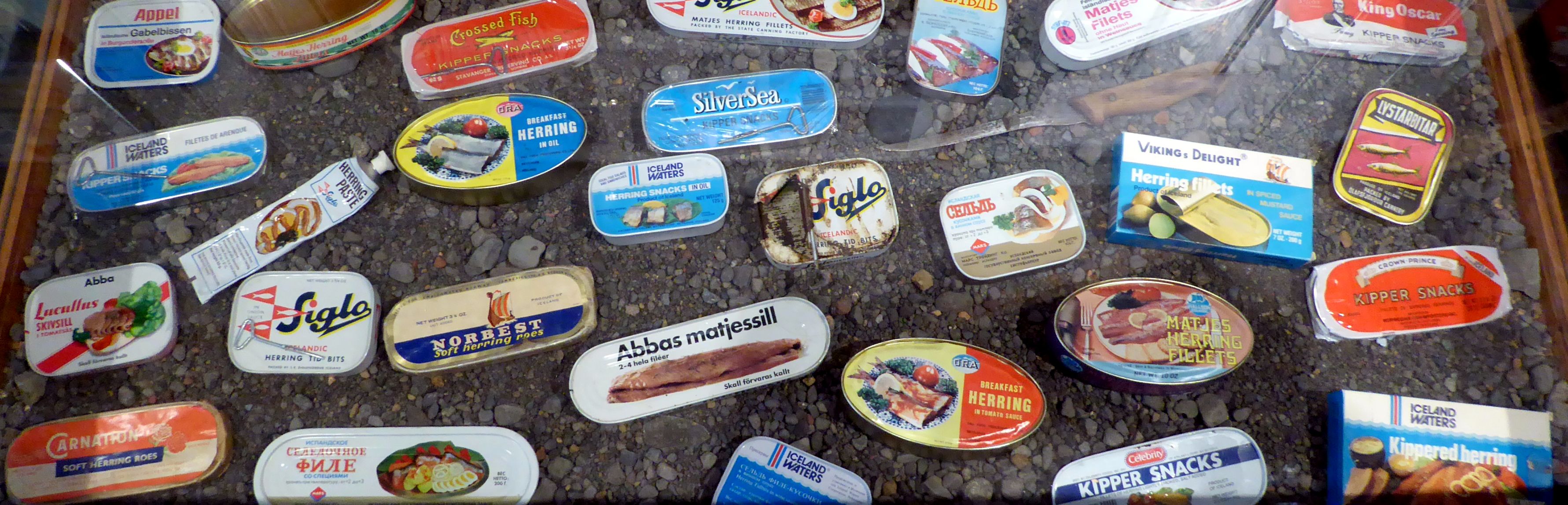
Known for their history of its fishing industry, Siglufjordur has been shrinking in size since the 1950’s, when the population maxed out at 3,000. What was the draw? Herring, and a lot of it! Siglufjordur was the largest herring town of all, thanks to the abundance of this profitable fish. In the 1960’s, however, the fishing industry collapsed, due to over-fishing and the major downturn of the world market for stockfish. The town had relied on just the one industry, which proved to be a catastrophic. People left, property values fell; and, many shops and services closed their doors. Today, there are less than 1,200 people calling this little town home.
Fortunately, the herring stock slowly recovered, although it is carefully regulated and monitored. The town also reinvented itself with the The Herring Era Museum and Folk Music Centre— both draws for tourism. It also hosts the Herring Festival every August, and the Folk Music Festival every July.
We made the journey to this quaint town to visit both museums. The Herring Era Museum brings back to life the “glory days” of Iceland’s herring fisheries and industry. As the 2004 winner of the European Museum Award, it was considered Europe’s best new museum of industry and technology. I can see why; it was worth the visit!
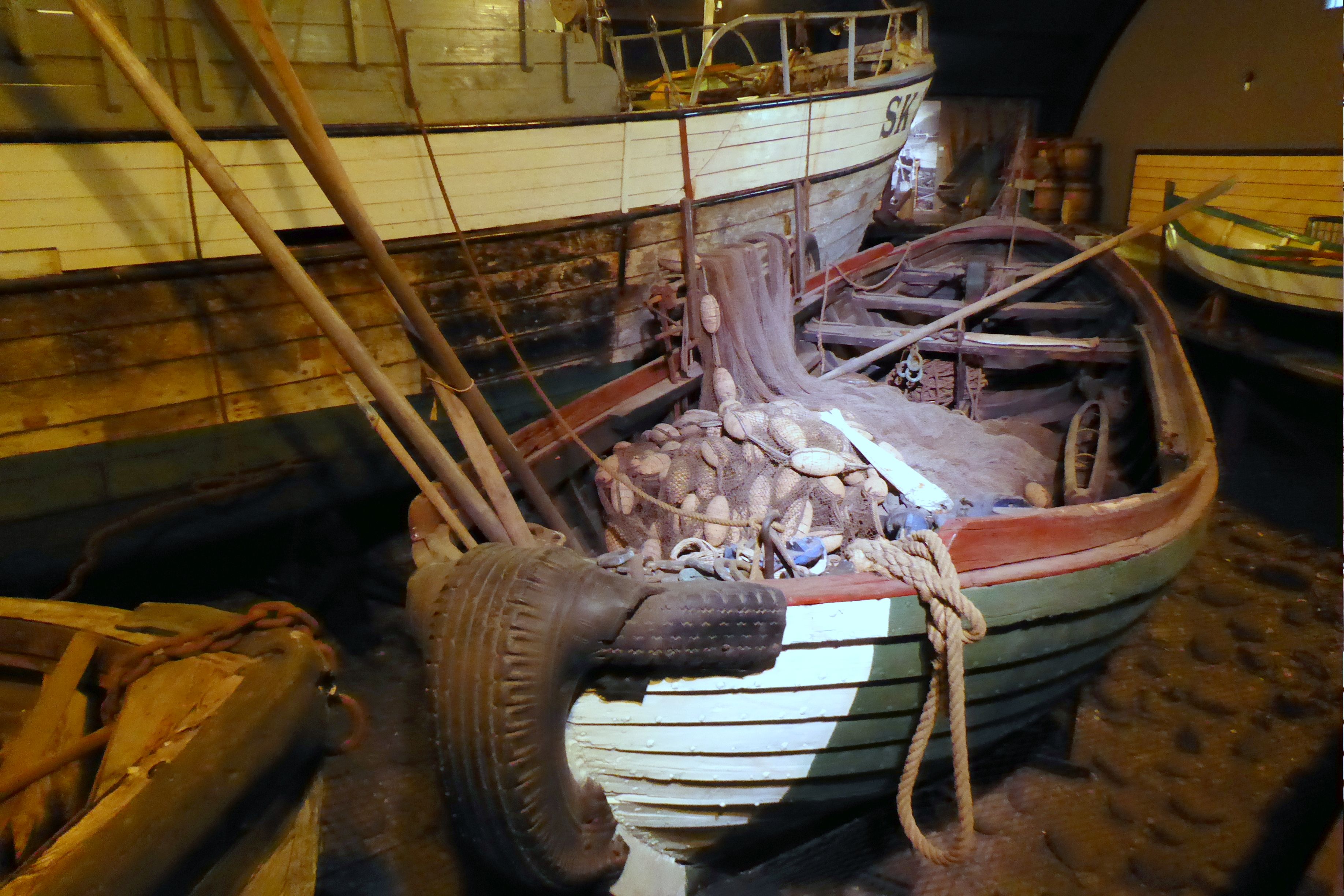
Fishing boats displayed inside the museum
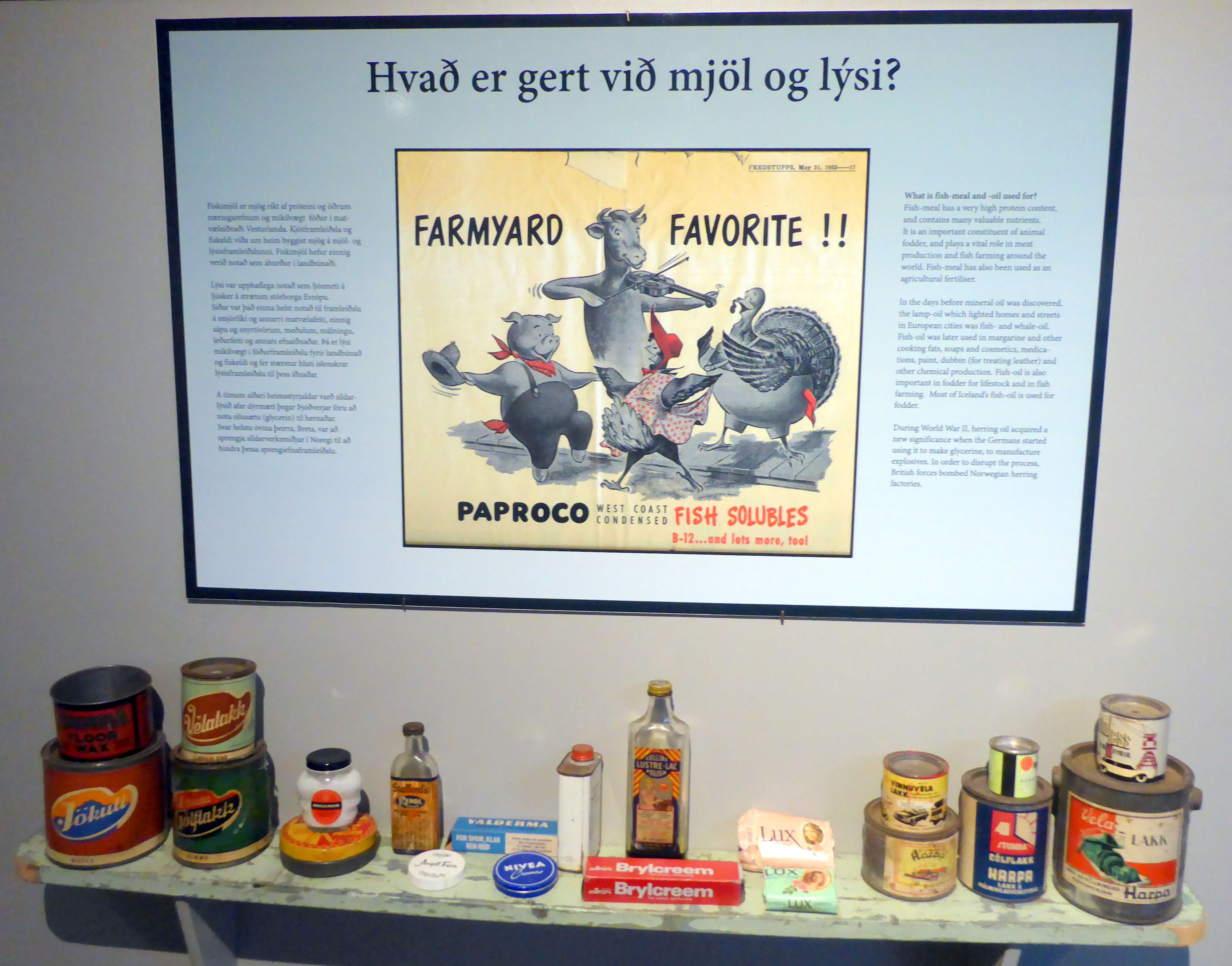
Products made from herring oil
I wanted to know why this fish was so important. First, it is one of the most abundant fish species in the world. It is also quite nutritious, rich in vitamin D and Omega3. The consumption of herring and its industry has been so significant to so many European countries that it is regarded as the most commercially important fish in history.
For Iceland, the herring fisheries (producing salt herring for human consumption, fish-meal and oil) sometimes accounted for nearly half of the country’s national income.
Iceland’s first plants to process fish-meal and oil were set up in 1911 by Norwegian entrepreneurs. In the following decades, dozens more were built around the coast of Iceland — first by foreigners, later by Icelanders.
What was most interesting to me was learning about the “Herring Girls.” Between the 1910’s and 1960’s, thousands of young women formed the backbone of Iceland’s thriving fishing industry. And, they worked their backs to the bone doing it. These women came from all around Iceland to work gutting, cleaning, and salting barrels for freshly caught fish. They often earned more money than men working the docks; however, the conditions were brutal, and the living conditions were worse. We saw how they lived; eight to a tiny bedroom sharing two sets of bunk beds. Can you imagine two people sleeping on a tiny mattress? One would sleep with their head at one end, and the other would have their head at the opposite end. That alone would be a non-starter for me! These gals were tough.
It was the Herring Girls that helped secure gender equality in Iceland, because they fought for equal pay and labor rights. They are the reason Iceland ranks #1 on the World Economic Forum’s Global Gender Gap Report. You go, girls!
Herring Girls
We made this delicious chocolate coated ice cream our lunch. Icelandic soft serve is so much better than Dairy Queen!
Following our morning at the museums, we continued heading to Akureyri, our base for three nights. This will be the topic of my next post…
Next up: Appealing Akureyri
Note: If small group travel is of interest to you, I highly recommend Overseas Adventure Travel (OAT). Although Bruce and I travel together, they do not charge a single supplement for those who travel on their own. Singles also get their own room at hotels. If you book, you can get $100 off your trip by providing my name and customer number (Elaine Krugman, #3018126) as the person who referred you. I will also get $100 off future travel– a win-win!
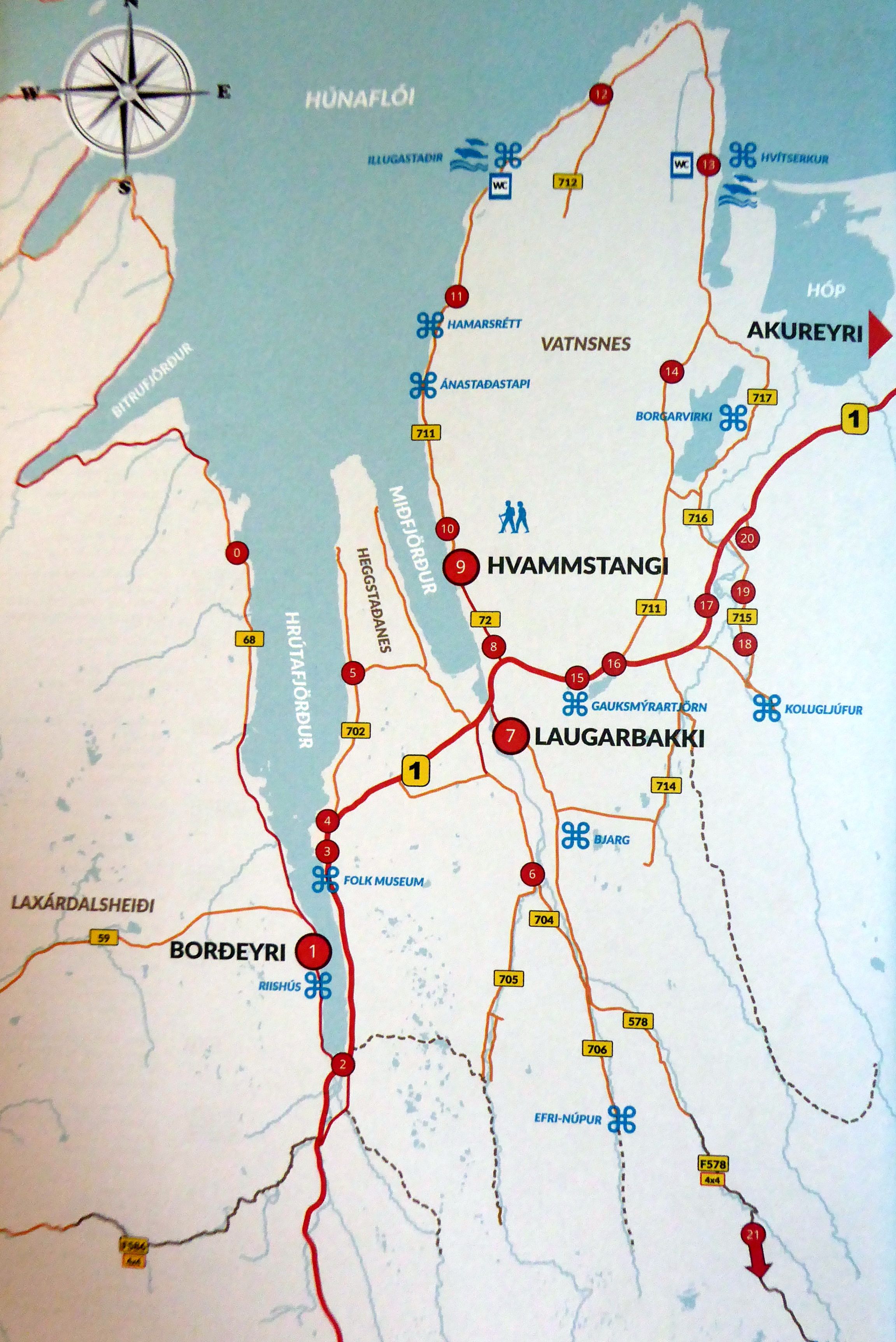
From the Snaefellsnes Peninsula in the western region of Iceland, we made our way northeast to Hvammstangi. During our bus rides (and throughout the tour), Thorunn told us so much interesting information about her country and shared stories of what it was like growing up in Iceland.
(For all pictures, click on the image to see full screen view.)
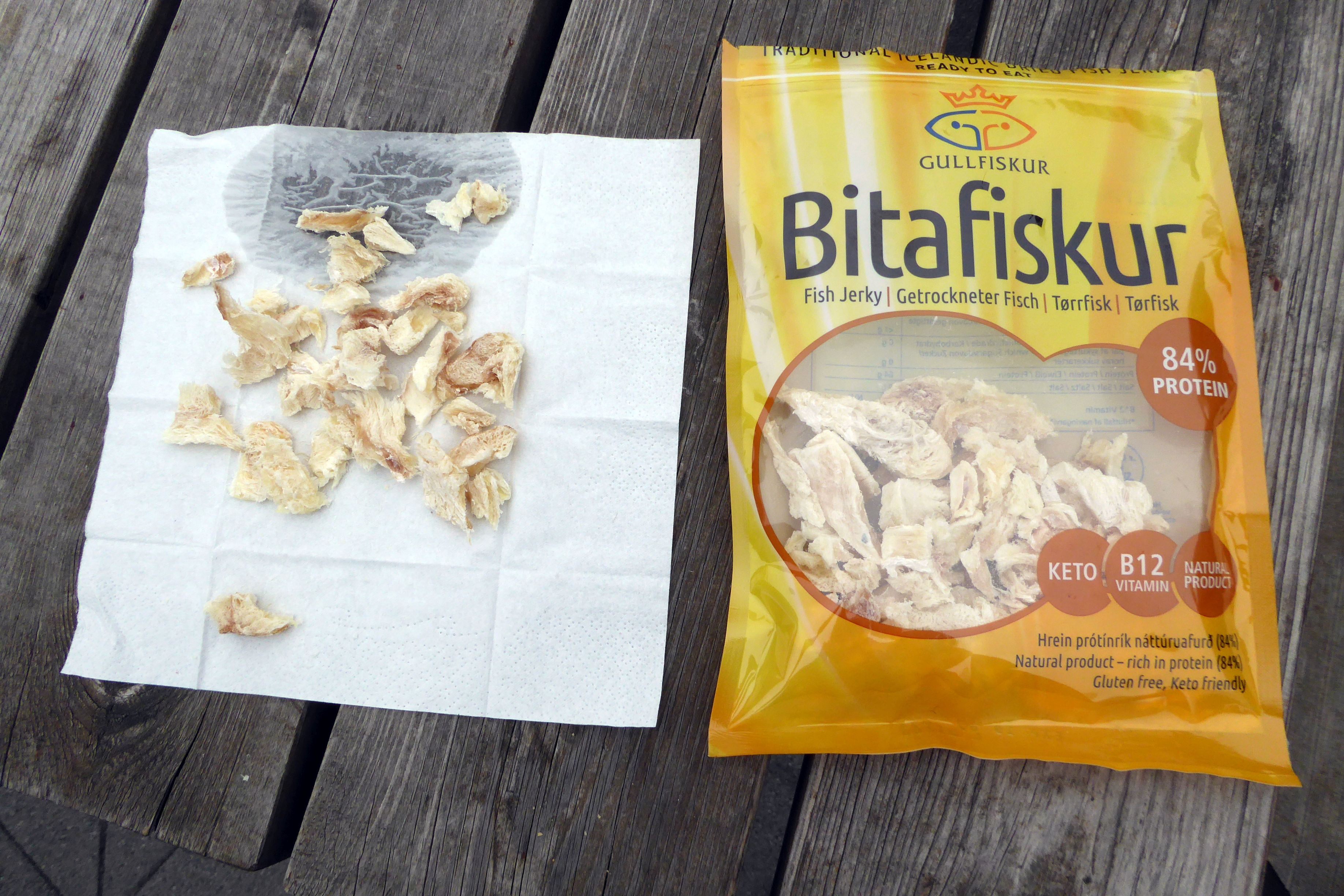
During one of our “comfort” stops, Thorunn bought some “treats” for us to try. This is fish jerky. We all tried some, and as you can see by what was left over, nobody went back for seconds…
I asked for seconds on this one; an Icelandic “biscuit” that was sweeter than a cracker, but not as sweet as a cookie. Yum!
I was interested to learn that many couples live together for several years before marriage, and women keep their name rather than taking on their husband’s name. I could relate to both; Bruce and I were together for six years before marrying, and I kept my family name.
There are no family names in Iceland; children take on their father’s first name as their last name. A boy’s last name of “Jonsson,” for example would mean his dad’s name is “Jon,” and he is Jon’s son. If Jon had a daughter, she would have the last name of “Jonsdottir.” (“Dottir” is how “daughter” is spelled in Icelandic.)
Icelanders are very supportive of gay marriage. The first one took place in 1996, and the country is very socially progressive and tolerant.
Families are tight-knit and well-supported in Iceland with good benefits. Paid maternity leave is six months, and paternity leave is three months. Leave can be taken all at once or split up into different time periods, so parents can alternate staying home with their children, if desired.
Health care is excellent and well-covered; Icelanders only pay $3 for a clinic visit; and, education is nearly free, including public universities.
I was interested to learn that Iceland does not have a military; however, the U.S. built a base near the national airport there during World War II for defense. It was quite controversial at the time, and the country was divided. Thorunn’s family lived near the base, so she shared stories about what it was like. There were some protesters, but others appreciated the job opportunities that were created as well as the infrastructure the Americans built. In 2006, the Americans left and turned the base over to the Icelanders.
Immigration is a big topic everywhere these days, so we were curious to hear about Iceland’s policies. Like the U.S., Iceland has taken in asylum seekers, mostly from Nigeria and Venezuela. In addition, people from the Philippines come to Iceland to get temporary work in healthcare, and there are many Polish people working in hospitality and construction. In all, 14% of Iceland’s population are immigrants.
Here’s a bit of recreation trivia I found surprising: Iceland has a greater percentage of the population playing golf than Scotland, even though the environment is generally ill-suited for it. There are 77 golf courses in the country! Handball is Iceland’s national competitive sport, and soccer, athletics, basketball, and tennis are also popular. Swimming is more of a leisure (rather than competitive) activity, as is ice, mountain, and rock climbing. Hiking and horseback riding are also very popular. (There are 80,000 horses with 80 different color variations in Iceland!)
Speaking of horses, Iceland has an interesting history! The Icelandic horse is a specific breed that was developed from ponies taken to Iceland by Norse settlers in the 9th and 10th centuries. These horses are typically small, hardy, and long-lived. Although they can be exported, once an Icelandic horse leaves the country, law prohibits it from ever being returned. As a result, there are very few diseases affecting Iceland’s horse population.
Historically, the Icelandic horse was intended to assist farmers with shepherding, but they are now also used for leisure, showing, and racing.
We stopped at a horse farm that neighbored the one we would be staying at for the night. This was one of their Icelandic horses.
Our bus driver, Haflidi, loves animals! This little guy followed us around to the stables where we had a tour and met some of the other horses.
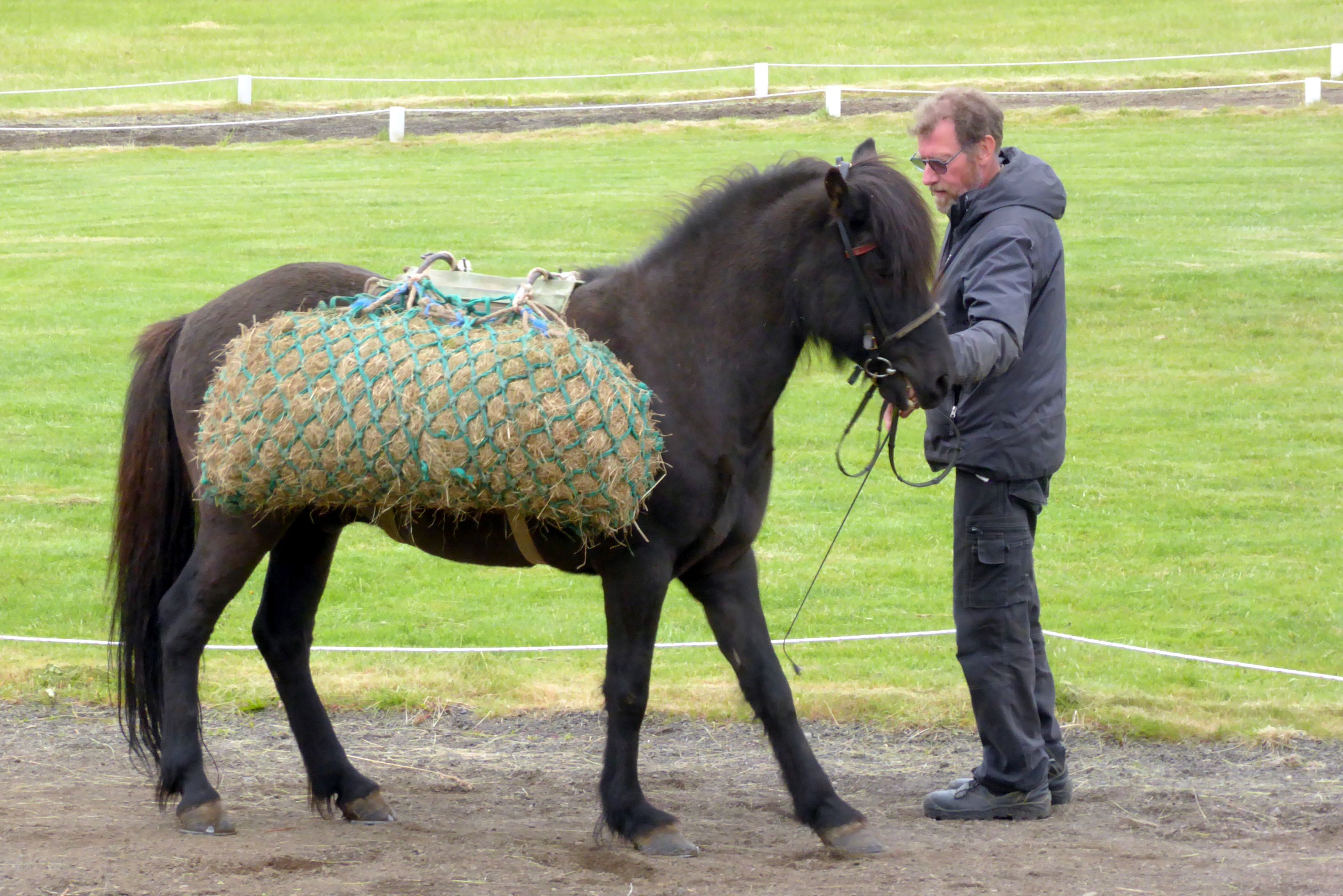
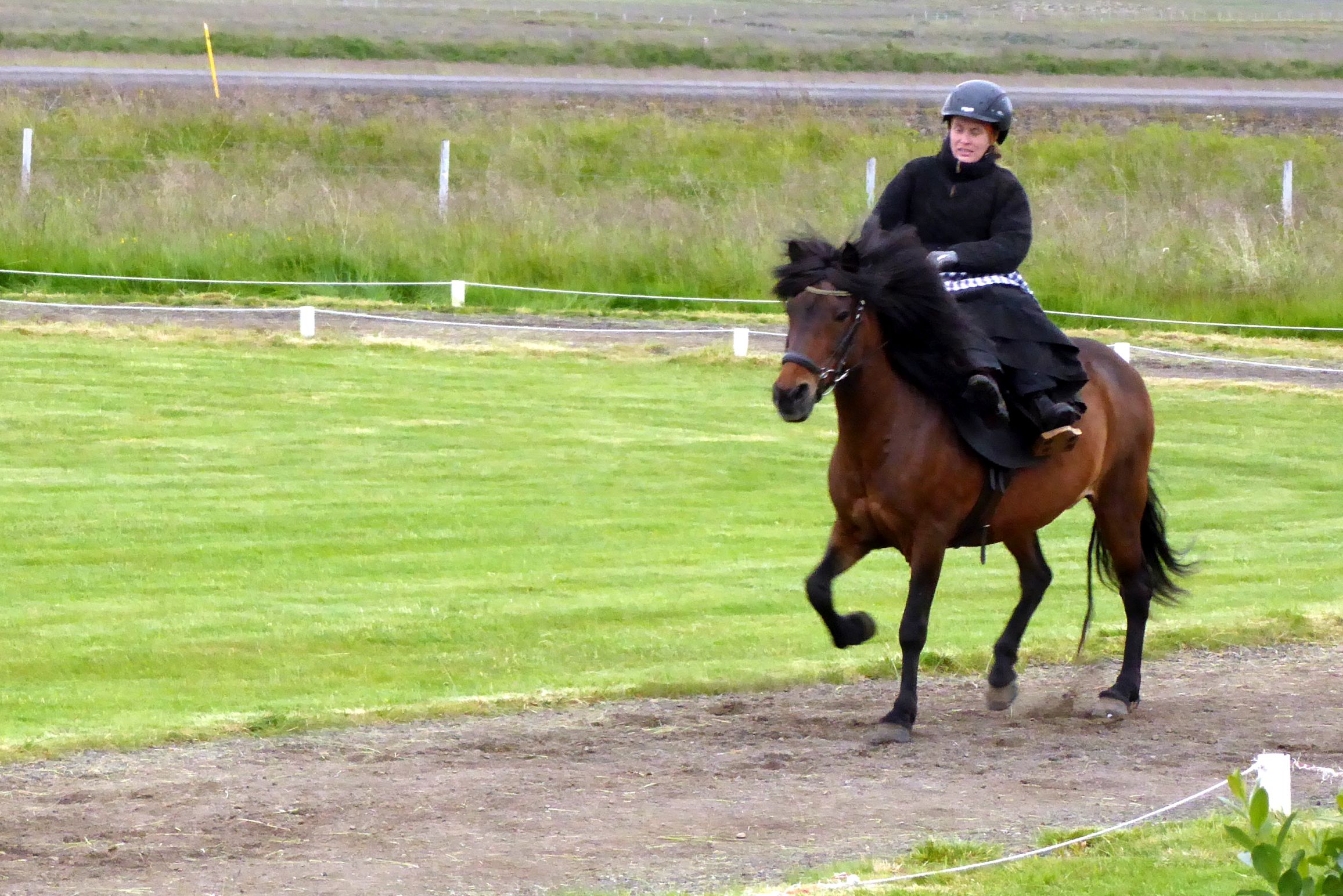
The most unique characteristic of these horses is their versatility of gaits. Not only can they do the typical walk, trot, and canter/gallop; but, they can also tolt and flying pace. We got to see these gaits in action at a horse show while staying at Daeli, a family-run horse farm and guest house. (They also had a fabulous chef. Our meals there were delicious!)
This is the father of the family running the horse farm He assisted with the horse show. His daughter-in-law trains the horses and demonstrated the various different gaits.
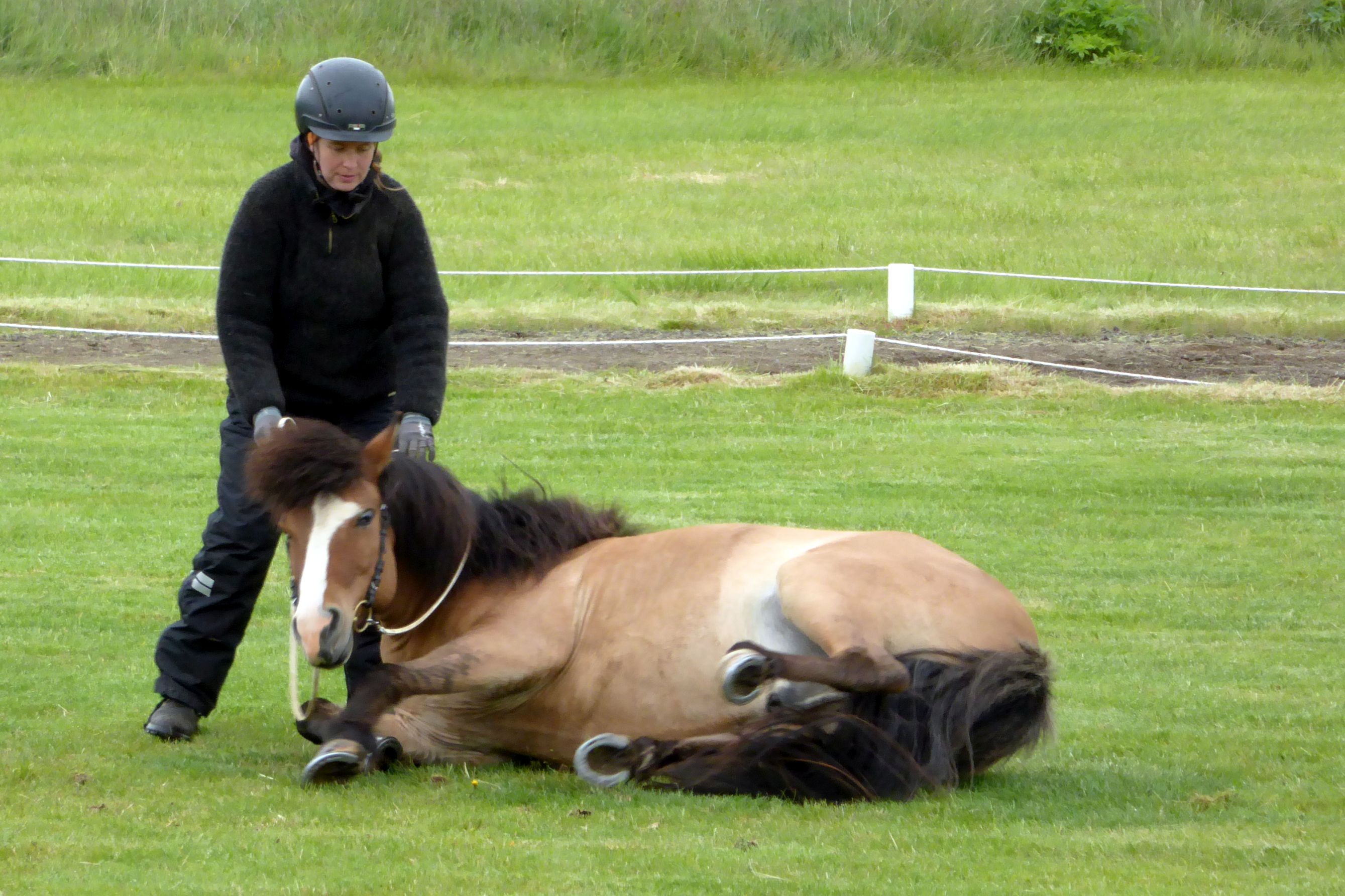
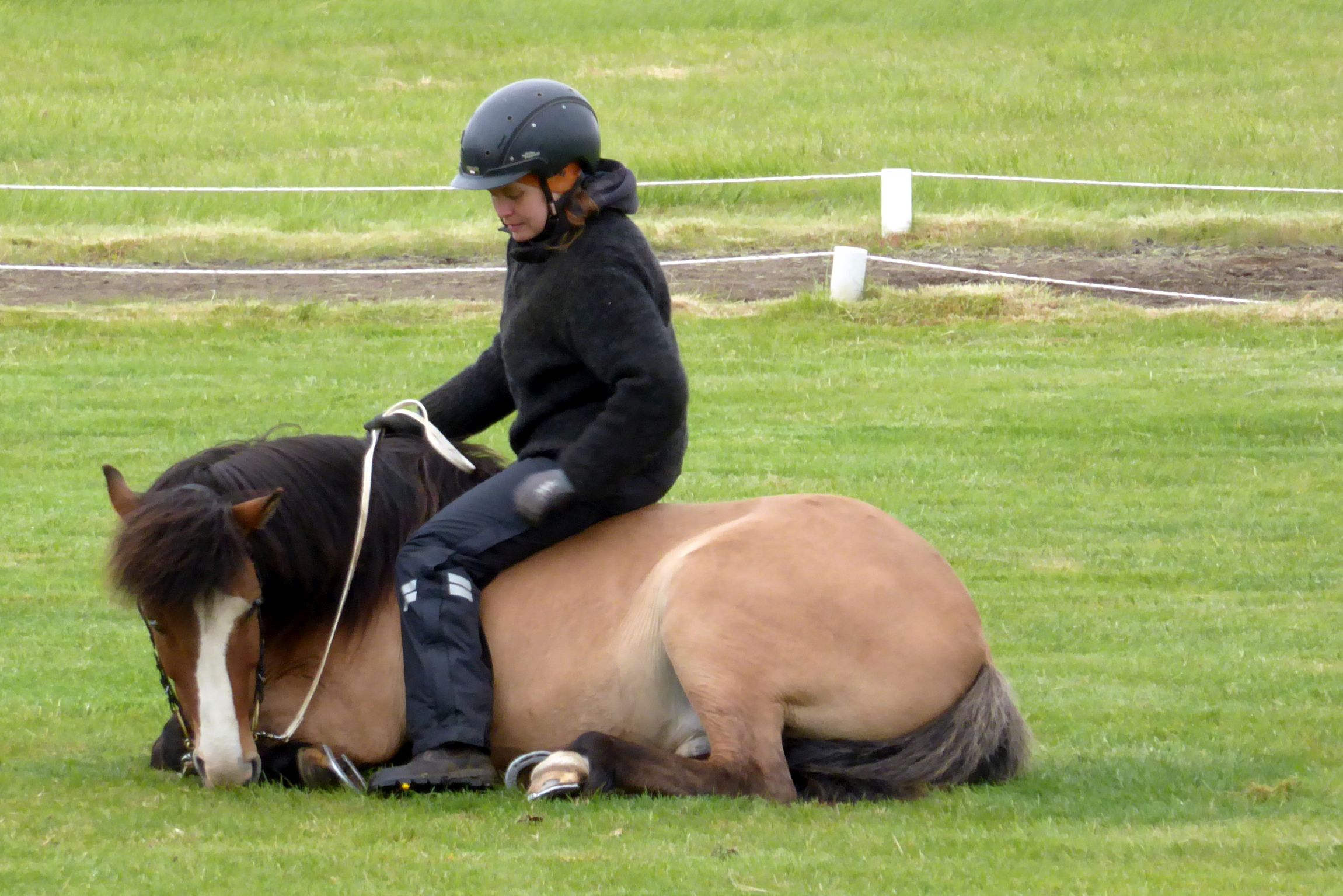
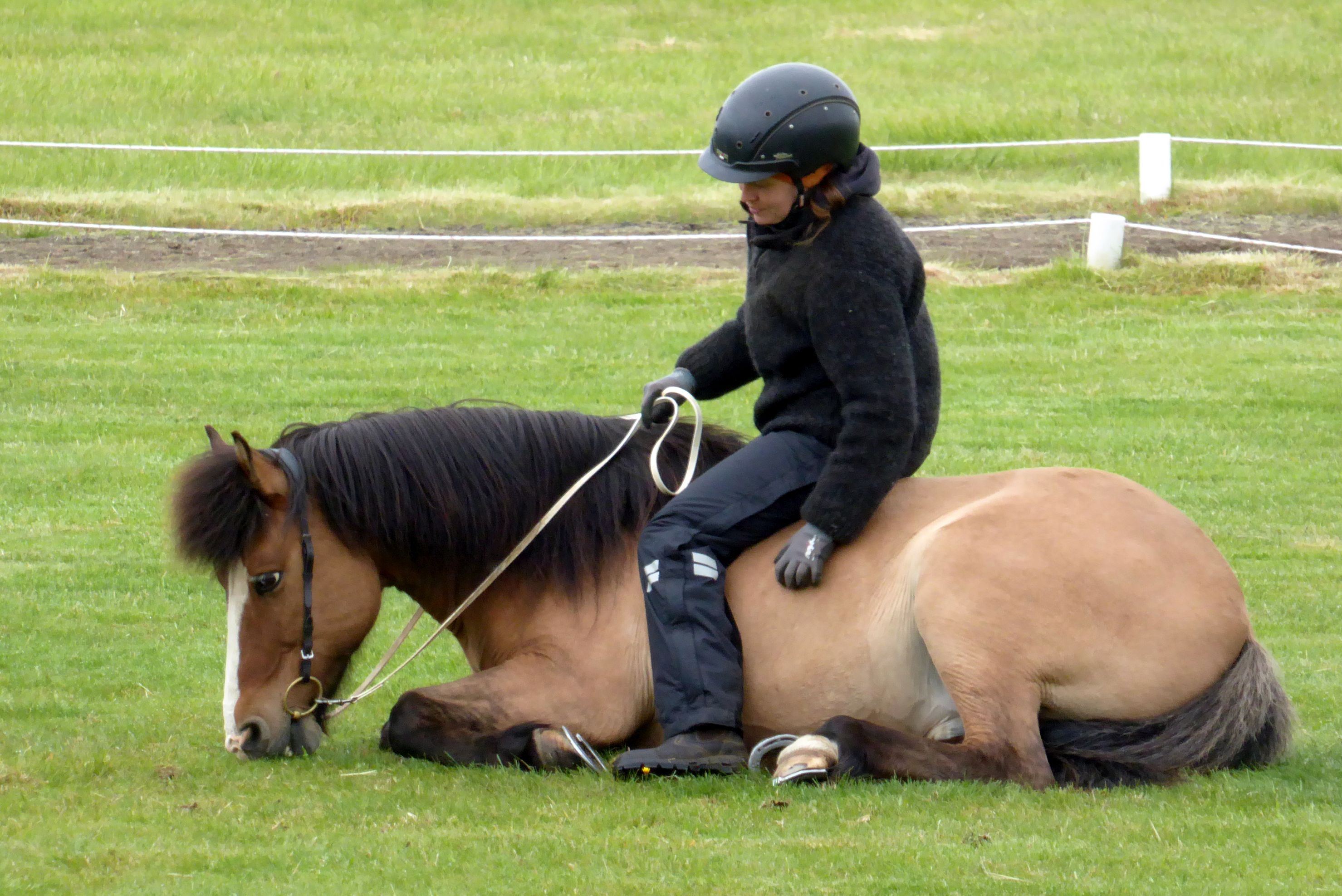
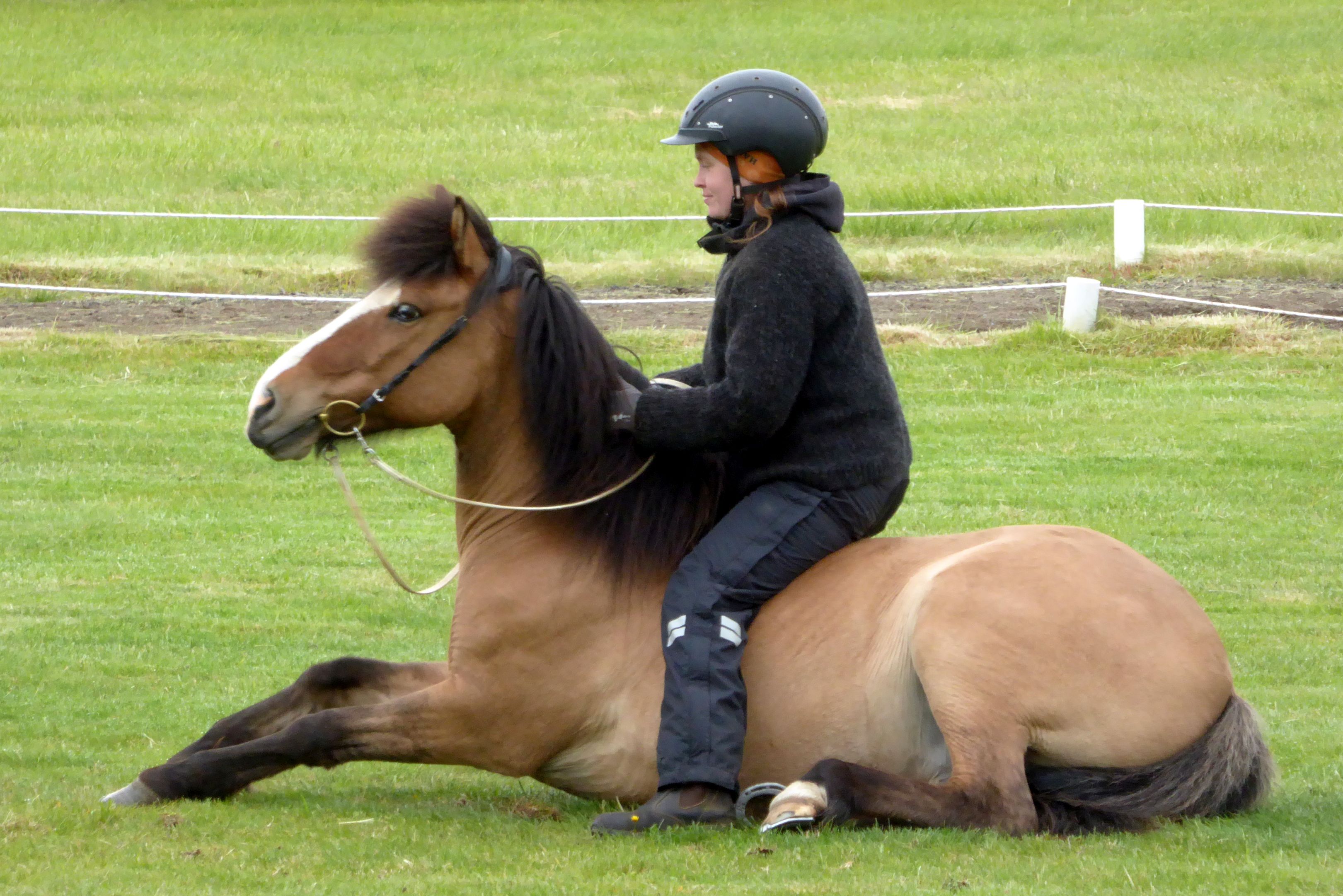
This may have been an easy way for her to mount the horse, but it was much more difficult for the horse!
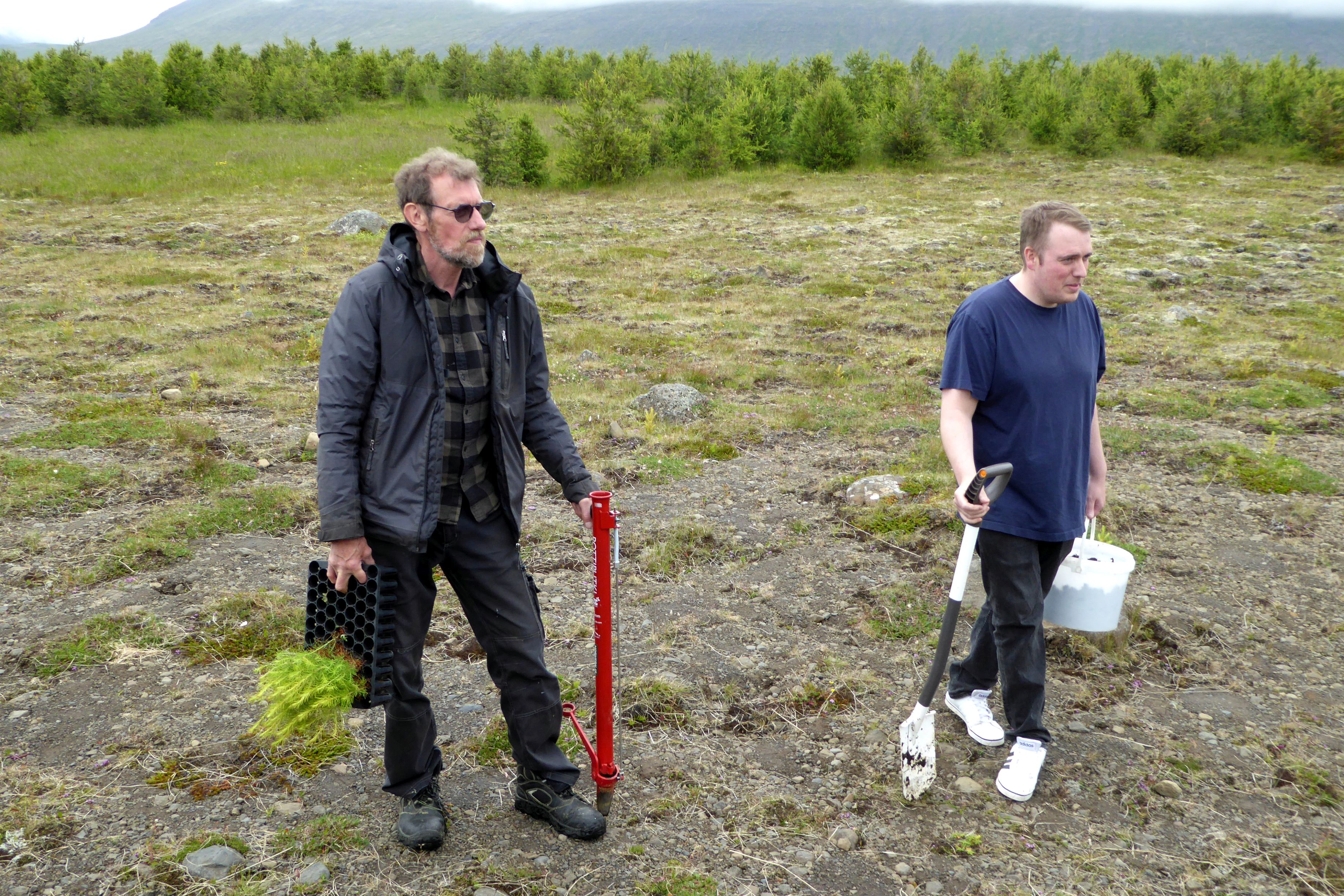
In addition to learning about what is involved in raising and training horses on their farm as well as the neighboring farm we visited, we took a short ride up the hill to see where the family has been contributing to a reforestation project. Each of us planted a tree; our tiny contribution to the effort.
In all, we came to know what a day in the life of an Icelandic horse farm was like for those who make it their living. It’s a lot of hard work!
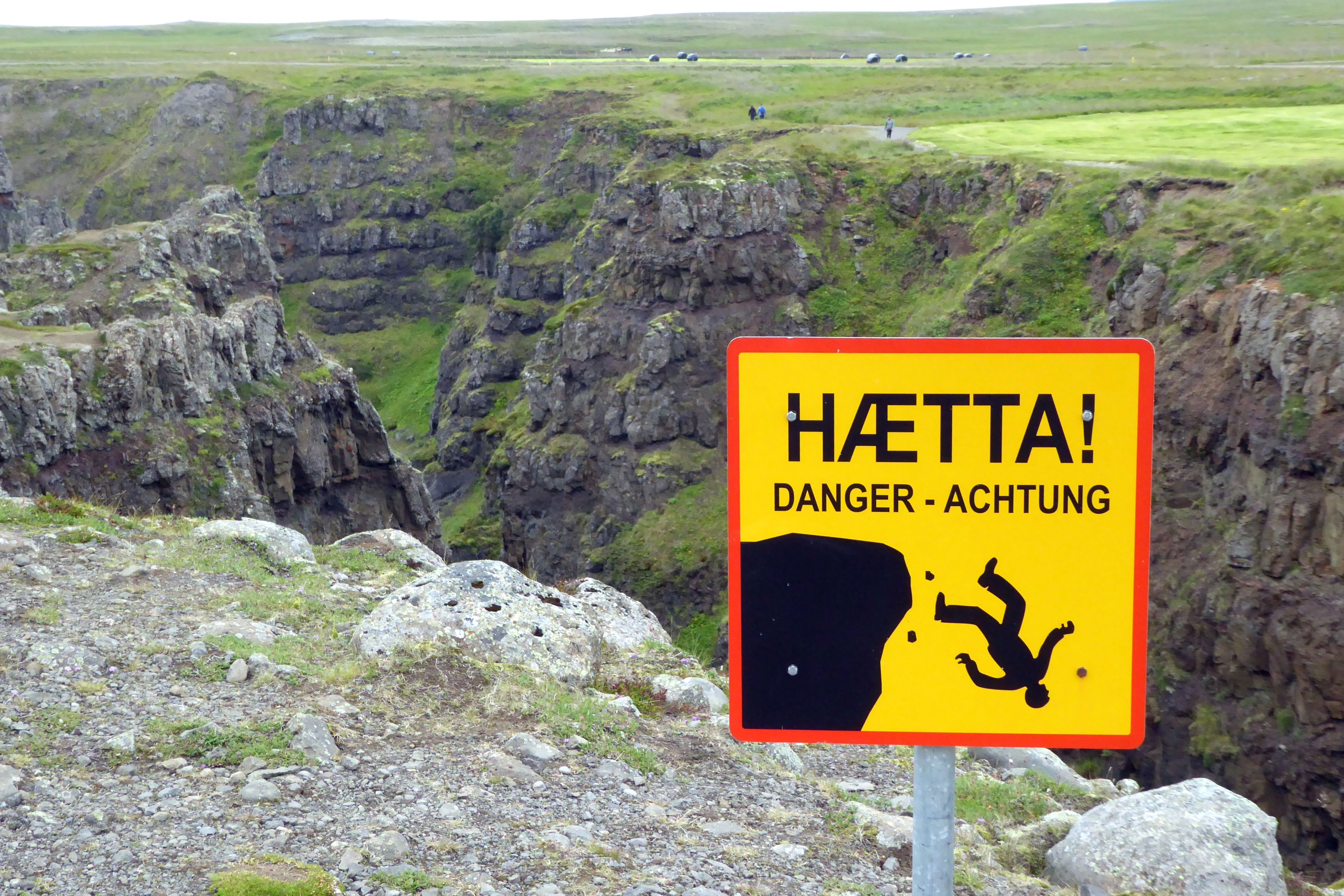
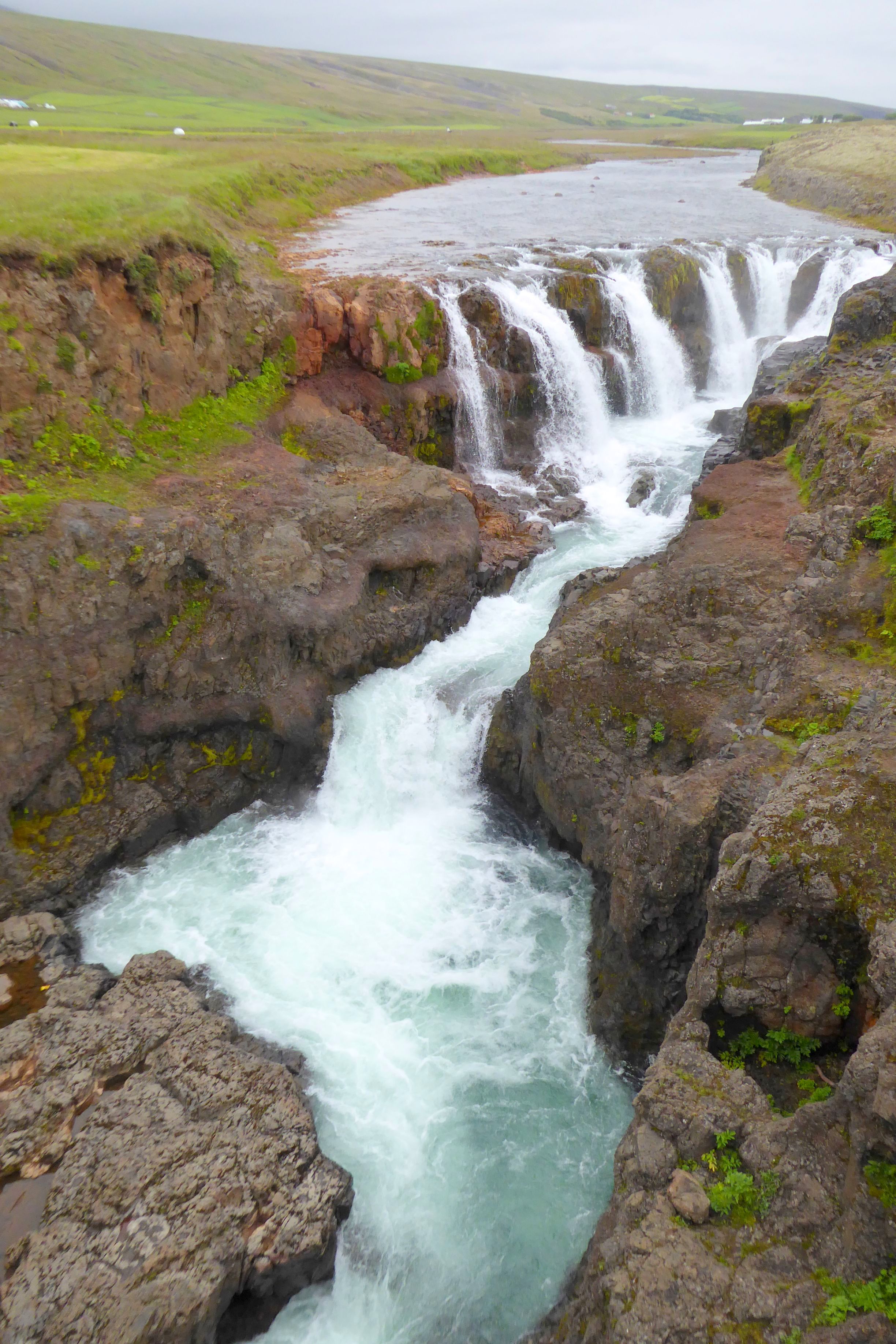
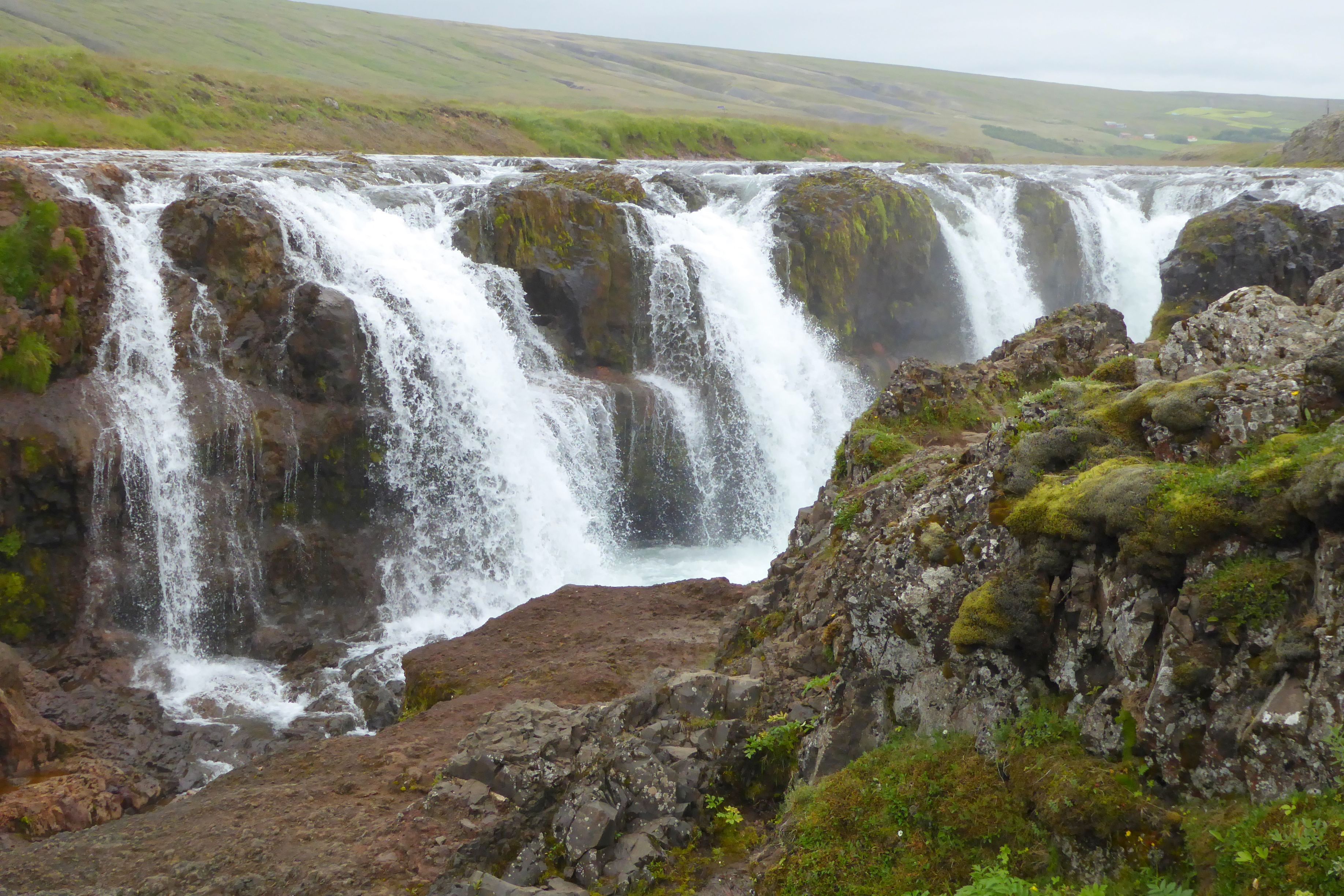
During the afternoon, we took a short drive from Daeli to see Vididalur Waterfall and hike around on the paths and volcanic rock. Gorgeous!
Our stay at Daeli was so enjoyable and memorable!
Coming up next: North Iceland Near the Arctic Circle
Note: If small group travel is of interest to you, I highly recommend Overseas Adventure Travel (OAT). Although Bruce and I travel together, they do not charge a single supplement for those who travel on their own. Singles also get their own room at hotels. If you book, you can get $100 off your trip by providing my name and customer number (Elaine Krugman, #3018126) as the person who referred you. I will also get $100 off future travel– a win-win!
After having four days of sunny and warm (for Iceland) weather, our luck ran out. We knew it would. It had to! We had fabulous weather during our Canadian Rockies trip last summer as well as in Italy this past April. The same good weather continued during our Utah National Parks trip in May. For this trip to Iceland and Scotland, we knew it would be expecting way too much for more of the same, so we were prepared.
Although we haven’t checked in luggage since prior to the Canadian Rockies trip (carry-on backpacks and roll-a-boards have become our standard travel choice), we were still able to travel with warm and waterproof gear with room to spare (for chocolate!). That gear came in handy on this cold, gloomy morning on the Snaefellsnes Peninsula.
We visited the entry point to Jules Verne’s Journey to the Center of the Earth, a 1959 science-fiction movie I never saw. A glacier-peaked volcano, volcanic rock formations, and black-sand beaches are features of this area, and there is also a beautiful brown-sand beach that we visited.
Along the way, we stopped at what was supposed to be a panoramic viewpoint; however, the clouds and smoke from the erupting volcano obscured the view. I opted to make a beeline to the cute sheep grazing near the road.
(For all pictures, click on the image to see full screen view.)
To get to Budir Beach, we walked past a lovely little church and through the Budahraun lava field. Off in the distance, we could see the glacier and a handful of waterfalls pouring down the volcanic mountain. It was so quiet and peaceful; nature at its best!
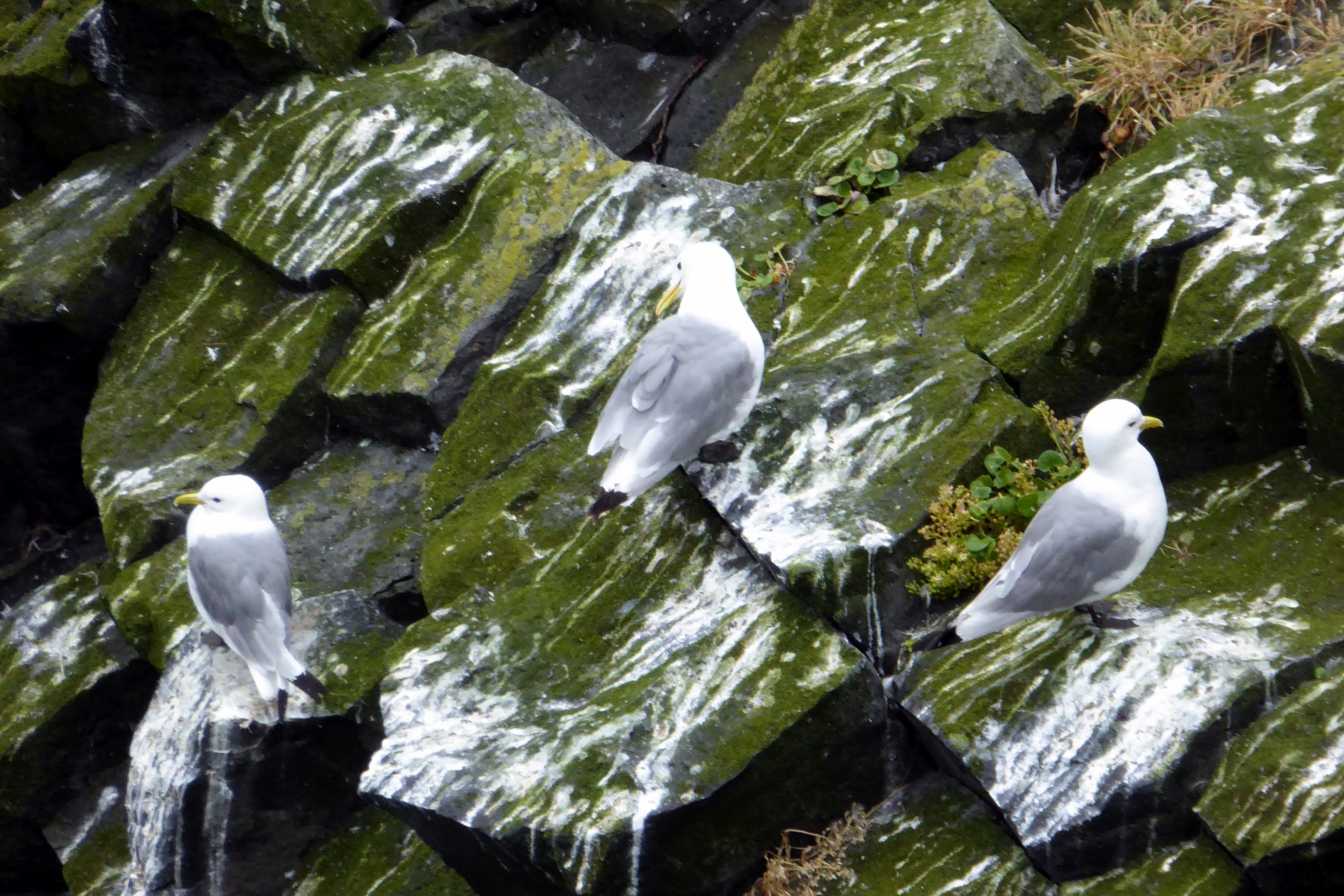
My favorite part of the day was the four-mile coastal walk we did to see the bird cliffs full of nesting birds, lava fields, and black sand beaches. I felt like I was walking through a National Geographic documentary! It was so amazing to see so many birds perched in the crevices of huge volcanic rock formations and to hear their chirping and squawking.
The walking trail started at this little harbor.
It wasn’t until we arrived at a viewpoint at the top of the cliffs that I realized I had left my spare camera battery in my backpack on the bus, and my battery was about to die. This is the only shot I was able to take of this cute mom and baby, which turned out a bit out of focus:
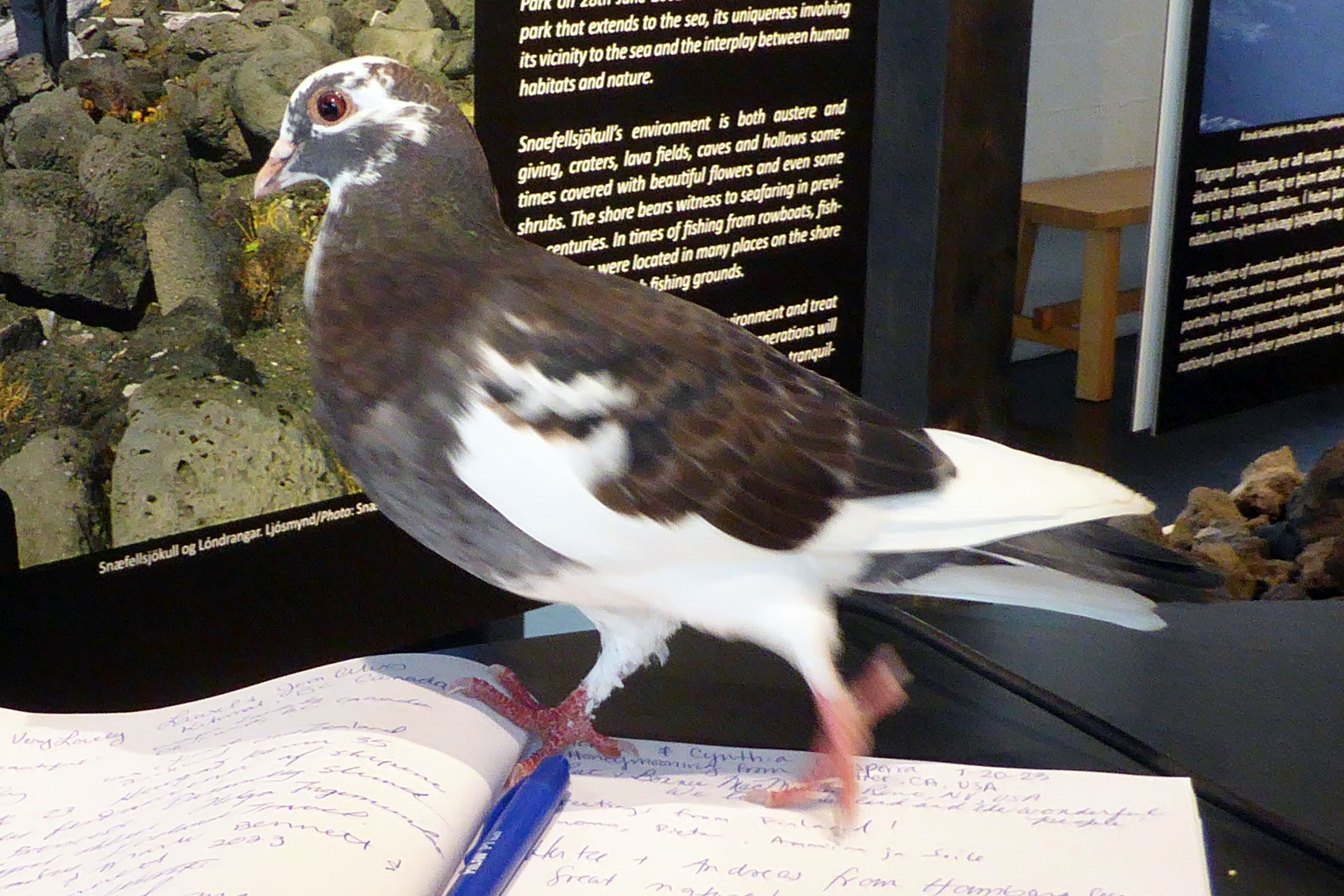
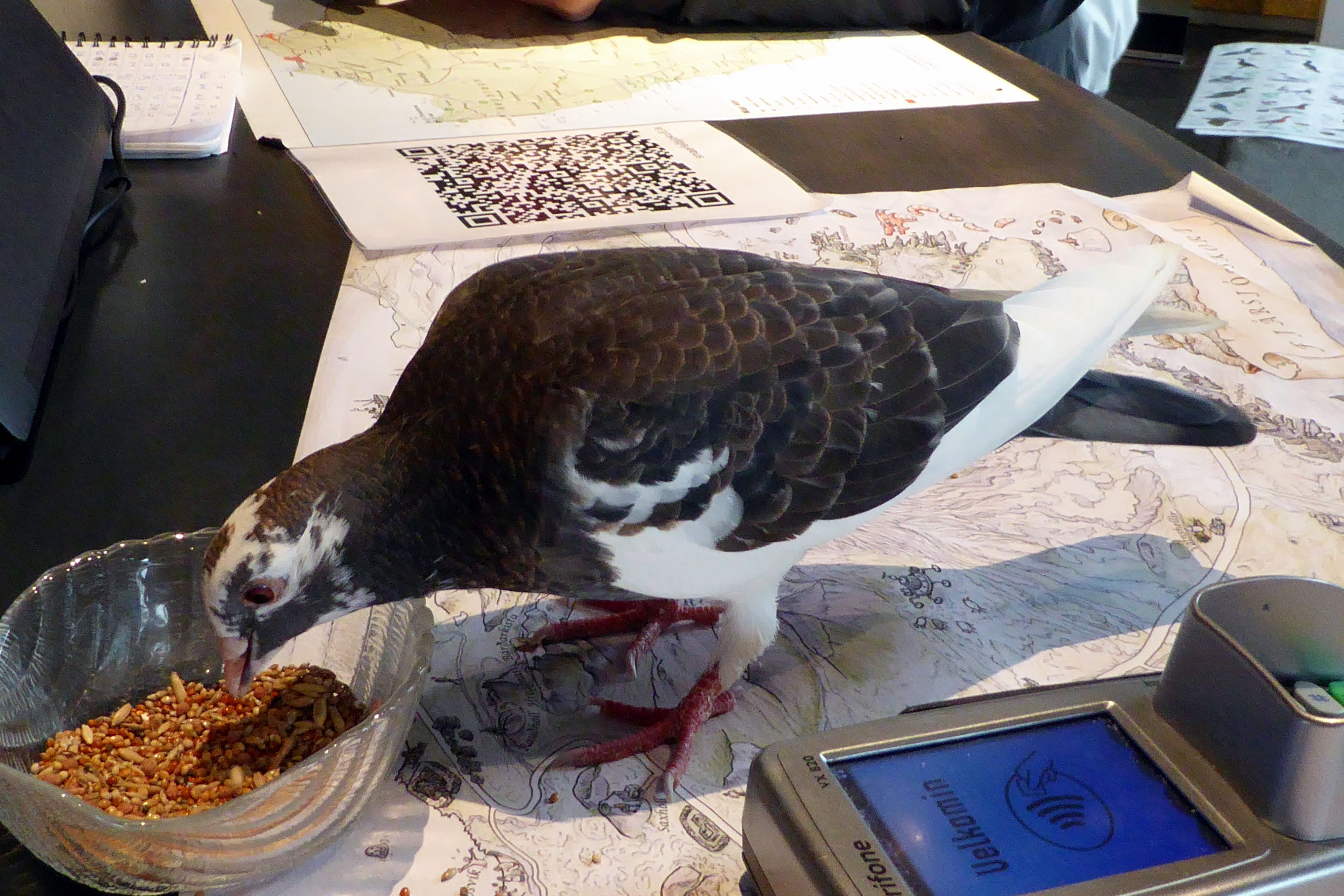
Fresh battery in camera, we stopped at the park’s visitor center and were greeted by this little guy acting like he owned the place! He (she?) flew in one day, and has been visiting on a daily basis ever since. As soon as they open the front door, he swoops in and takes over the reception counter. The staff members think he may be somebody’s pet that got away, because he is so tame and will eat out of your hand. They are hoping to find the owner soon, but if they can’t, he sure seems to be happy in his new home!
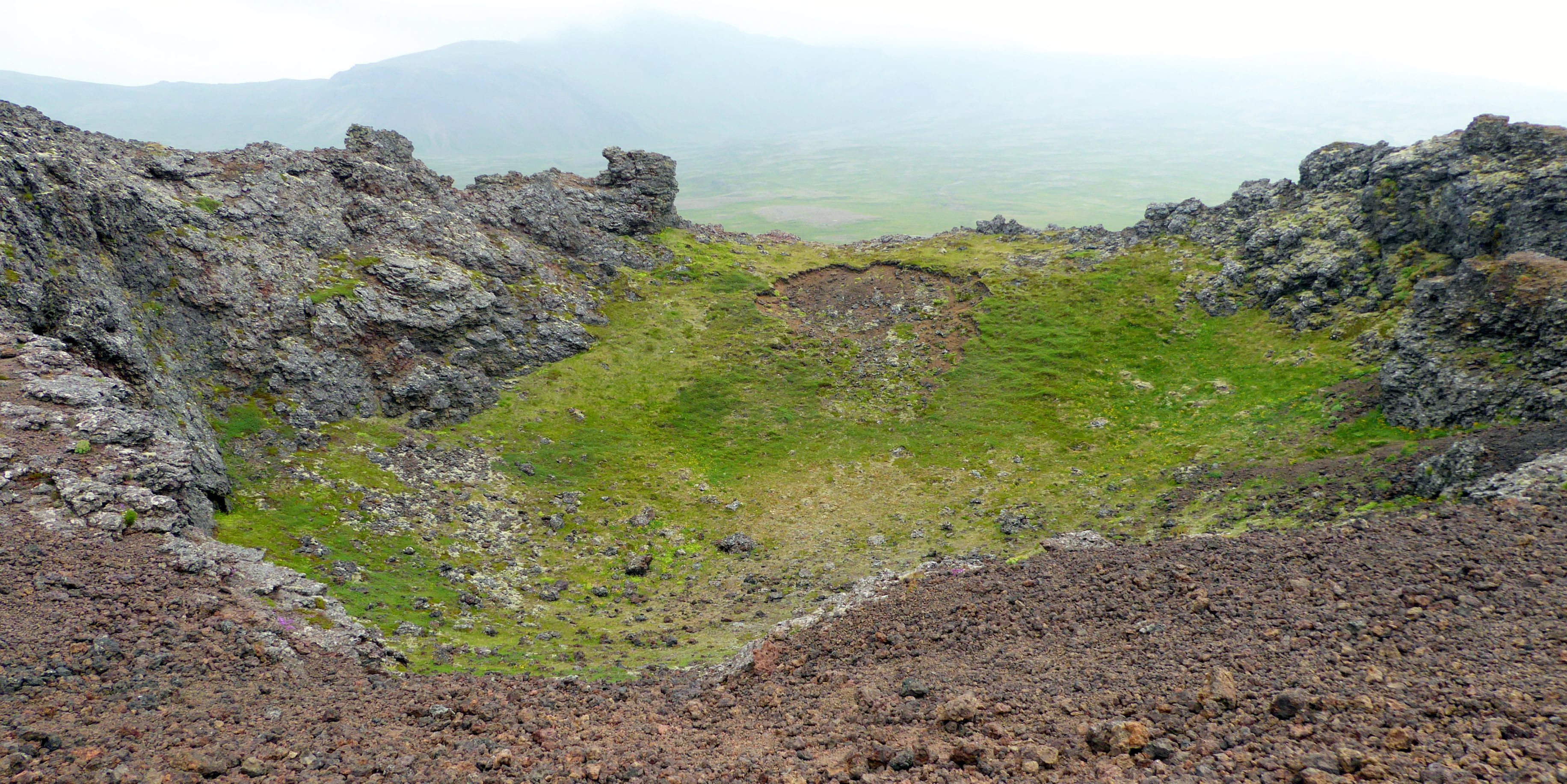
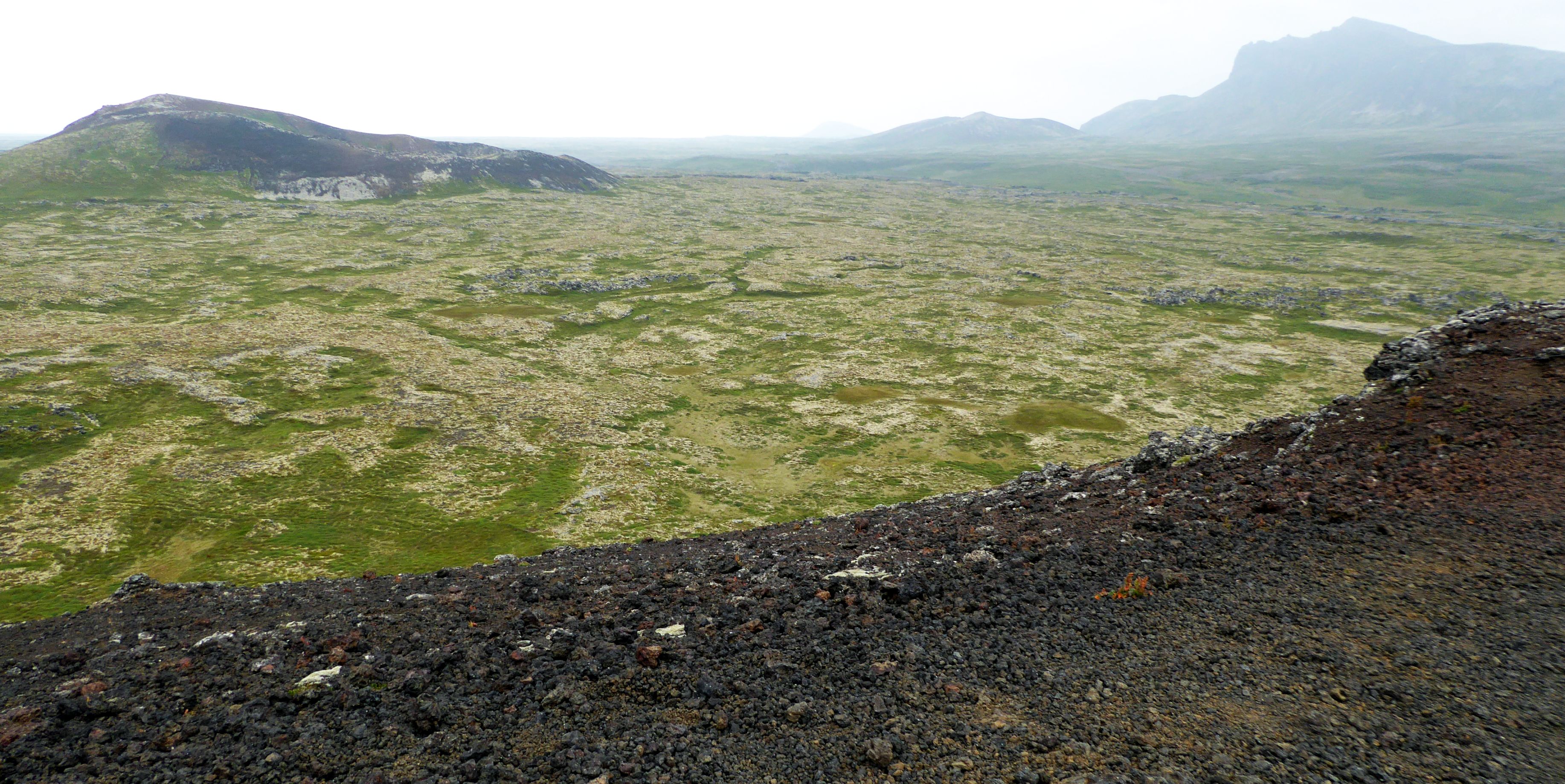
Our final stop was to hike up to Saxholl Cratervia the Saxholl Stairway. The top of the crater is 130 feet high, and the award-winning metal stairway was built to prevent further erosion of the crater from hikers. The 525-foot stairway of 384 steps wraps around the side of the crater and was constructed in modules in such a away that it can be removed without leaving permanent traces. The hike up was invigorating, and had it been a clear day, the view down into the valley from the top would have been spectacular! The erupting volcano had caused the sky to fill with smoke, however, so the conditions weren’t best for photography. Still, I can’t complain; at least it wasn’t raining!
Back in Stykkisholmur, the afternoon was free, so I took advantage of the pool, which I could see from our hotel room window, just across the small park. Swim caps in hand to give away to the locals, I was off! Check out the water slide in the link above. It was beckoning me after my swim workout, and I hadn’t ridden on one since visiting a water park as a kid. I gave it a try, and it was terrifying and fun at the same time! It’s not the best thing to do repeatedly when you have Meniere’s, but I couldn’t resist taking a second ride. After that, I was definitely DONE.
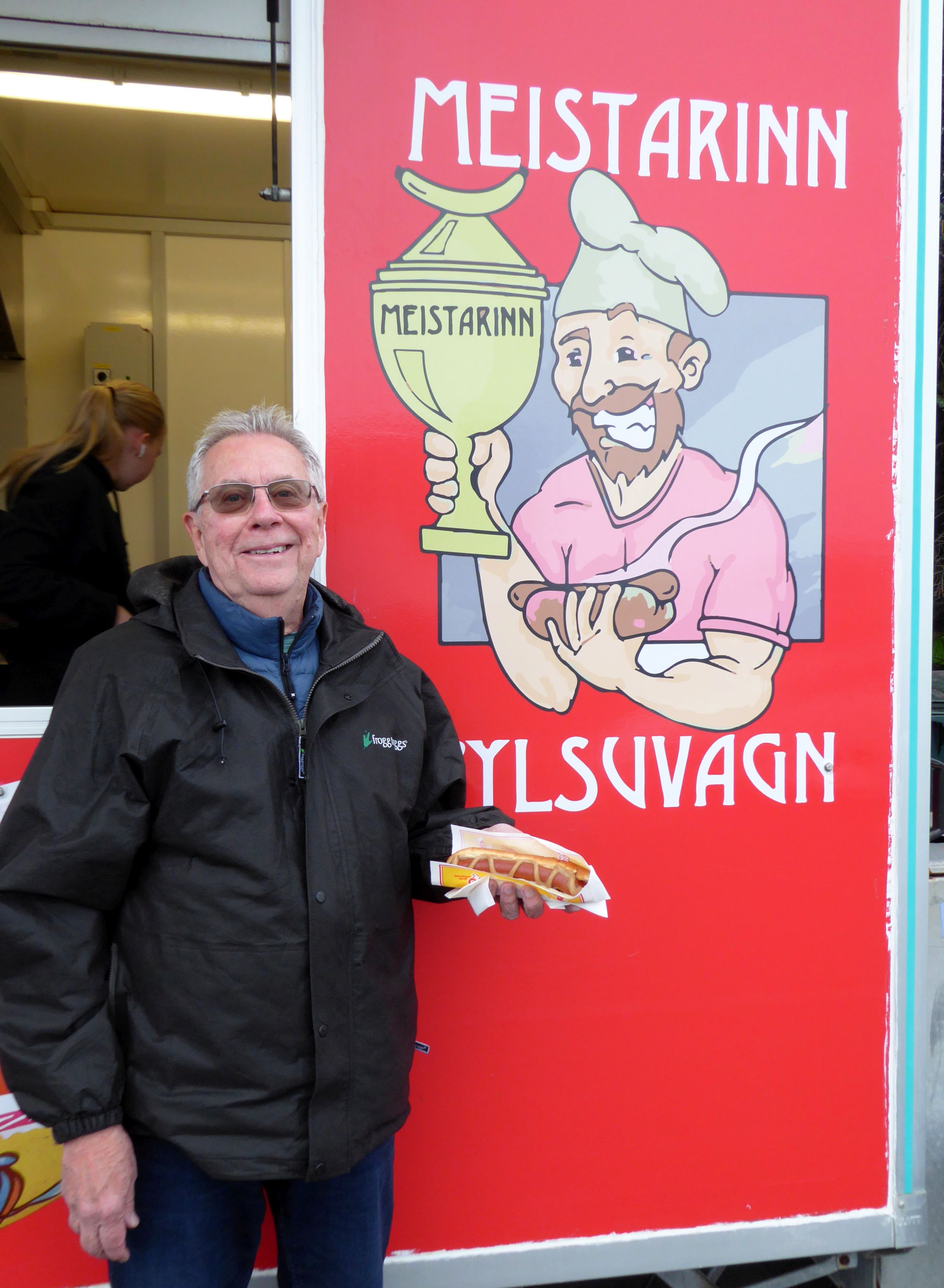
Dinner was on our own, so Bruce and I walked over to the hot dog stand after my swim. As a pescatarian (for the most part), I eat meat and poultry as little as possible; however, I had to give this Icelandic thing a try. Yes, Icelandic hot dogs, called pylsa or pulsa in Iceland,have reached cult status.
This is what makes these dogs different: First, the main ingredients are a combination of (mostly) locally-sourced lamb, beef, and pork spiced with a unique blend of spices. Icelanders like to tout their lamb as being the best (just like the Kiwis do in New Zealand). They graze freely on lush, open farmland; and, the meat is organic and high quality.
The key to properly cooking these dogs is in the timing, so they are firm to the touch and snap when biting into them..
As for the toppings, well, they are interesting! Although hot dog stands offer all sorts of different topping combinations, the iconic Icelandic dog must be ordered with “everything” on it, at least the first time you try one. This includes fresh and fried onions, ketchup (made with apples and tomatoes for a sweet and tangy flavor), Icelandic sweet brown mustard (“pylsusinnep”), and remoulade sauce. All of this is loaded into a warm, fluffy steamed bun.
Sound gross? I thought so. Was it good? Yes! Meistarinn’s dog was so good that we went right back to the window to order another round. (As a side note, we can’t say the same Baejarins Beztu Pylsur in Reykjavik. They may have been the first hot dog stand in Iceland, and President Bill Clinton helped make it famous by eating there, but they aren’t the best in our book. The dogs we were served were luke warm, and the toppings were not as flavorful. We passed on ordering seconds).
Given the high cost of eating out in Iceland, the 2720 ISK ($20) we spent on four hot dogs for the two of us was a bargain. Besides, it was fun, and a very Icelandic thing to do!
Coming up next: A Day in the Life of an Icelandic Horse Farm
Note: If small group travel is of interest to you, I highly recommend Overseas Adventure Travel (OAT). Although Bruce and I travel together, they do not charge a single supplement for those who travel on their own. Singles also get their own room at hotels. If you book, you can get $100 off your trip by providing my name and customer number (Elaine Krugman, #3018126) as the person who referred you. I will also get $100 off future travel– a w
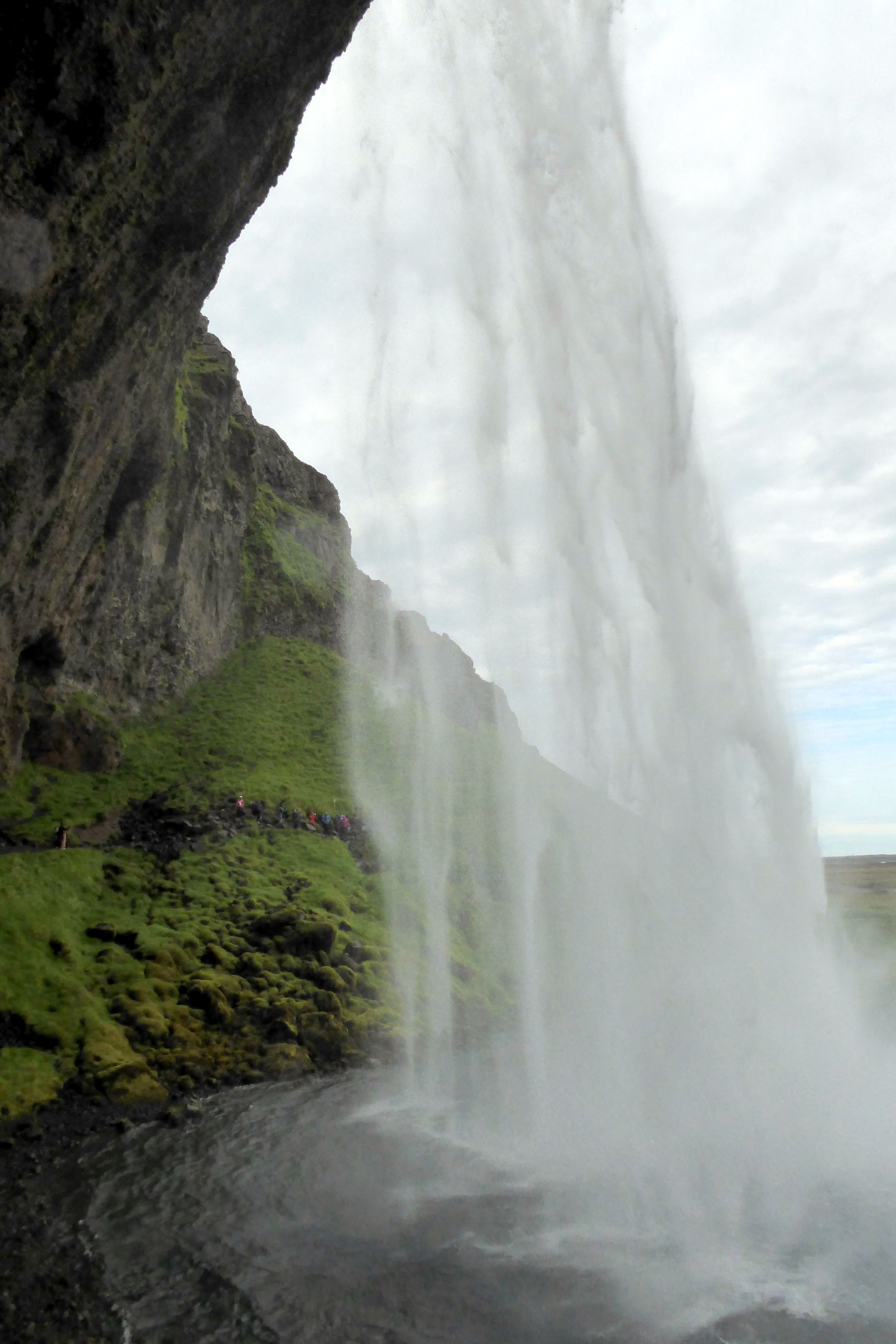
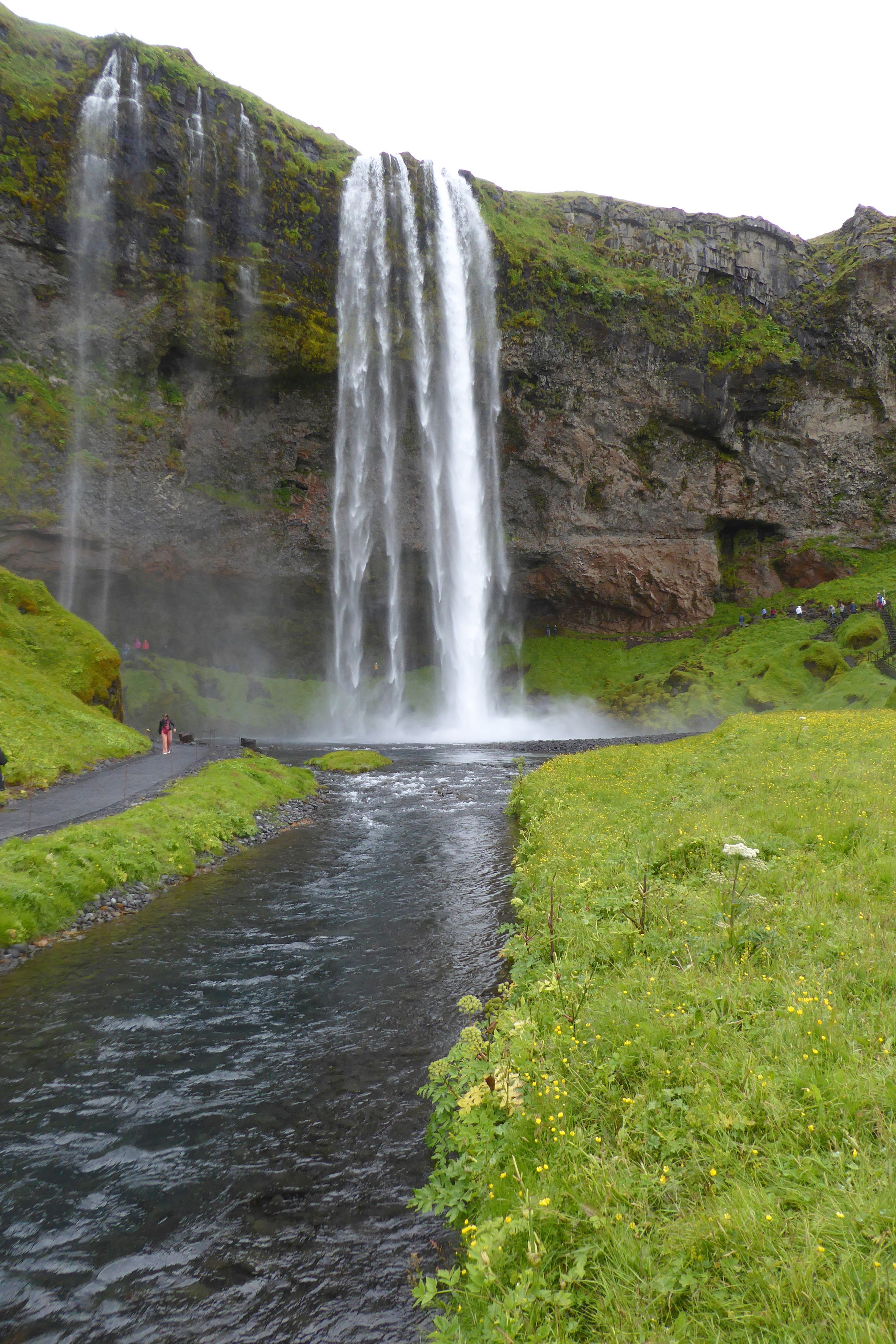
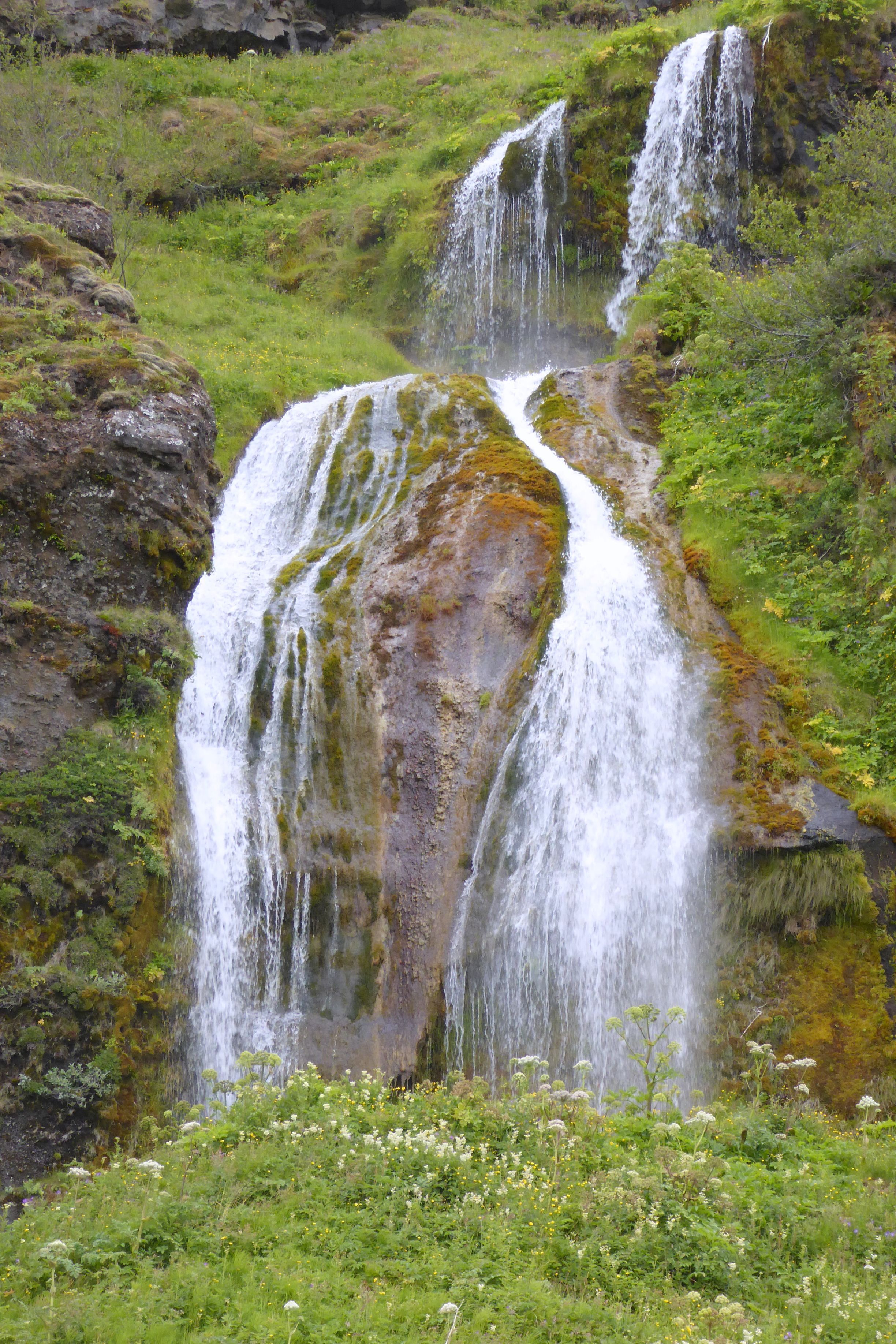
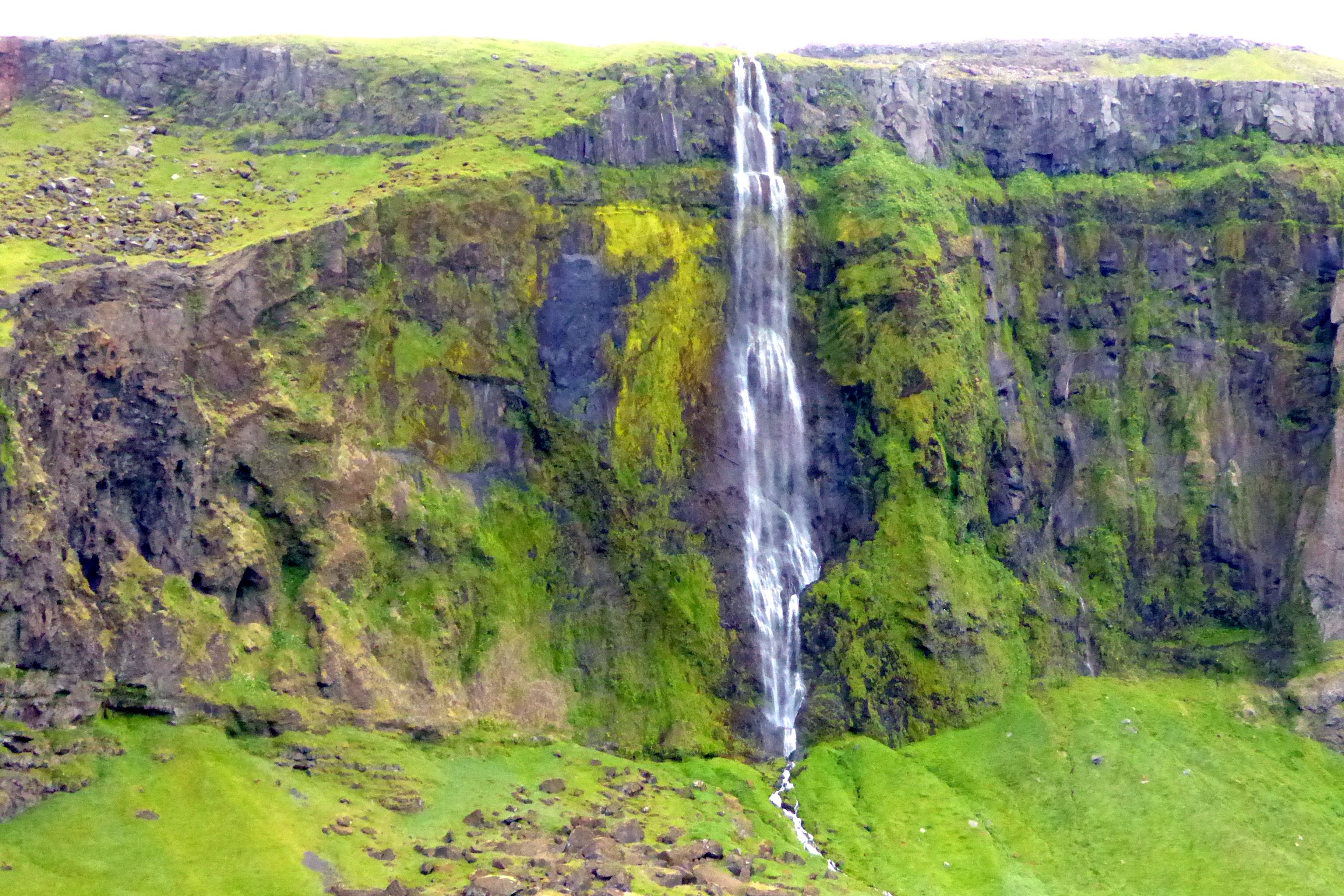
Another day, another beautiful waterfall! I love waterfalls, especially hearing the powerful sound of rushing water. It is truly mesmerizing and relaxing for me. Seljalandsfoss Waterfall, situated along Iceland’s Ring Road, was much smaller than Gulfoss, but I thoroughly enjoyed the short hike up to it and being able to walk behind it. Yes, I got wet from the spray, but I’m a swimmer! I love getting wet!! Everybody who braved the icy water to walk behind the waterfall and come out the other side came out laughing. It was fun! There were also a couple of other waterfalls nearby, and they were gorgeous. It was a very enjoyable first stop of the day!
(For all pictures, click on the image to see full screen view.)
By now, I was getting quite wet from the spray!
was standing on a small bridge, enjoying the view of where I started my hike (on the right) to the path (on the left) where I came out wet and cold. It was worth it!
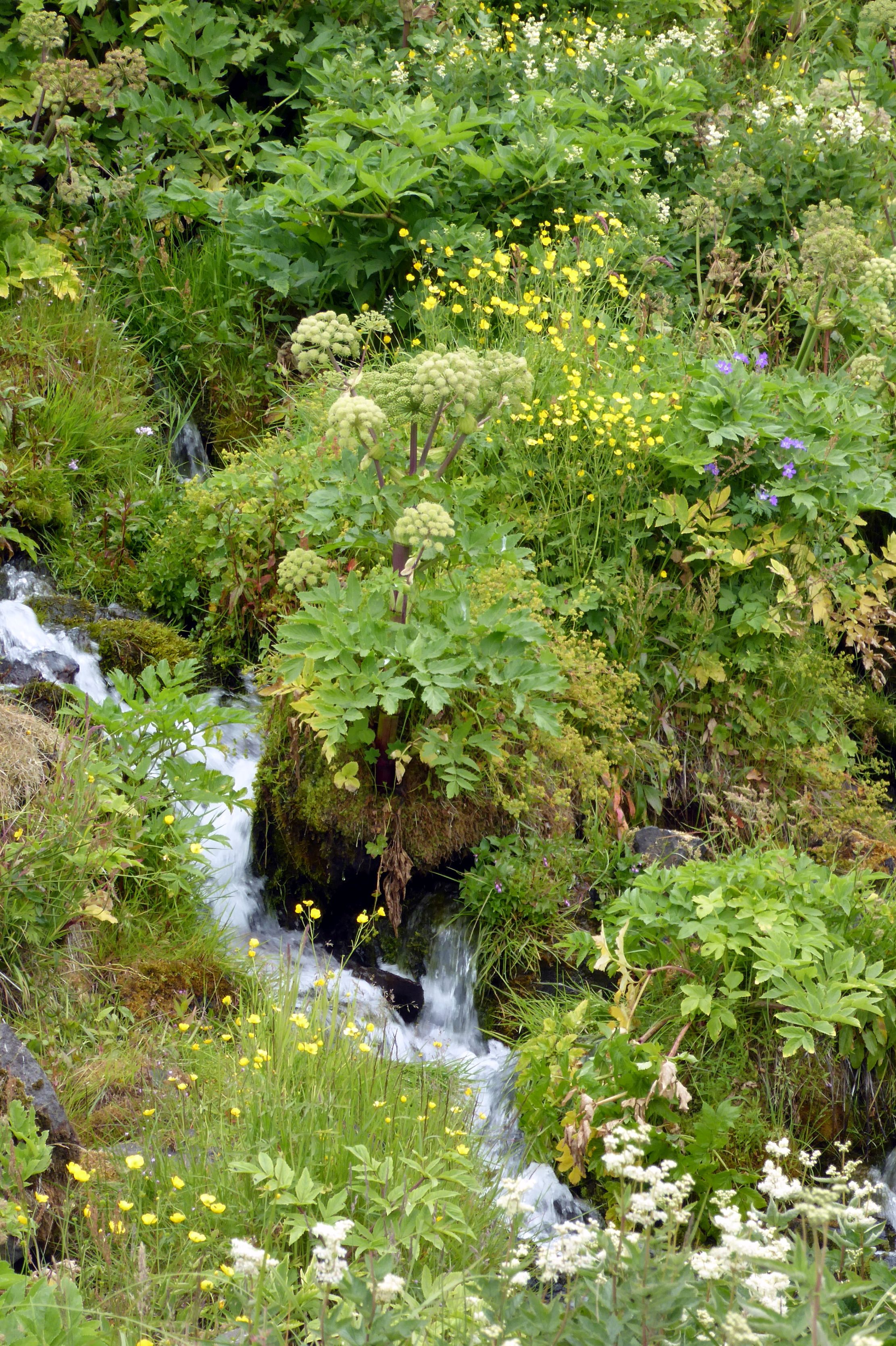
There were so many pretty wildflowers in bloom; a nice surprise!
Cottongrass
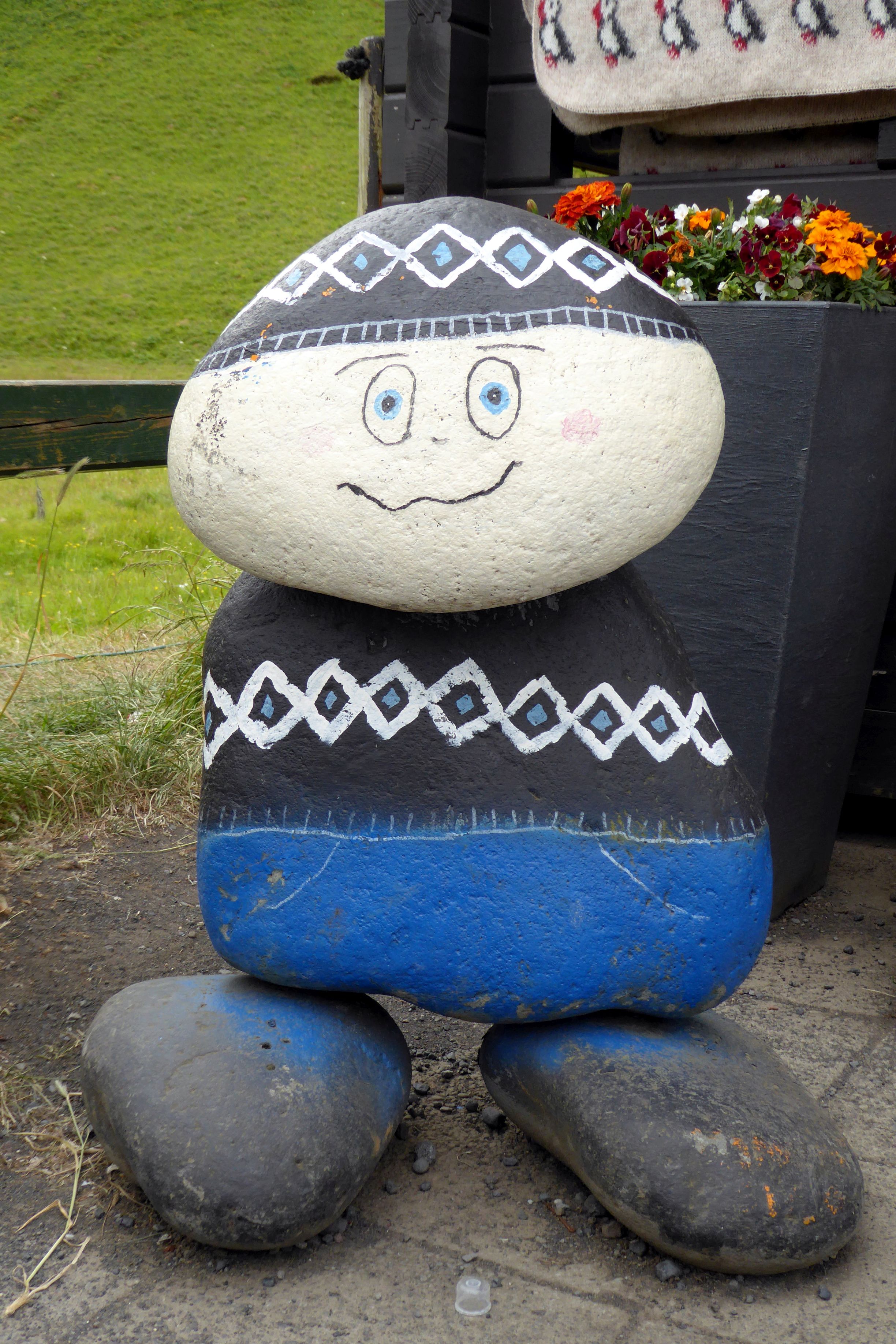
Standing guard in front of the wool shop near the waterfalls.
Views from the bus on our drive to Dyrholaey Cliffs.Our next stop, Dyrholaey CliffsBruce suggested shooting it in black and white.
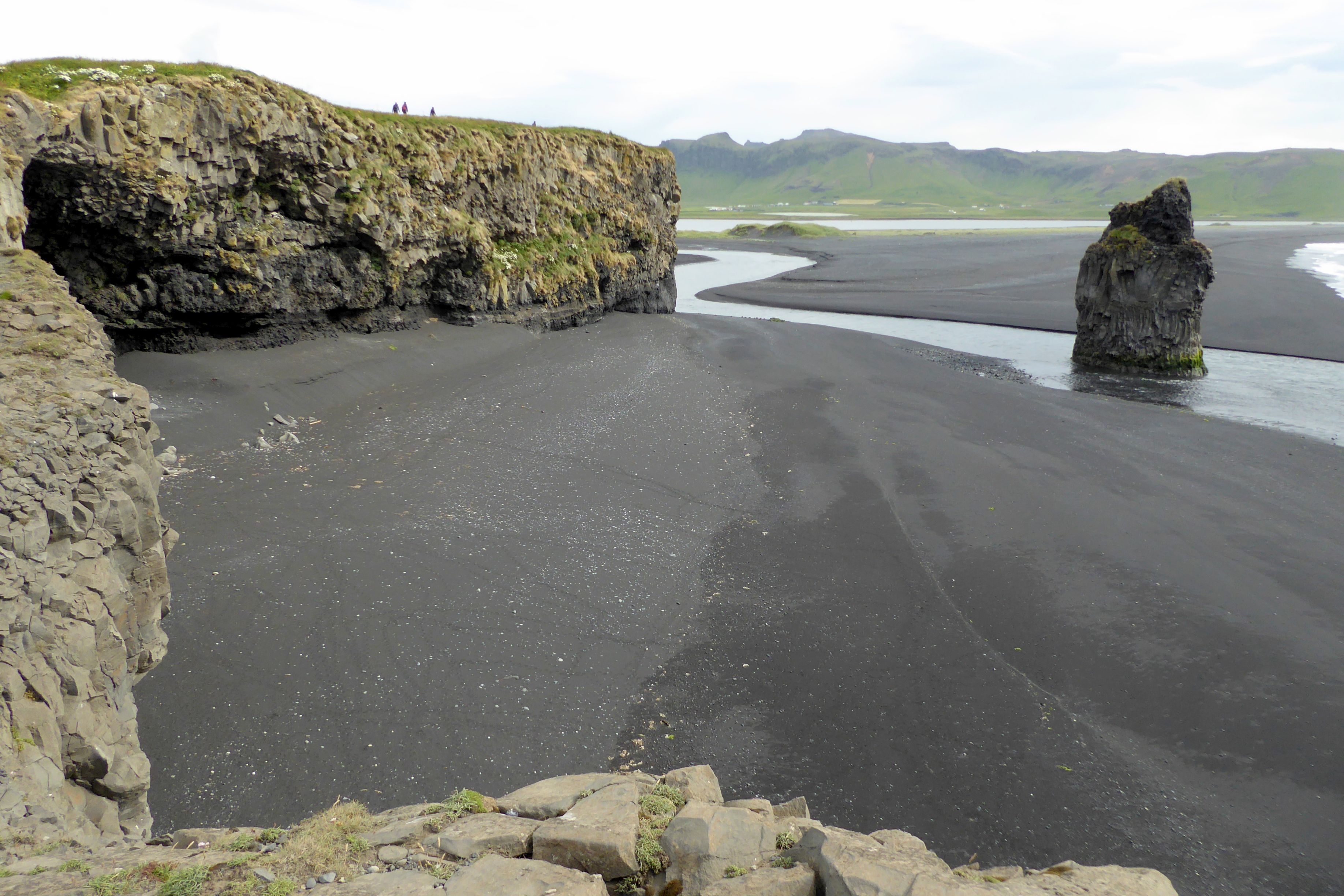
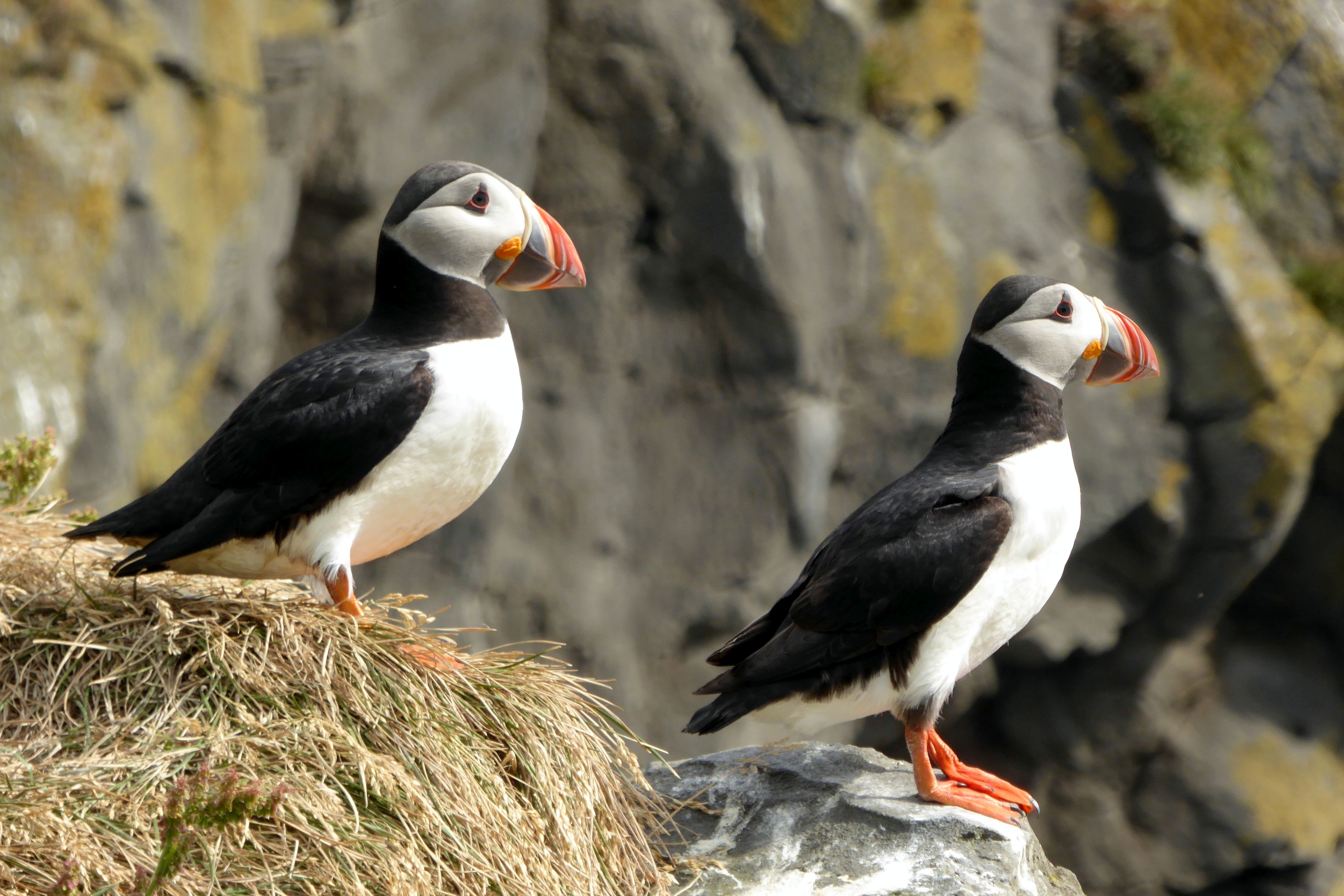
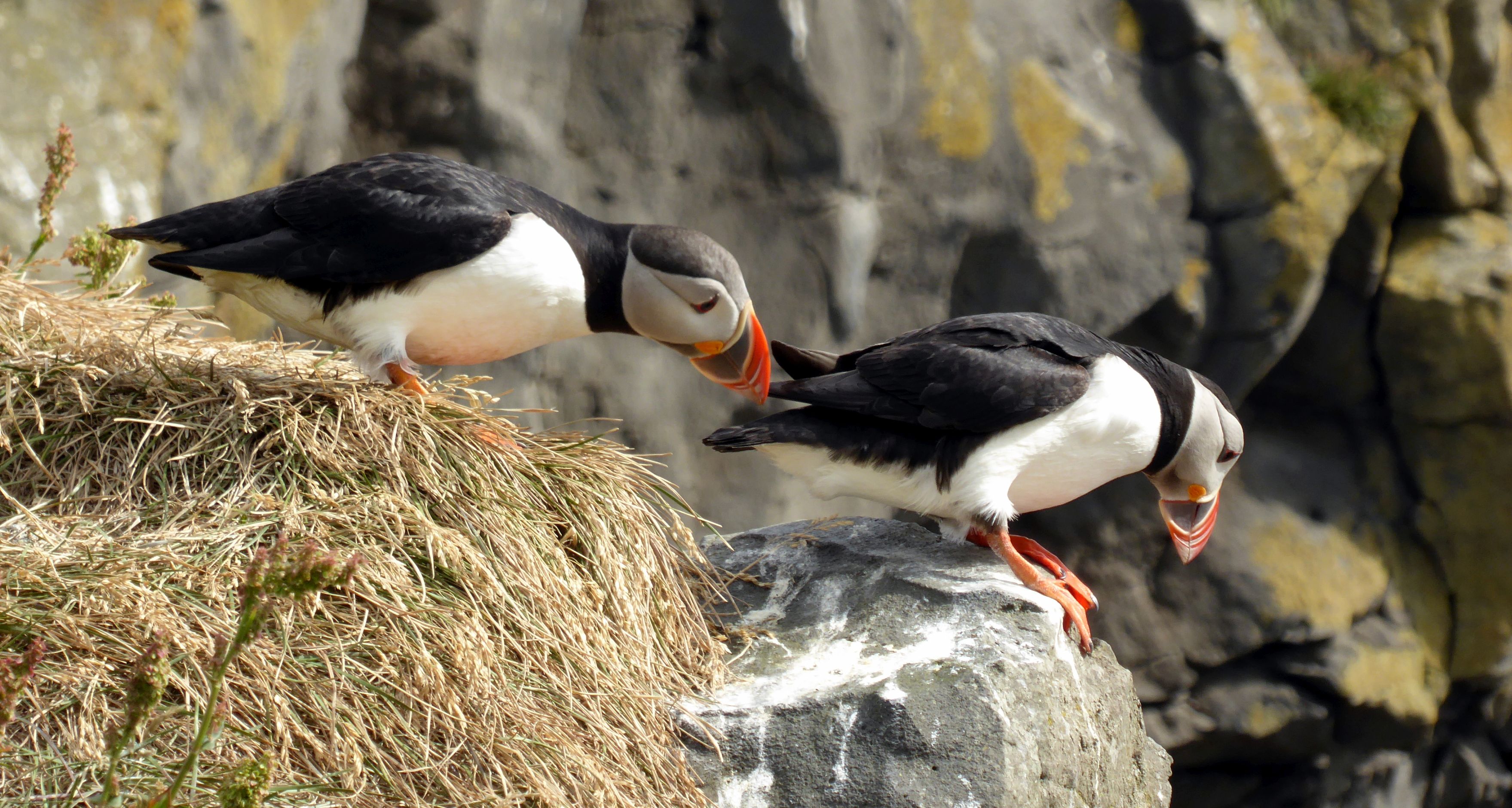
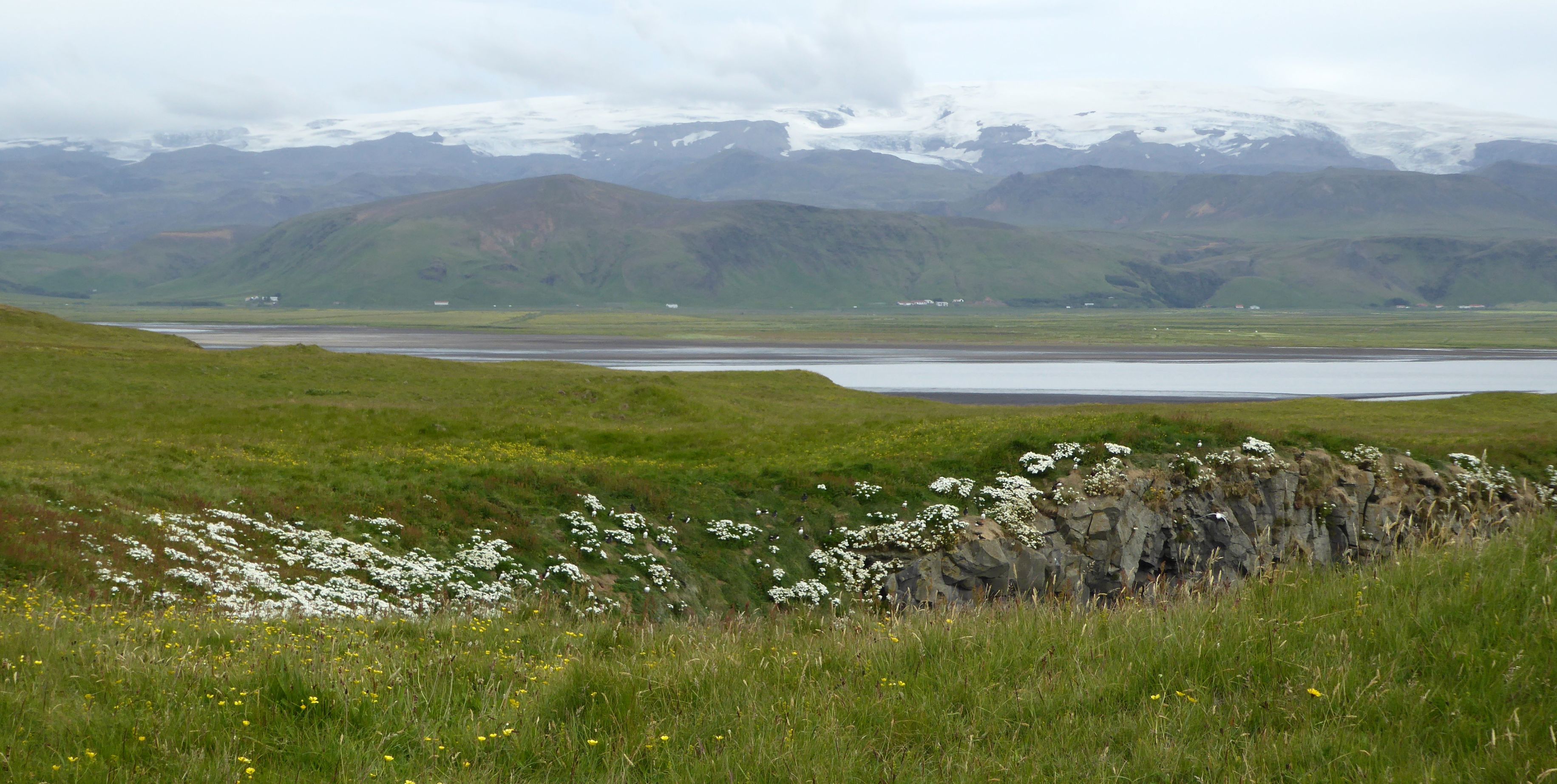
What came next was a complete surprise, because it wasn’t on our itinerary: seeing puffins at Dyrholaey Cliffs, overlooking a black sand beach. We had chosen a tour date that didn’t offer the pre-extension that would have included seeing puffins, so we weren’t expecting to see any during this trip. When Thorunn said we were going to visit some cliffs where we may see puffins, I thought, “Yeah, right. We’ll see them as little specks, way off in the distance, barely visible.” Imagine my surprise when we started our walk along the cliff path and came across a small group of people gathered around taking pictures. Oh, it was probably some seagulls or something… No! It was seven nesting puffins, the closest perhaps 8-10 feet away! All I could do was say, “Awww, they are so CUTE!” Then, I shot photos—and, a lot of them. I couldn’t stop shooting and staring at those adorable birds. It was love at first sight! These are my favorites; I couldn’t narrow it down anymore:
Ready… set……GO!!!
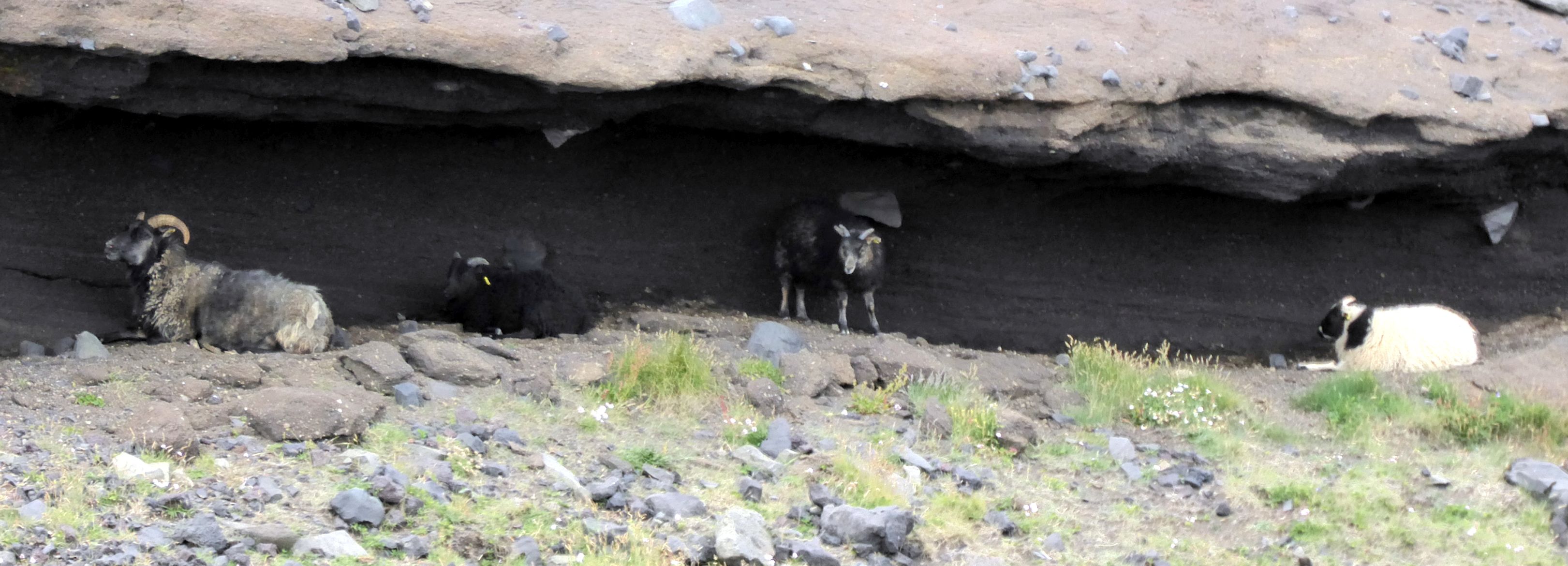
More views around the cliffs…Sheep hanging out in the crevice you can see in the picture above.
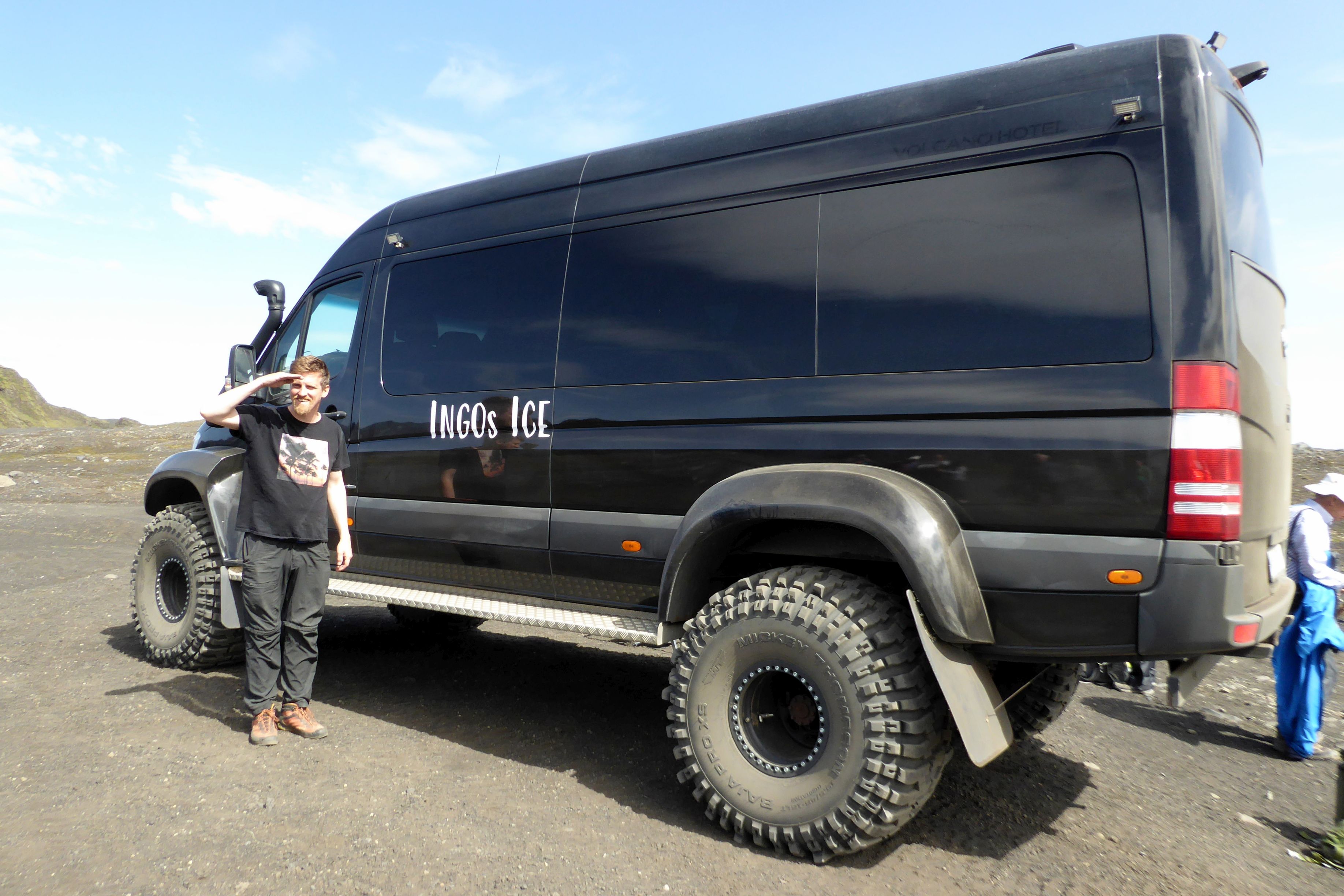
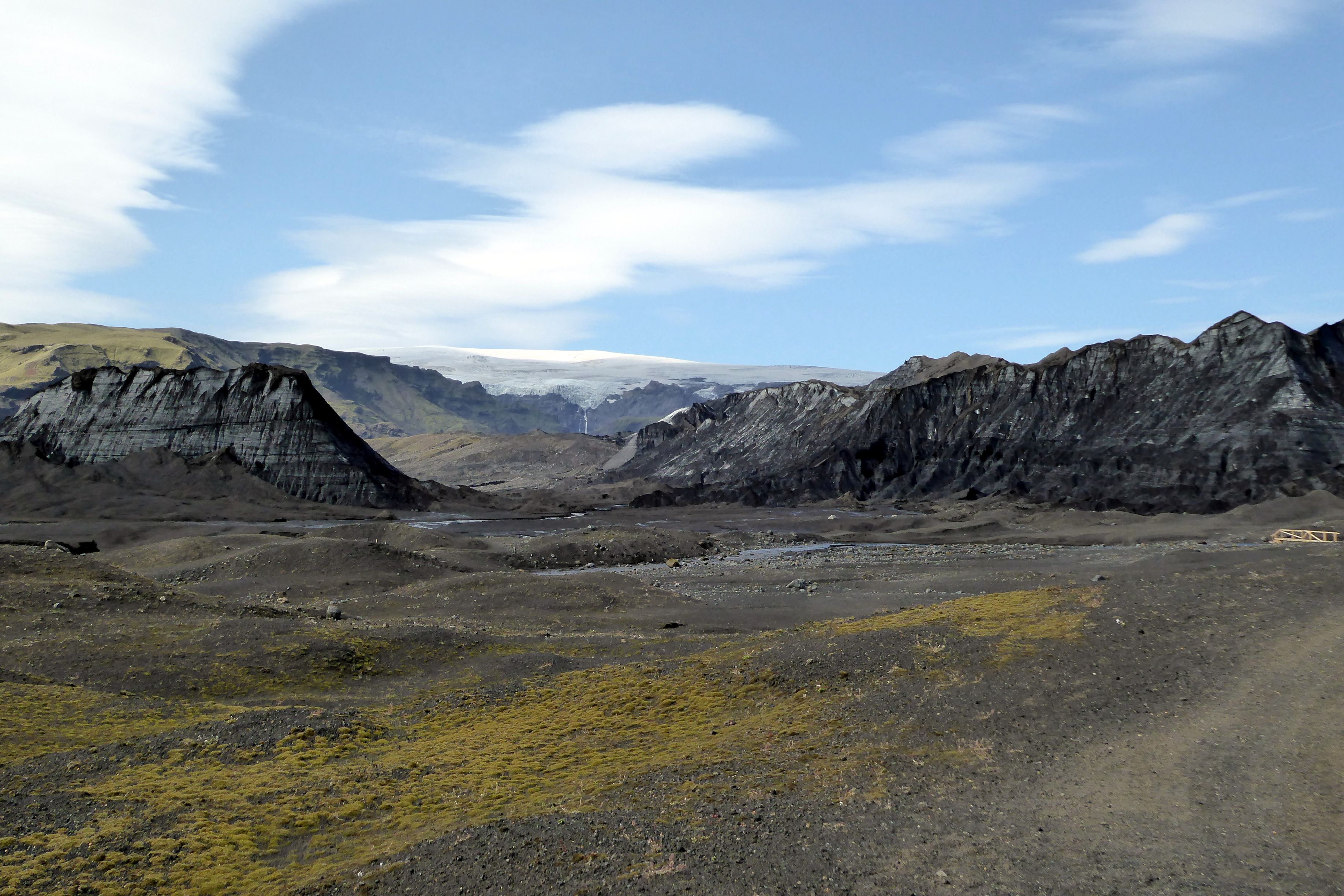
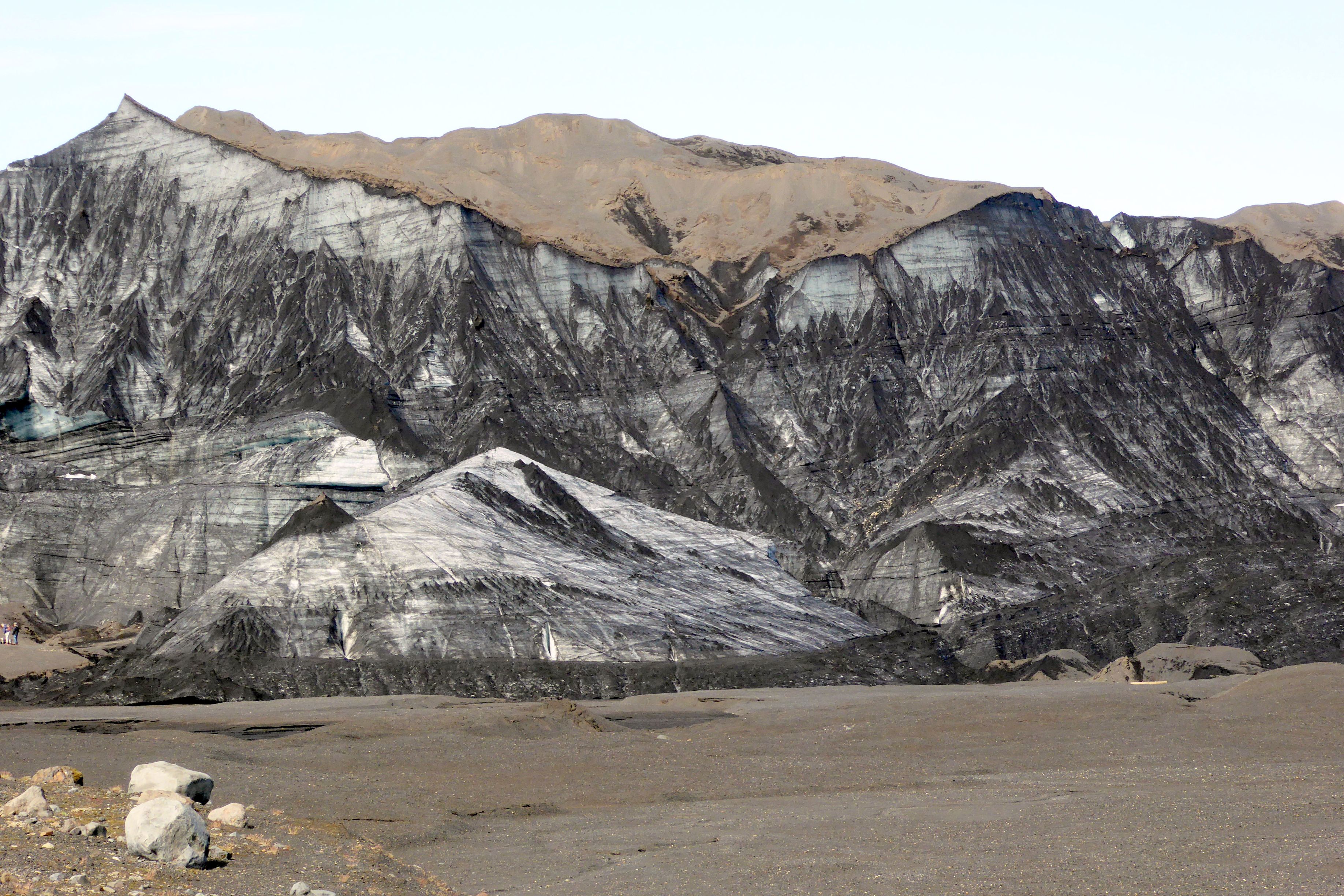
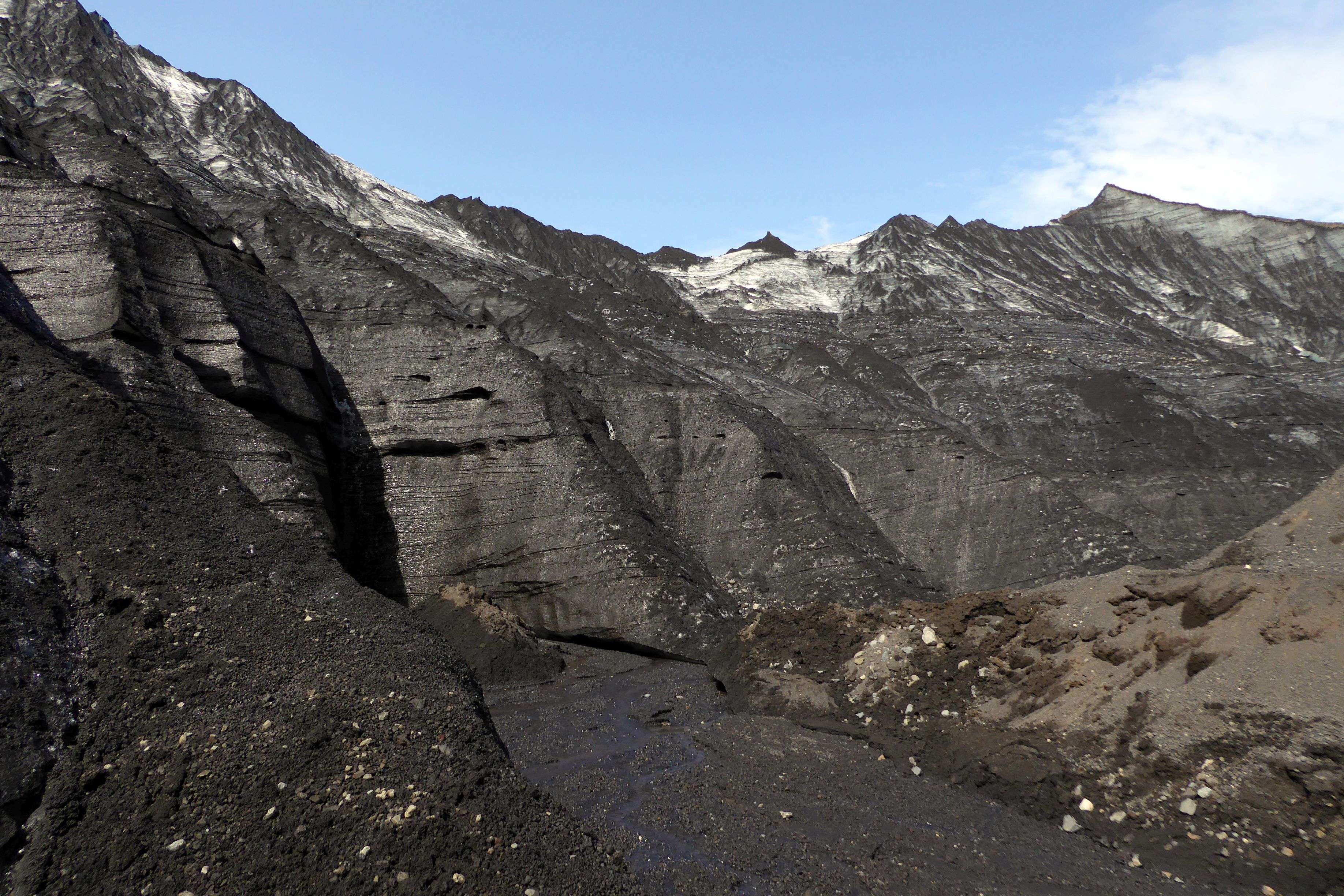
I finally had to tear myself away to rejoin our tour. As if what we had already seen wasn’t spectacular enough, our afternoon Super “Jeep” Tour with Ingo was amazing. We all piled in his specially outfitted mega-“Jeep” (not really a Jeep) for a three-hour tour to see the dormant glacier of Kotlujokull, where the ice is 600 years old.
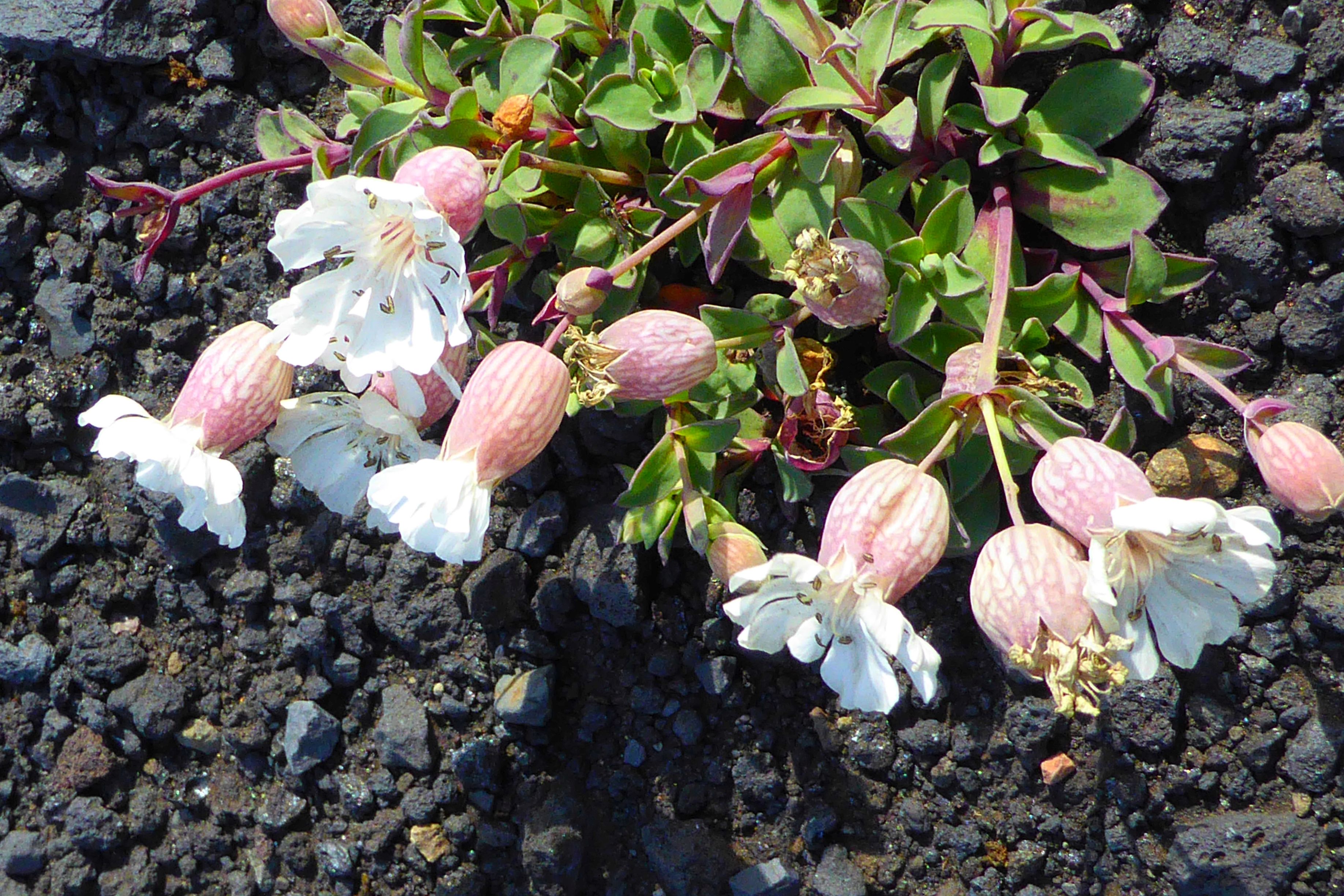
Sea Campion
Iceland is a very environmentally-conscious country, so strict laws require vehicles to stay on a well-marked road to the glacier. Once we arrived at the end of the road, we hiked the rest of the way in to see the glacier.
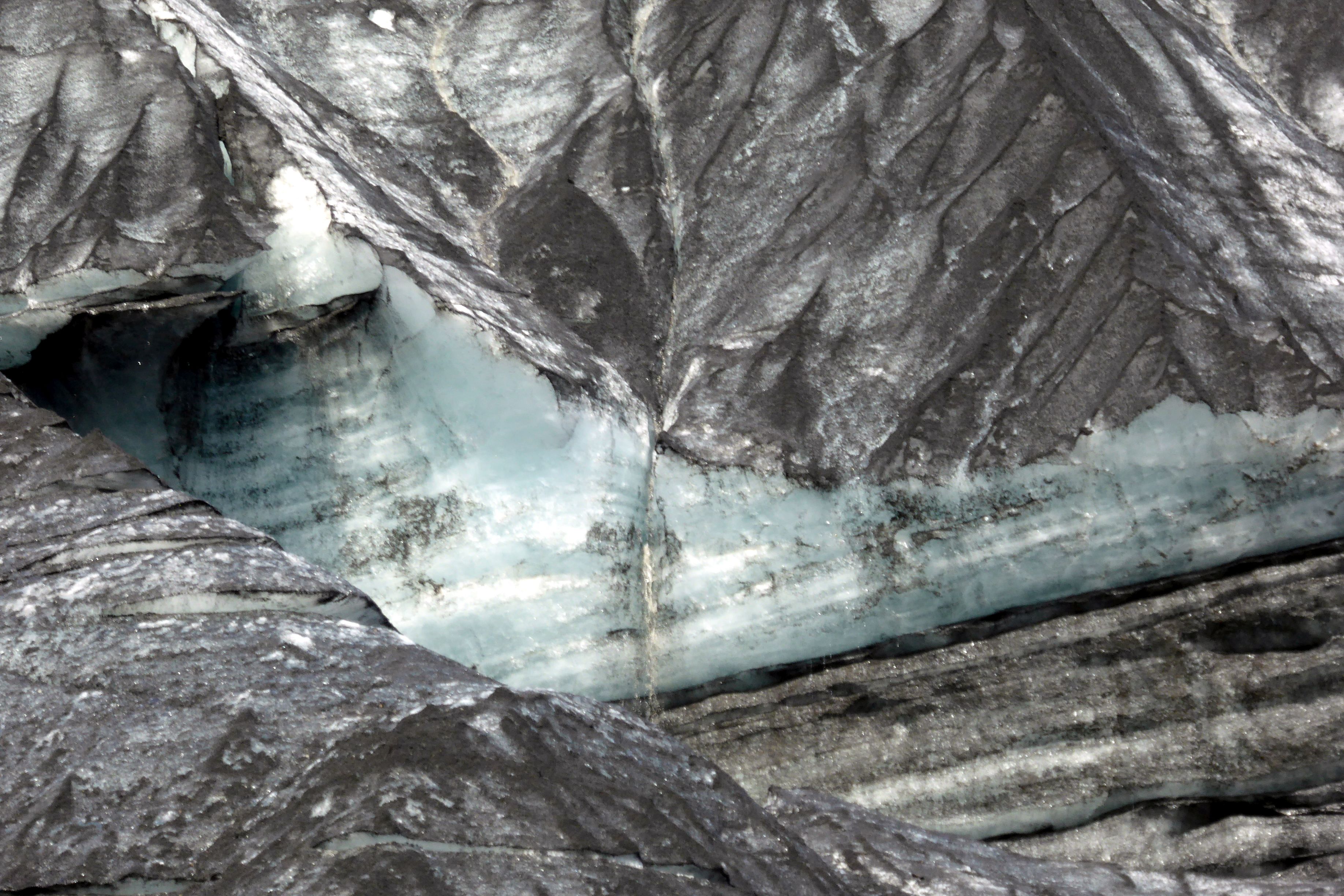
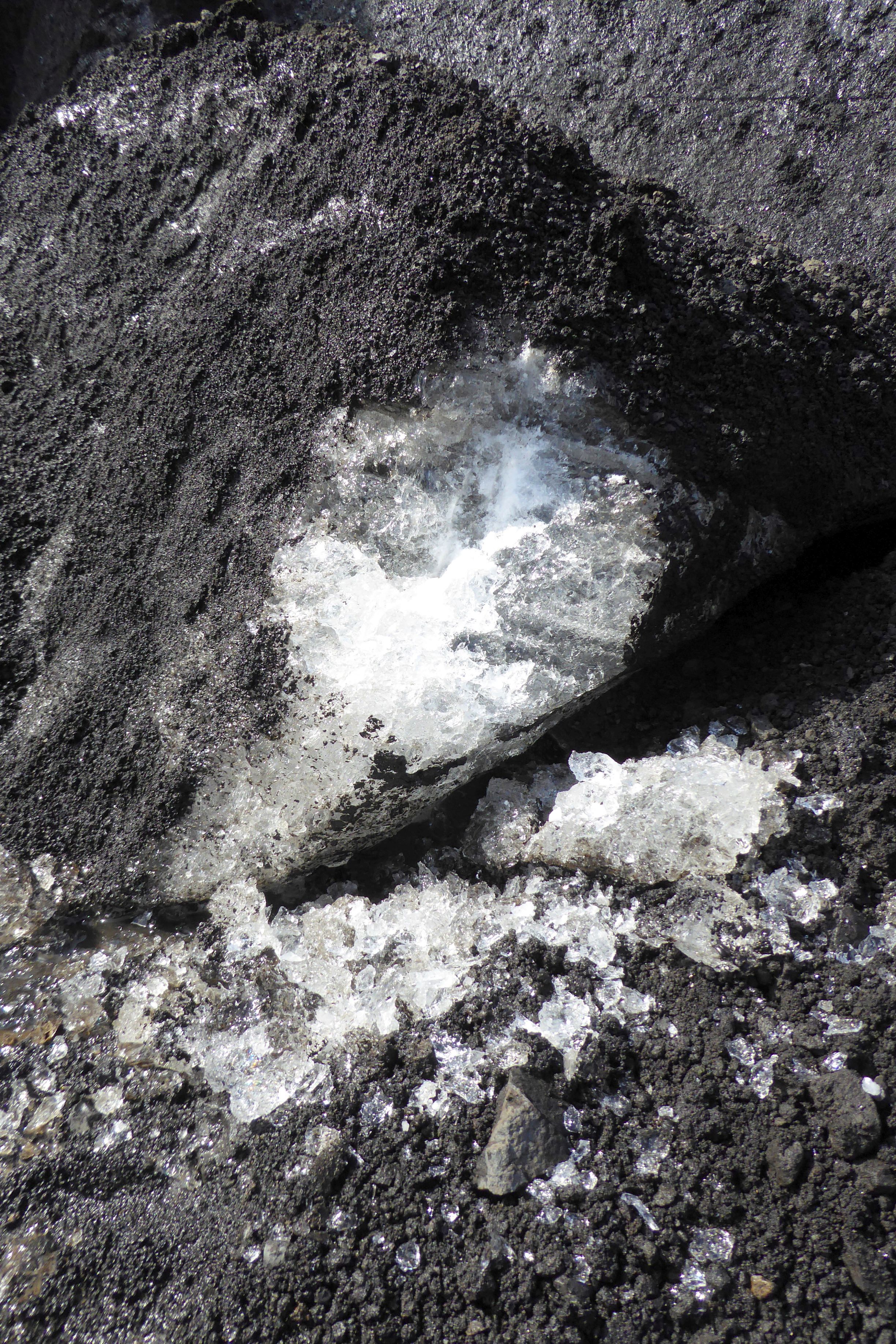
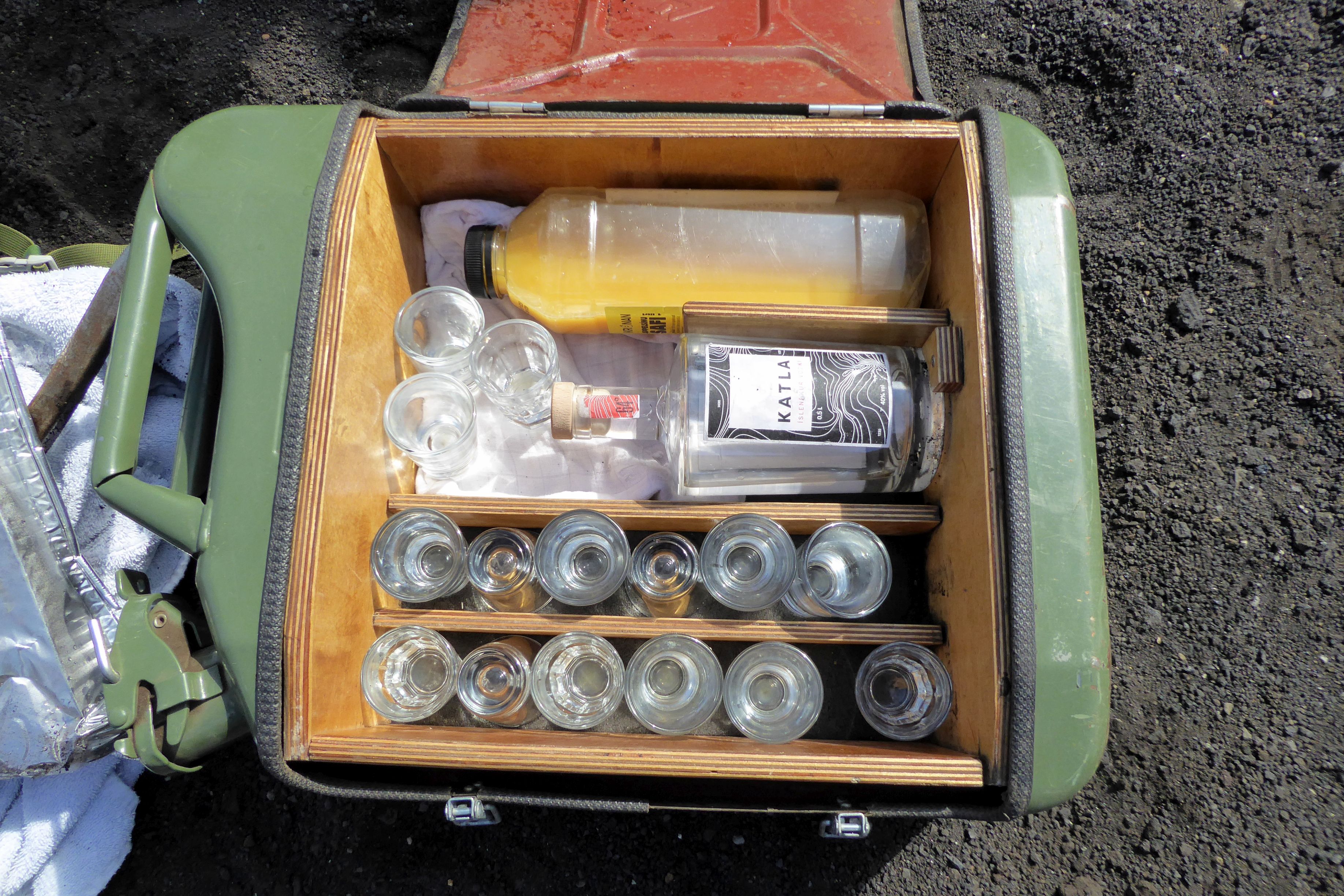
Ingo was carrying a box with him; I assumed it was a first-aid kit and water. Once we arrived, he grabbed an ice pick he had left at the glacier and picked away at the ice which was covered in black volcanic ash. Below the top layer was beautiful white ice. He gathered an aluminum tray full of ice, for what, I didn’t know, until he opened his box:
CHEERS!
The scenery throughout our three-hour tour was beautiful; we were fortunate to have sunny skies! Ingo was a delight—funny and informative. He really made our adventure and enjoyable one!
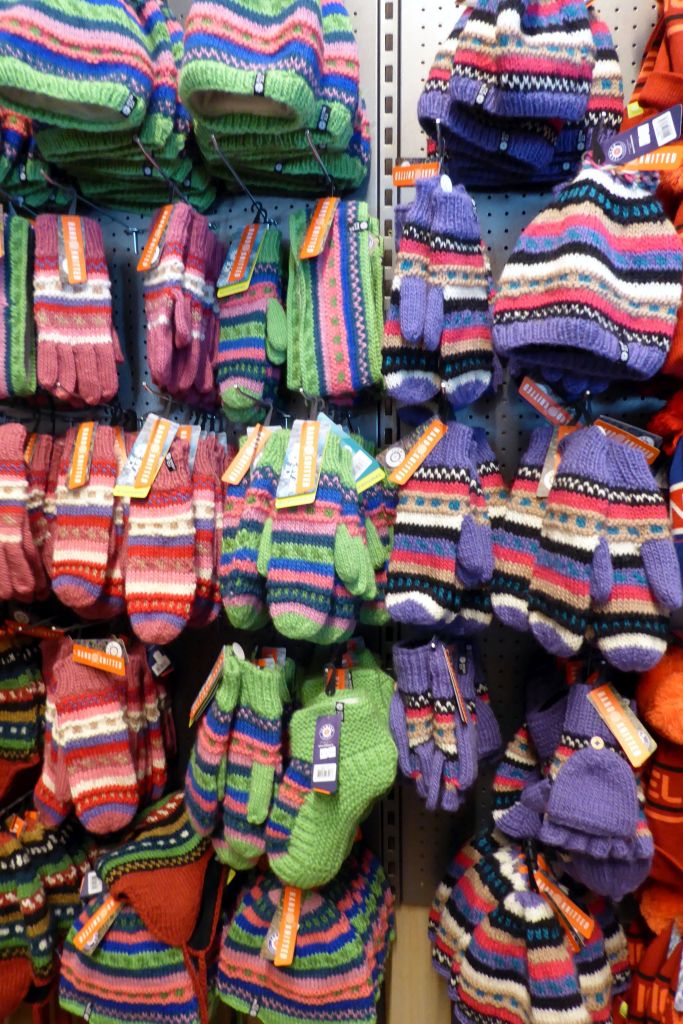
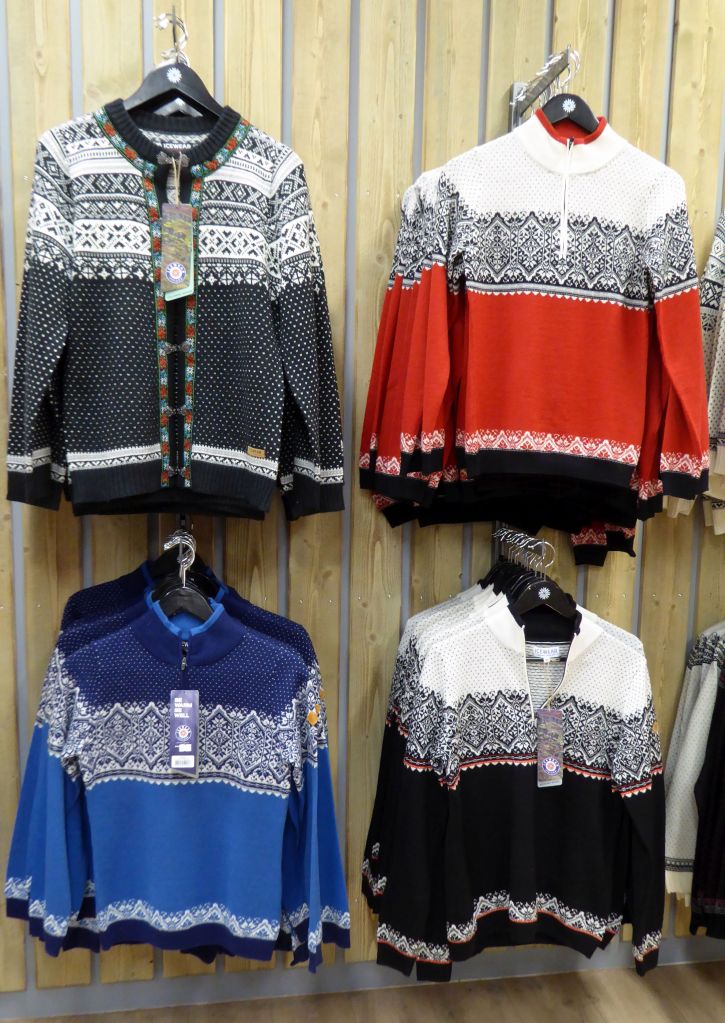
Back in Vik, where our tour began, we had a little extra time to take a spin through their massive gift shop and stop into Kronan for some snacks. We did both. I’m not a shopper (unless it’s for chocolate), but I did want to see Icelandic wool products. I took pictures of the wool and bought some chocolate to add to my chocolate label collection(Time to update my tally, although only one label per brand counts.):
In a previous post, I had mentioned Kronan and Bonus as being the cheapest grocery stores in Iceland. If you ever go to Iceland, look for the smile (Kronan) or pink pig (Bonus). Either one or the other (or both) will be in most towns, and you will save a lot of money shopping at either one of them.
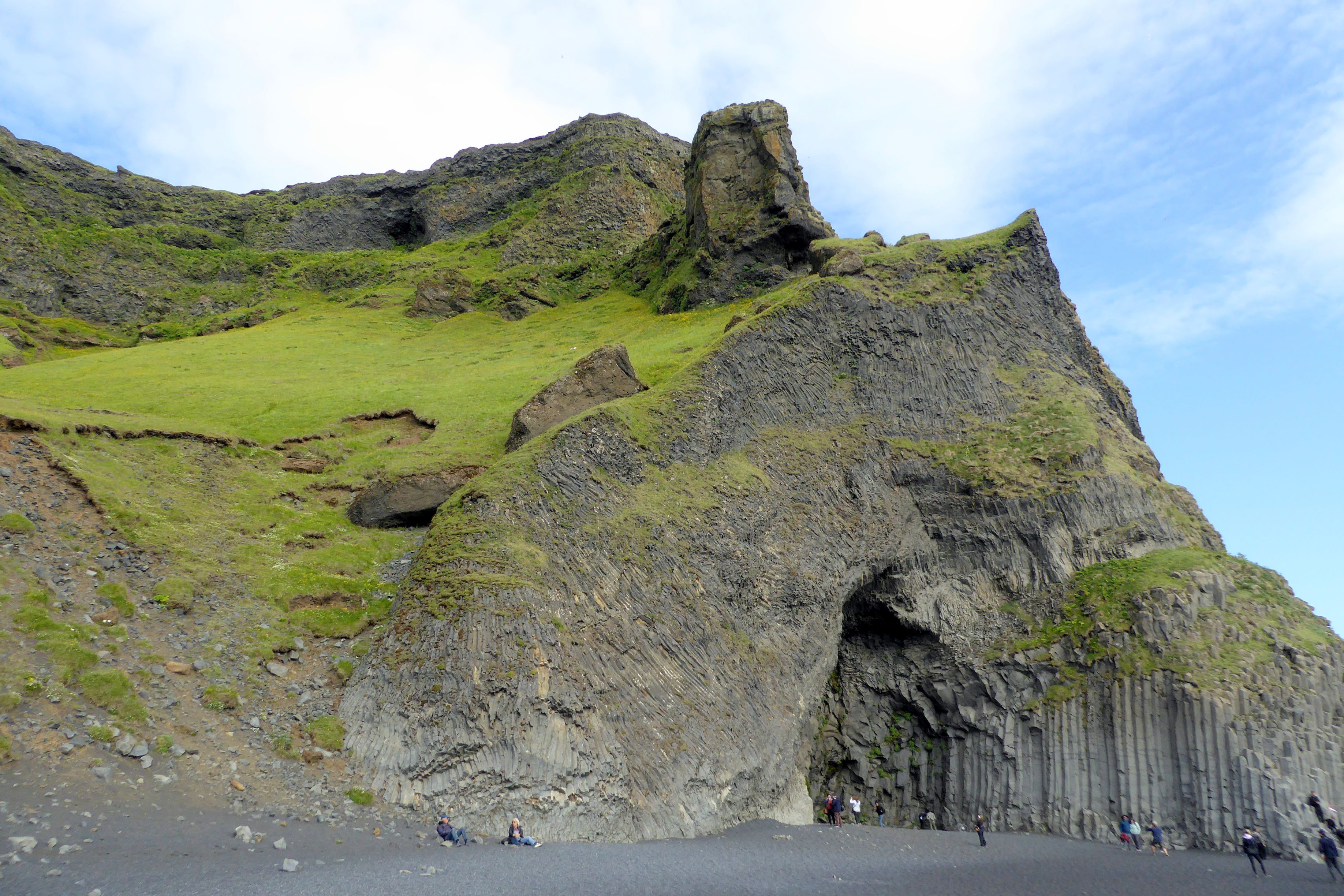
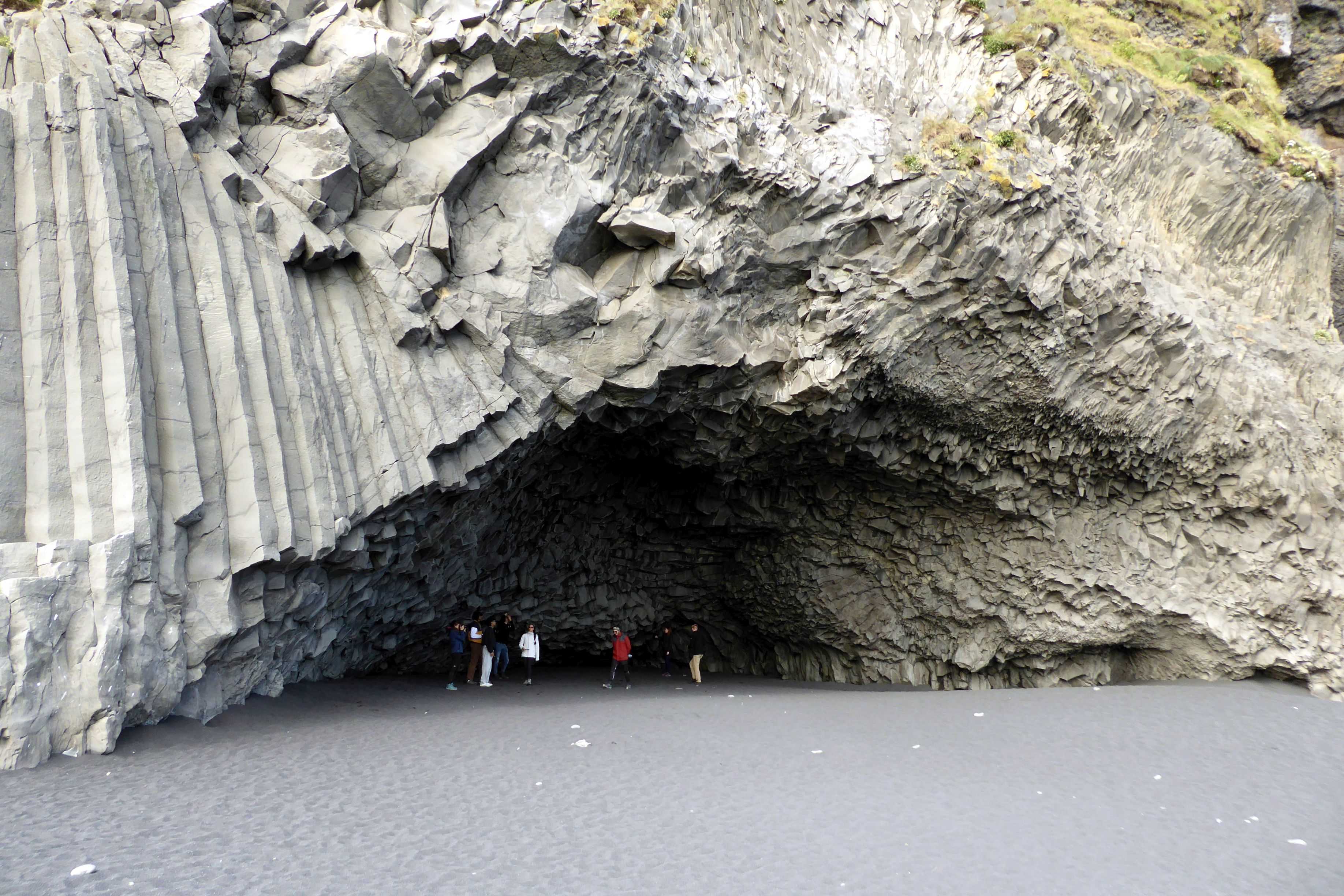
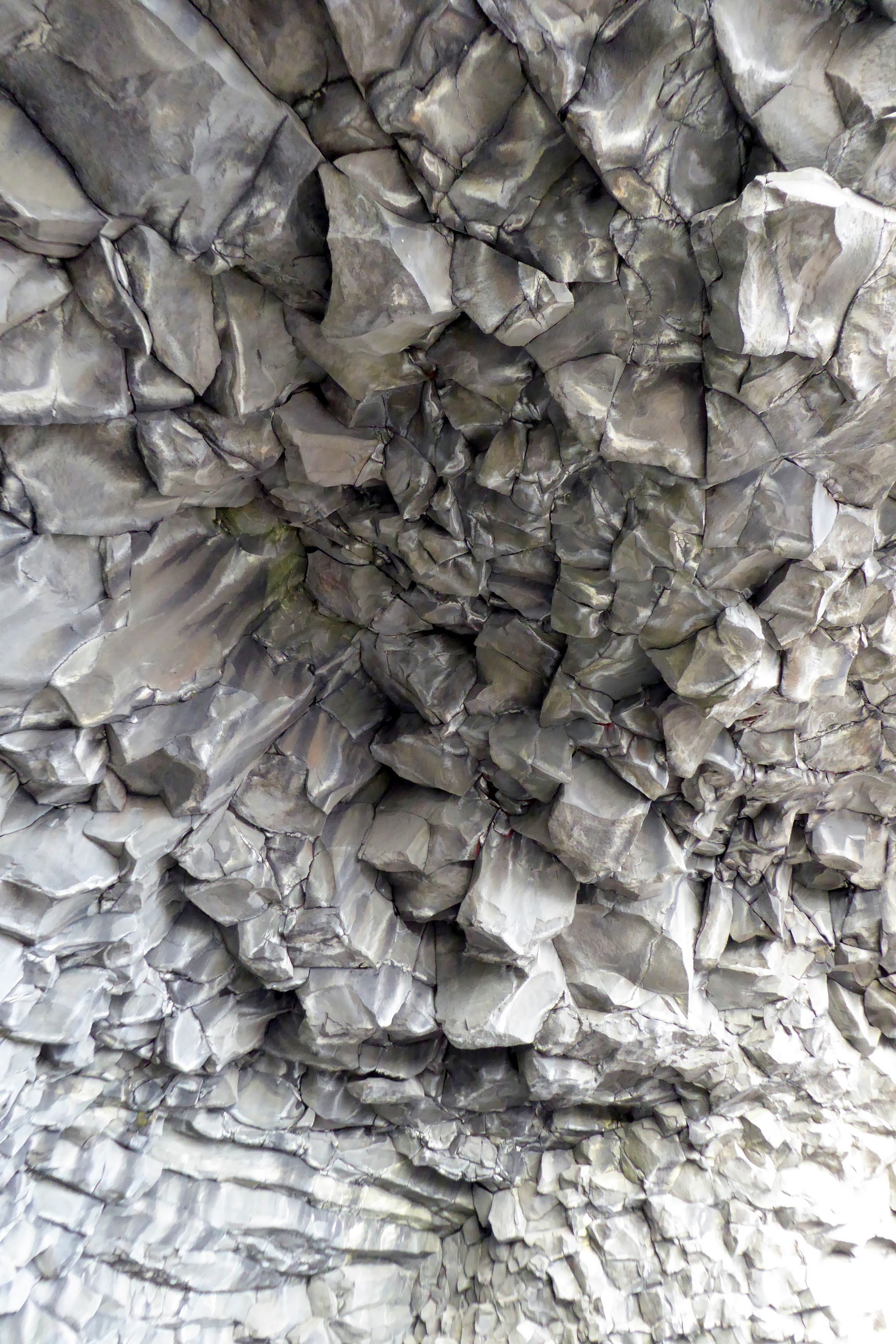
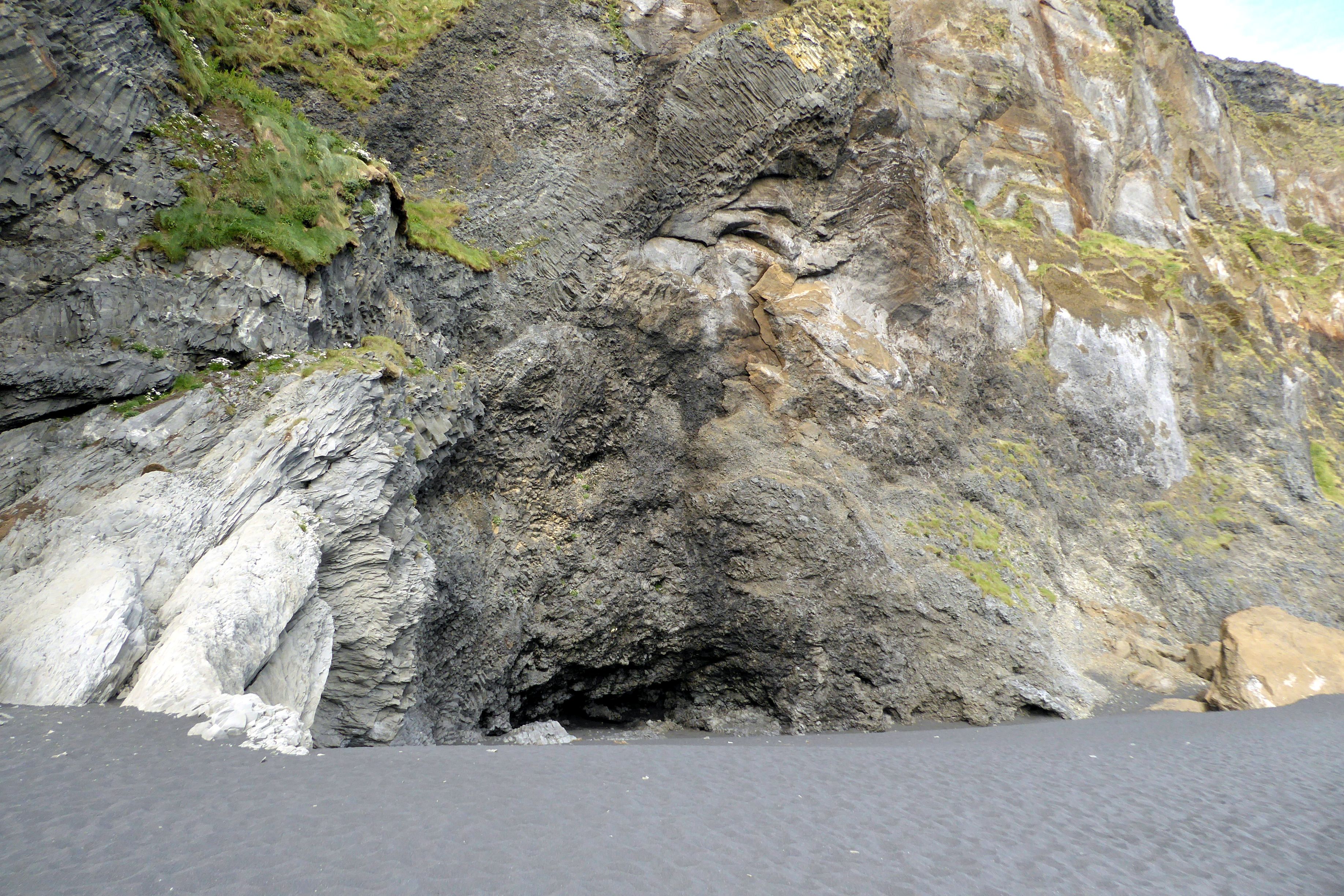
After lunch at a local restaurant, we visited Reynisfjara Beach, which lies between the peninsula of Dyrholaey and Mount Reynisfjall. What a trip! I have never seen anything like it! Halsanefshellir Cave, formed by the pounding waves against the soft volcanic rock, featured amazing hexagonal basalt formations, the result of magma cooling slowly and cracking into columns as the surface area decreases. Fascinating!
The day proved to be another one full of gorgeous natural wonders that I am appreciating more as I look back on my photos and let it all sink in. How fortunate I was to see it all! For that, I am extremely grateful.
Coming up next: Scenic Stykkisholmur & Snaefellsnes Peninsula
Note: If small group travel is of interest to you, I highly recommend Overseas Adventure Travel (OAT). Although Bruce and I travel together, they do not charge a single supplement for those who travel on their own. Singles also get their own room at hotels. If you book, you can get $100 off your trip by providing my name and customer number (Elaine Krugman, #3018126) as the person who referred you. I will also get $100 off future travel– a win-win!
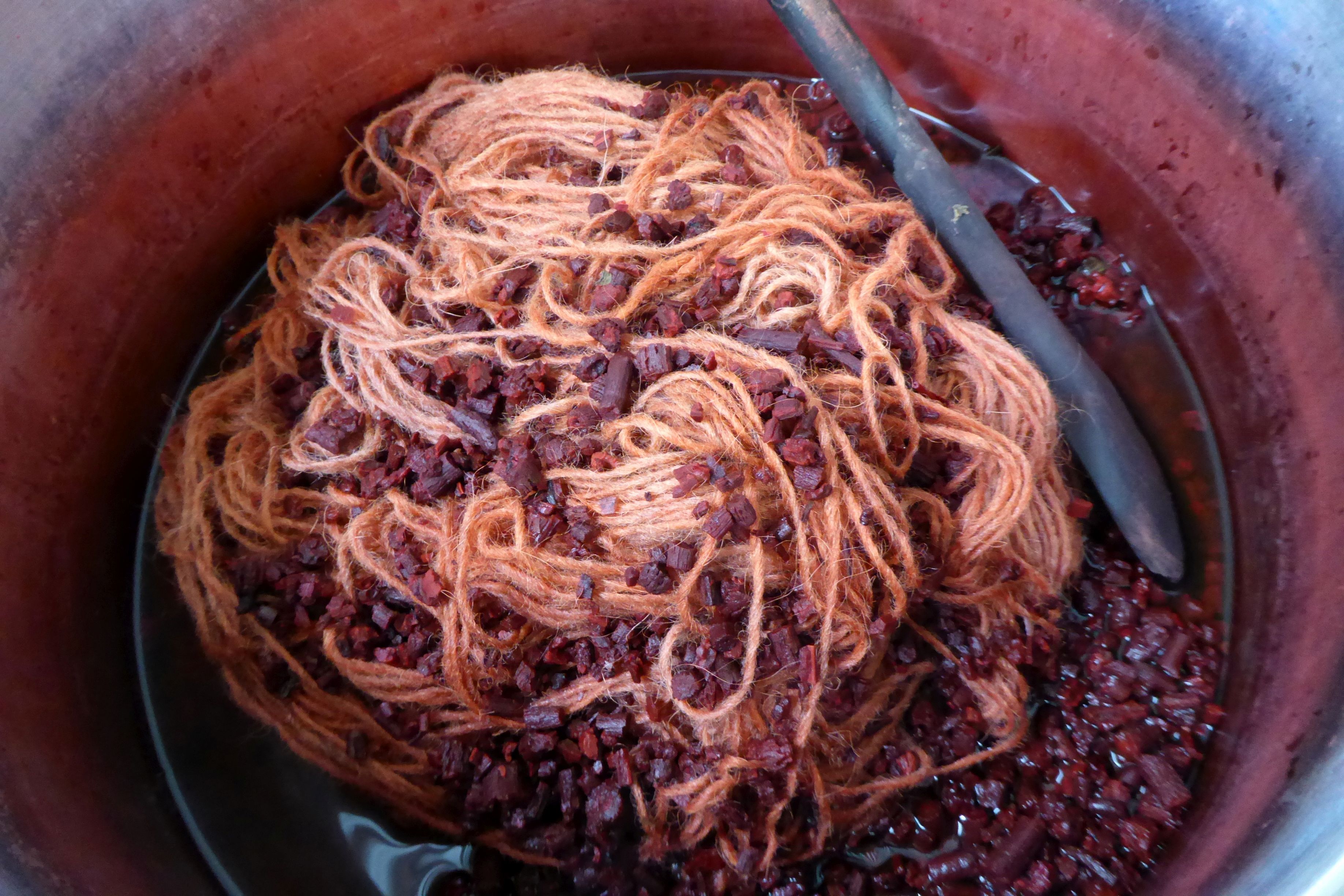
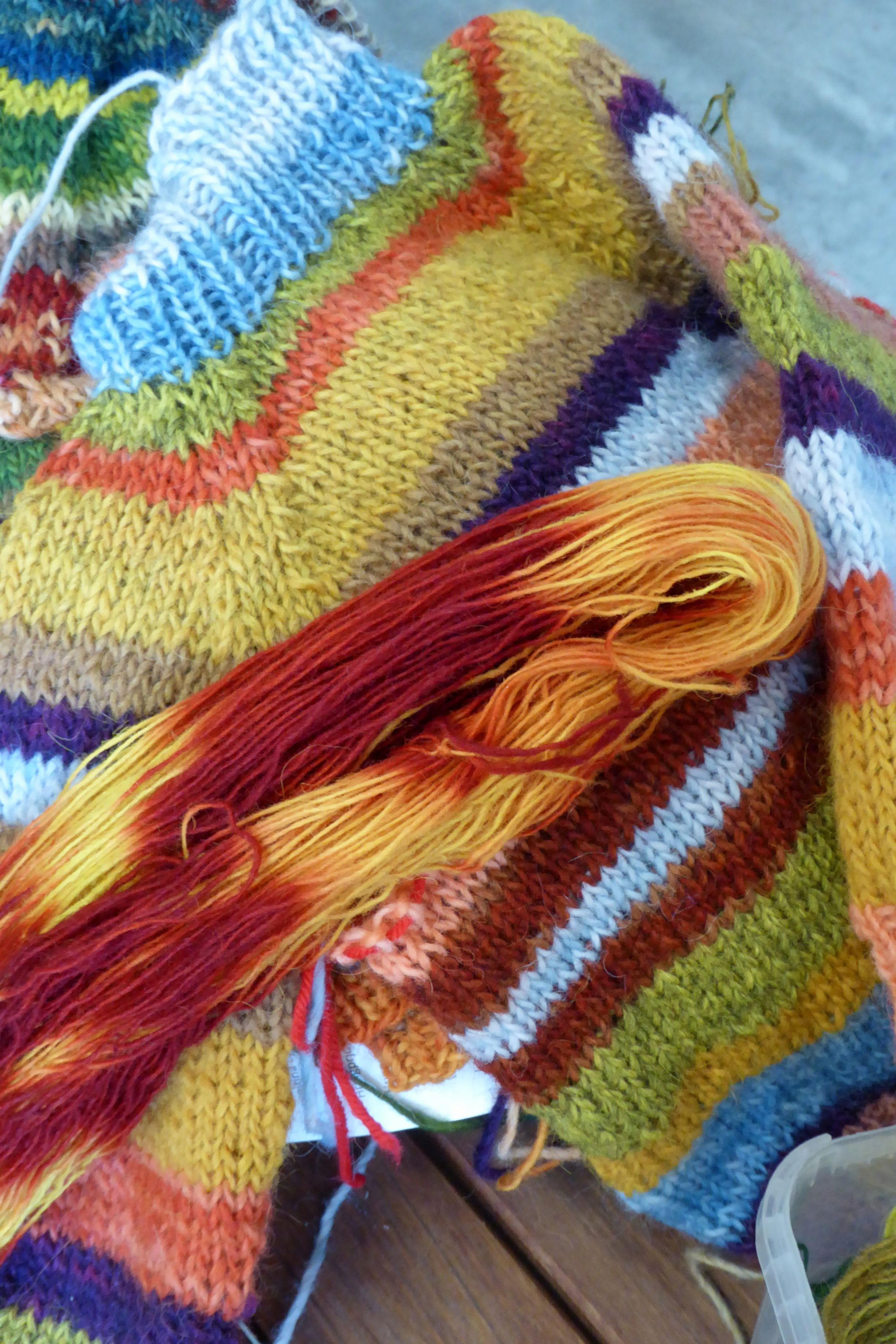
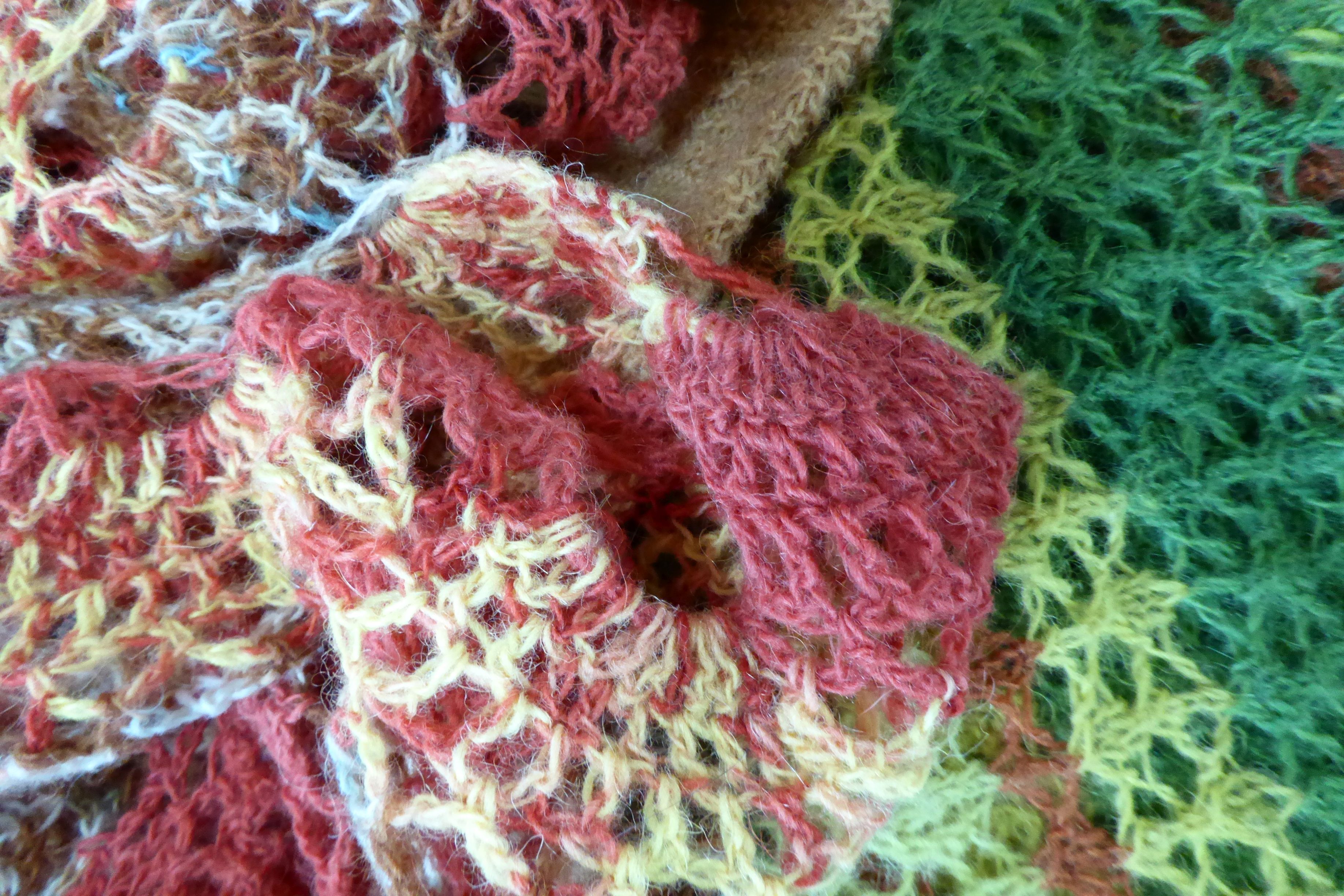
Looking back over my photos from our first full day in Iceland, it really was a full day! Beginning near our hotel in Selfoss, our tour leader, Thorunn, and bus driver, Haflidi, took us to Hespa, a local wool studio to learn about wool dying using natural ingredients and traditional techniques. It was fascinating to learn about which ingredients produce various colors and to see the process. Wool clothing is a staple in every Icelander’s closet and a popular tourist souvenir, so it is an important industry for the country.
(For all pictures, click on the image to see full screen view.)
Next, we were off to circumnavigate the Golden Circle, a ring of natural highlights which are a huge tourist draw. Being the high season and tourism numbers being way up in Europe, we weren’t the only bus to pull in at each spot. The nice thing was our bus was full-sized like the others, but only 16 of us had to get off and back on. If you are going to do a guided tour, small-group tours are the way to go!
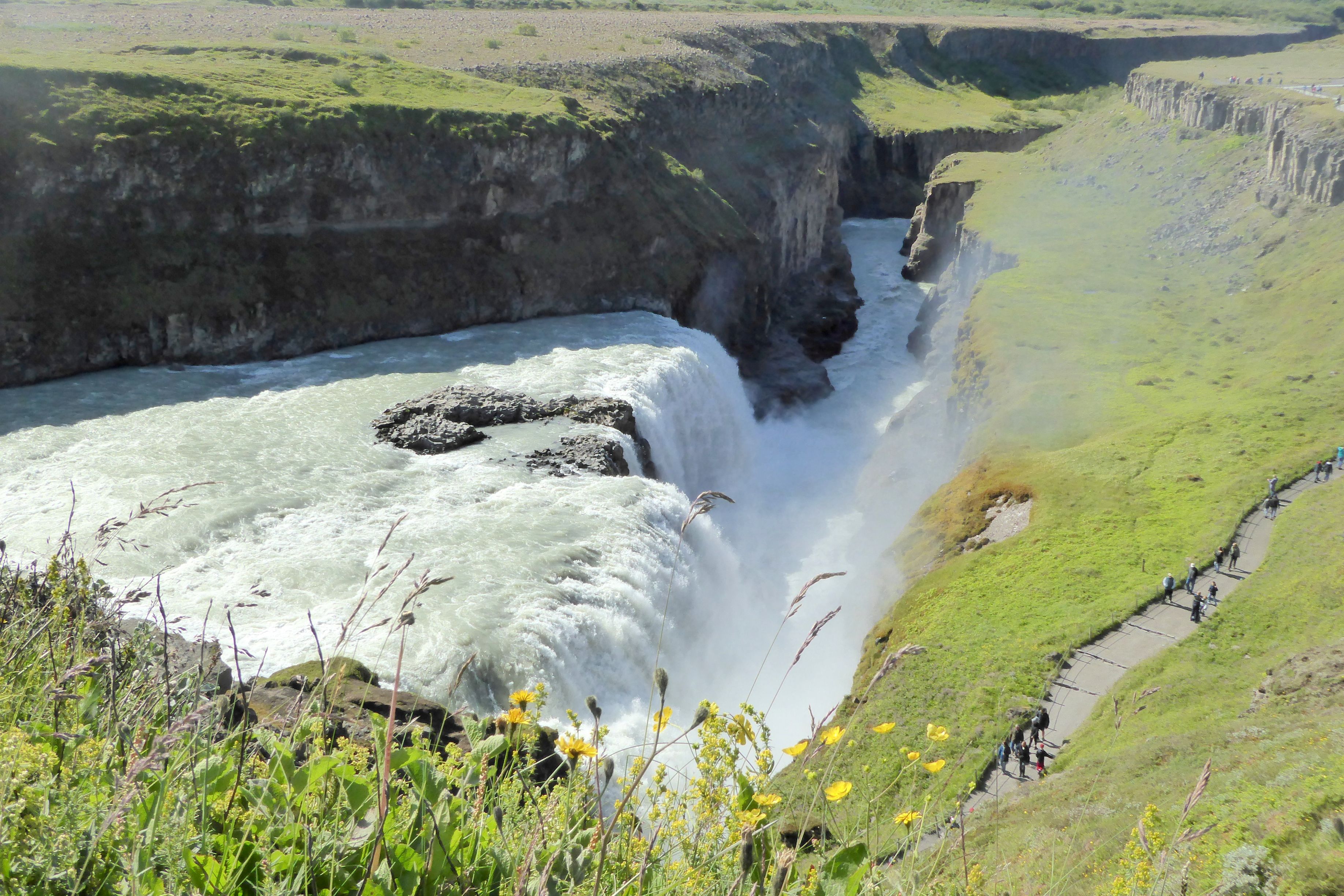
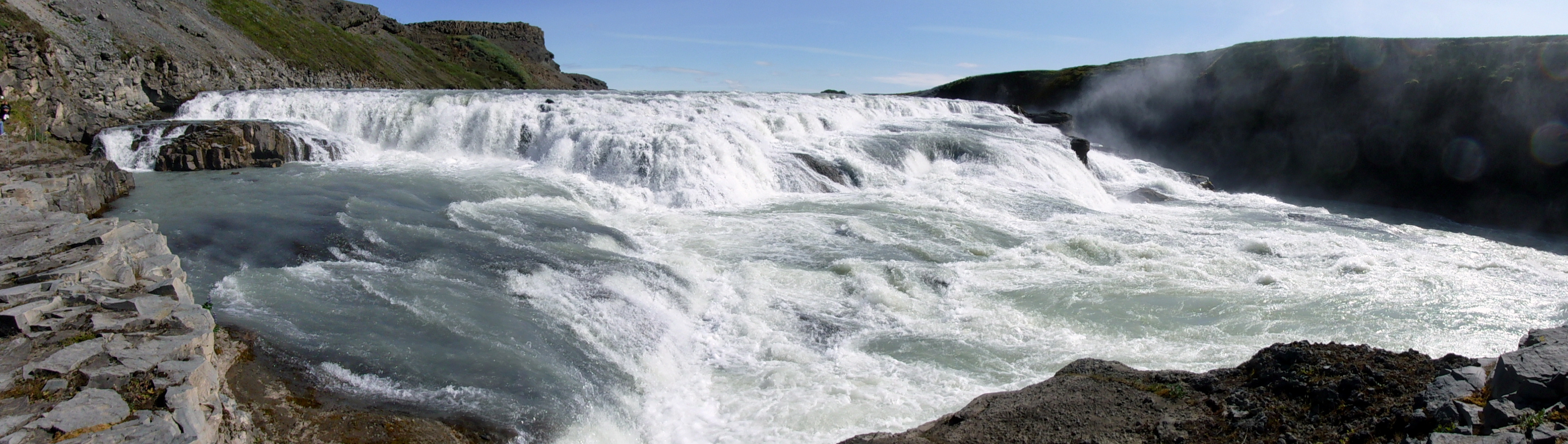
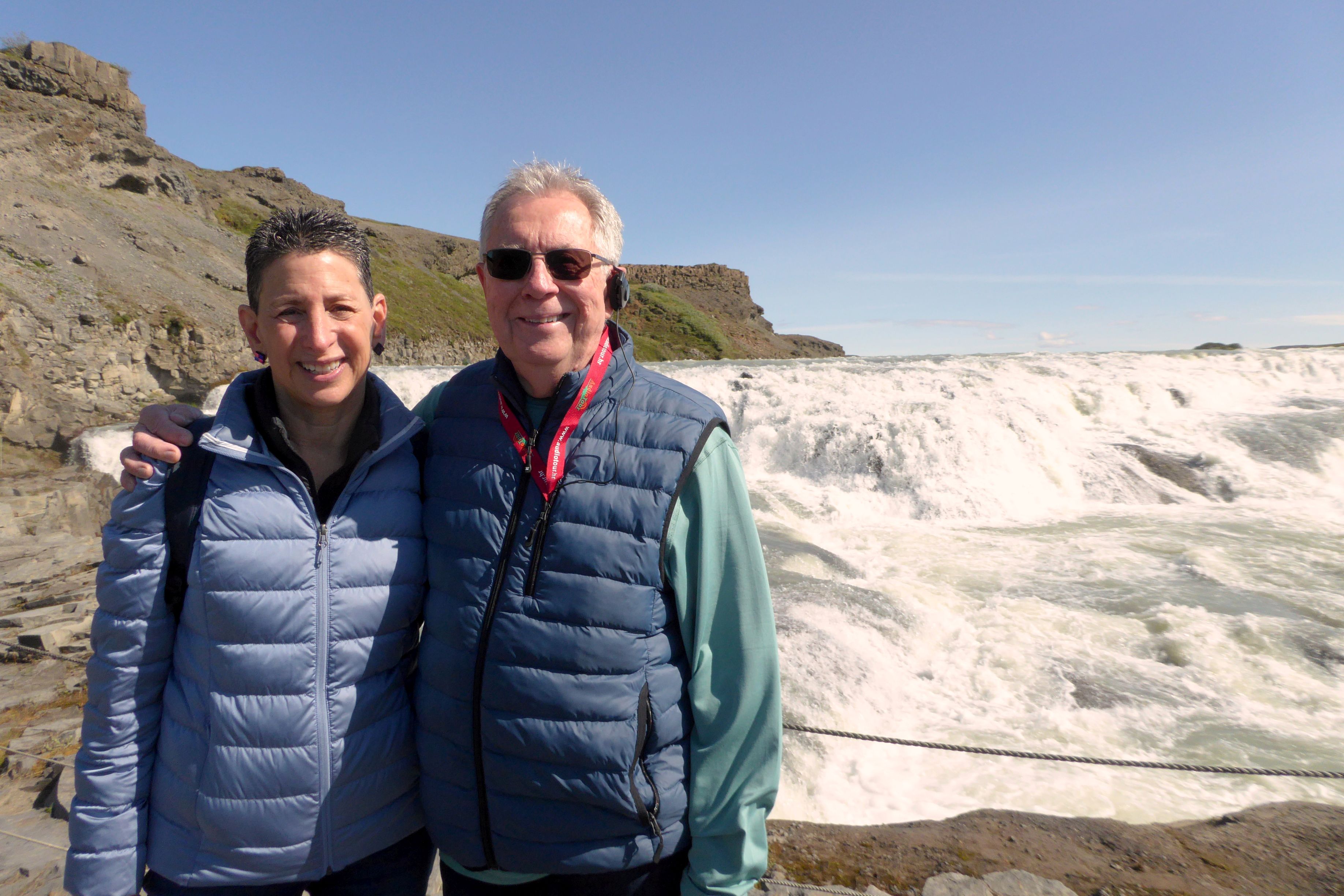
Our first stop was at Gullfoss waterfall, just one of MANY waterfalls in Iceland. The country is full of them! This one was really special, though – absolutely breathtaking!
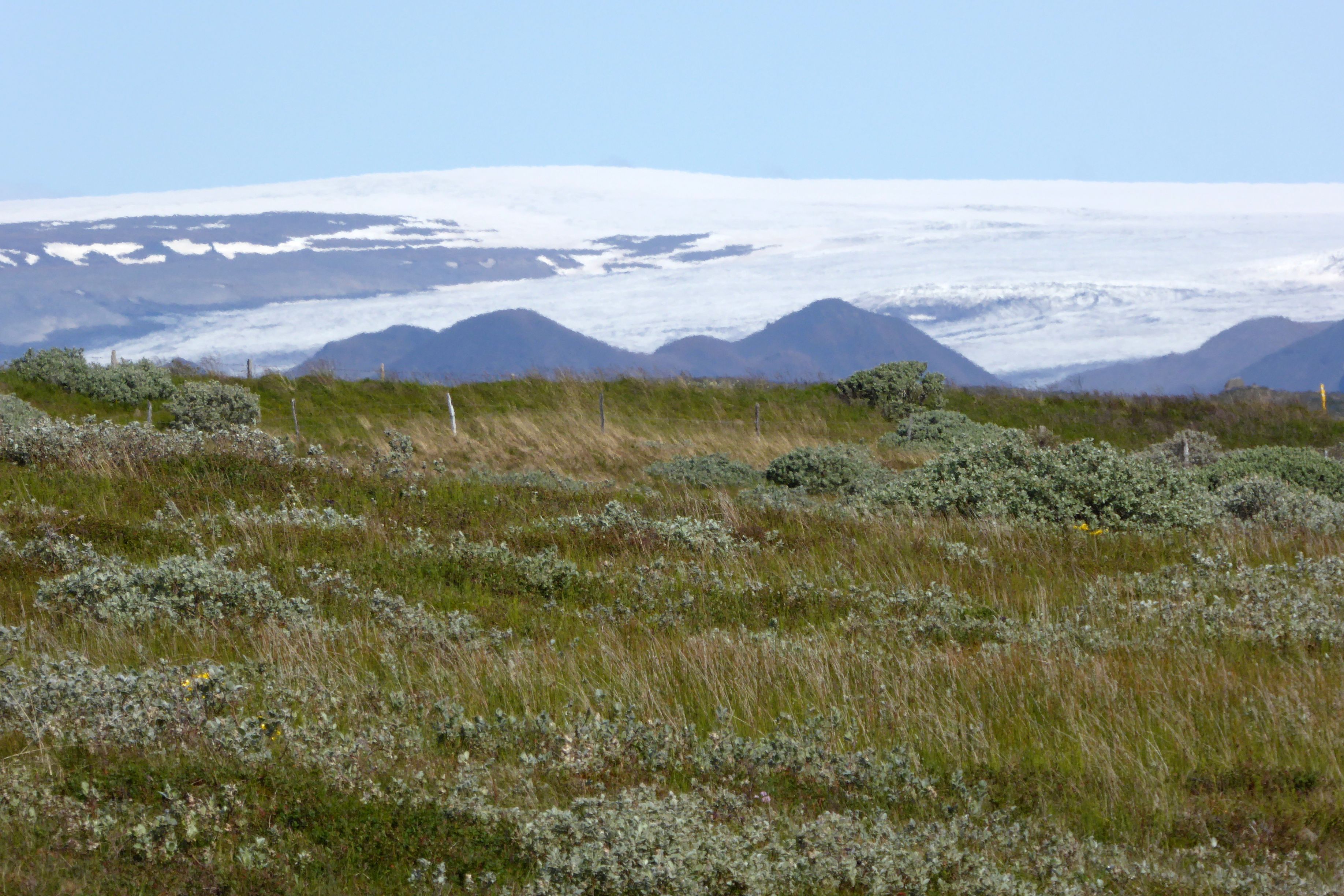
As we walked the path to the waterfall, we saw this glacier off in the distance.
Click on this one– a panorama, and my favorite.
I’m not one for selfies or a lot of photos of us at landmarks, but I was just so happy to finally be in Iceland!
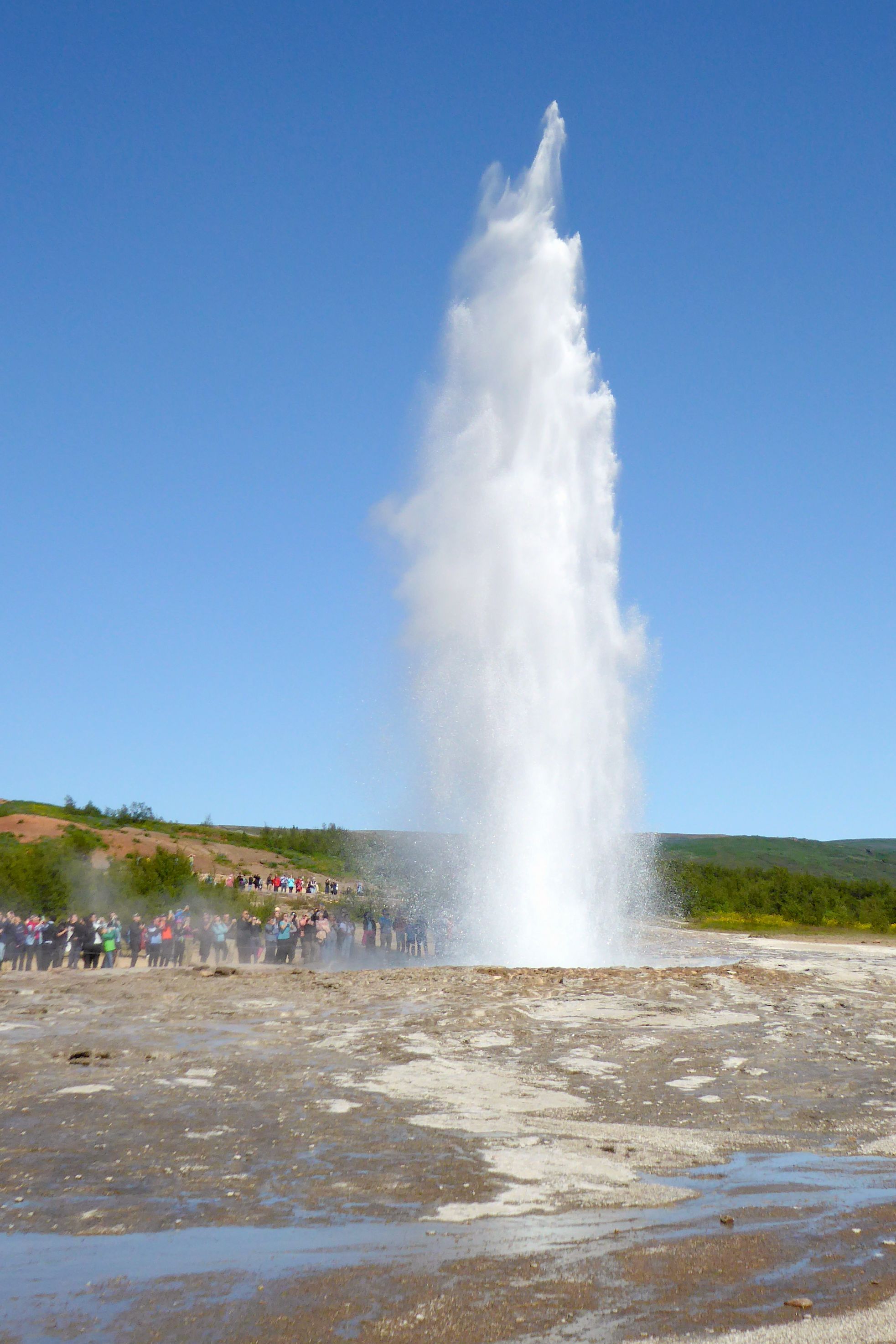
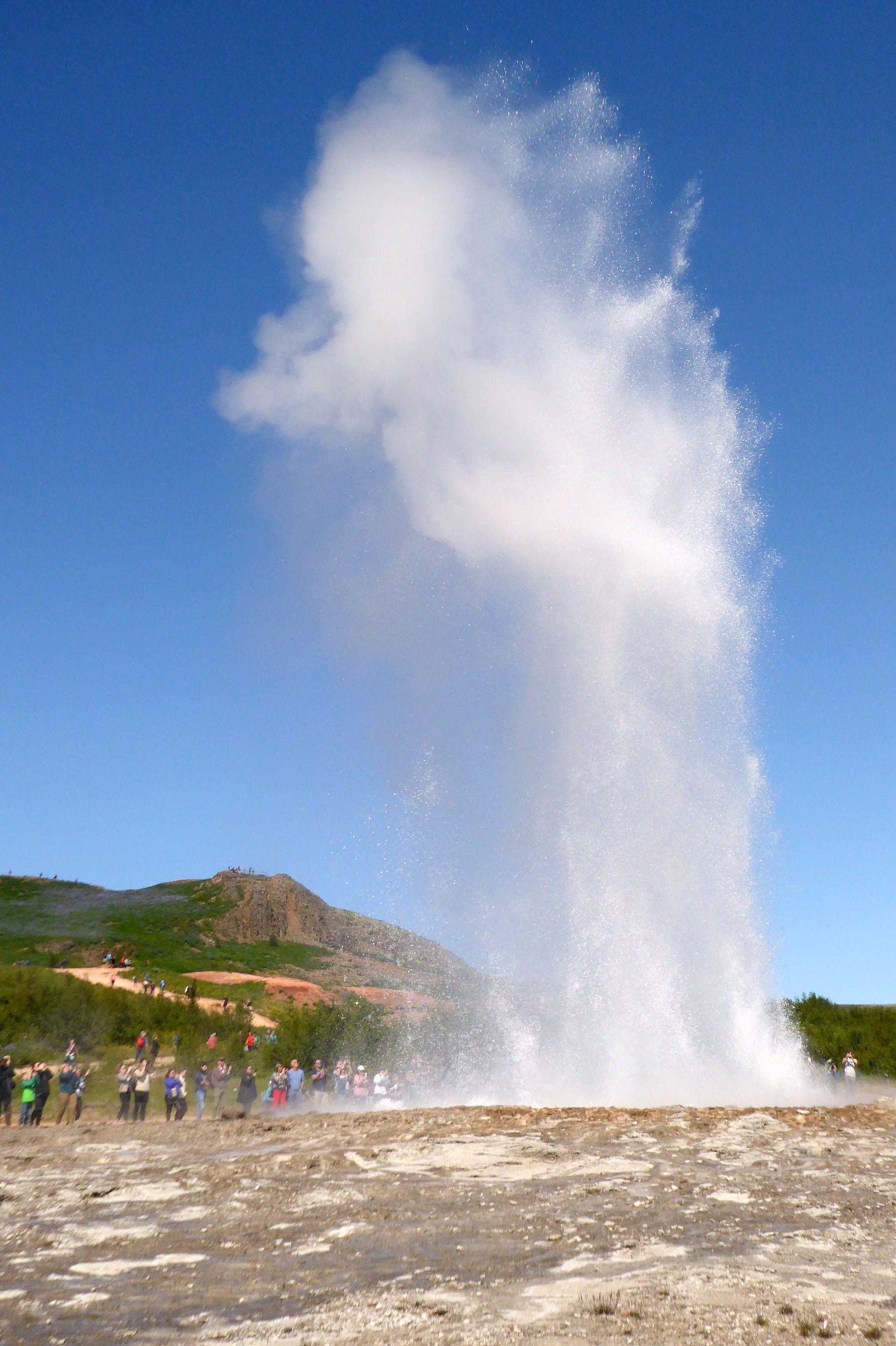
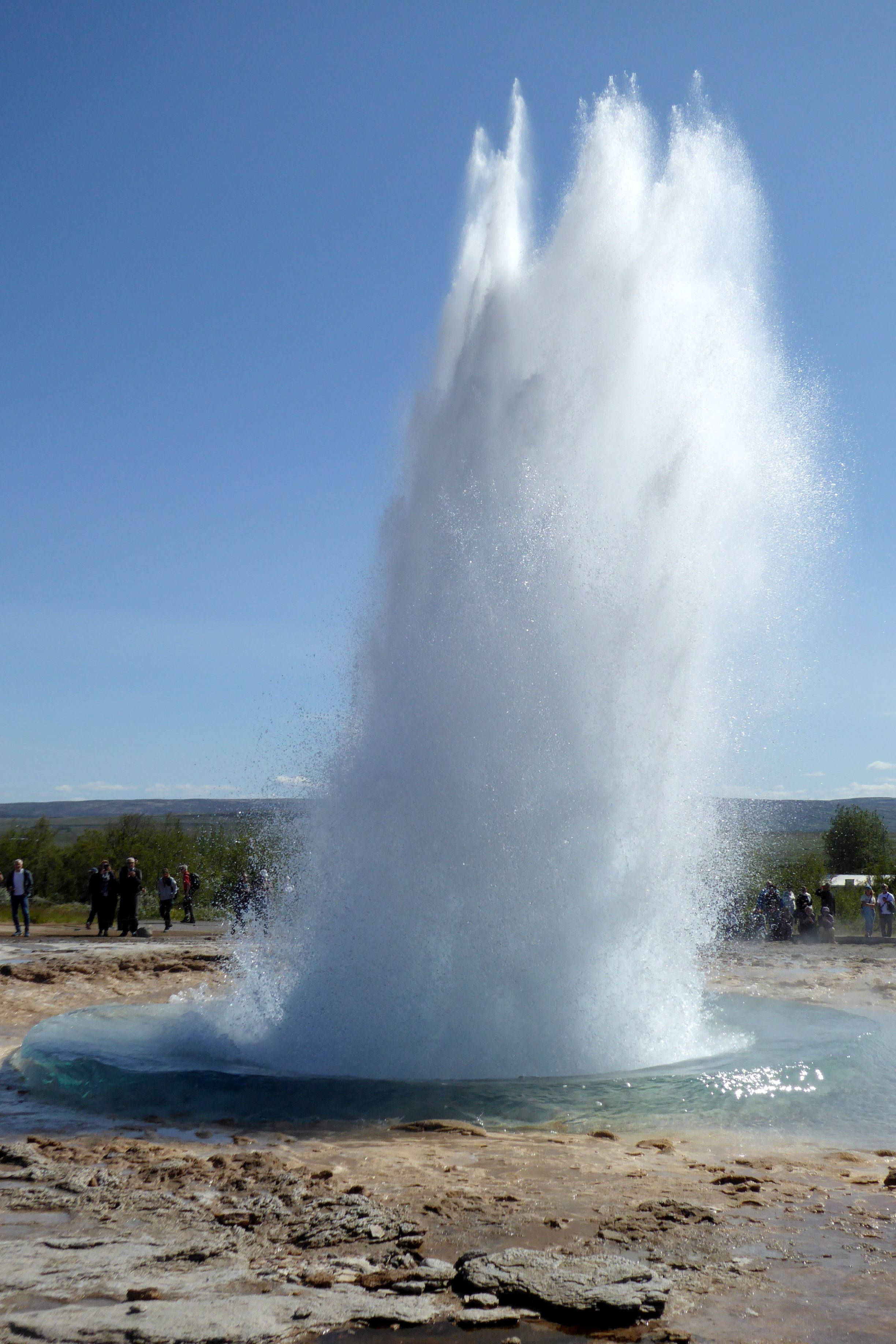
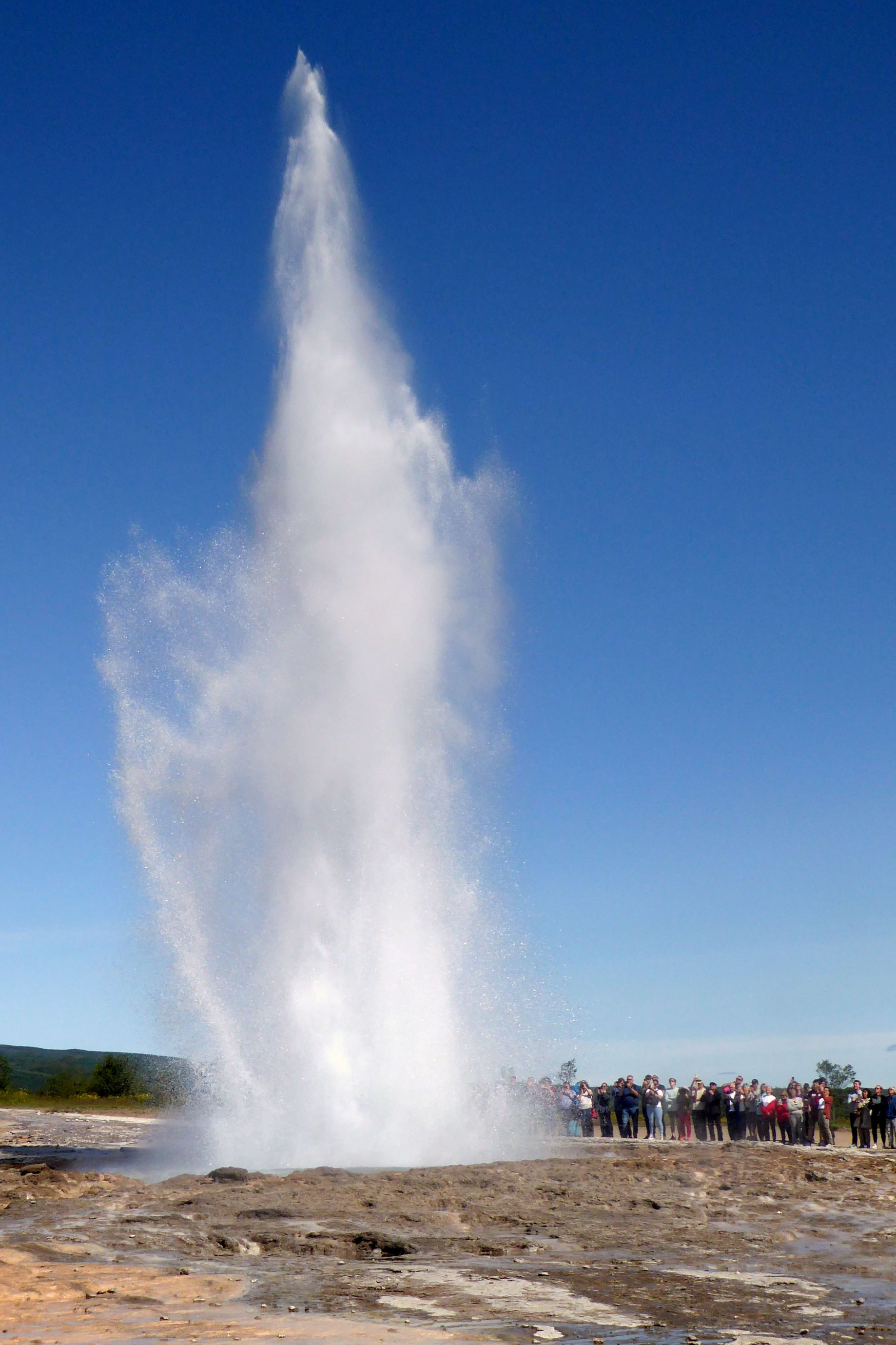
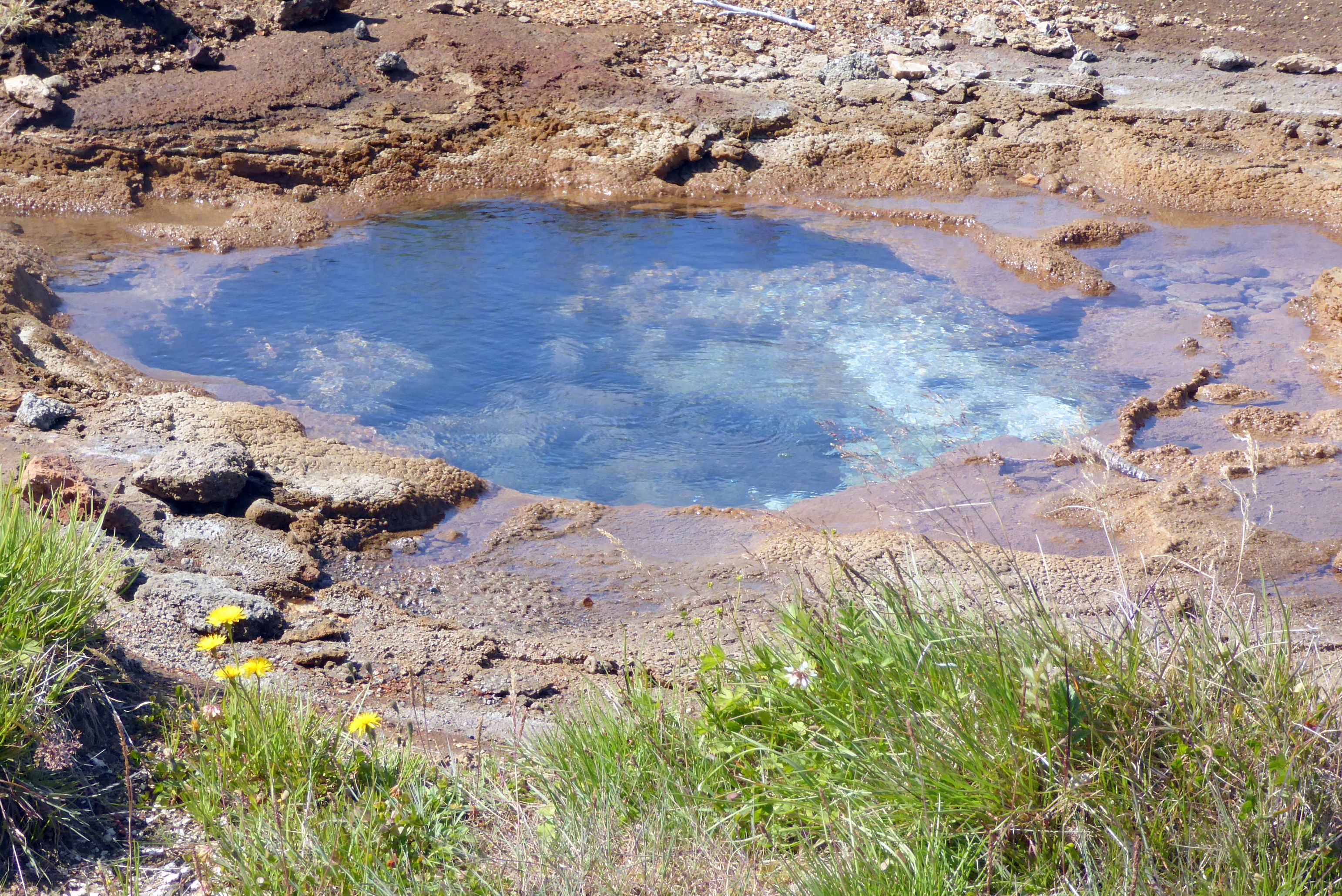
Geysir was a fun and fascinating stop for us. The main draw was the geyser that periodically spouted boiling water a couple of hundred feet up into the air. I watched it 14 times, and Bruce witnessed 16 spouts. (I was hiking up the hill to get a birds-eye view and missed a couple.)
That geyser put on a show for us! The wait was no more than ten minutes each time, and the people gathered around to watch enjoyed the show. We had packed a couple of sandwiches made from the hotel’s breakfast buffet for our lunch, so we sat on a bench and ate while watching for the spouts. (Don’t tell Hotel Selfoss! In our defense, we both had eaten light breakfasts and skipped the hot food buffet. That’s my rationalization, and I’m stickin’ to it!)
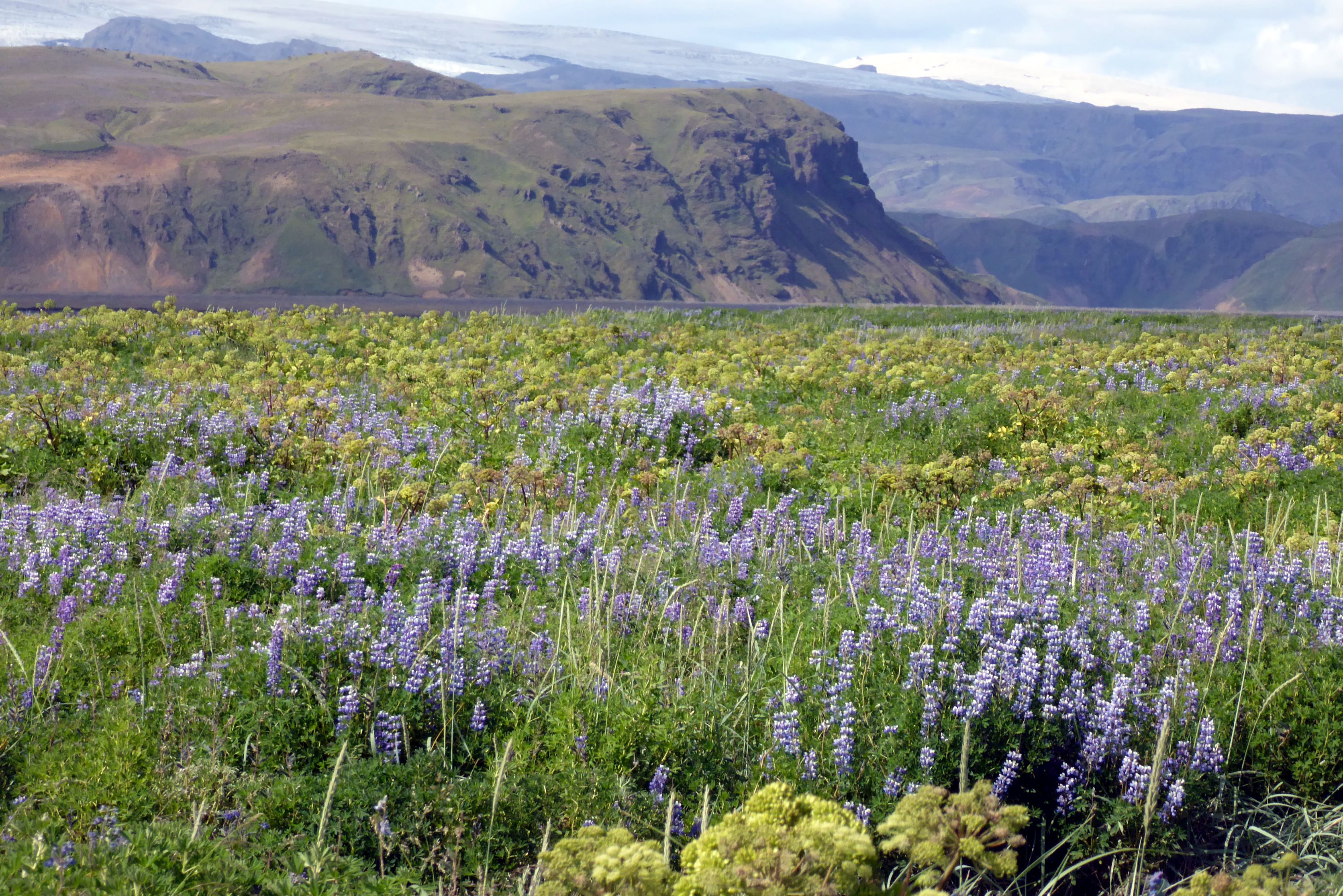
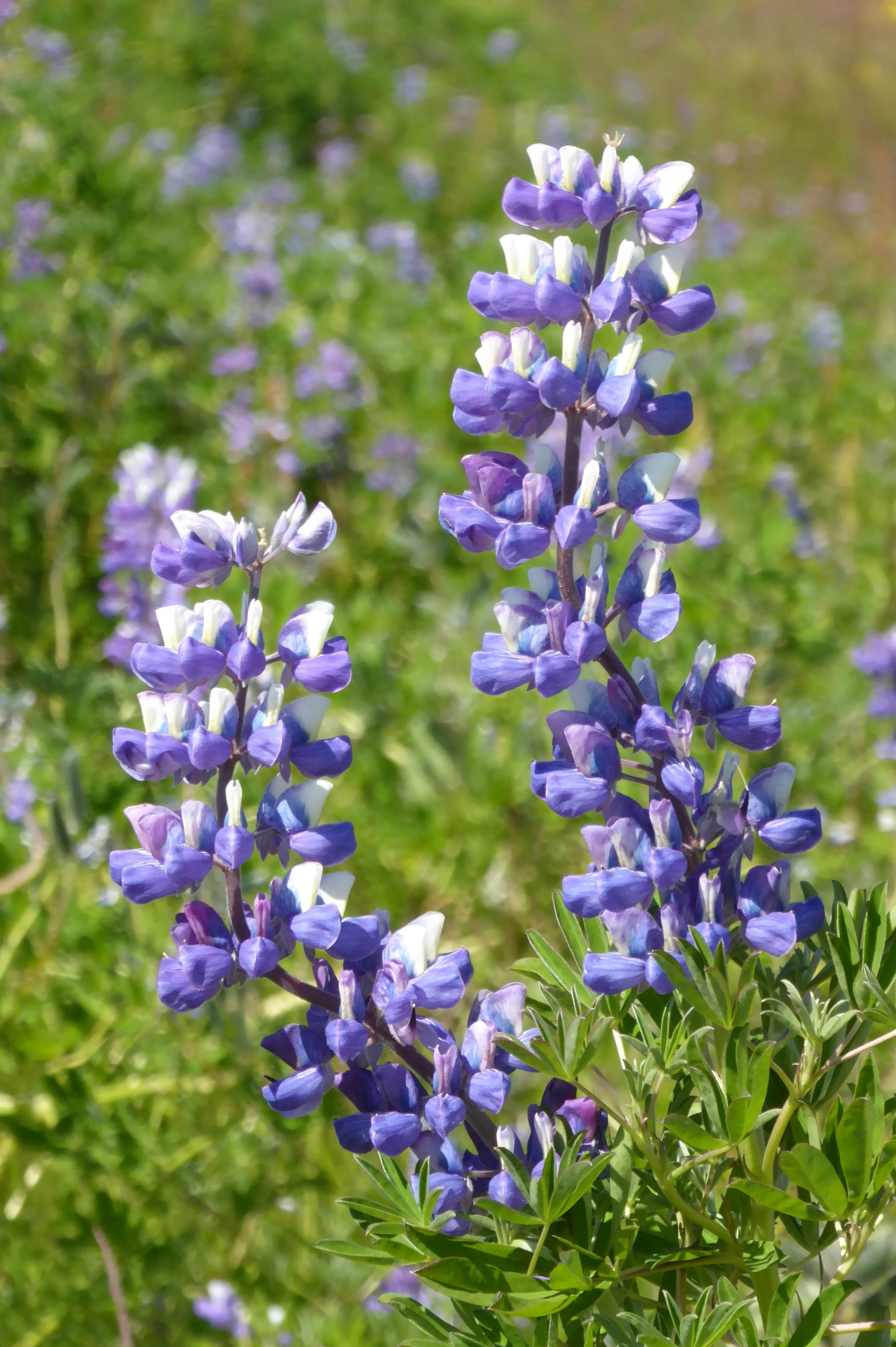
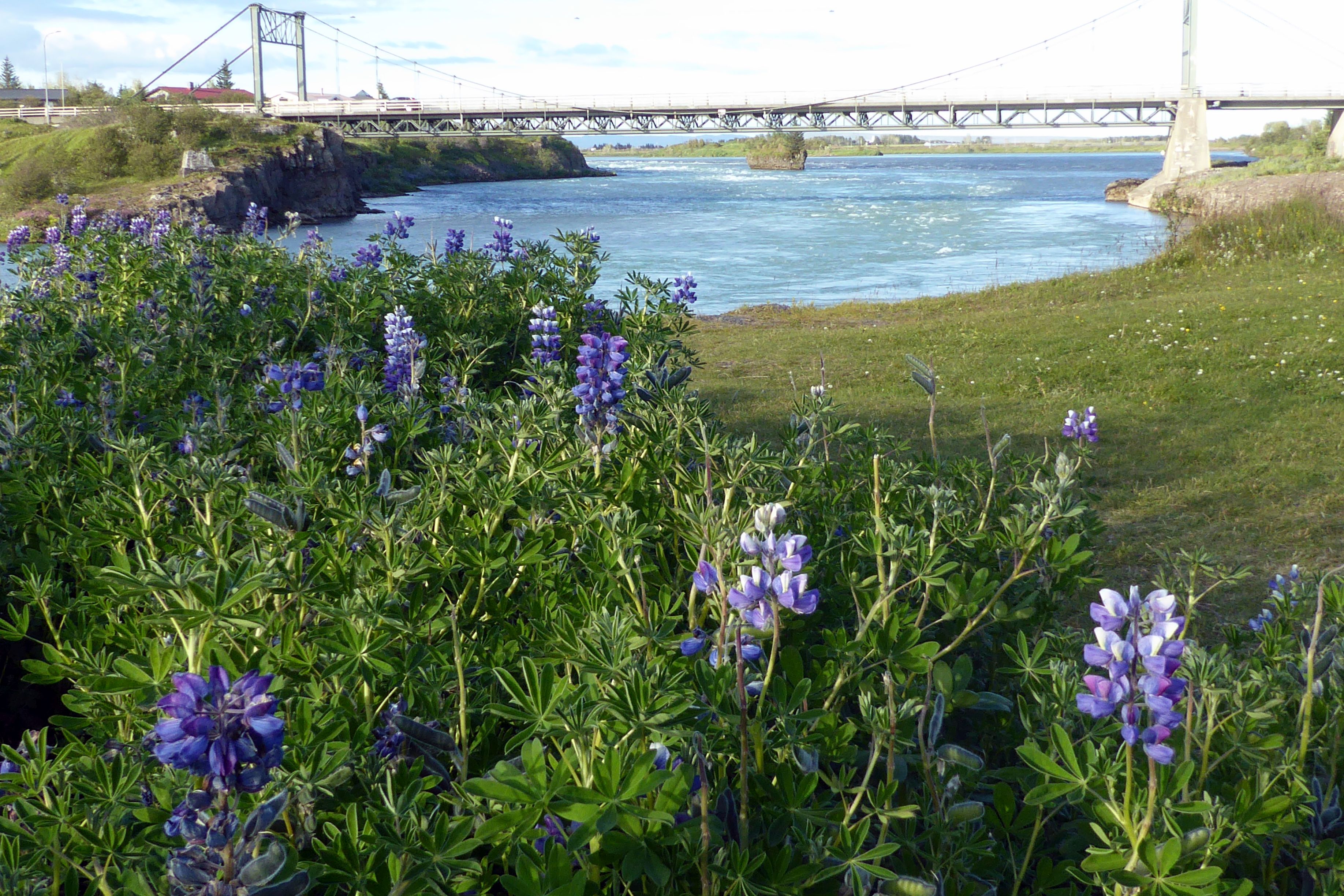
We were so fortunate to be in Iceland during the prime time for lupin. It was growing everywhere throughout the Golden Circle!
A note about the cost of food in Iceland: It is EXPENSIVE, unless you pick up some groceries at Bonus or Kronen. Take Subway, for example, the dreaded sandwich chain that has taken over the world. A foot-long will set you back $15, and a three-course meal in a mid-range restaurant will cost about $50. Add a domestic .5 liter draught beer to that, and you’re looking at about $9. If you think you are going to go really cheap by eating at McDonalds (Just say NO!), your McMeal will cost you $14.
Having done my research, I already knew that we would have some talkin’ to do about the meals that wouldn’t be included on our tour. Bruce and I both decided those included meals (The first one was Arctic Char, a fish similar in appearance and taste to salmon—delicious!) would be enough. We were fine with shopping at Bonus or Kronan (similar to Aldi or Lidl) for some skyr (Icelandic yogurt similar to Greek yogurt, but better!), an apple, and a sandwich.
The grocery prices in those two stores were quite comparable to Publix in the U.S., and it was a fun experience. I love shopping in markets in foreign countries to see what the locals eat, check prices, and look at all of the different products—especially chocolate! (I bought a lot of it…)
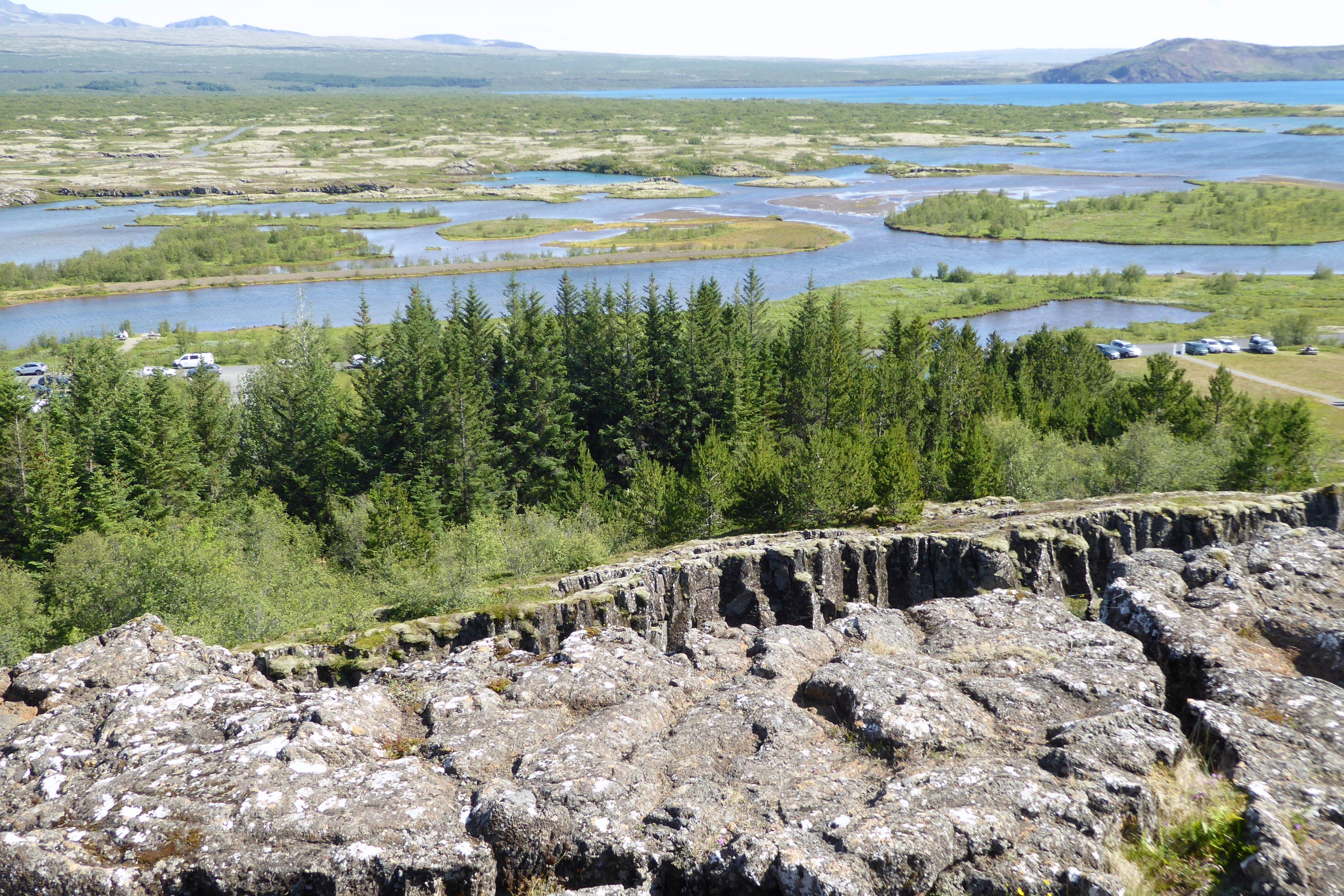
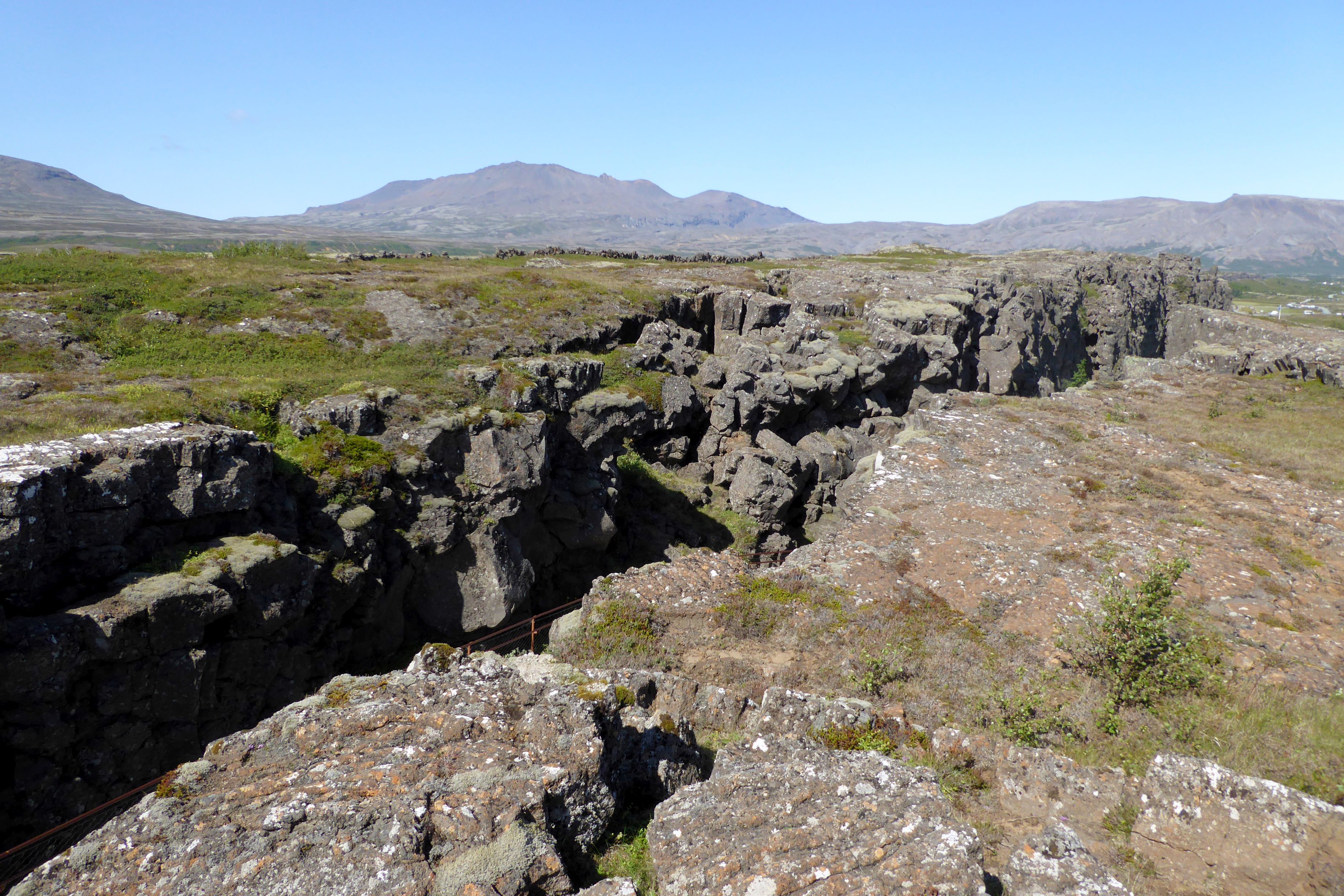
Wow, I sure digressed! Where was I? Oh! Back to the Golden Circle! Next stop: Thingvellir National Park. (That’s how it is spelled in English. Check out the link to see the Icelandic character for “Th.”) A UNESCO World Heritage Site, it has an interesting history. This Wikipedia article gets into much more detail, but suffice it to say the park is a site of historical, cultural, and geological significance. It is also one of the most popular tourist destinations in Iceland. The biggest draw is that you can see the continental drift between the North American and Eurasian Plates. It’s not just the visible cracks (faults); there is a canyon clearly demonstrating the existence of plate tectonics. It was an appropriate location for the world’s oldest Parliament, assembled in 930.
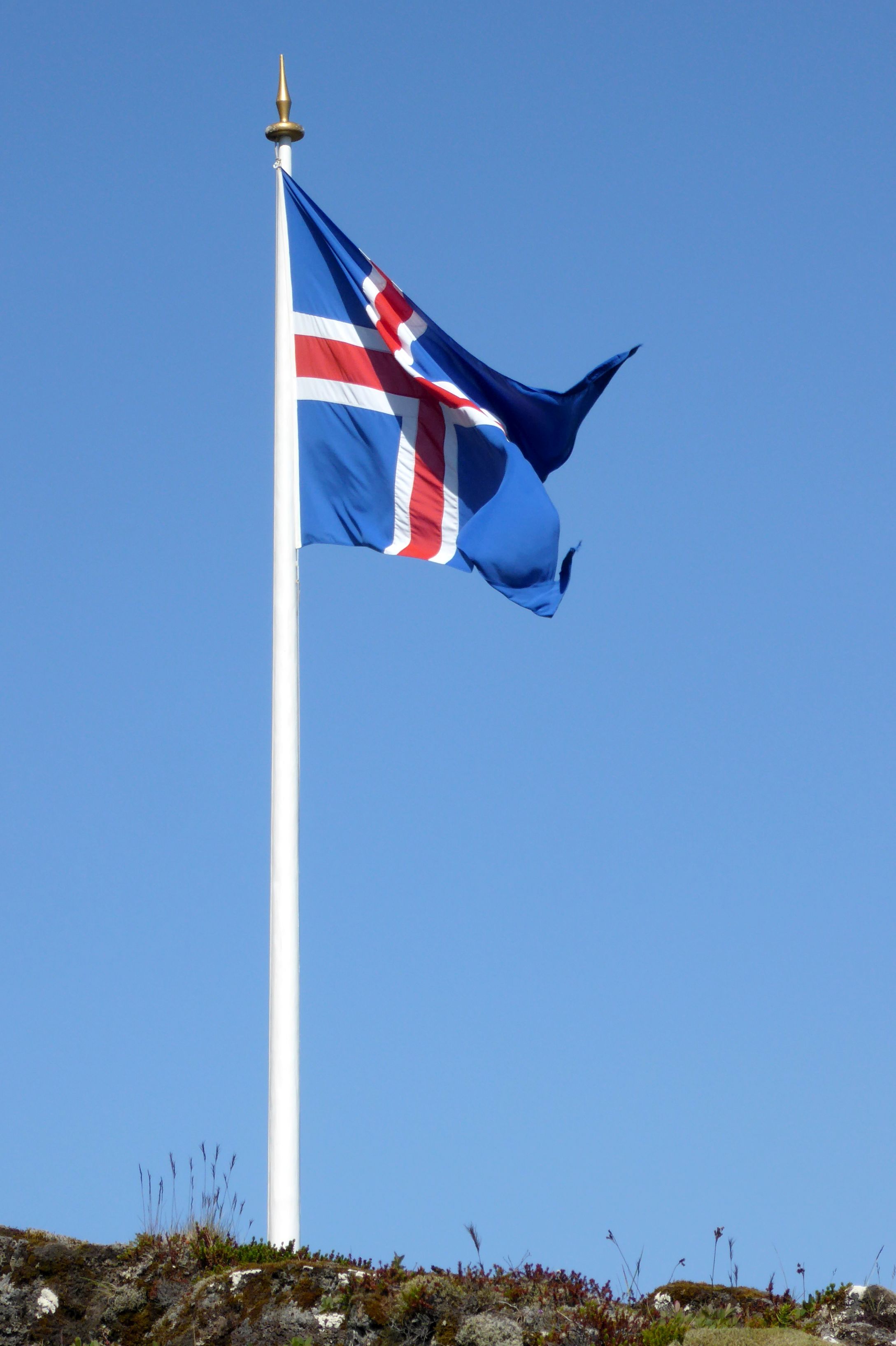
Red represents Iceland’s volcanic fires, white is for the snow and glaciers; and, blue represents the Atlantic Ocean.
Although it was a full day on the Golden Circle, there was still time in the afternoon for a swim at the local Sundlaug (pool). Not only did I get in a good swim workout; but, I met five Icelanders to gift my U.S. Masters Swimming Fitness Series caps to in the process!
Next up: Waterfalls, Puffins, Glaciers, and Beaches! Oh My!!
Note: If small group travel is of interest to you, I highly recommend Overseas Adventure Travel (OAT). Although Bruce and I travel together, they do not charge a single supplement for those who travel on their own. Singles also get their own room at hotels. If you book, you can get $100 off your trip by providing my name and customer number (Elaine Krugman, #3018126) as the person who referred you. I will also get $100 off future travel– a win-win!
The first swing and a miss was in 2008, when it was a scheduled port on a trans-Atlantic cruise I was working on with my mom, teaching arts and crafts classes. Somehow, we made it into Qaqortoq, Greenland – a rarity, due to the frequency of high seas and/or winds making it dangerous for operating the tenders. Our captain said we were extremely lucky, so I was grateful. It was a wonderful experience.
Our next port, Reykjavik, Iceland, was supposed to be a sure bet; however, a storm brewed in the North Atlantic, and we had to change course.
It wasn’t until 2020 when I took another swing, and it was a BIG miss: COVID. Don’t even get me started…
As you know from my last post, this swing yielded a home run! Forget the ships; our small group land tour was the way to go.
Why Iceland? I had been intrigued by Iceland since learning about their progressive country as a teenager; and, as time went on and I grew up, Iceland continued on that positive course.
Iceland is one of the world’s most feminist countries and ranked among the top three countries in the world for women to live in. It is the first country to have a political party formed and led entirely by women, and nearly half of parliament members are women. They were the first country to have a female president.
Icelandic women are more likely to get university degrees than men, up to the PhD level, and the country has the world’s highest proportion of women in the labor market. As an extra bonus, they have the smallest overall gender gap.
More favorite facts:
Iceland’s literacy rate is among the highest in the world, ranking #3. Books are the traditional gift exchanged at Christmas.
Iceland ranks in the top five happiest countries in the world—and, the 2008 – 2011 financial crash did not affect that ranking.
Iceland is ranked 3rd in the world for median wealth, and it is nearly a classless society.
Iceland is ranked 1st on the Global Peace Index; and, there are no murders and very little crime.
Iceland has a stellar environmental record.
Iceland is an open, tolerant, and prosperous society with a strong safety net of social welfare programs.
What’s not to like?
Well, there are those cold, dark Iceland winters…
Traveling to Iceland during the summer was a joy, though! The days were long; and, the high 50’s and low 60’s (Fahrenheit) temperatures during our 13 days was a welcome respite from the miserably hot and humid temperatures down here in Georgia. We even had a couple of days that reached 64 degrees. So much for the multiple pairs of Hot Hands I packed for the trip. I only needed them on one cold, rainy day and during our whale watching trip. Those suckers work! I stuck them in my gloves, and my hands were toasty!
As an English-speaking American, Iceland is an easy country to navigate. Thankfully, nearly all Icelanders speak English fluently, because studying the language is mandatory in Icelandic schools. What a relief! I tried to teach myself some Icelandic phrases, but their language is extremely difficult, and I was unable to pronounce the words correctly.
Besides Iceland’s progressive culture and (awesome!) society, there were so many other reasons to travel to this wonderful country. Hopefully, in the coming blog posts, my photos will do the natural wonders we saw some justice. At times I wondered what planet or moon I was on, because the landscape was so visually foreign to me; but, it was always beautiful, even if in a strange way.
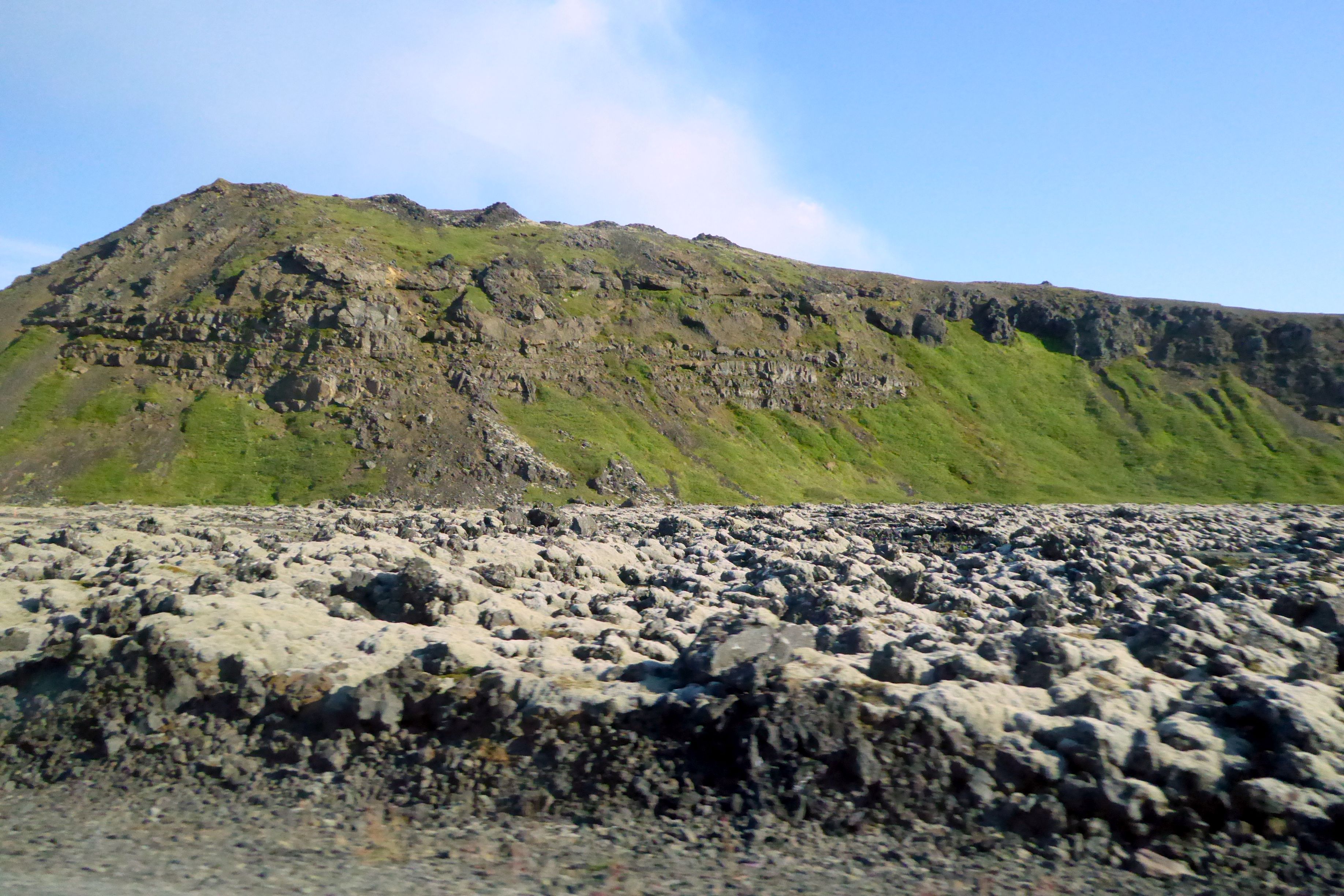
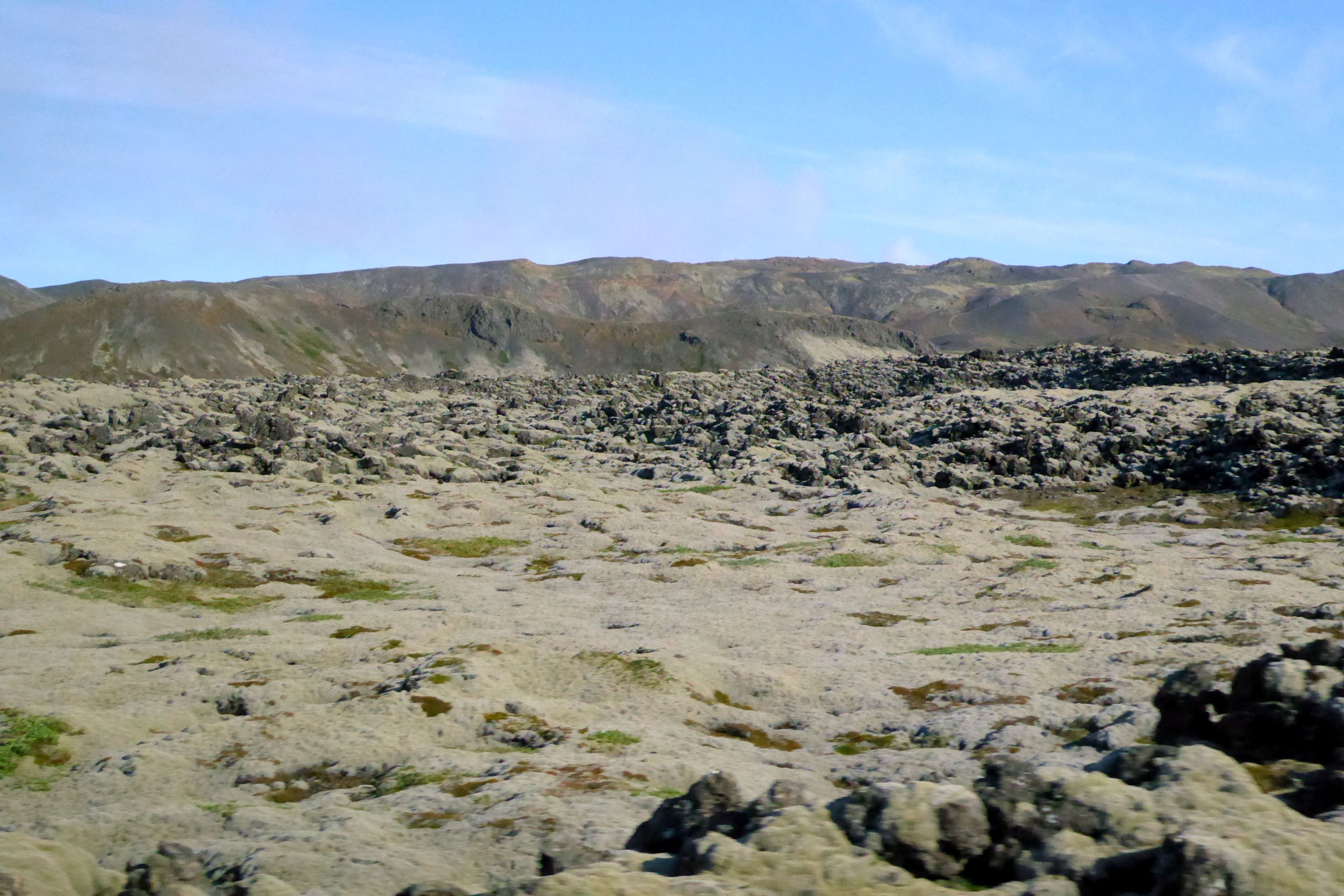
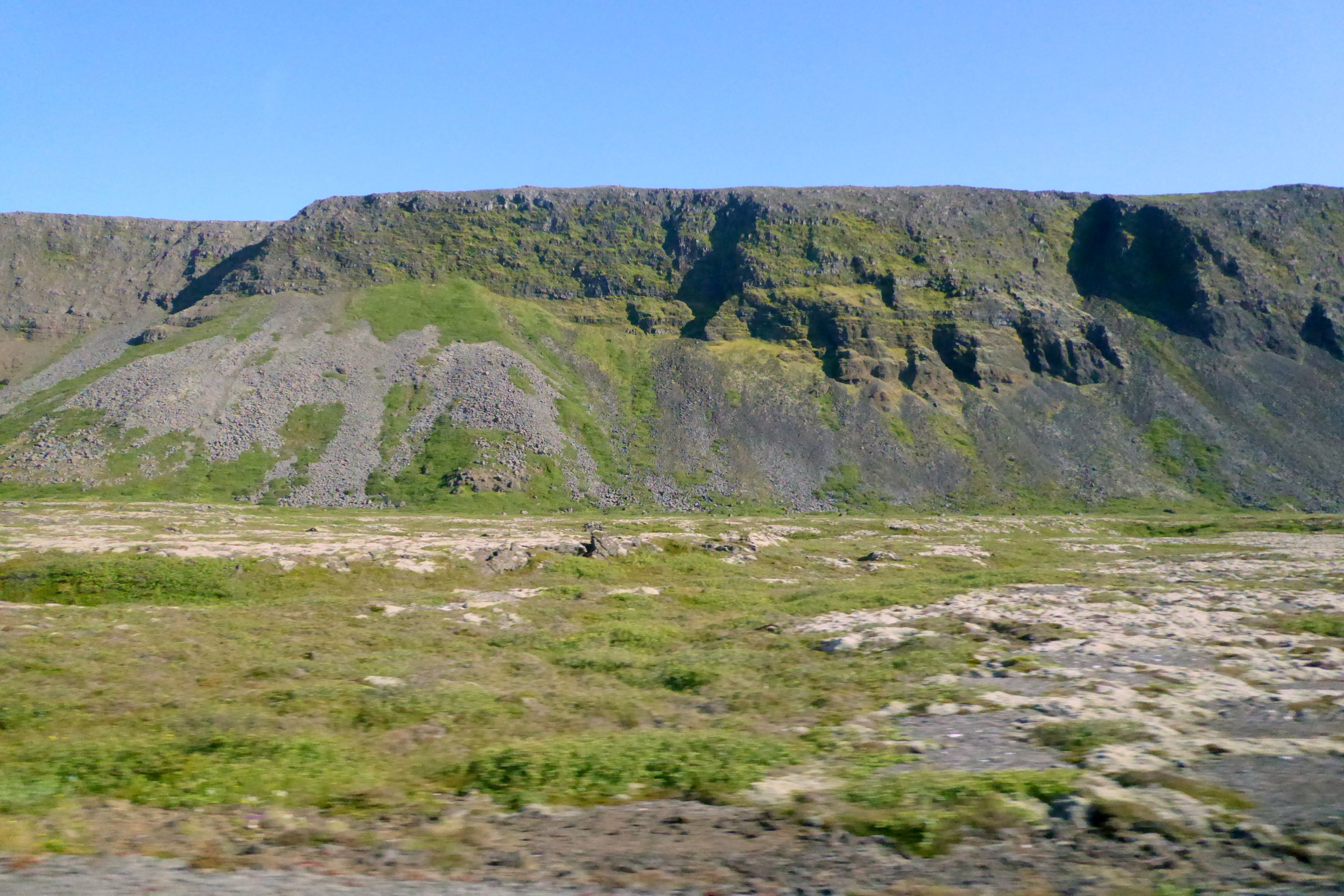
Until next time, I will leave you with some photos I shot out the bus window during our drive from the airport to Selfoss (our base for three nights) as well as a few from around our hotel. After our morning arrival and breakfast, we had the afternoon free before convening for our orientation and welcome dinner, so after a quick look around town, I headed straight to the community pool for a jet lag-combating swim. Ahhh!
(For all pictures, click on the image to see full screen view.)
According to Wikipedia: The geology of Iceland is unique and of particular interest to geologists. Iceland lies on the divergent boundary between the Eurasian plate and the North American plate. It also lies above a hotspot, the Iceland plume. The plume is believed to have caused the formation of Iceland itself, the island first appearing over the ocean surface about 16 to 18 million years ago.[1][2] The result is an island characterized by repeated volcanism and geothermal phenomena such as geysers.The view from our room at Hotel Selfoss
Long shoe horns must be a thing in Selfoss. Both our hotel room and the pool shoe rack had them!
Coming up next: Circumnavigating the Golden Circle
Note: If small group travel is of interest to you, I highly recommend Overseas Adventure Travel (OAT). Although Bruce and I travel together, they do not charge a single supplement for those who travel on their own. Singles also get their own room at hotels. If you book, you can get $100 off your trip by providing my name and customer number (Elaine Krugman, #3018126) as the person who referred you. I will also get $100 off future travel– a win-win!
During the last half of July, Bruce and I traveled to Iceland on a small group tour with Overseas Adventure Travel. To begin my blog series on this wonderful country, I am copying in an article I wrote for the upcoming Georgia Masters Swimming Newsletter, as part of my “Elaine’s Tip of the Month” series:
ELAINE’S TIP OF THE MONTH: SWIMMING IN FOREIGN COUNTRIES
Is foreign travel in your plans? If so, don’t forget to pack your swim gear and caps! “Caps?” you ask? Wouldn’t I only need to bring one? Well, yes, but I’m not referring to the cap you will be wearing. I’m talking about all those swim caps you have accumulated from swim meets, fitness events, and charity swims. How many of those caps will you actually use?
I had tried to give mine away to coaches to give their age group swimmers, but nobody wanted them. They had plenty of their own to give away. Pleas on the USMS Community (Discussion Forums) and on the Georgia Masters Facebook page were dead-ends. This time, I had 21caps, so I took them with me to Iceland.
Iceland? There are public swimming pools in Iceland? Yes! There are 121(!) public swimming pools in a country roughly the size of Kentucky with less than 10% of Kentucky’s population. Even the smallest towns have a public pool with spas, which serves as the daily meeting place for the community—especially in the geothermal-heated spas where spirited conversations take place. Pools are a vital part of the typical Icelandic small-town community, and children are required to learn how to swim in early childhood.
That brings me to my first tip about swimming in foreign countries. (We’ll get back to those caps later.) First, check out http://swimmersguide.com to locate pools anywhere in the world.
Next (and this is an important one), research the swimming culture in your designated country, so as not to offend the locals. In Iceland, shoes are not permitted to be worn in the locker rooms for sanitary reasons. There are shoe racks located in the lobby outside of the locker rooms where you leave your shoes before entering. (Two of the pools I swam at had shoe trays, so you could place your shoes in your locker.) Secure lockers were also provided for free, so there was no need to bring a lock with me.
The shoe rack at the pool in Selfoss, Iceland.
They even supplied long shoe horns (on the chain) to make putting your shoes back on a little easier!
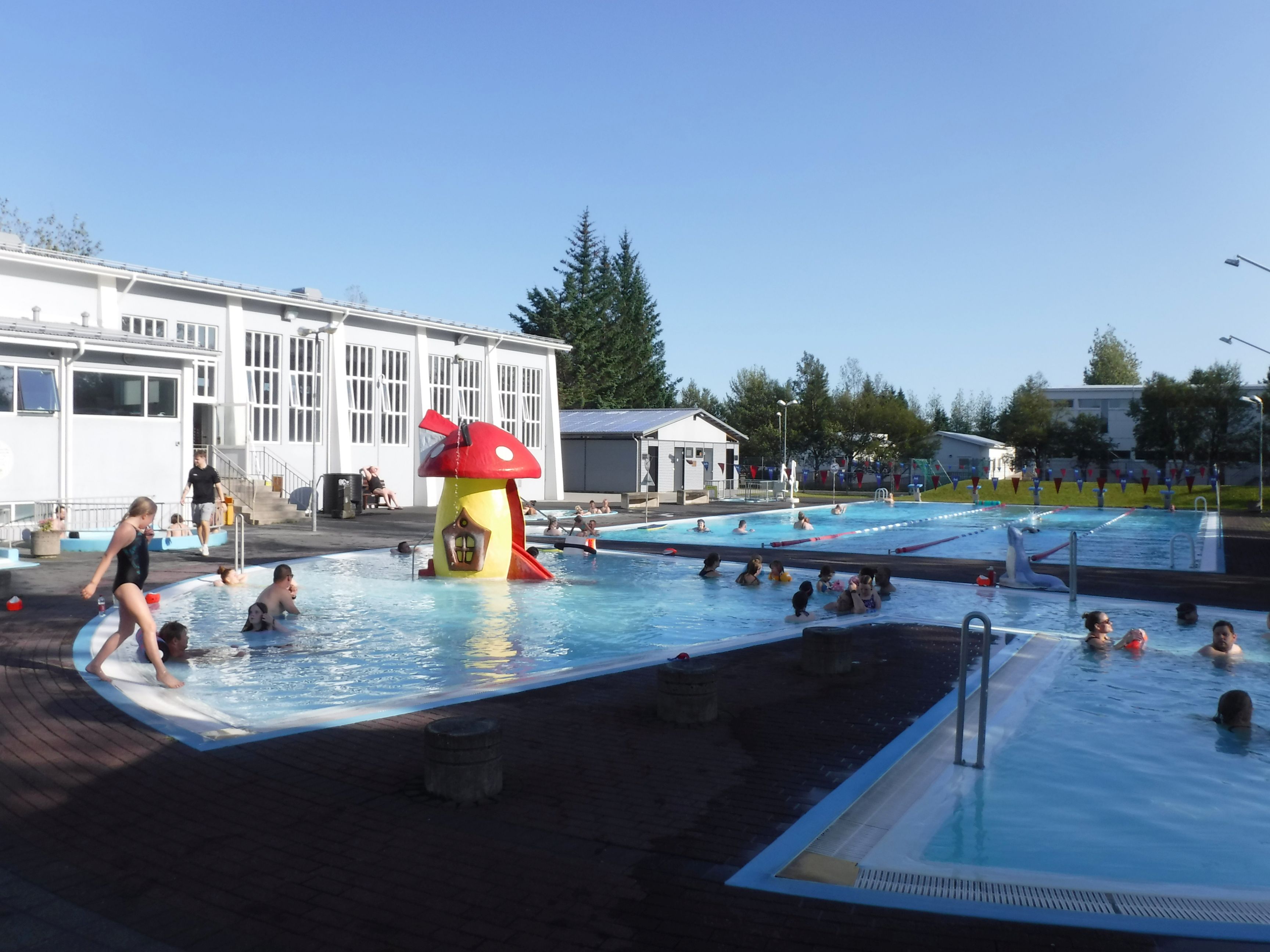
The children’s pool and spas had water temperatures posted. The pool in Selfoss had several spas, each kept at a different temperature. They even had a cold-water dunk tank. I passed on that one! After taking this photo, I learned that cameras and cell phones are strictly prohibited in the locker rooms and pool area.
Most importantly, it is required to shower WITHOUT your suit before you swim in Iceland, and the showers are not private. Naked women and children showered in the shower room without a care, donned their suits, and off they went, leaving their towels behind in the designated towel cubes rather than taking them out to the pool.
I was able to get in four late-afternoon swim workouts in three Icelandic towns during our two-week small group tour, in July. Although I left my towel in the locker room each time, I did bring my caps out with me to give away. It was a great conversation starter and a fun way to meet the locals—one of the most enjoyable aspects of international travel for me. I approached every swimmer I saw wearing a cap and asked if they would like to have a free cap from the U.S.A. A few were skeptical, but once they understood there wasn’t a catch, they were excited. Many of the swimmers took their own caps off and put on their new one.
As it turned out, one of the swimmers I met in Akureyri, Gudrun, was elected to the board of the Icelandic Swimming Association—the very organization I contacted about Masters Swimming in Iceland! We exchanged e-mails and are keeping in touch. (By the way, they are looking for coaches, so if you would like to coach in Iceland, let me know!)
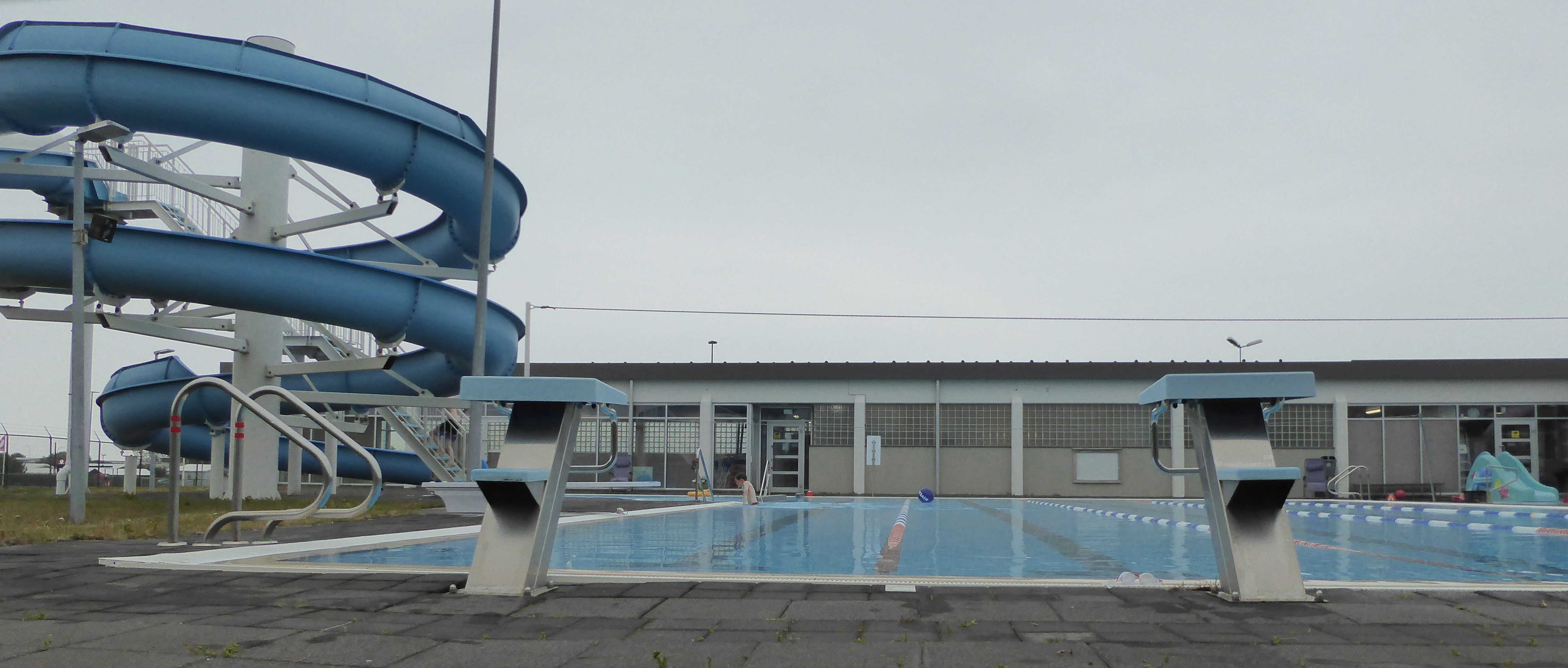
Since cameras and cell phones are prohibited inside the pool area, I shot this photo in Akureyri from behind the glass at the street. And, yes, I tried out both water slides. Terrifying!The pool in Stykkisholmur, photographed from outside the fence after the pool had closed. This slide wasn’t quite as terrifying.
Swimming in Iceland—and giving away my 21 caps—made my trip to Iceland so much more enjoyable than if I had left my swim gear at home. Give it a try next time you travel internationally and create some memories of your own!
Next up: I finally made it to Iceland!
Note: If small group travel is of interest to you, I highly recommend Overseas Adventure Travel (OAT). Although Bruce and I travel together, they do not charge a single supplement for those who travel on their own. Singles also get their own room at hotels. If you book, you can get $100 off your trip by providing my name and customer number (Elaine Krugman, #3018126) as the person who referred you. I will also get $100 off future travel– a win-win!
What did I get myself into? Overseas Adventure Travel solicits videos for their website, so I decided to make a slide show of this trip. It was my first attempt, and it’s just a basic show without all the fancy transitions. To watch full screen, start the video, and then expand to full screen by clicking on the symbol in the lower right corner.
I hope you enjoy!
Ciao!
Note: If small group travel is of interest to you, I highly recommend Overseas Adventure Travel (OAT). Although Bruce and I travel together, they do not charge a single supplement for those who travel on their own. Singles also get their own room at hotels. If you book, you can get $100 off your trip by providing my name and customer number (Elaine Krugman, #3018126) as the person who referred you. I will also get $100 off future travel– a win-win!
…do as the Romans do. Well, at least that’s how the saying goes. I had done that with my mom for five days in past travels, and Bruce opted not to do the Rome post-extension of our base trip. We both had decided we preferred to use our travel budget in other ways. So, our last full day in Italy was spent in Rome, before flying out the following morning.
(For all pictures, click on the image to see full screen view.)
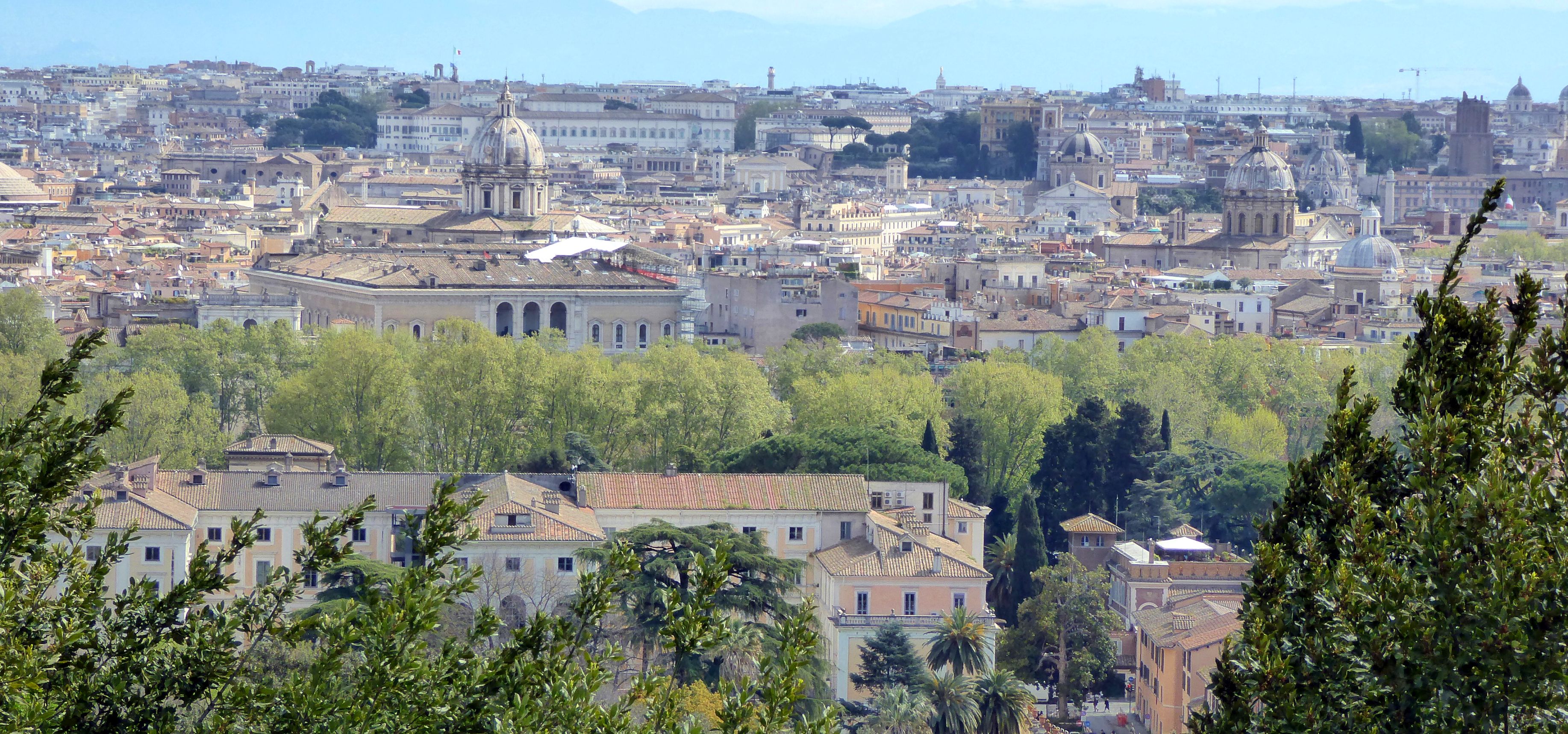
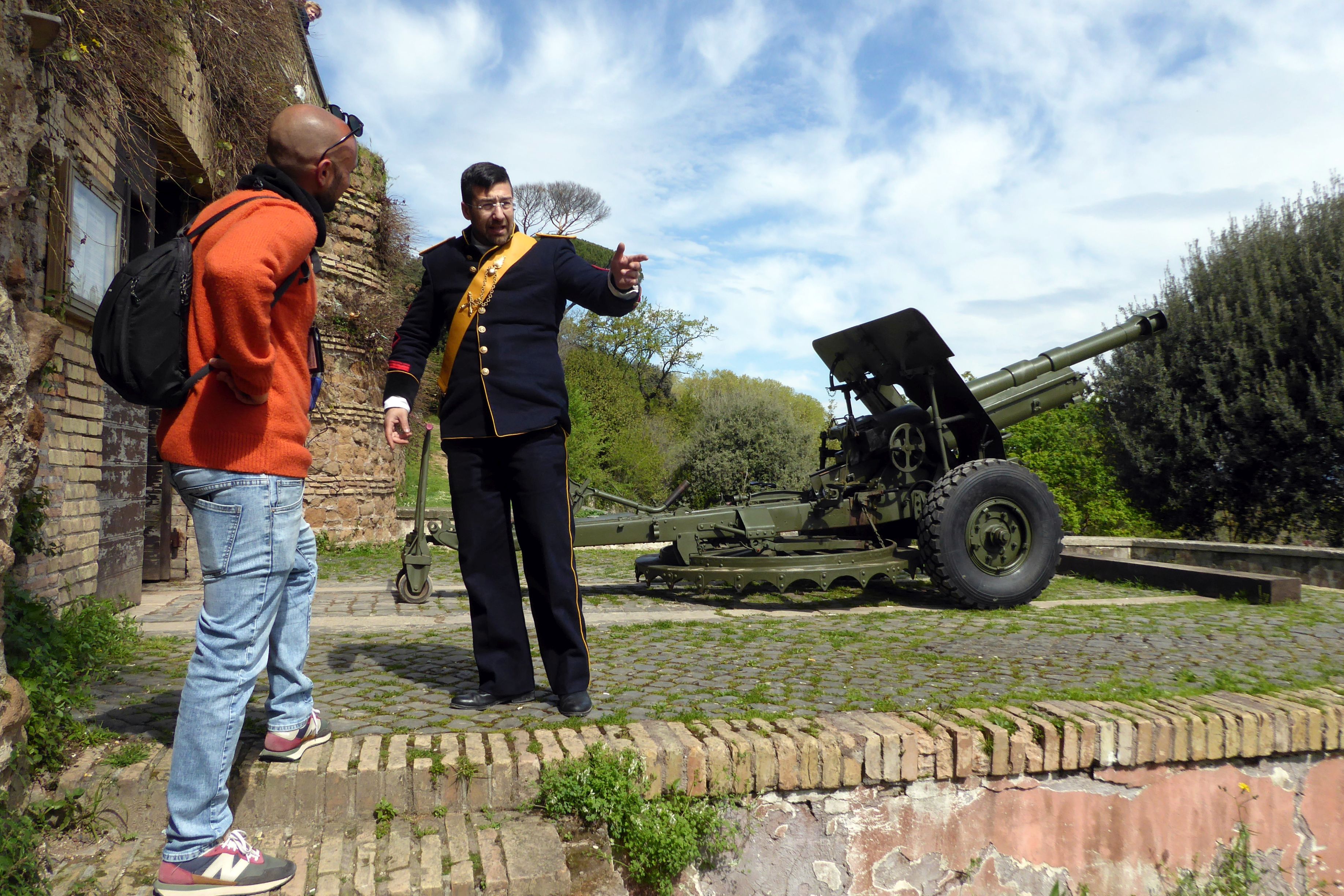
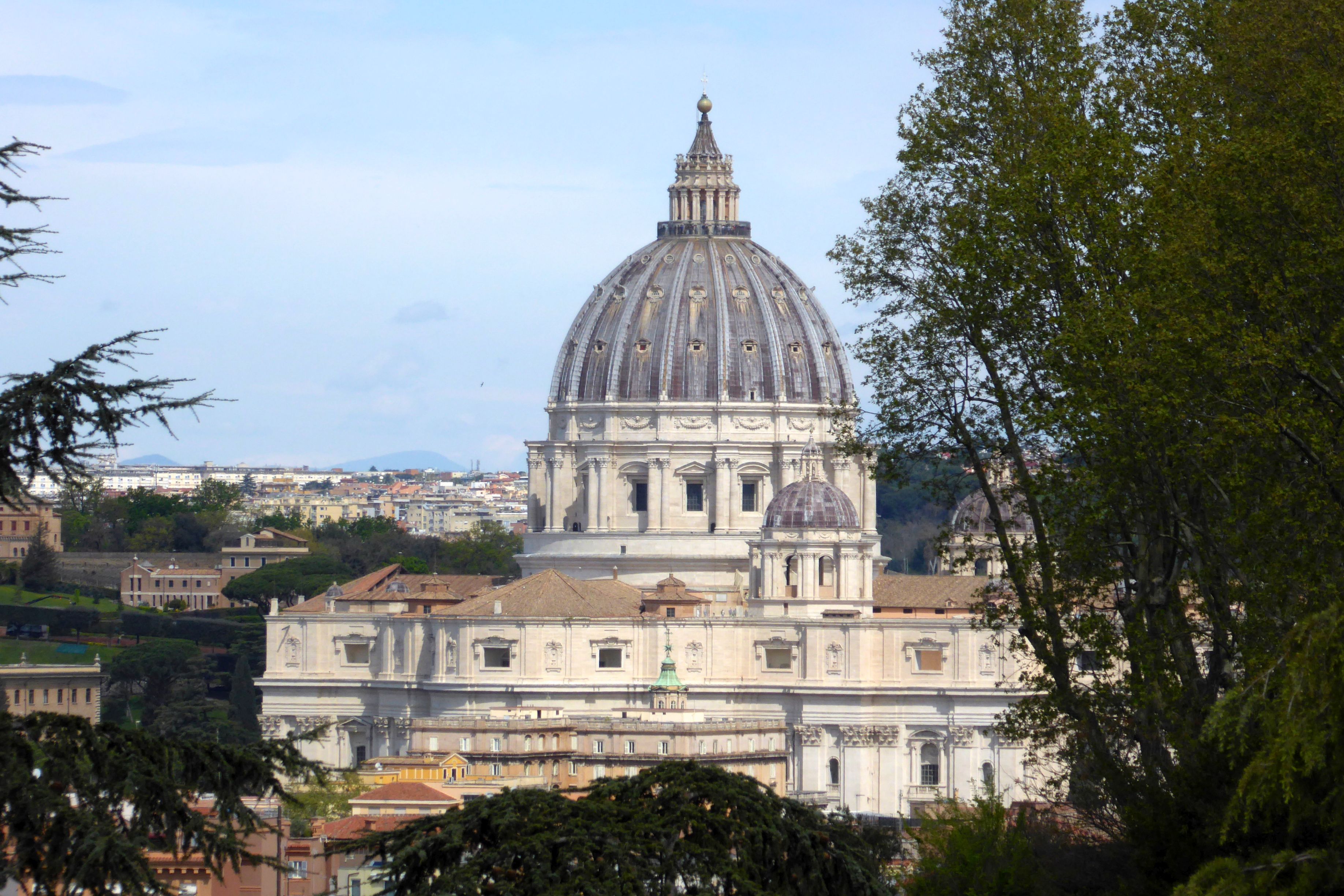
Our day in Rome began with a walking tour in the Trastevere district, conducted by a local guide. The timing was just right to be at Gianicolo Hill. Our guide was friends with the military officer in charge of firing off the noon cannon that day, so we were invited down to meet him and have a closer look.
Prior to December 1, 1847, the sound of numerous Roman tower bells would sound at noon. The thing is, “noon” meant something slightly different to each bell ringer. The ringing would go on and on. That was until Pope PIO IX decided it was time to coordinate the official time by replacing the bell ringing with a single gunshot, fired from Castel Sant’Angelo.
This traditional gunshot was kept there throughout the period of Italy reunification, until 1903. It was then transferred for a few months to the slopes of Monte Mario, and then finally to Gianicolo Hill. It is currently shot off by a 105/22 howitzer model 14/61 nicknamed “the monster.” It sounded like a monster; the shot was loud!
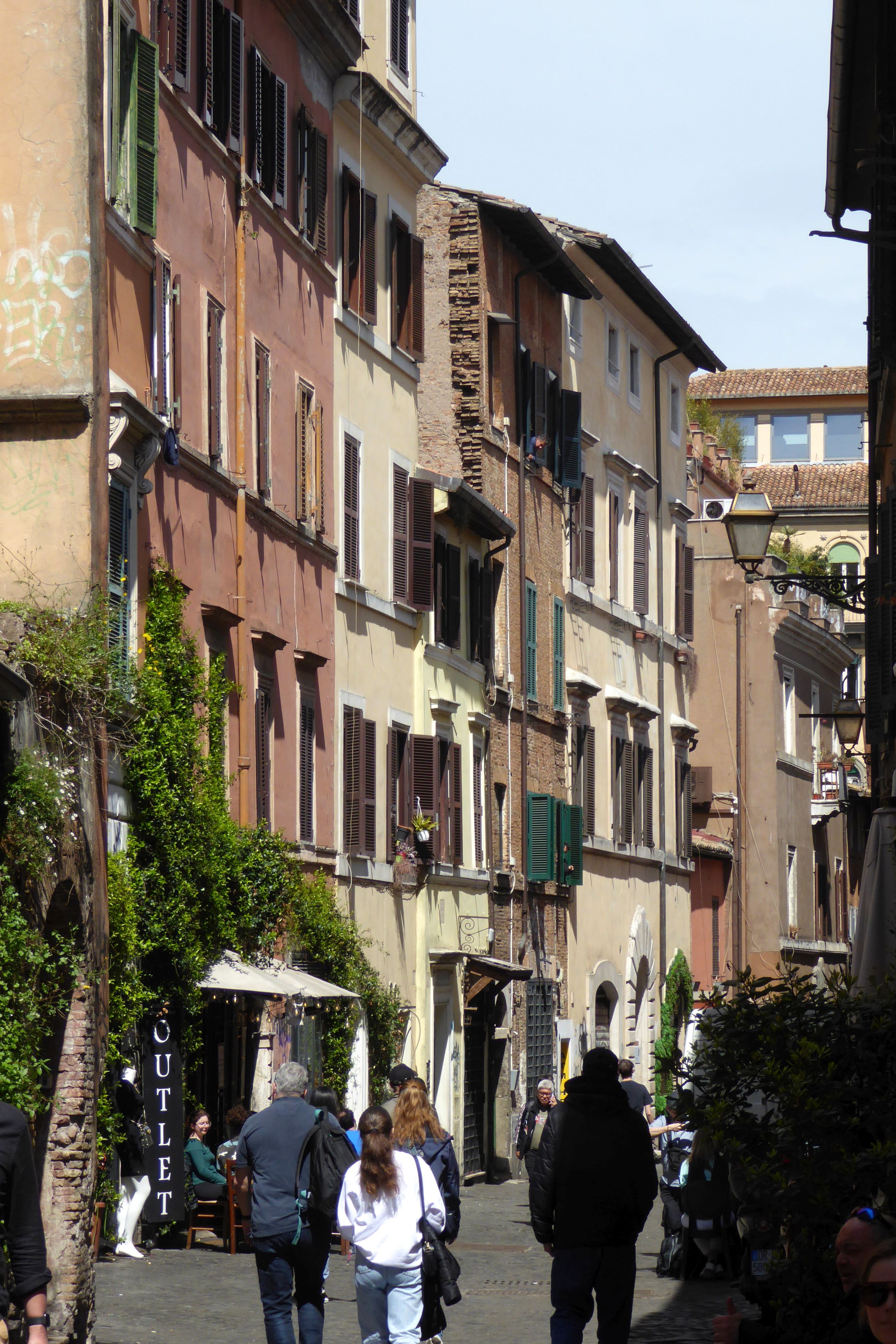
We continued walking through the quaint cobbled streets of the Trastevere district before ending our tour at Tonnarello for lunch. The place was bustling, but somehow, they cranked out delicious pasta and dessert.
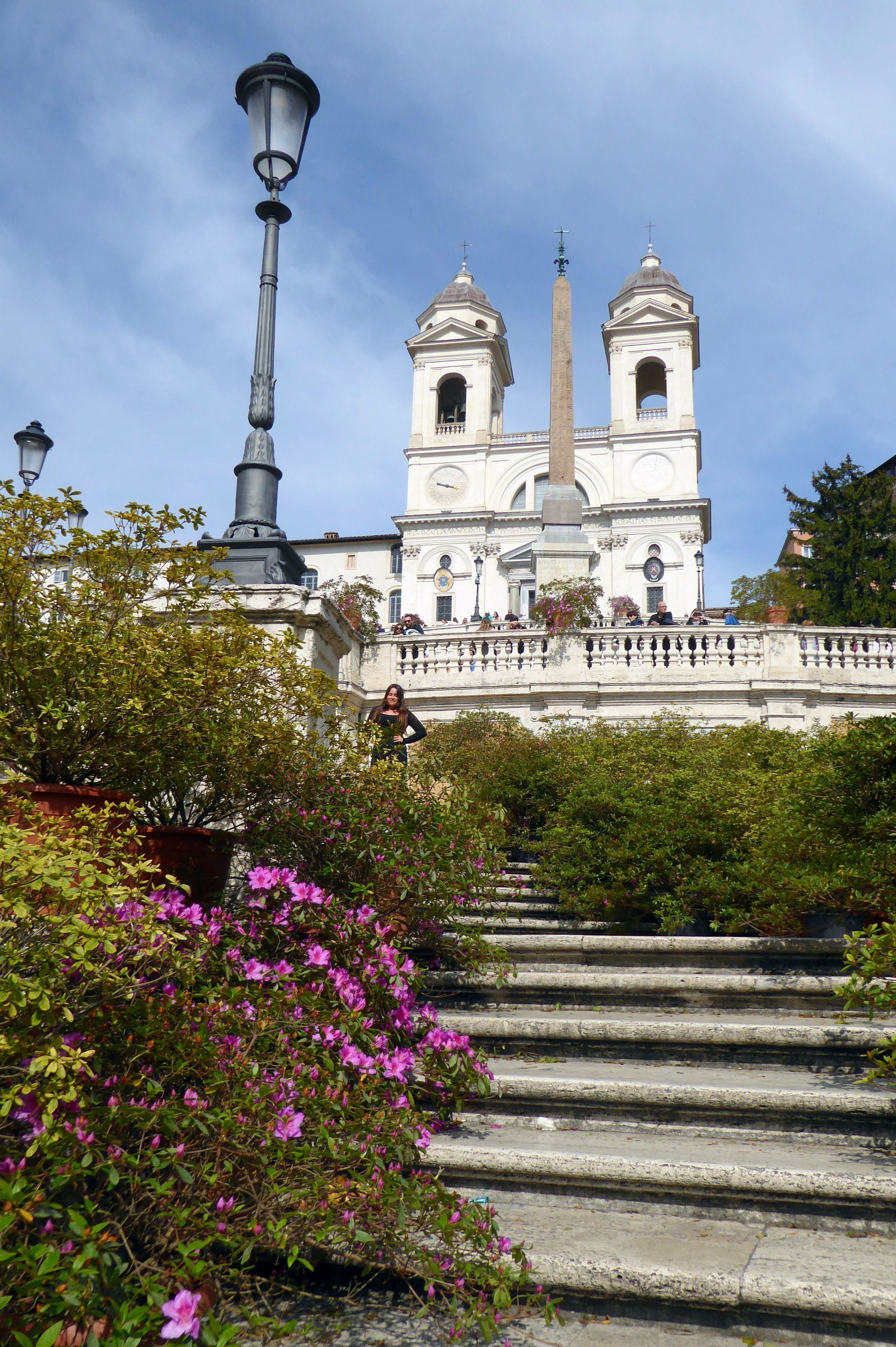
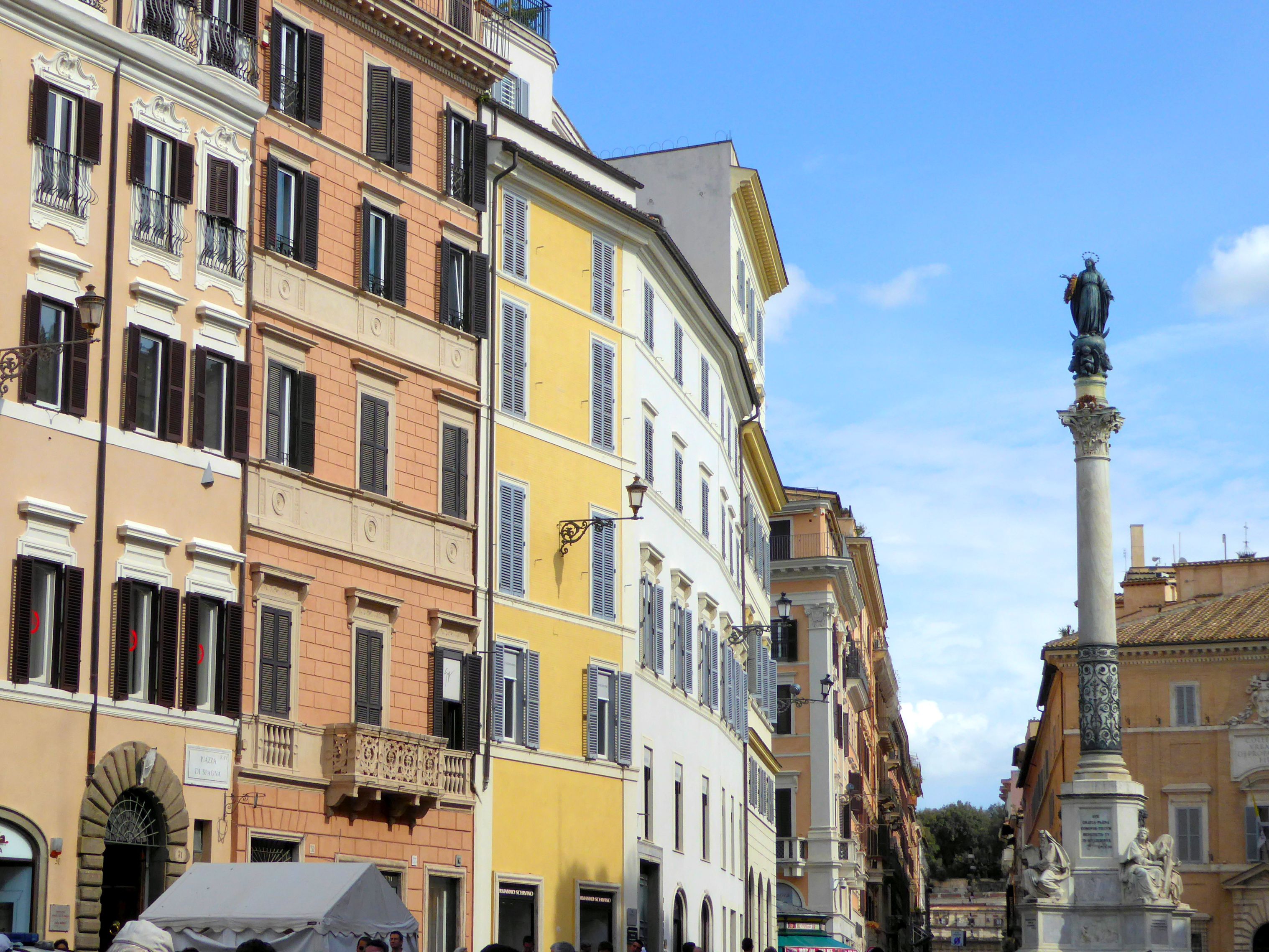
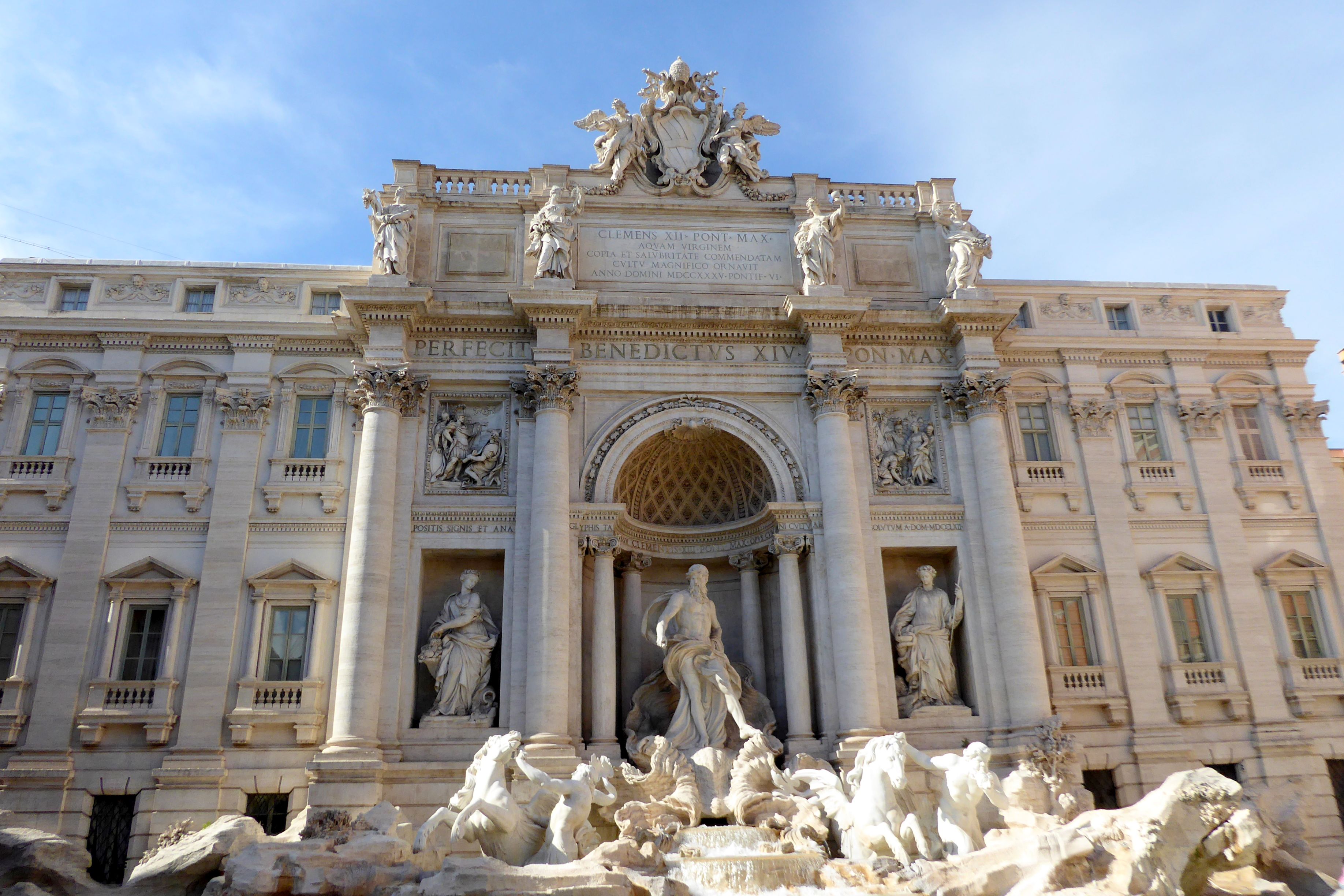
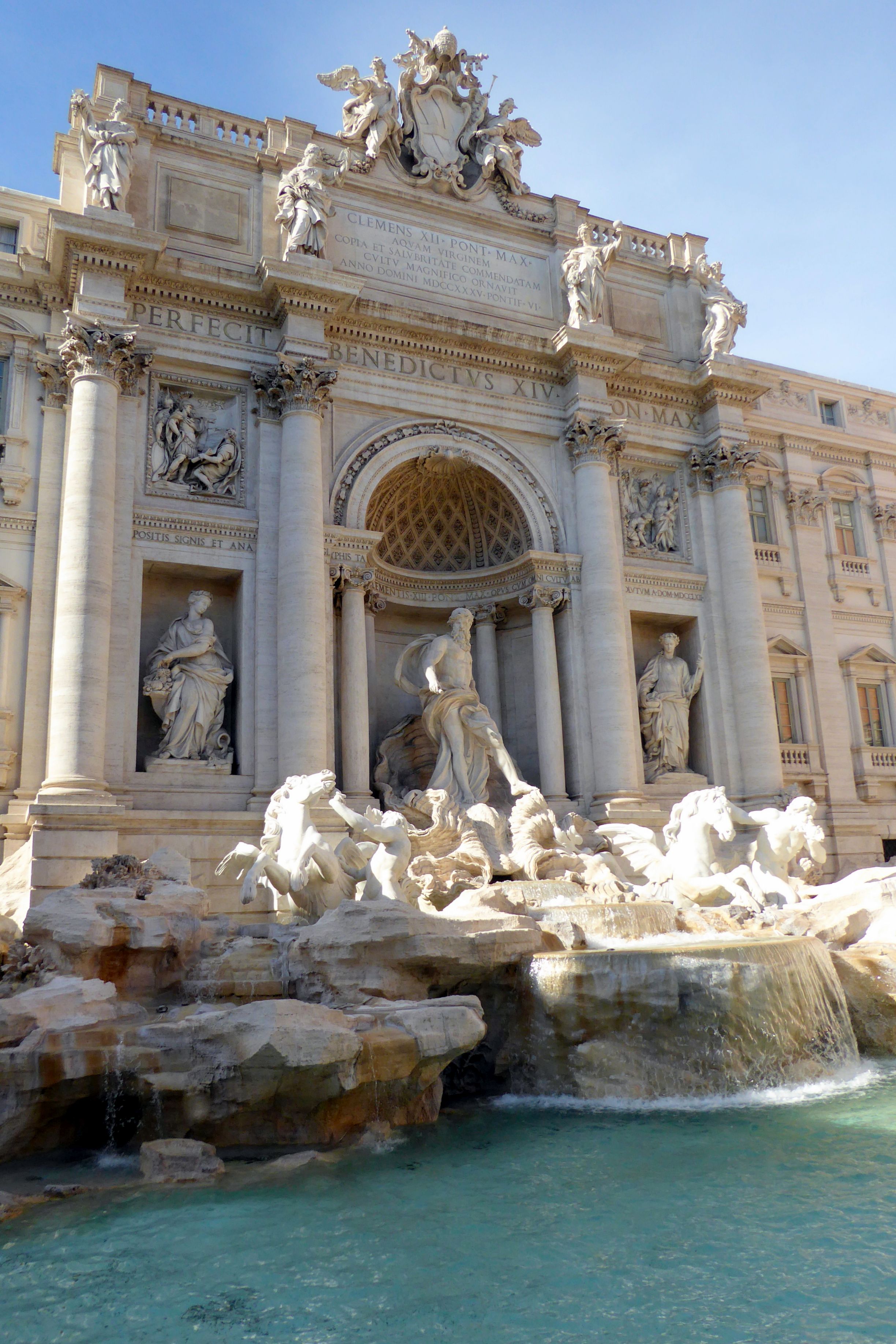
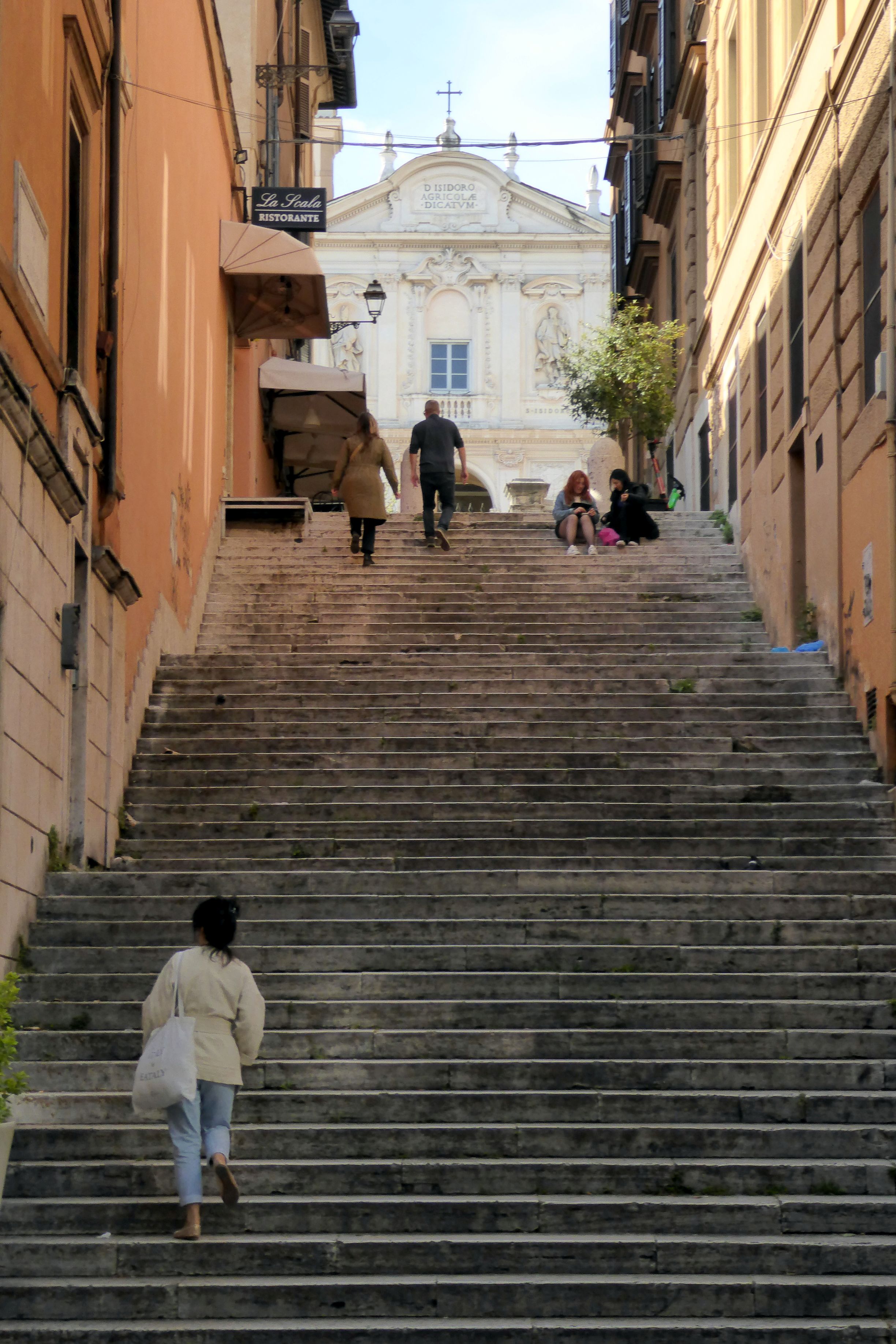
After moving on to our hotel and settling in, Ben led us through the busy streets of Rome to see the Spanish Steps and Trevi Fountain, before turning us loose on our own until our farewell dinner.
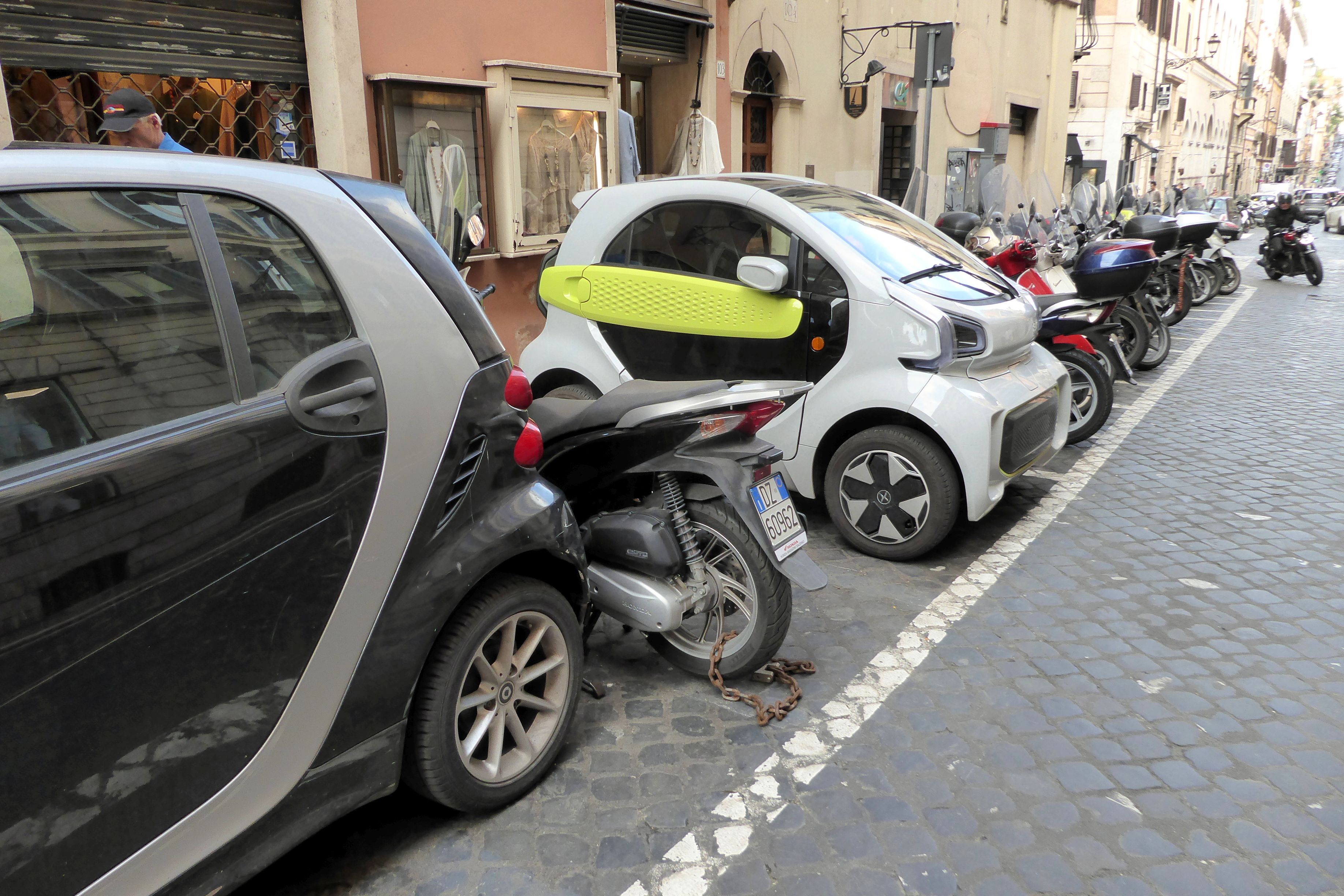
People park their cars any way and any place they can. It pays to have a Smart Car or something even smaller!
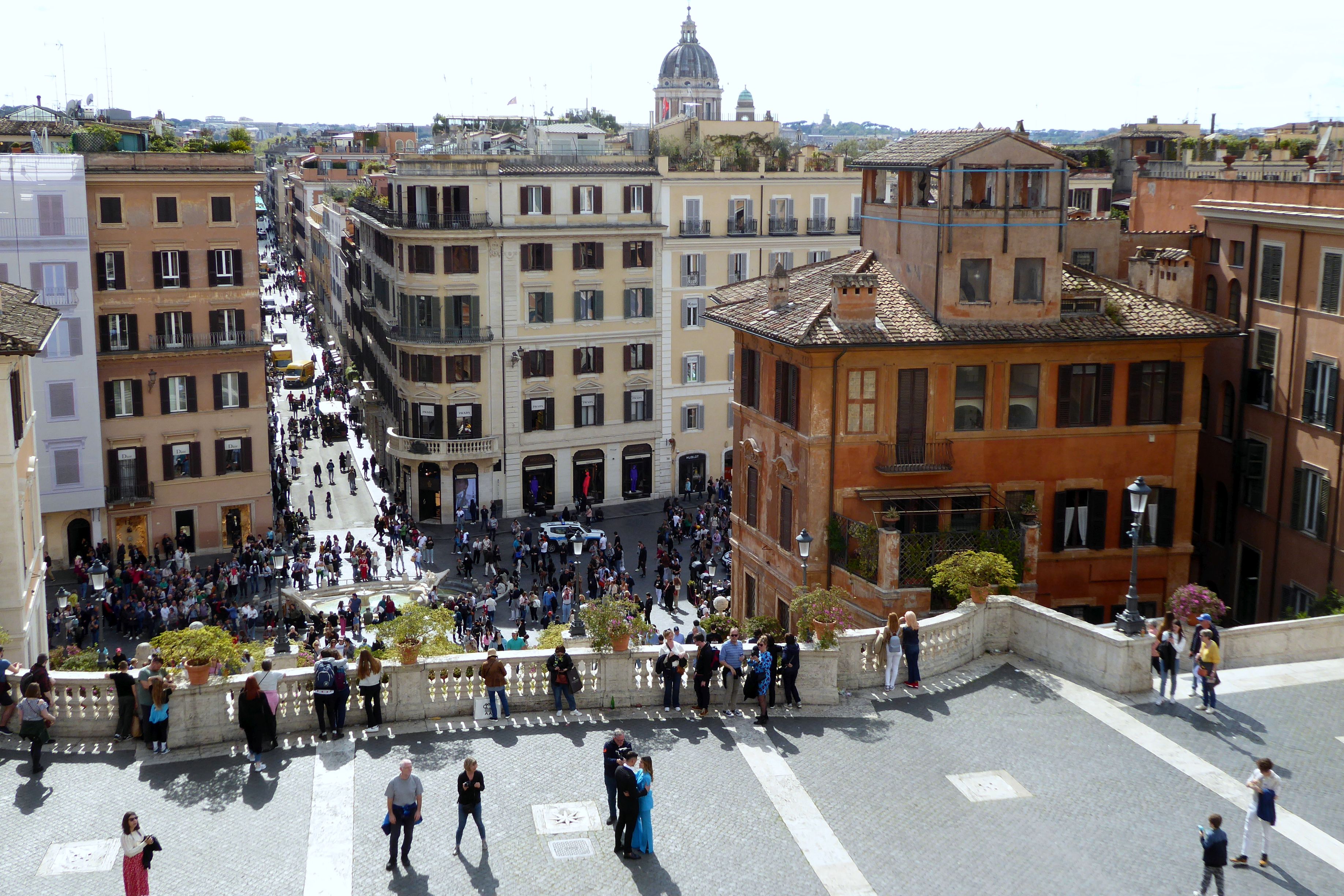
Above the Spanish Steps.
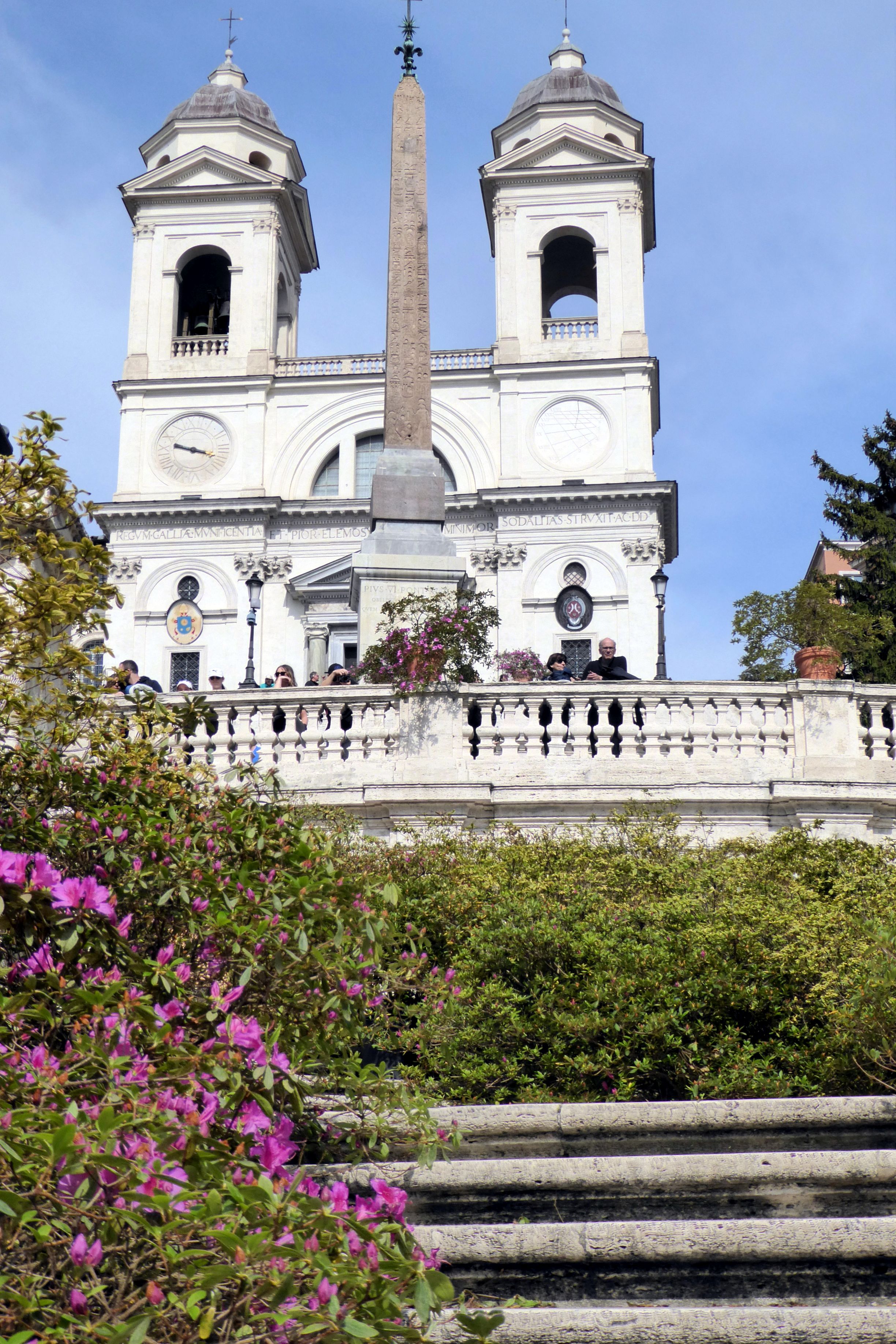
Descending the Spanish Steps and looking back up to the top.
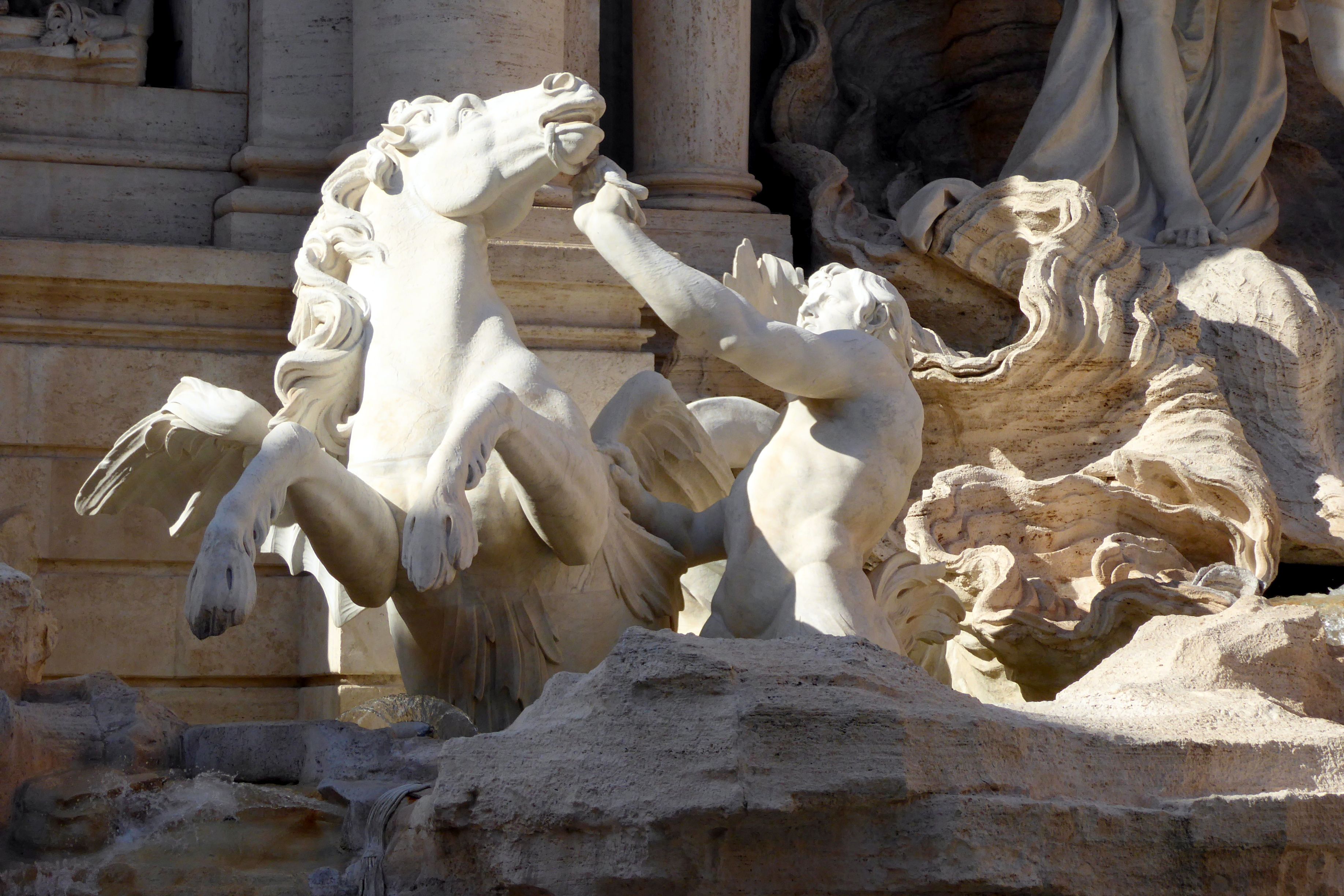
It was too crowded at the Trevi Fountain to shoot a wide angle shot with the water, so I shot just above the heads of everybody in front of me.
I worked my way up to the front!
Being in Rome brought back memories for me—especially since I had run into people I knew when I was there last time, walking with my Mom from the Trevi Fountain to the Spanish Steps.
At the time, in 1998, I had been working at the University Club, in San Diego; and, one of the former mayors of the city, Roger Hedgecock, was a member I had served at the club. At the time, he was a radio talk show host, and had led a tour to Italy. When I saw him in Rome, he was talking with his group on a very crowded piazza. I went up to say hello, and I heard a voice from the back of the group say excitedly, “I know you! You serve us at the University Club!” It was Dr. Vance and his wife, two of my regulars at the club! Imagine, late in the afternoon, in a VERY crowded European city, running into somebody you knew from the United States. What were the chances? The story ended up in a newspaper column in the San Diego Union-Tribune.
Our wonderful Italian adventure concluded with most of our group joining together on the rooftop of our hotel for a final drink and to reminisce about our times together. It was difficult saying goodbye to our tour leader, Ben, the following day; we had bonded with our new Italian friend.
Less that three weeks after returning home, we took off again—this time with Road Scholar for a tour of the Grand Circle of National Parks in Utah. Stay tuned; I will start posting those pictures in the coming days.
Note: If small group travel is of interest to you, I highly recommend Overseas Adventure Travel (OAT). Although Bruce and I travel together, they do not charge a single supplement for those who travel on their own. Singles also get their own room at hotels. If you book, you can get $100 off your trip by providing my name and customer number (Elaine Krugman, #3018126) as the person who referred you. I will also get $100 off future travel– a win-win!












































































 Elaine-iaK's Travels: A Traveler's Tales of People, Places, Photos, Pools... and CHOCOLATE!