A UNESCO-protected city, Mazara del Vallo (“Mazara”) is unique in several ways. First, it is Sicily’s most Arabic city and was conquered and controlled by all sorts of group after being founded by the Phoenicians in the 9th century BC.
Currently, 3,000 of the 60,000 residents are Tunisian or other Maghreb Arabs, so the culture is a mix of Sicilian and Arab. What makes it unique is the peaceful co-existence of Muslim and Christian Faiths. Add to the historical mix the small Jewish communities that were established centuries ago, it could have been a recipe for disaster. Instead, there has been religious tolerance in Mazara throughout history and they call themselves, “Citta della Pace” or “City of Peace.” There is even one street where there was an active church, Jewish temple, and mosque all within steps of each other.
Mazara is an important fishing center of Italy, and the Muslims and Christians work well together with mutual respect, side-by-side, on fishing boats as well as in agriculture, and other industries. That is unique in this crazy world!
Muslims pray five times a day, and there is no problem that the call of prayer is broadcasted throughout Mazara except in the historic Jewish Quarter. (Actually, there aren’t many (if any) Jews in Mazara currently, because they were kicked out during the Spanish Inquisition. There is a small Jewish community in Palermo, however.)
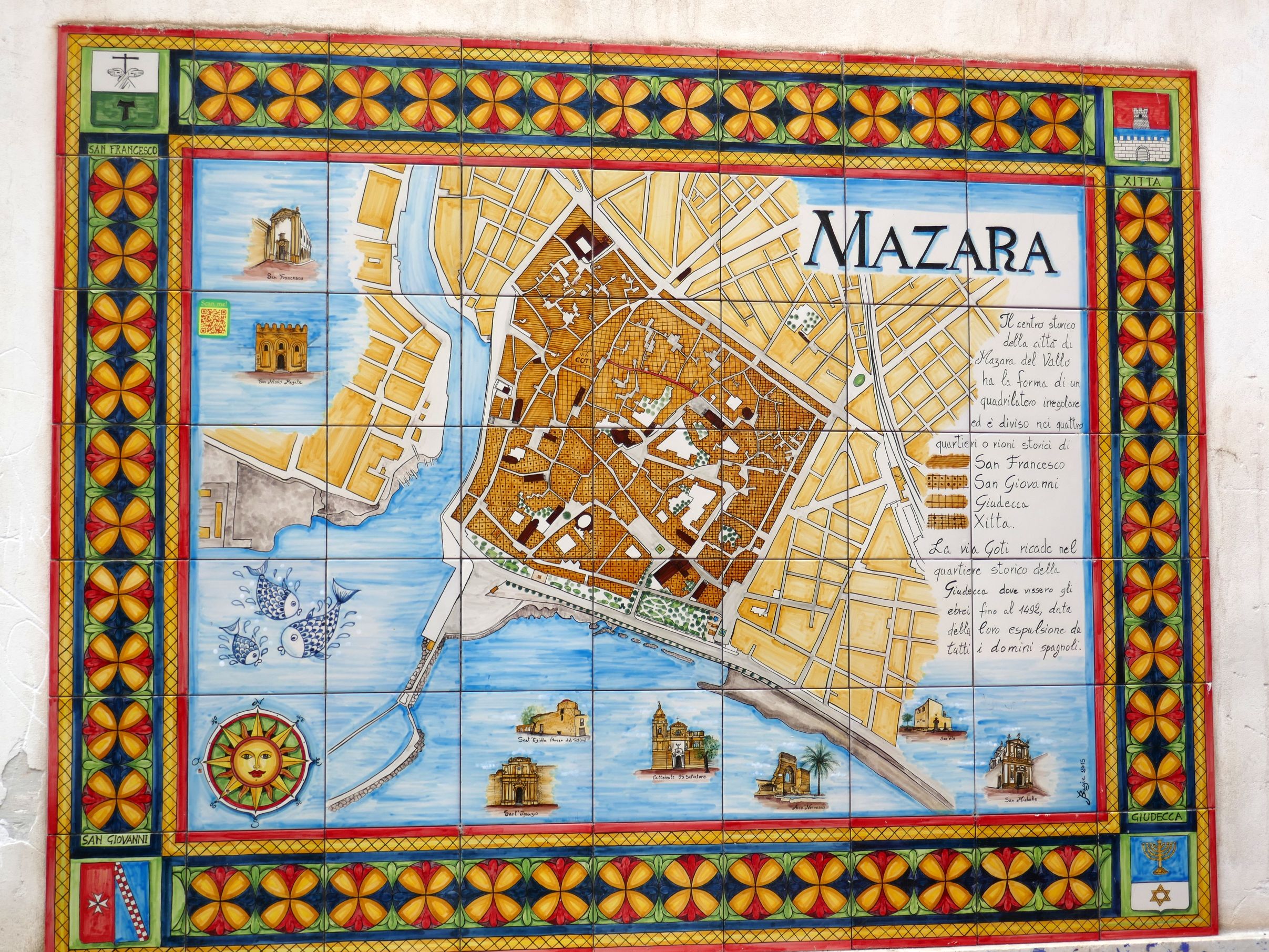
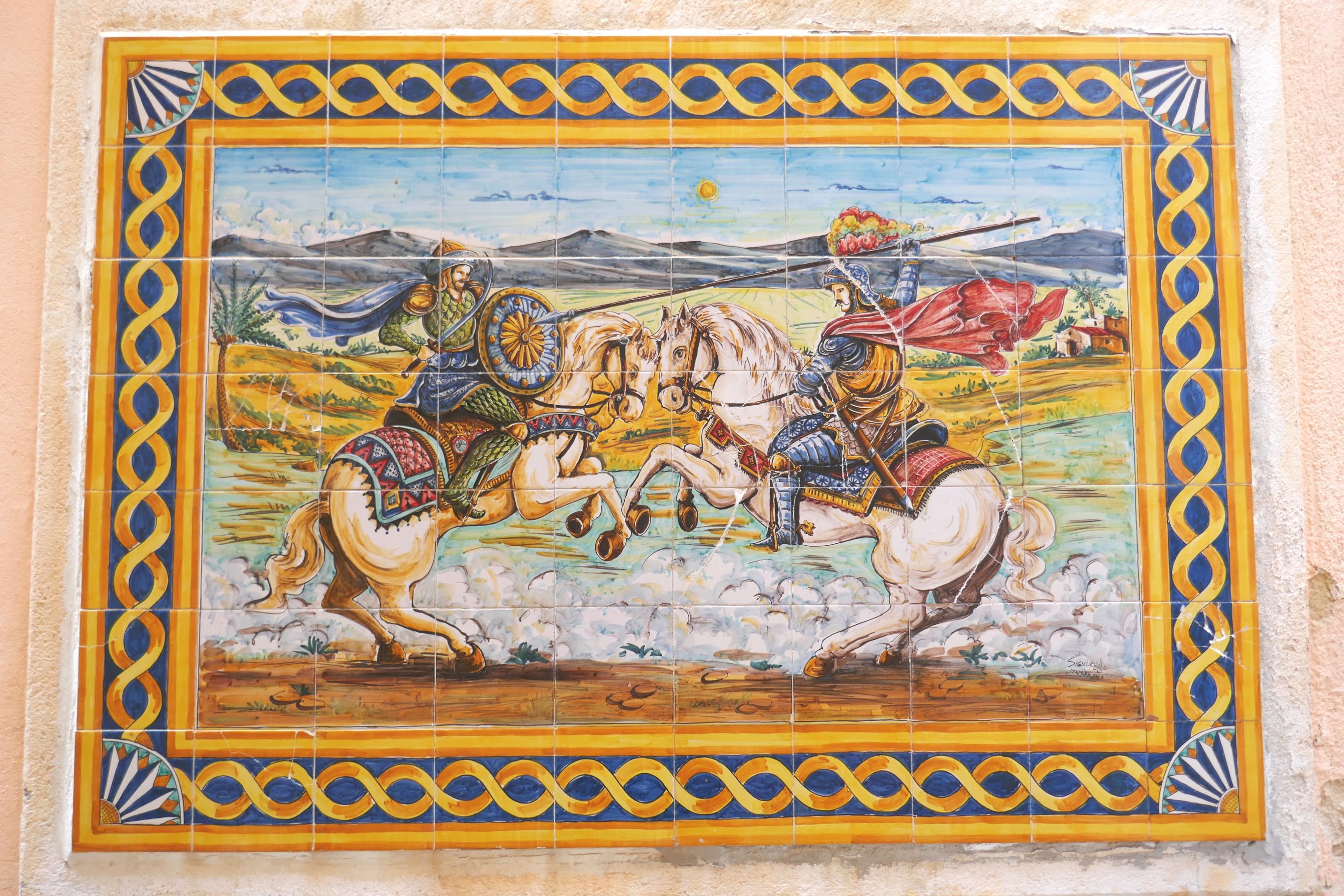
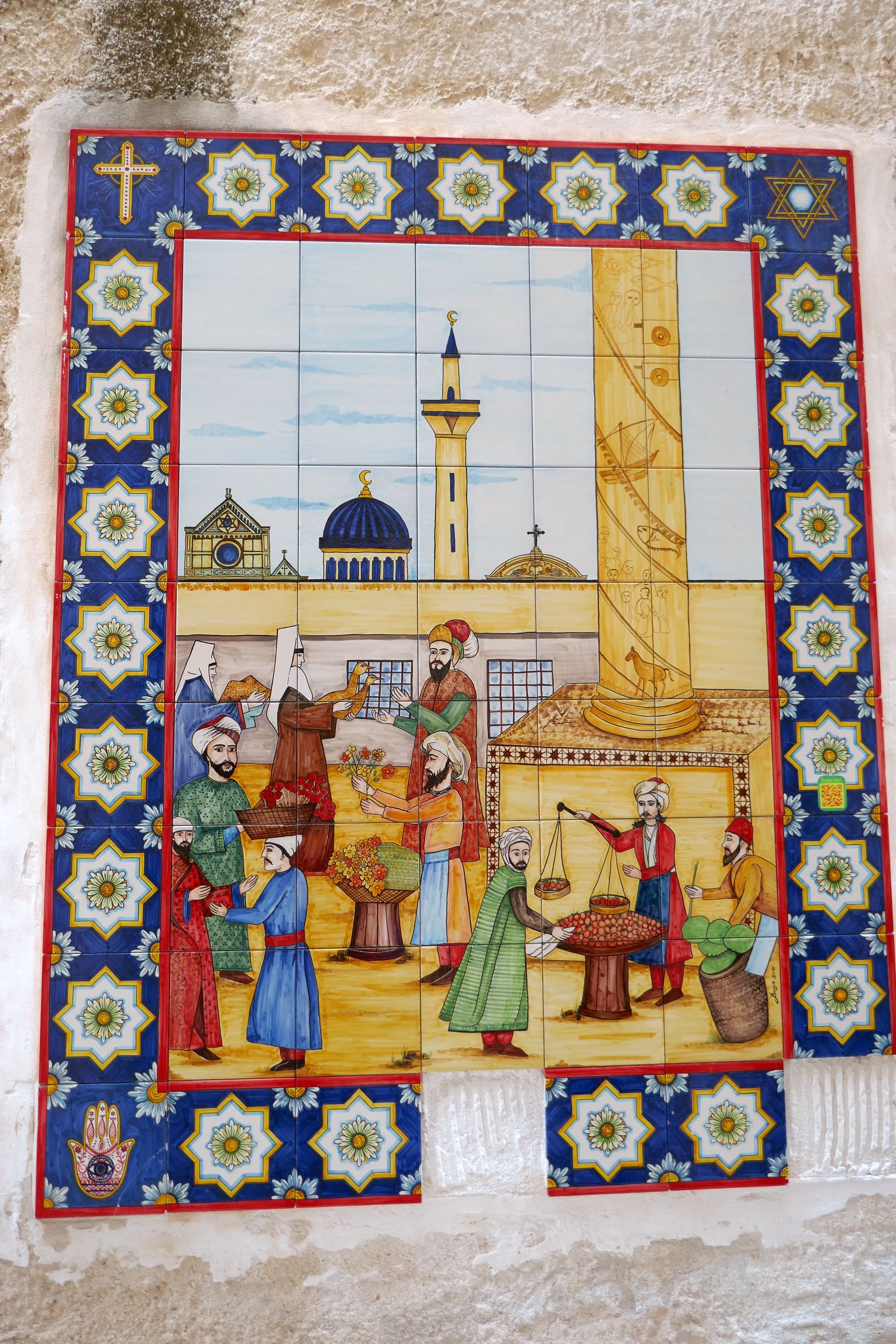
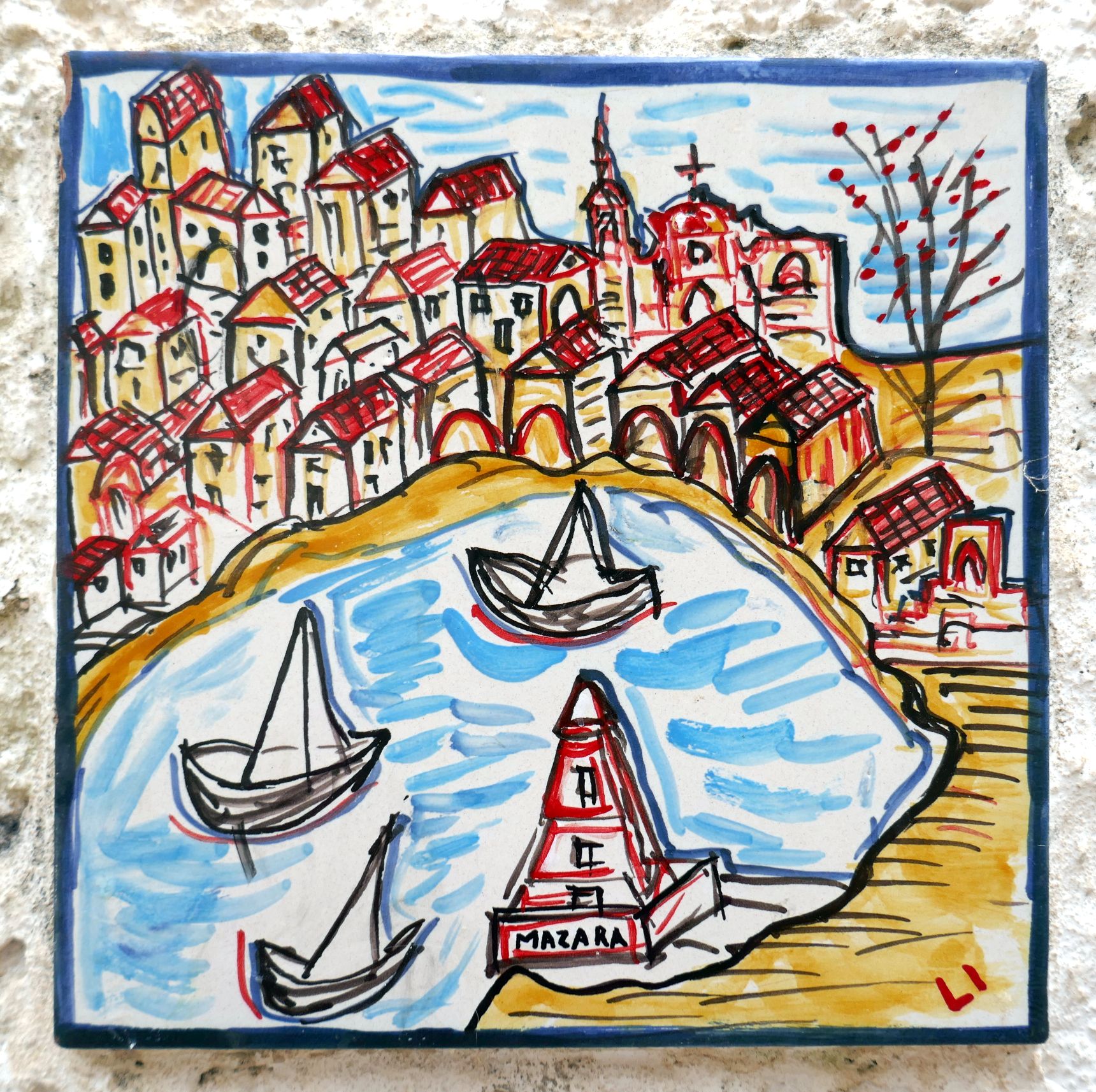
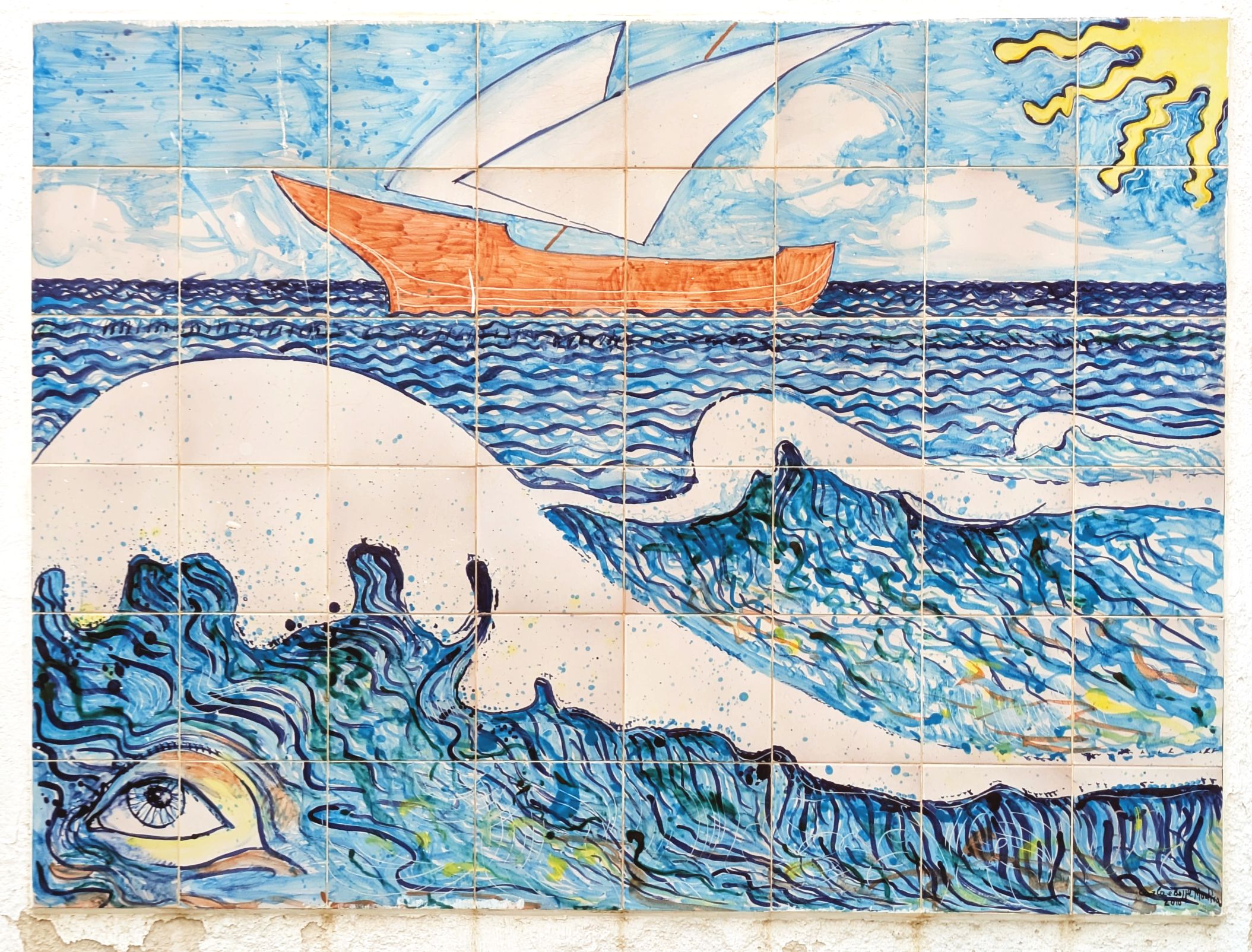
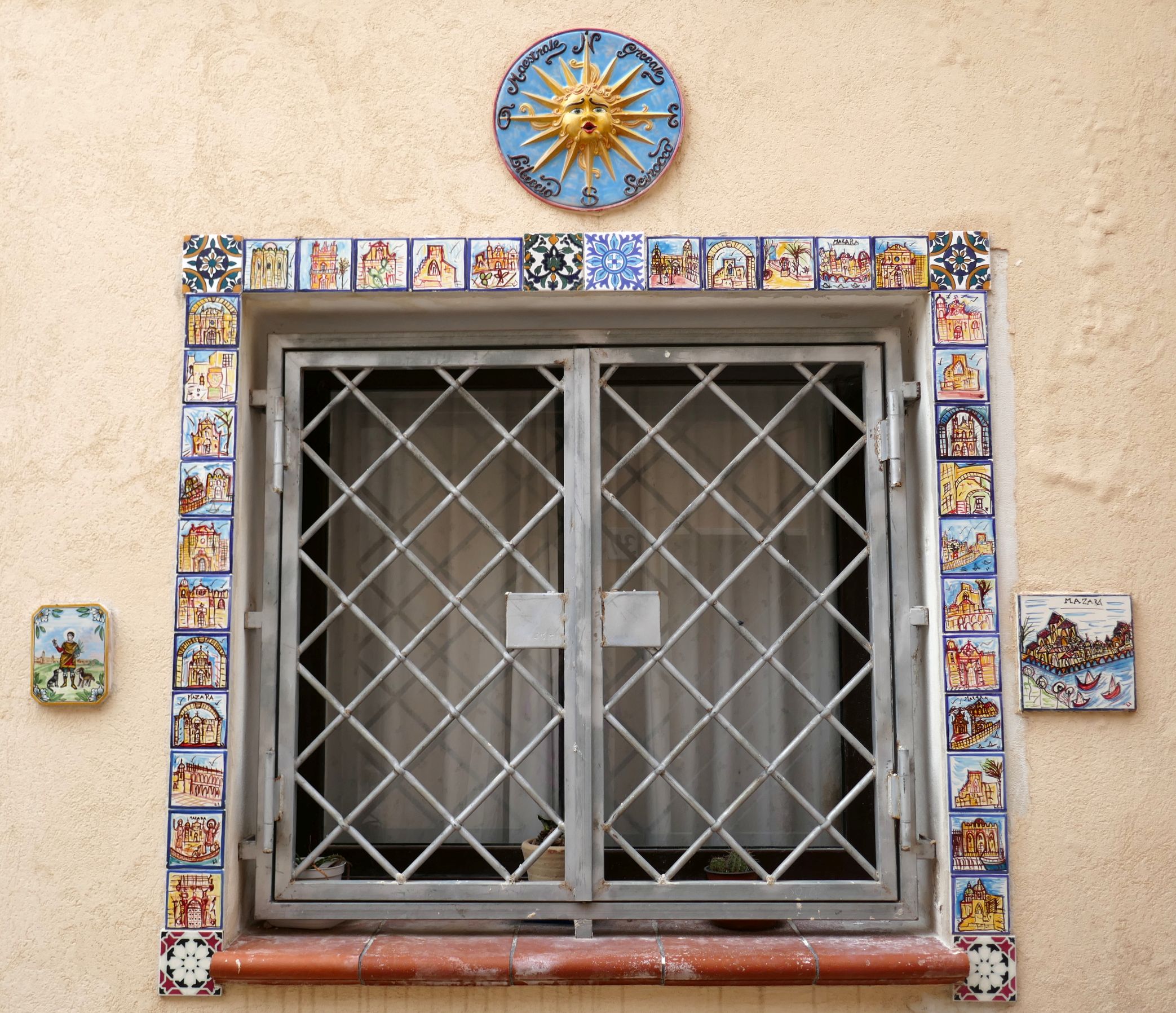
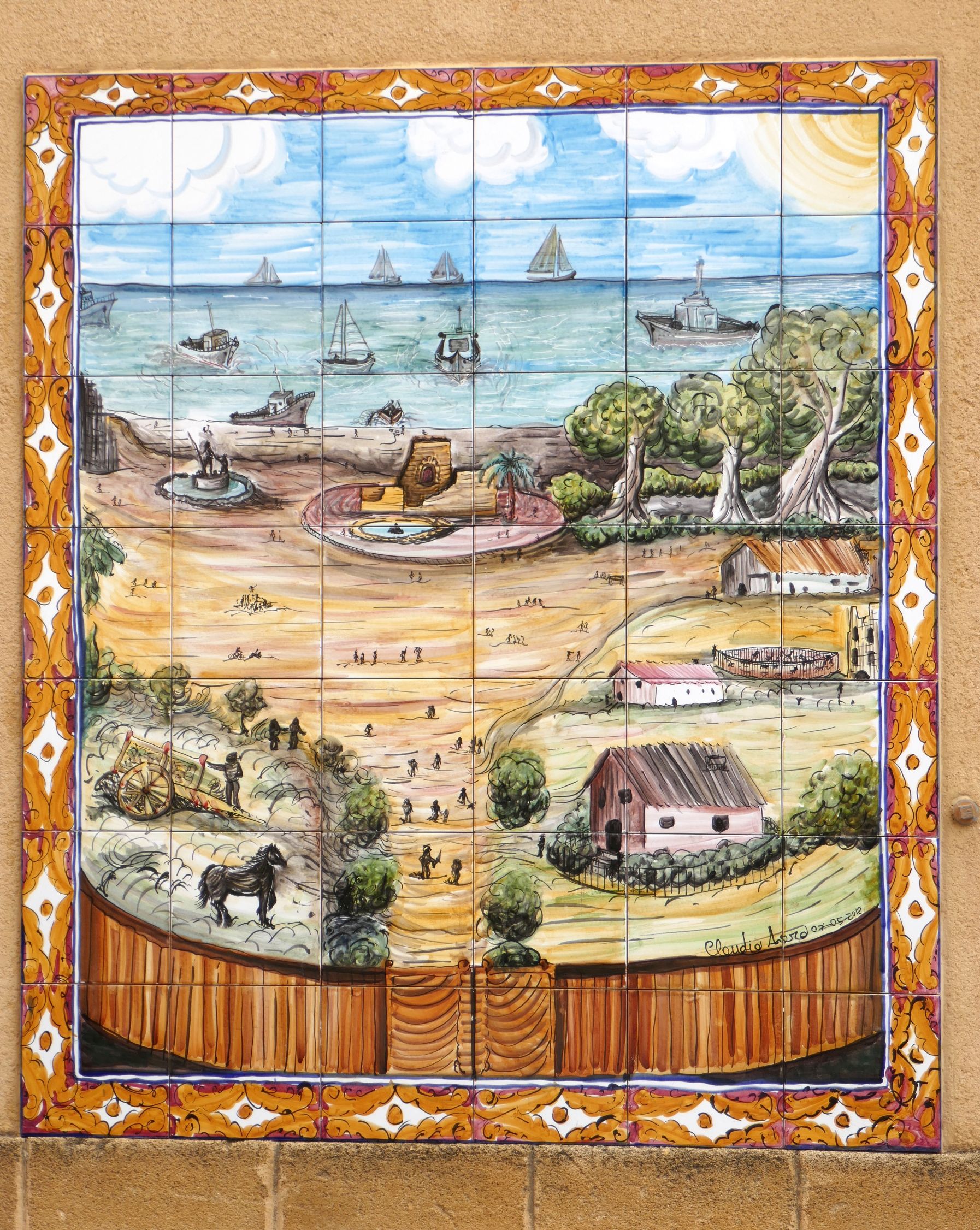
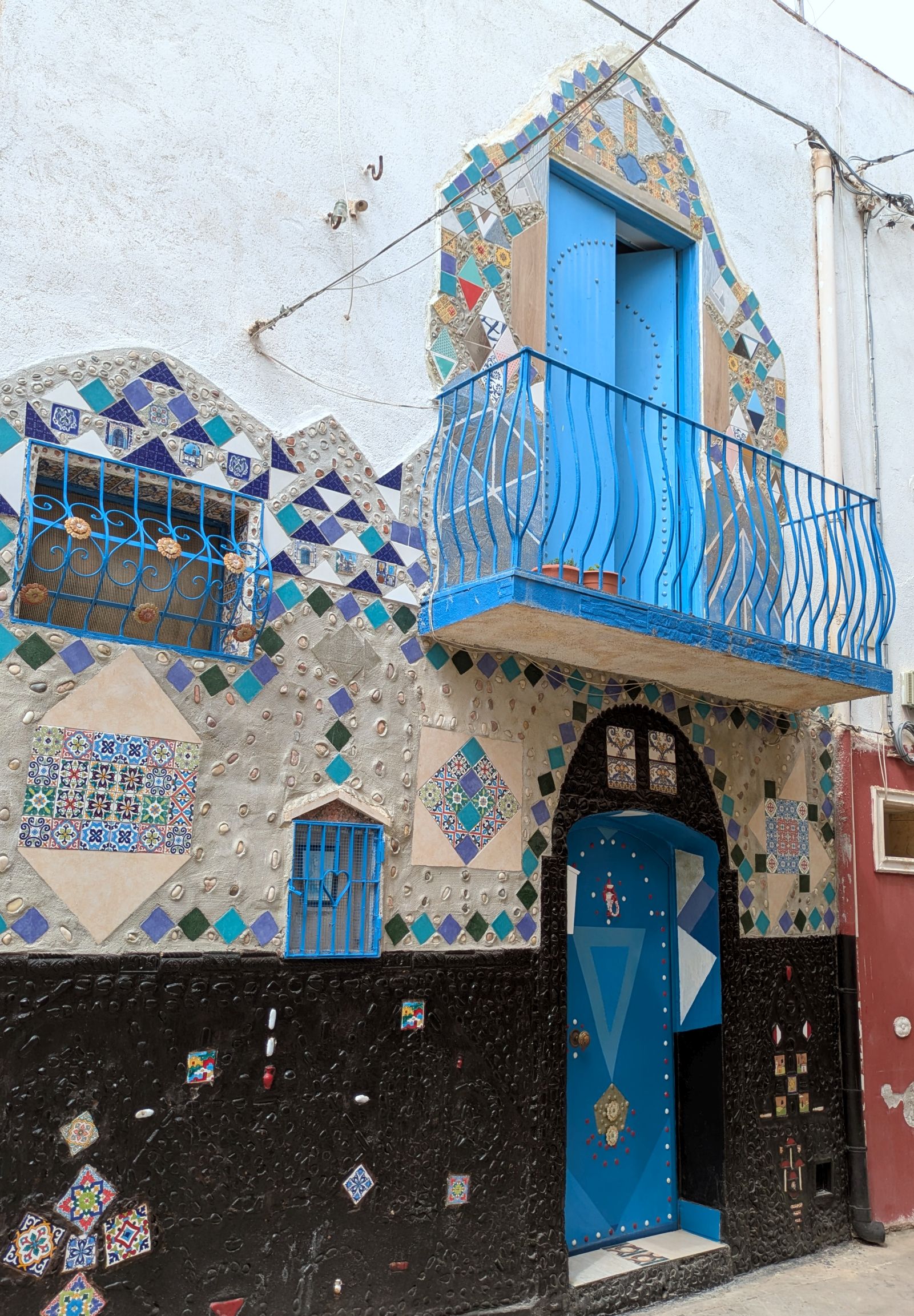
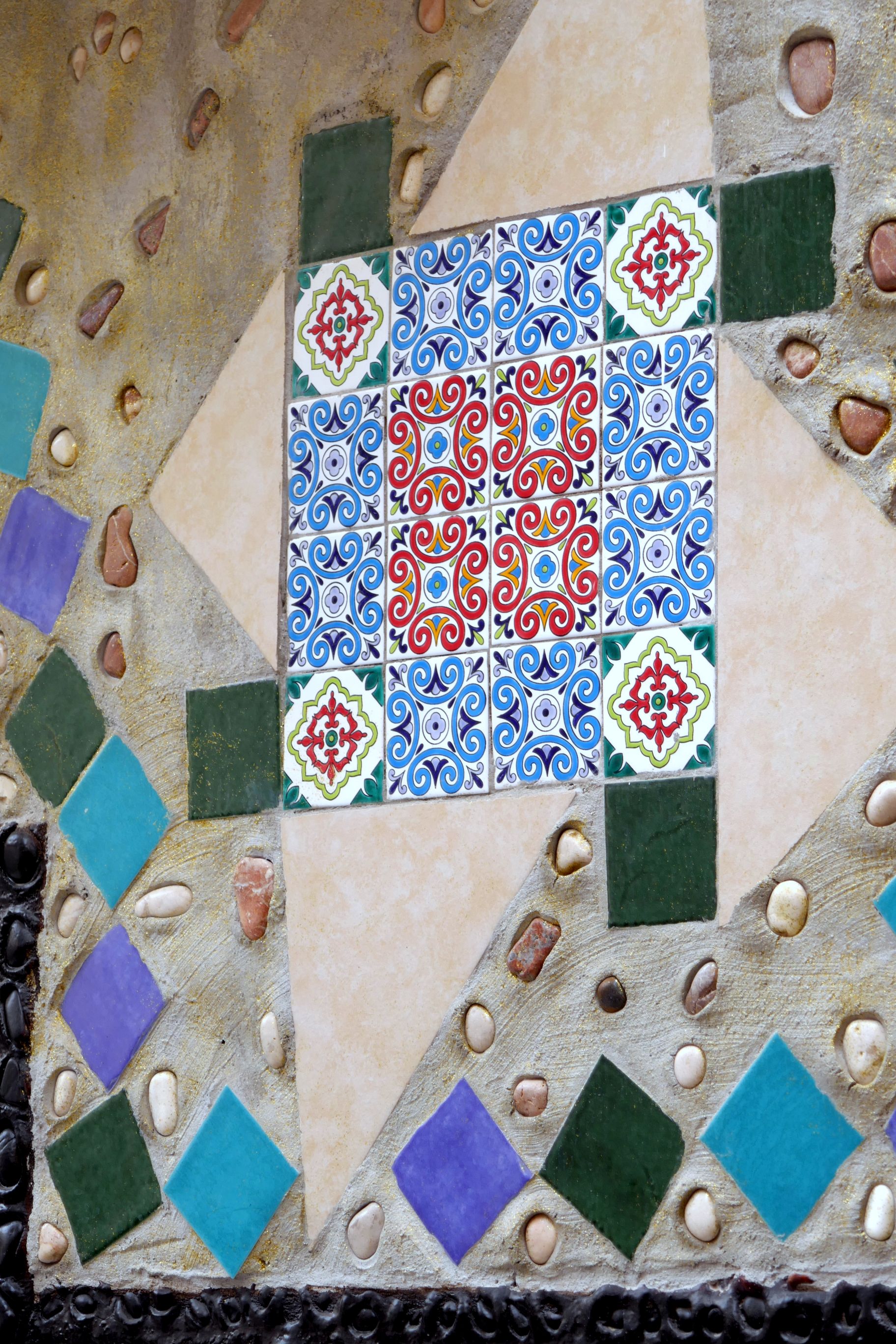
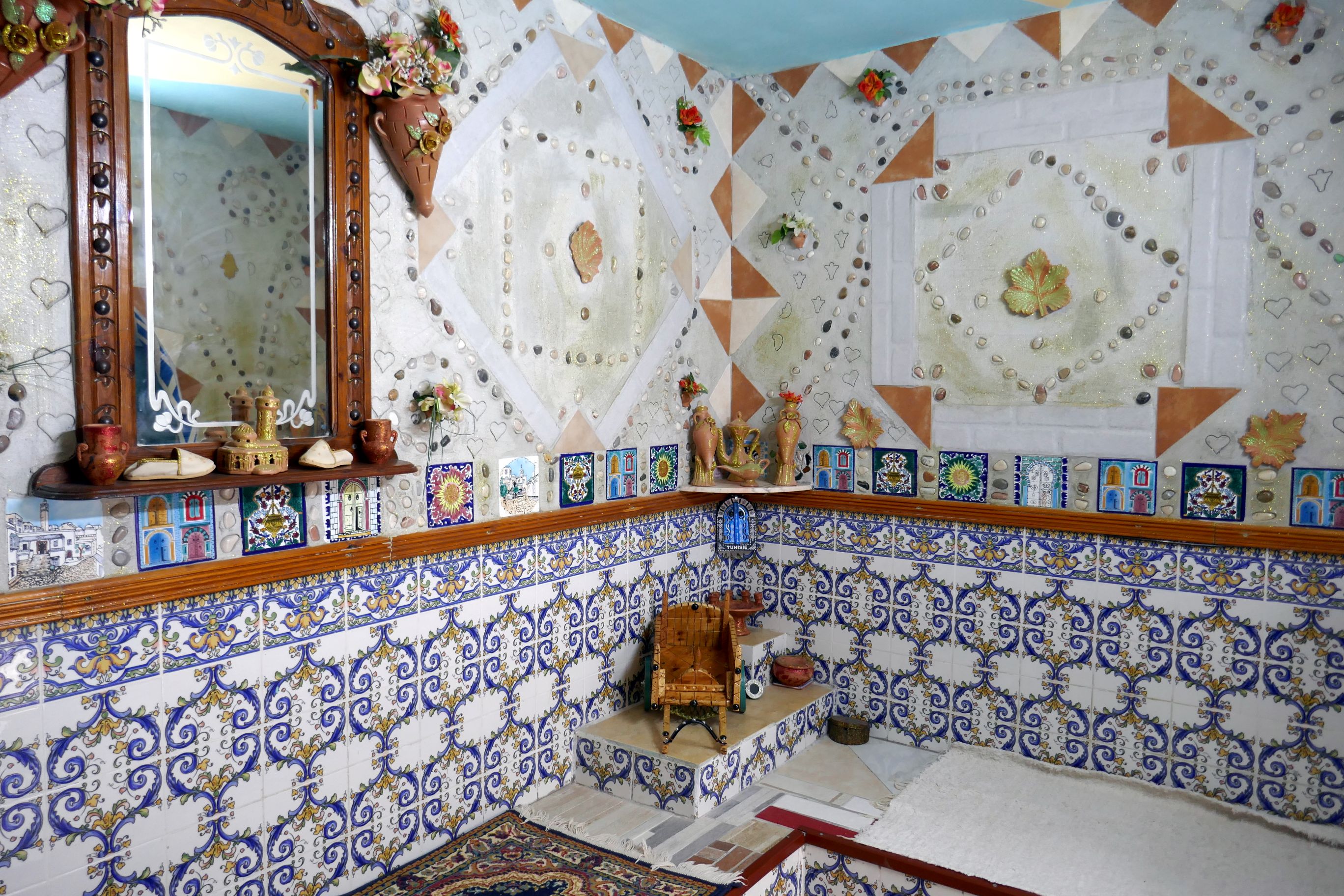
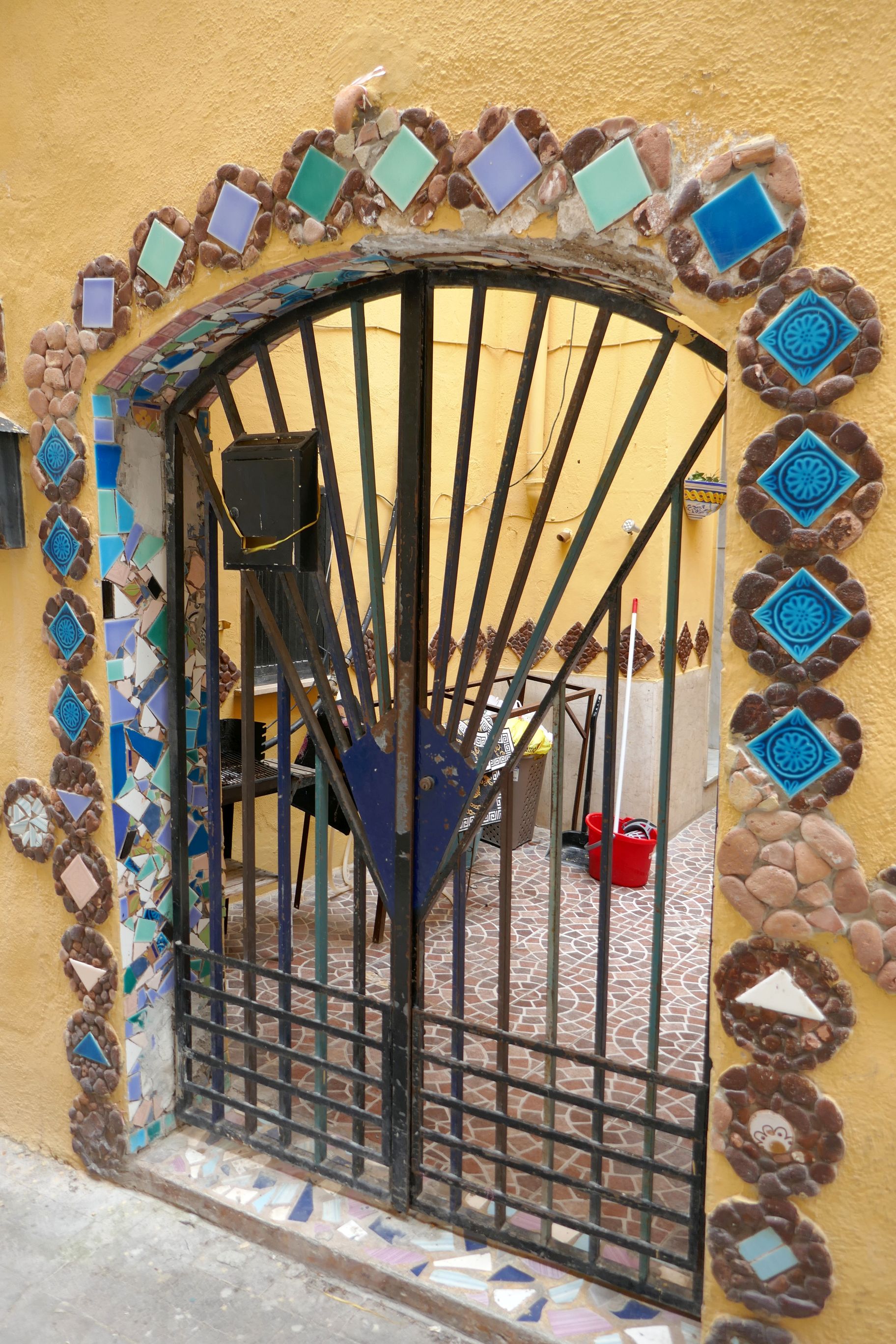
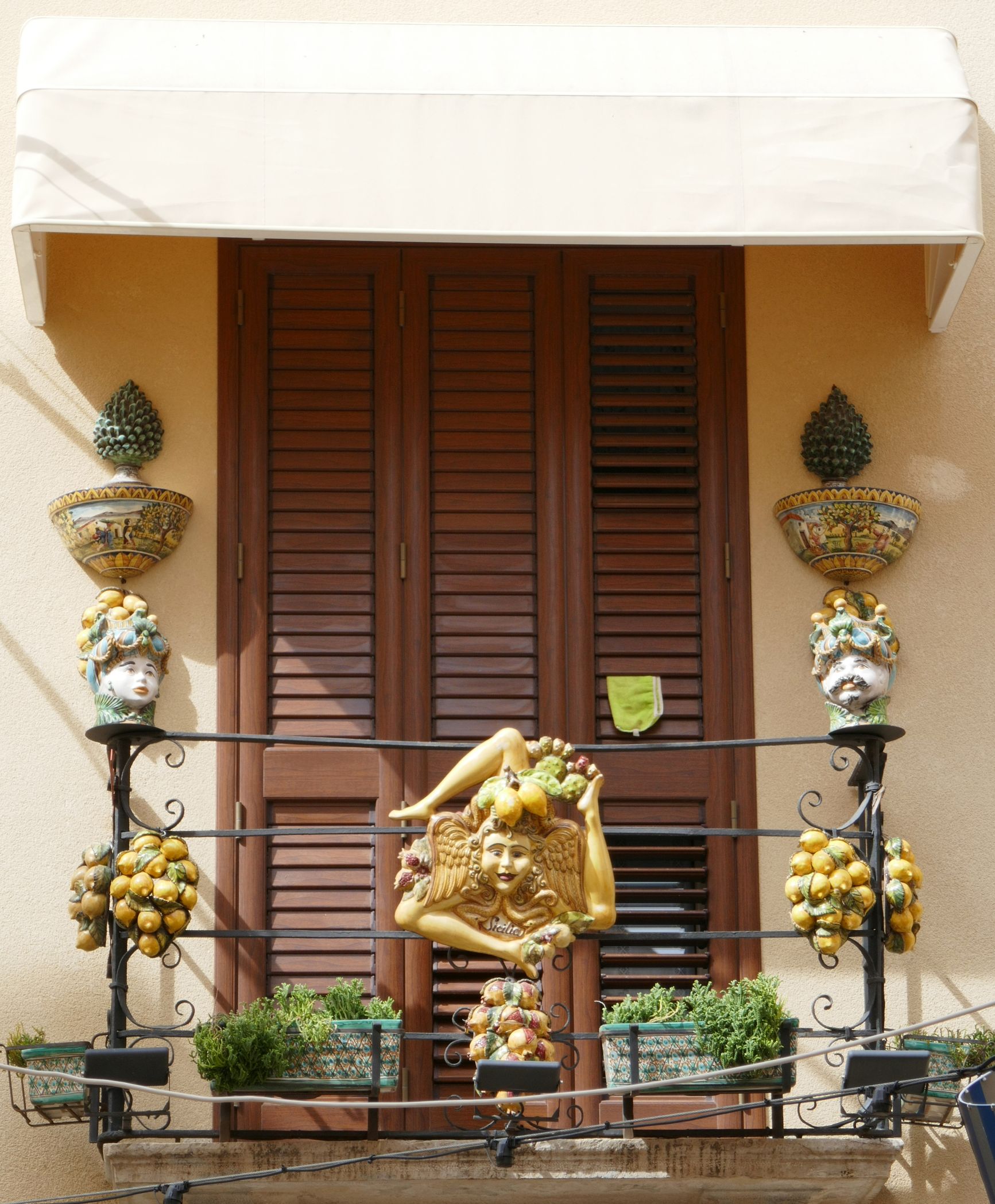
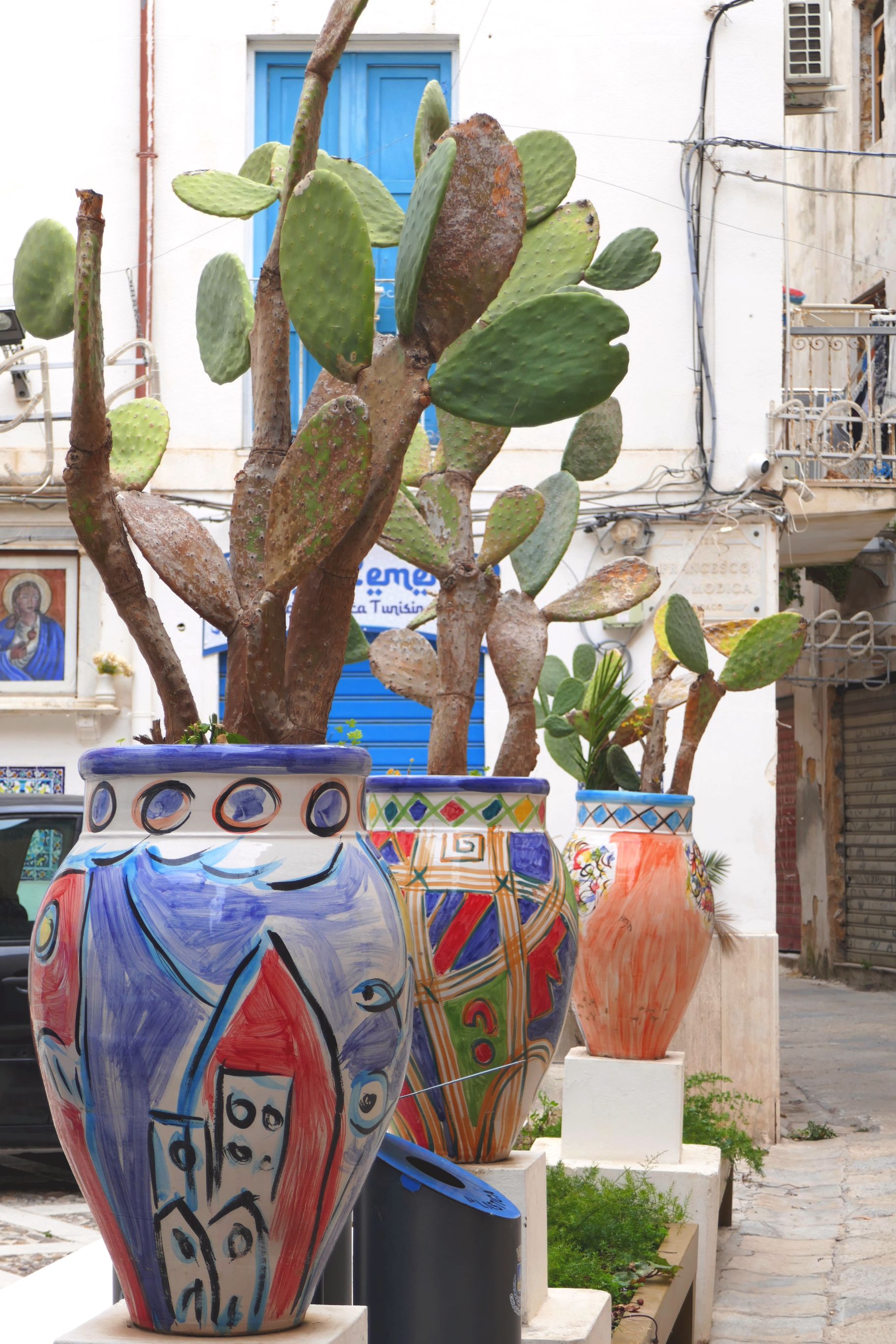
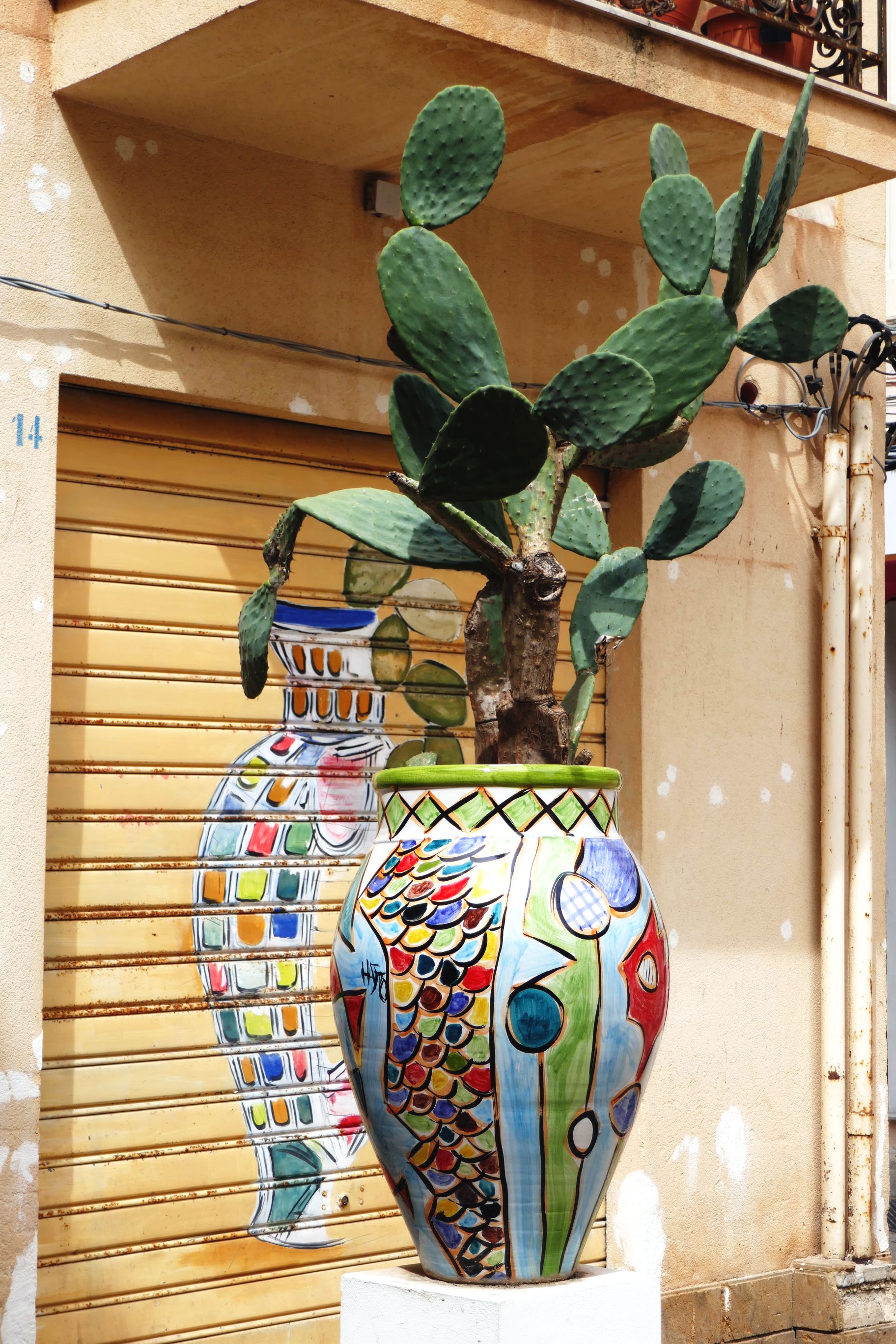
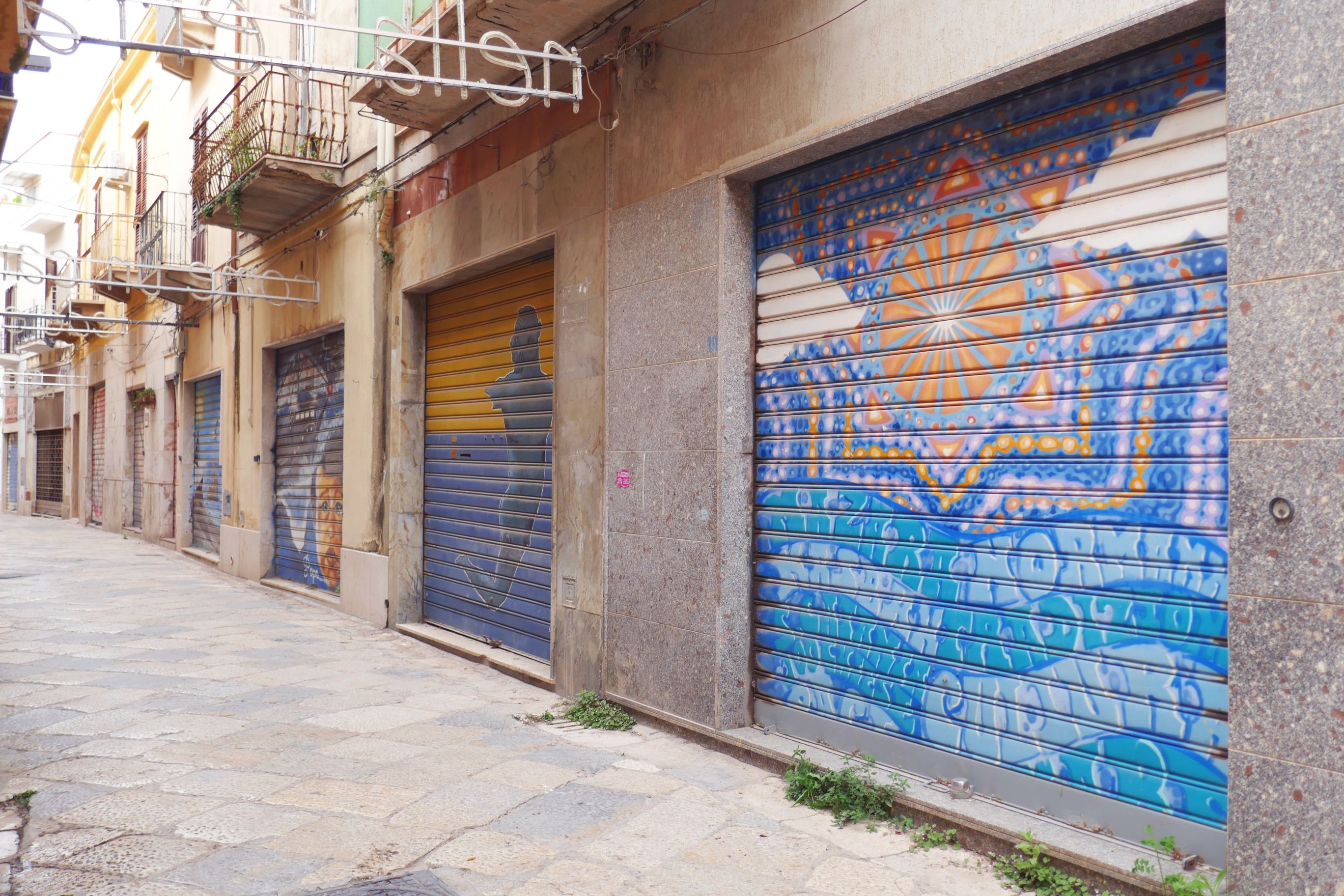
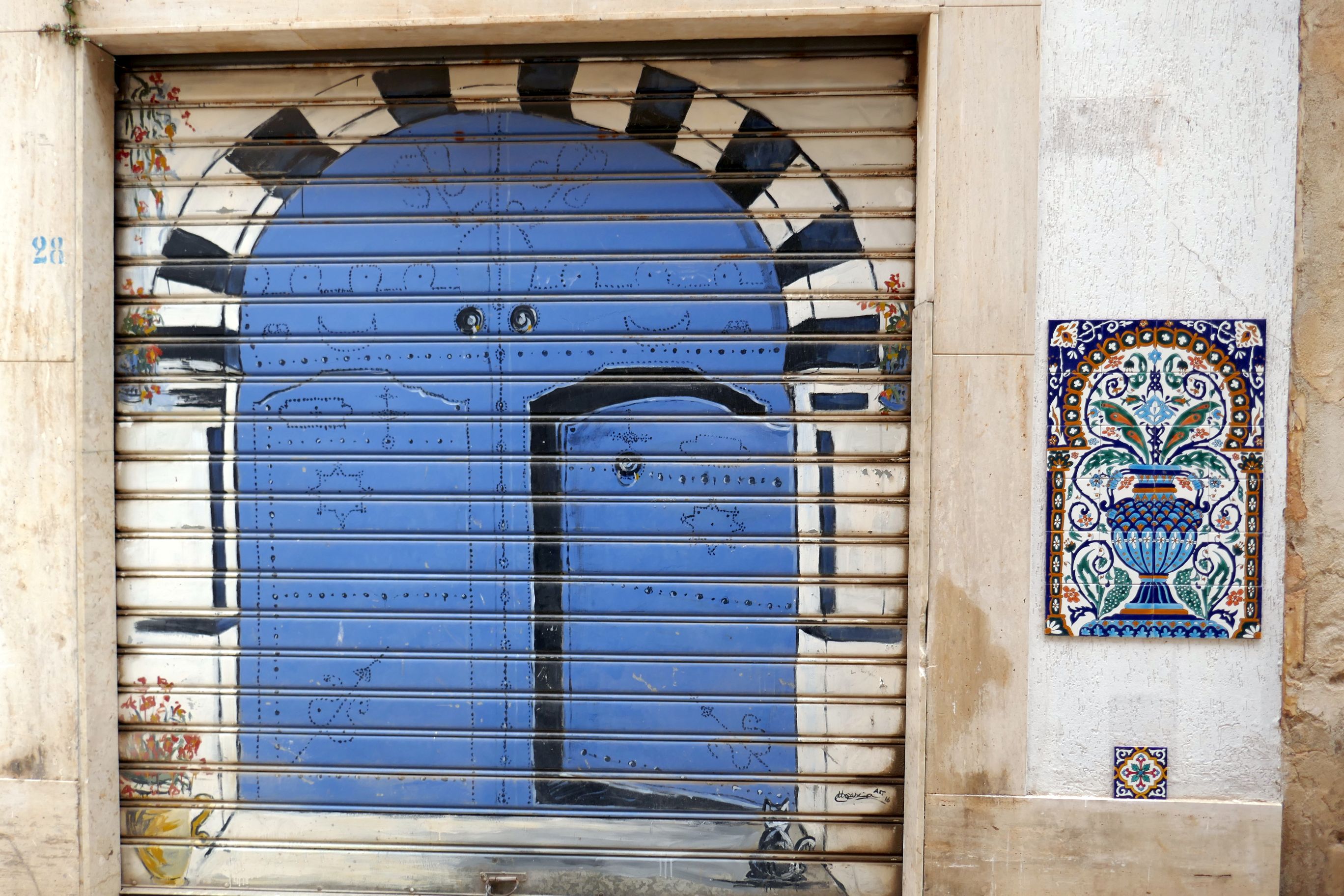
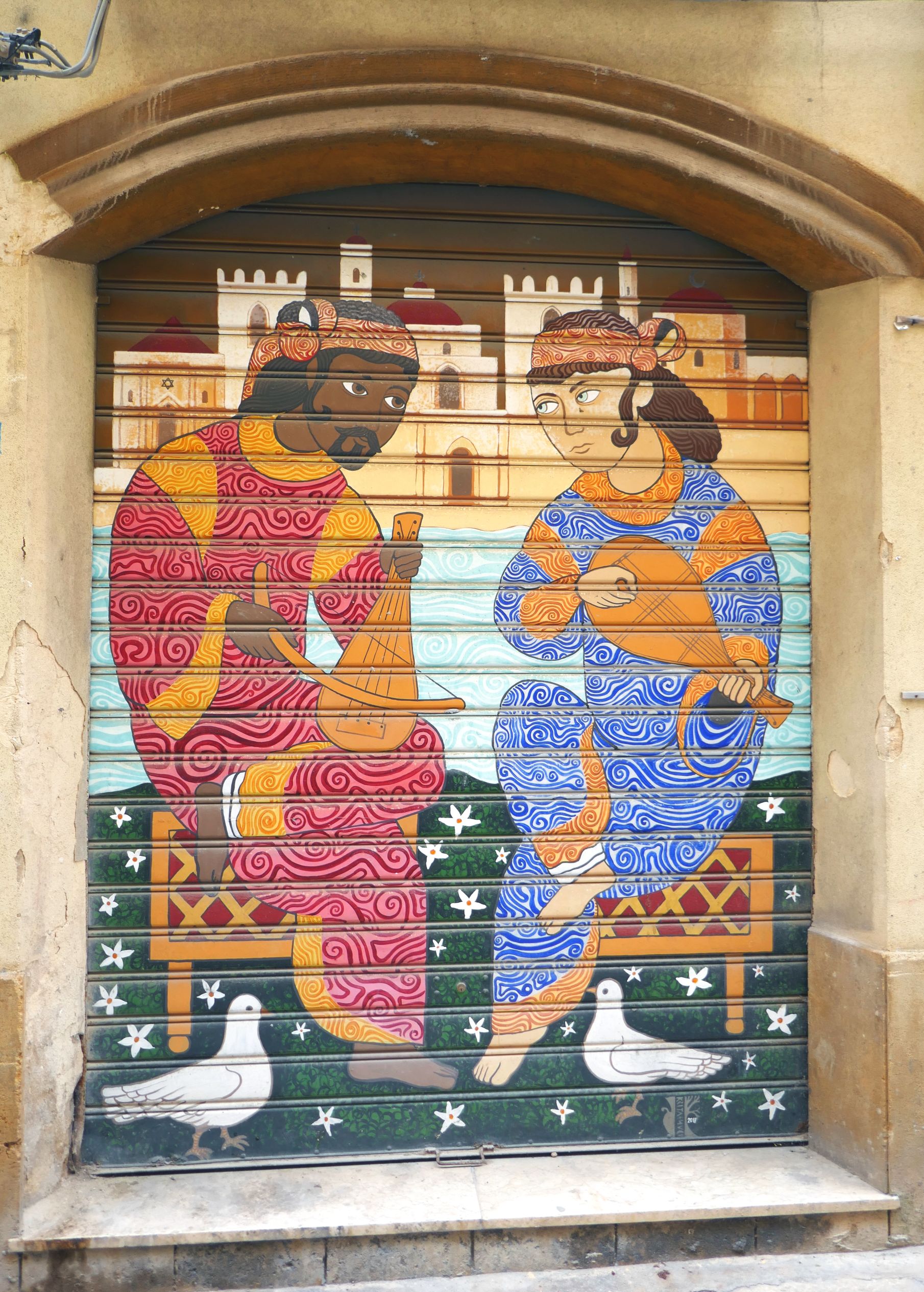
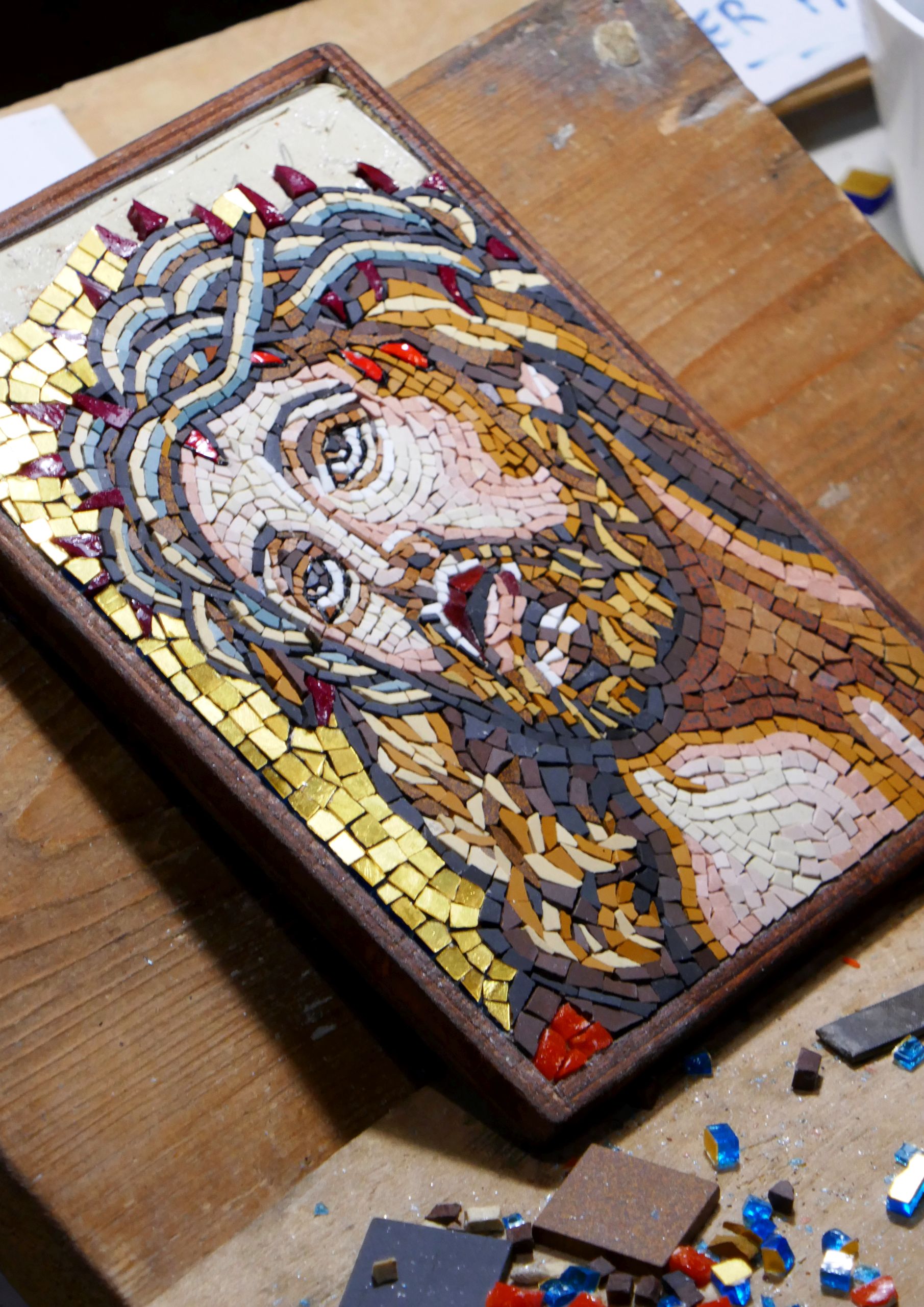
The Kasbah of Mazara is also unique in that its streets are full of colorful wall tiles and tile murals, garage door murals, and pottery. I was captivated by it all, so I couldn’t stop shooting photos during our walking tour! I hope you enjoy…
(For all photos, click on the image for a full screen view.)
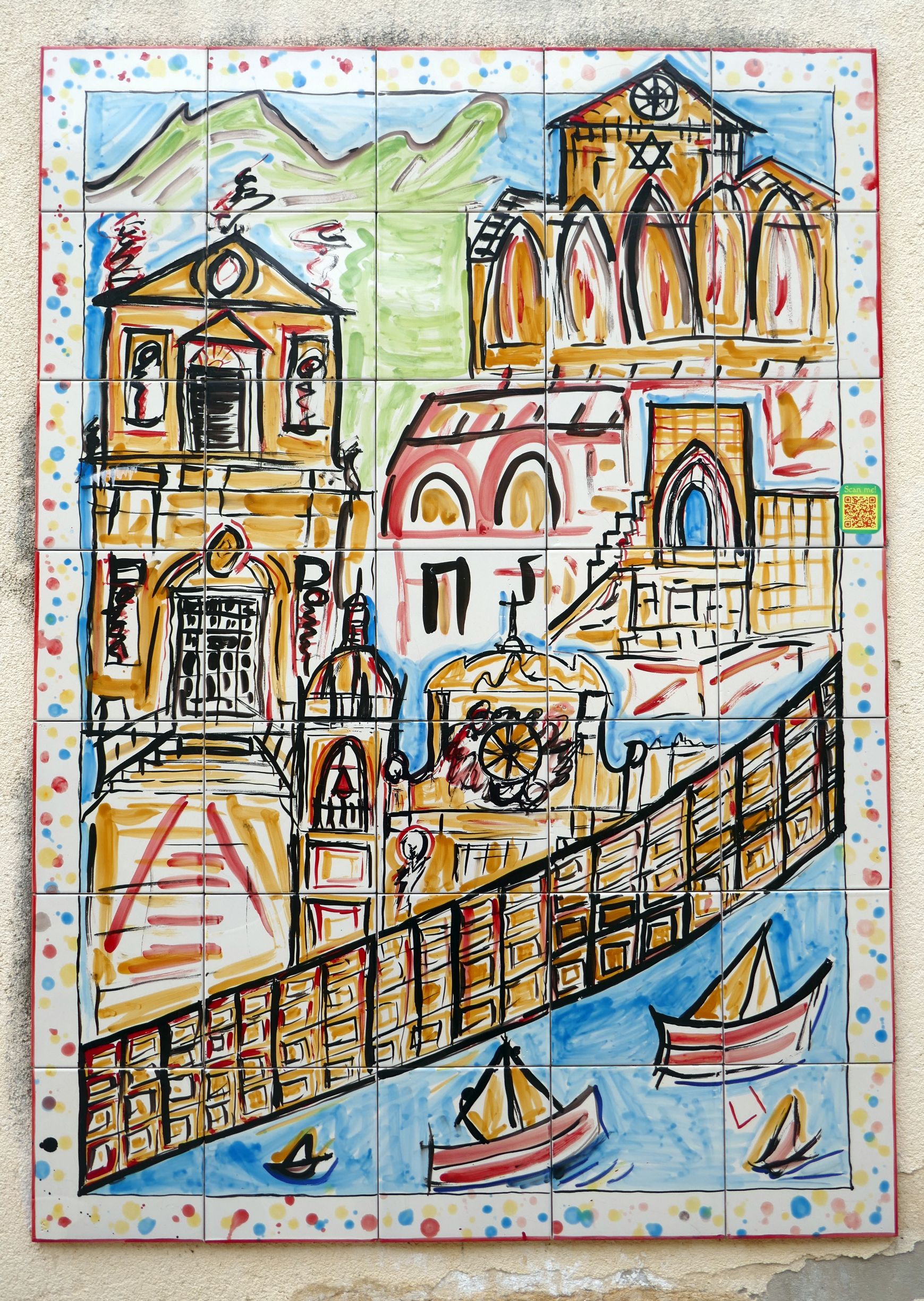
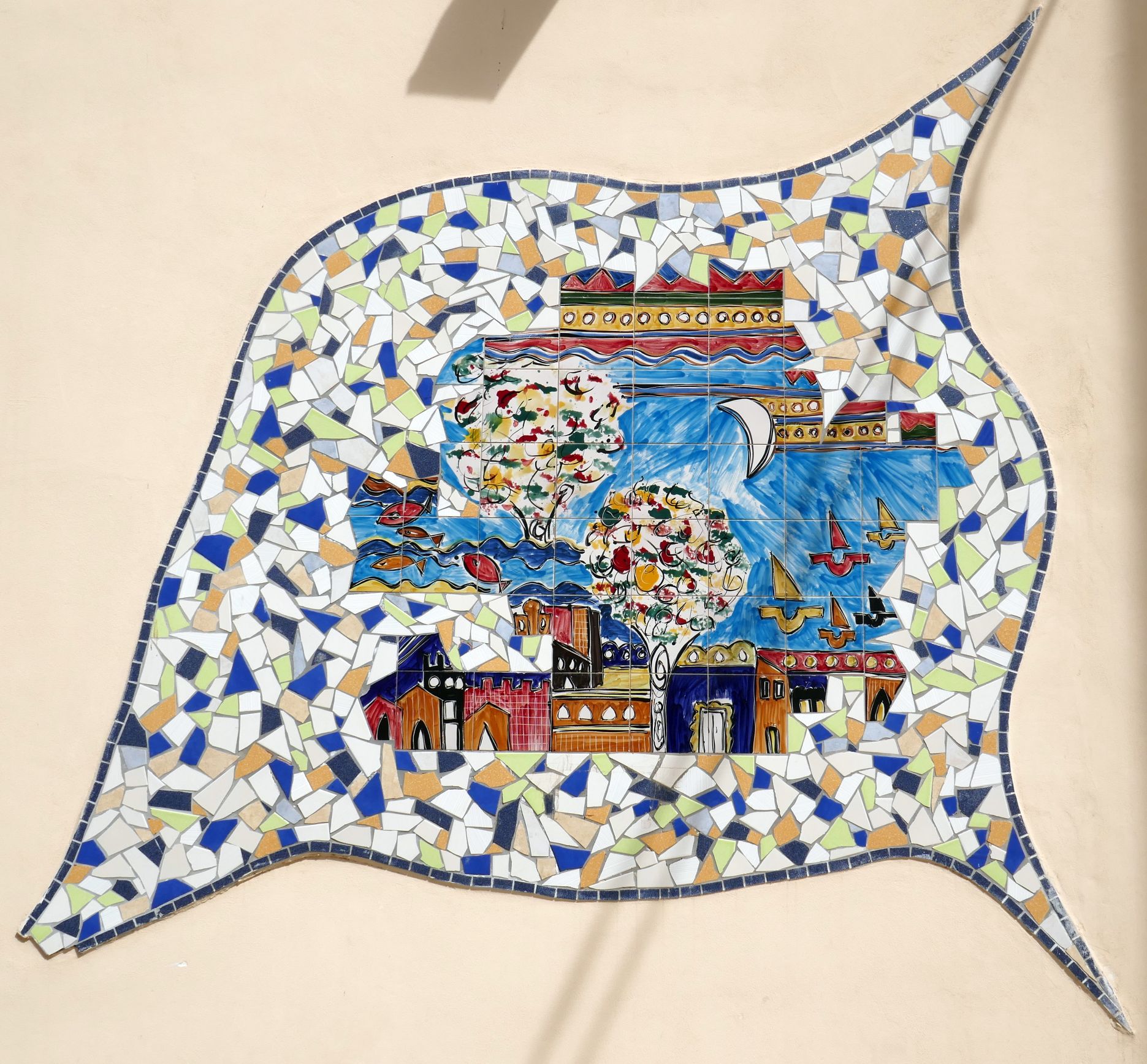
Tiles are missing, but the story of this mural is powerful, because it depicts the Jewish temple, Muslim mosque, and Christian church side-by-side as well as Mazara’s mix of people.
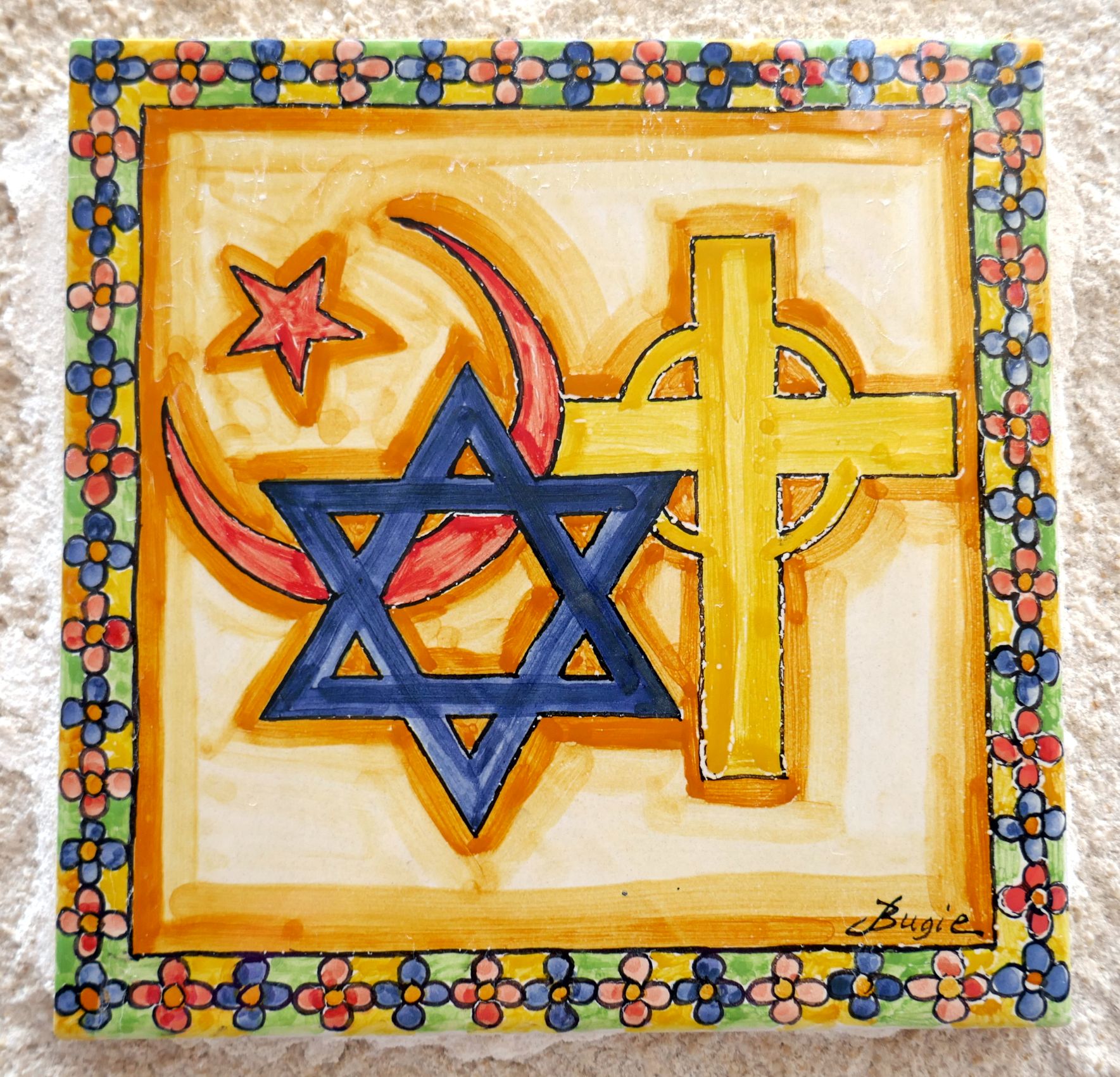
A different take on the same idea.
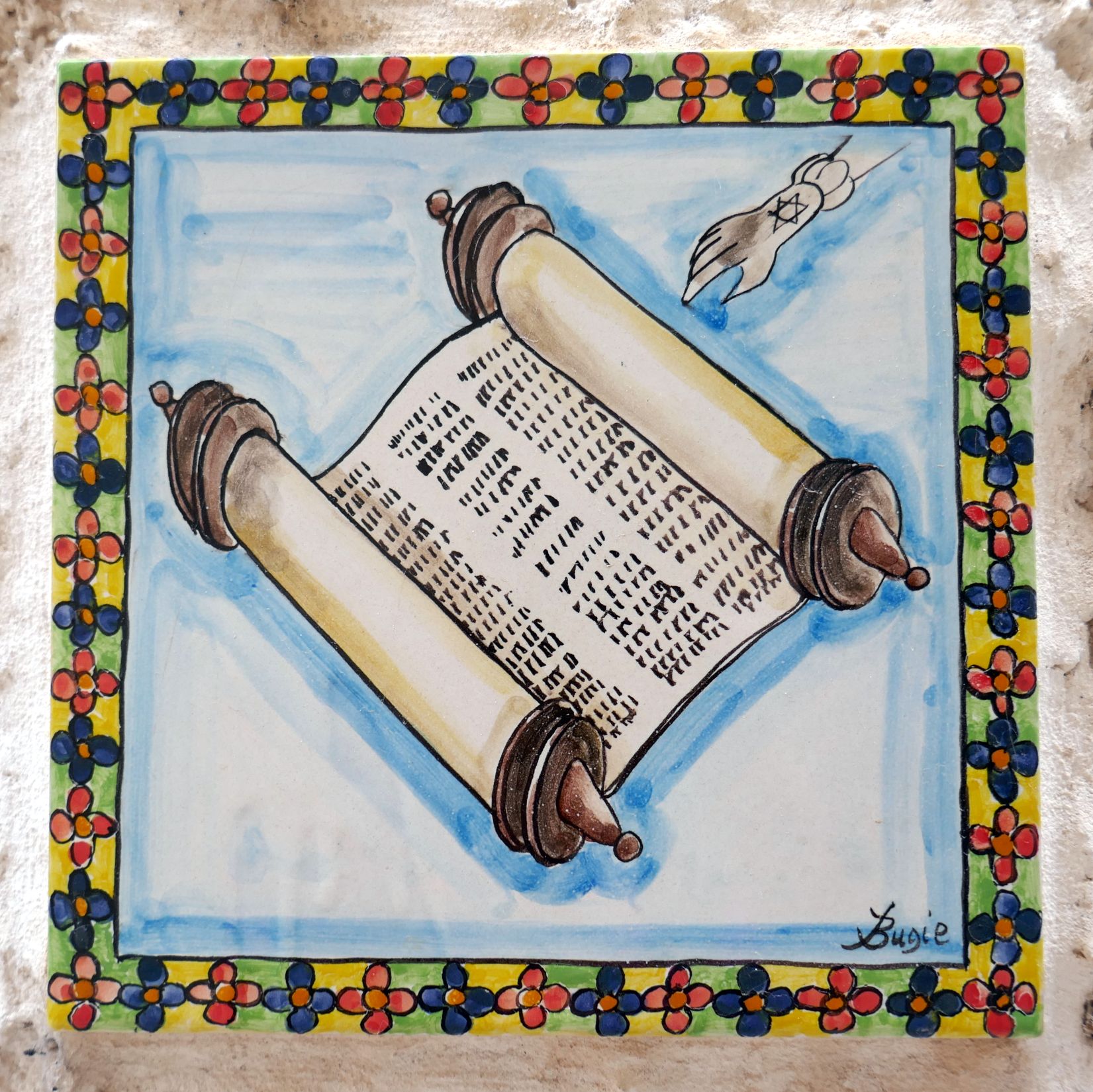
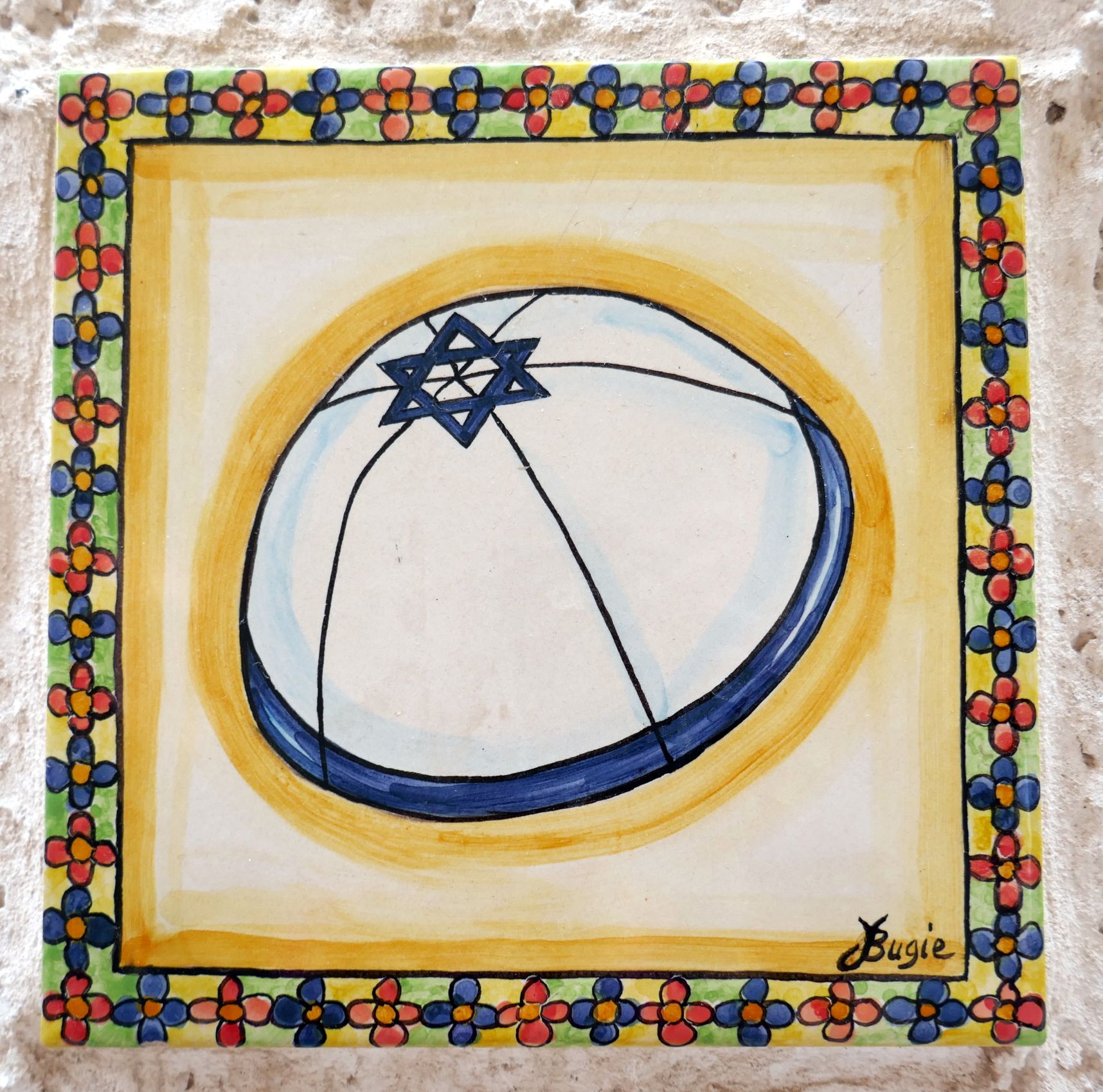
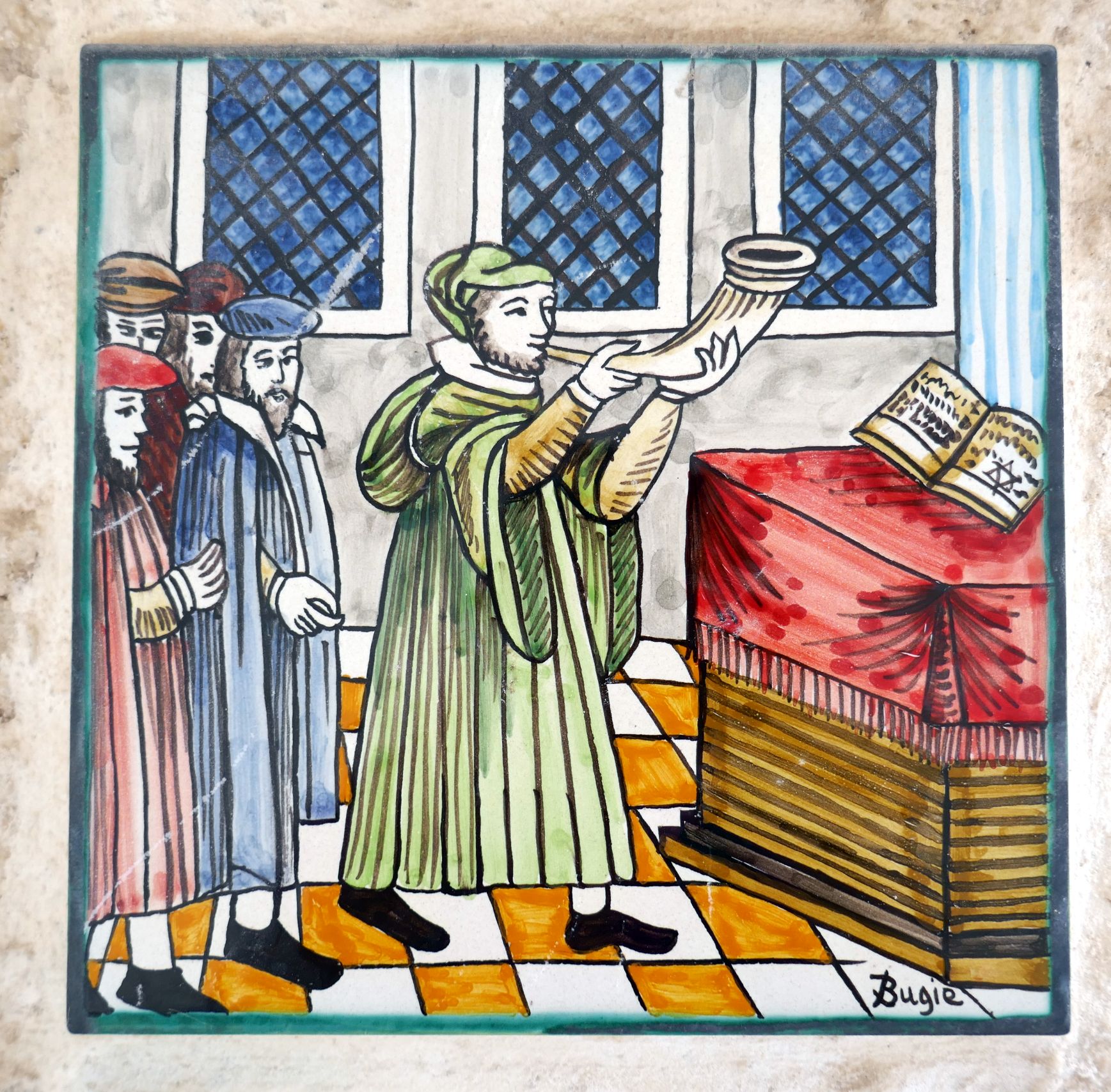
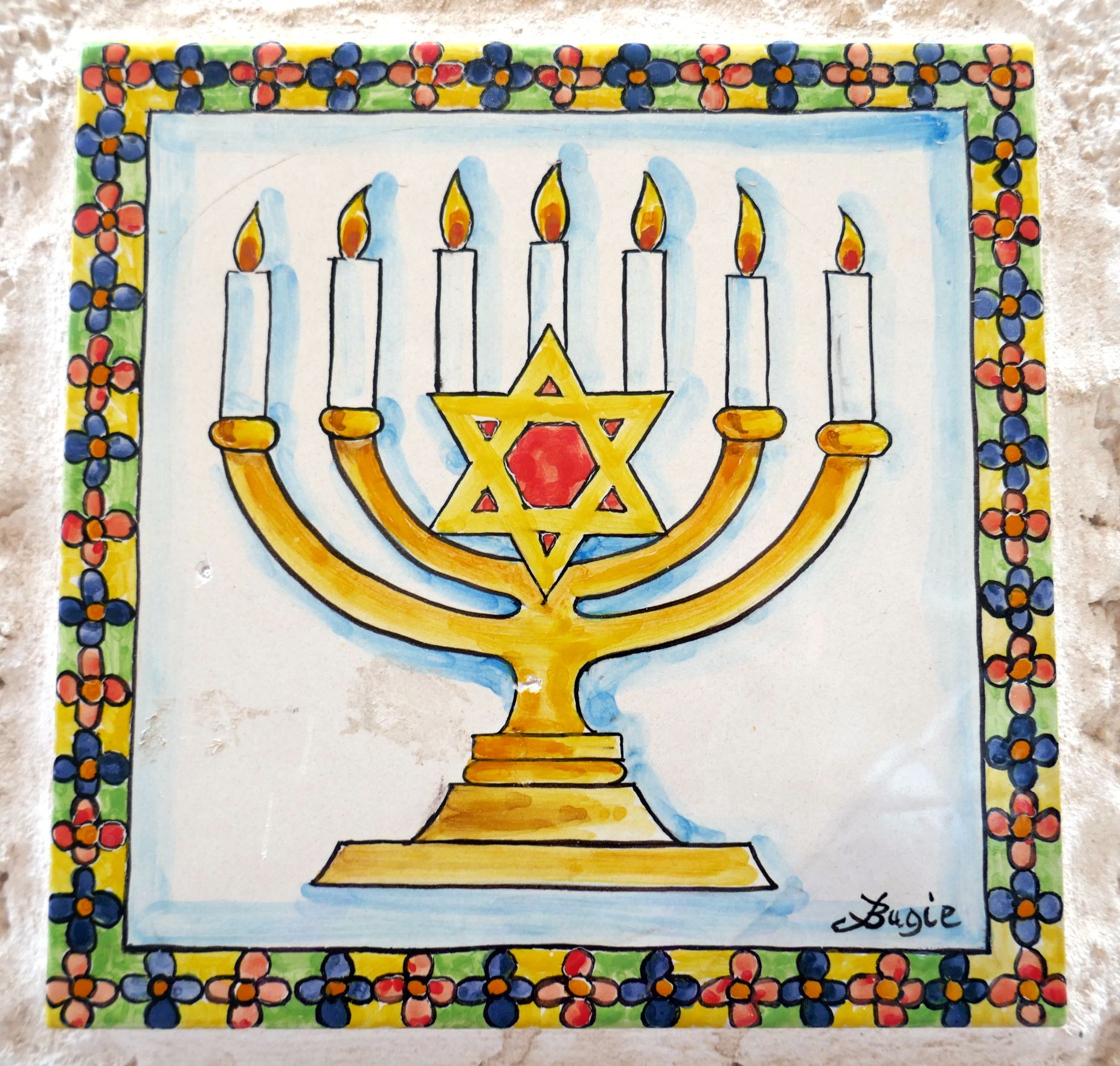
These are tiles on the walls of the historic Jewish Quarter, depicting symbols of Judiasm.
The gentleman who owns this home did all the tile and artwork himself. He graciously welcomed us into his home for a tour.
These garage door murals were all entered in a contest:
This mural won the contest. This little boy’s father was a fisherman on this boat and died in a storm.
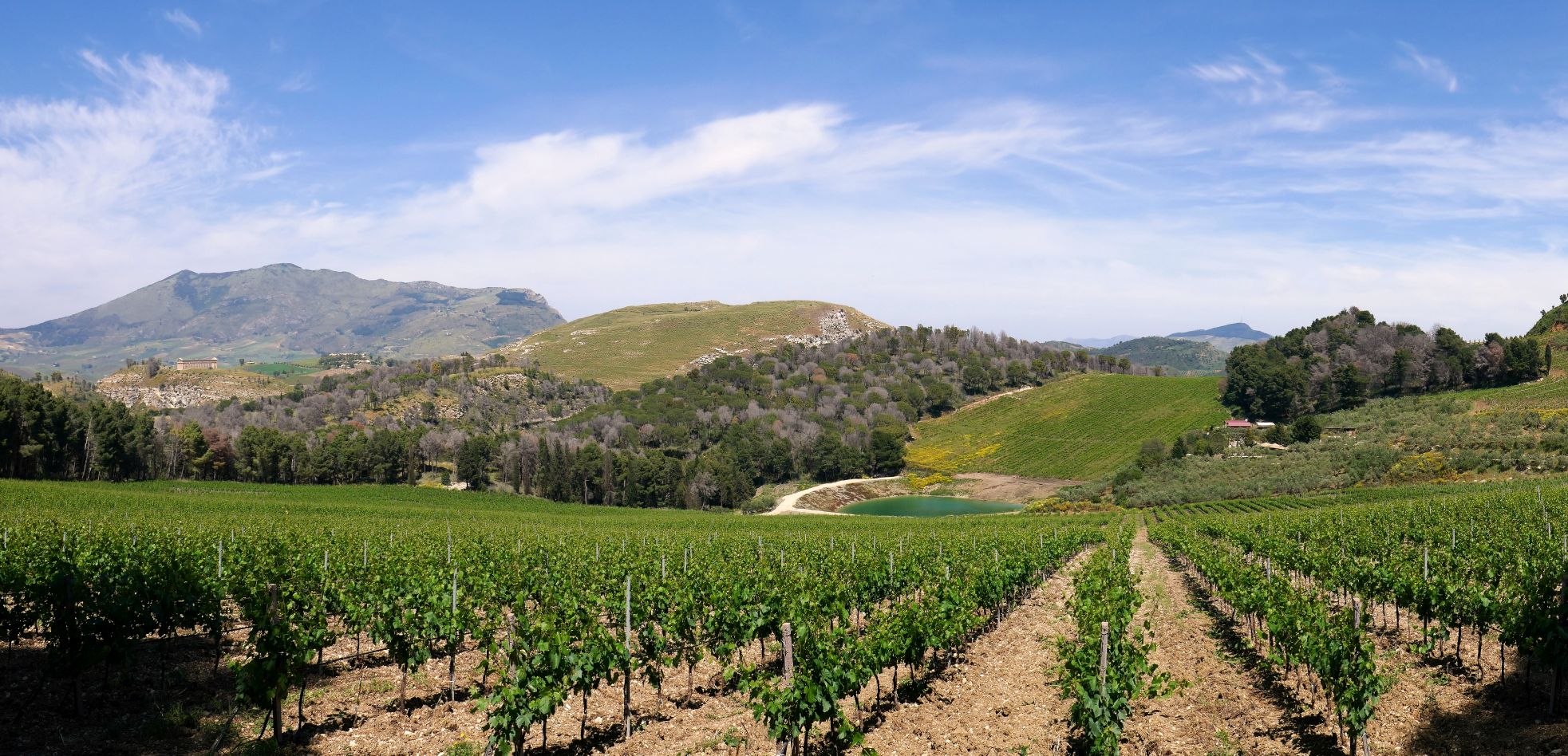
Following our tour of Monreale Cathedral, we set off to Segesta, a region that was once home to the ancient Elymians, one of the three indigenous peoples of Sicily. We enjoyed a wonderful lunch at an agriturismo, a traditional Sicilian farmhouse sanctioned for dining and lodging by the Italian government. Wine and olive oil is produced at this farm, so we learned about the process and tasted their products, all while enjoying the spectacular views from their hilltop location.
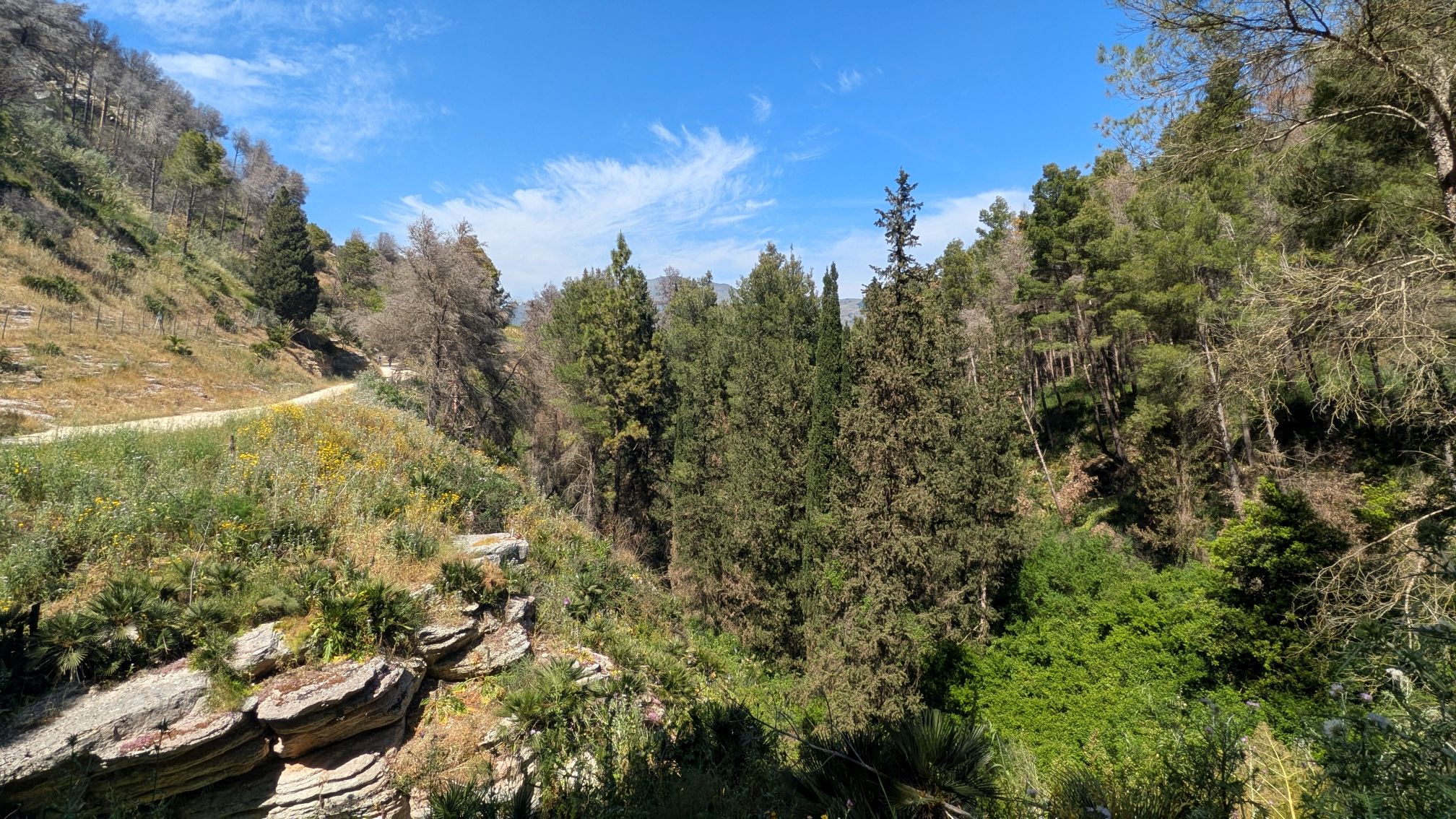
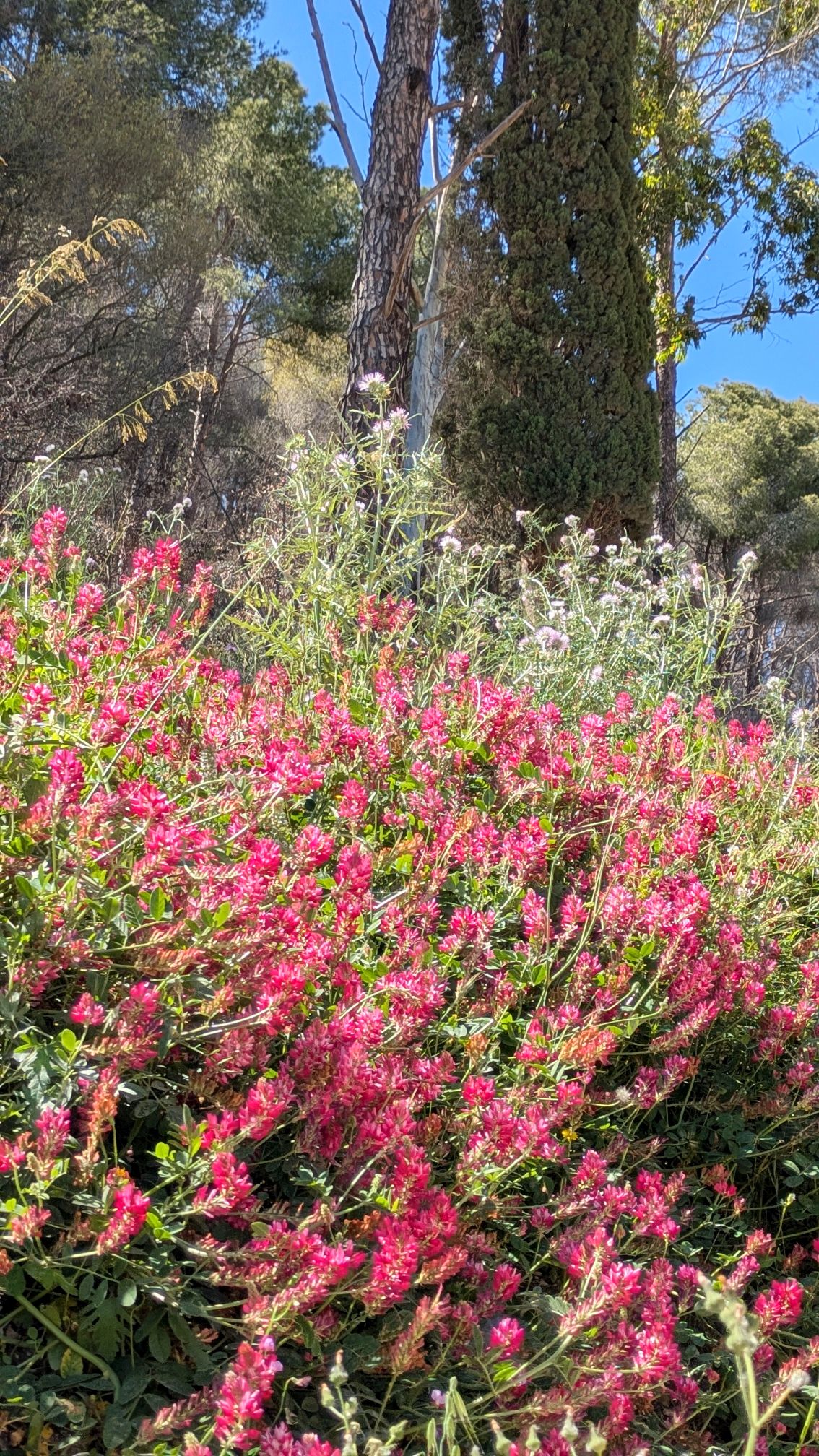
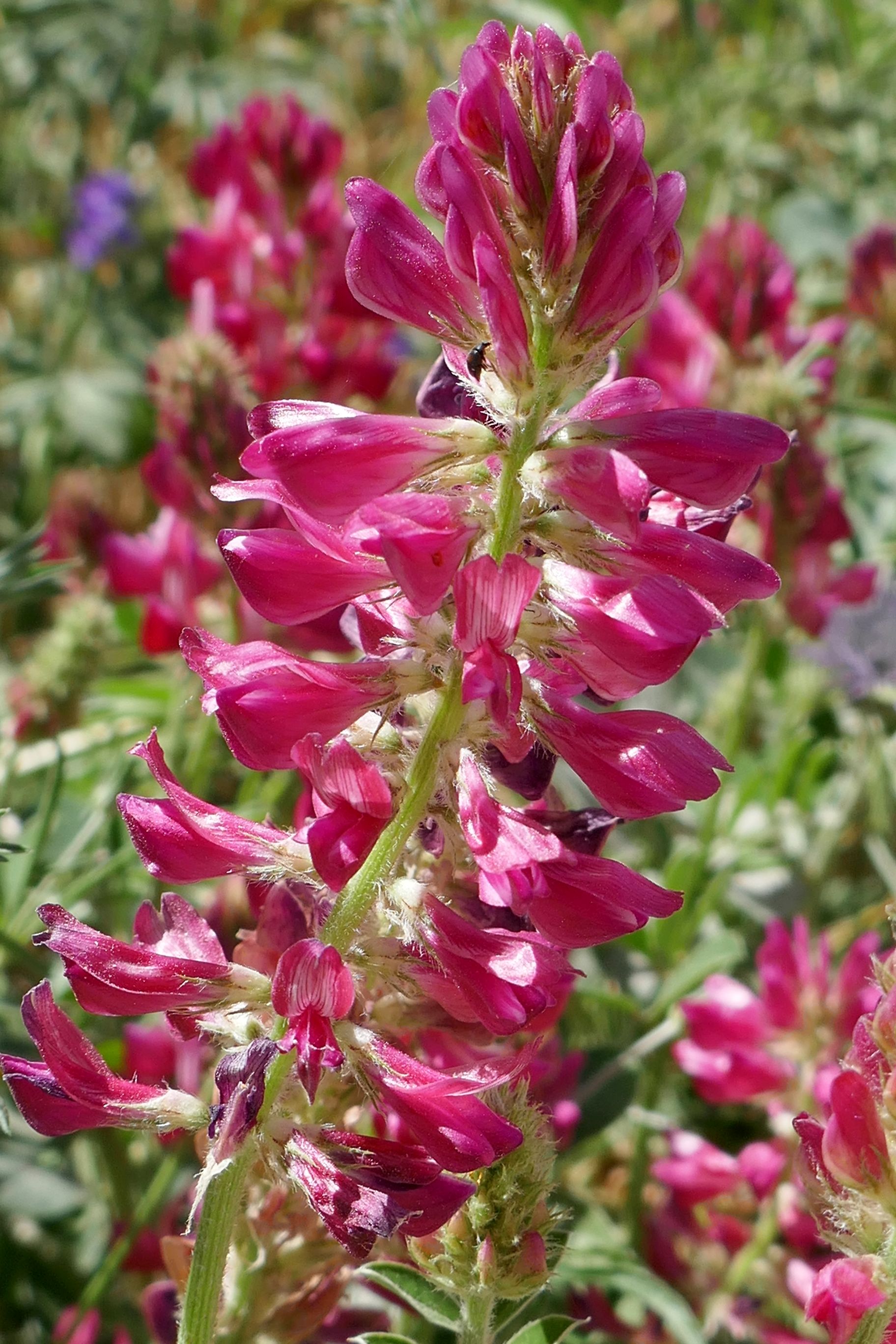
We had the option after lunch to take the bus back down the hill or to hike the path and enjoy the scenery on foot. It was a gorgeous day, the wildflowers were in bloom, and the views were beautiful, so I opted for the hike.
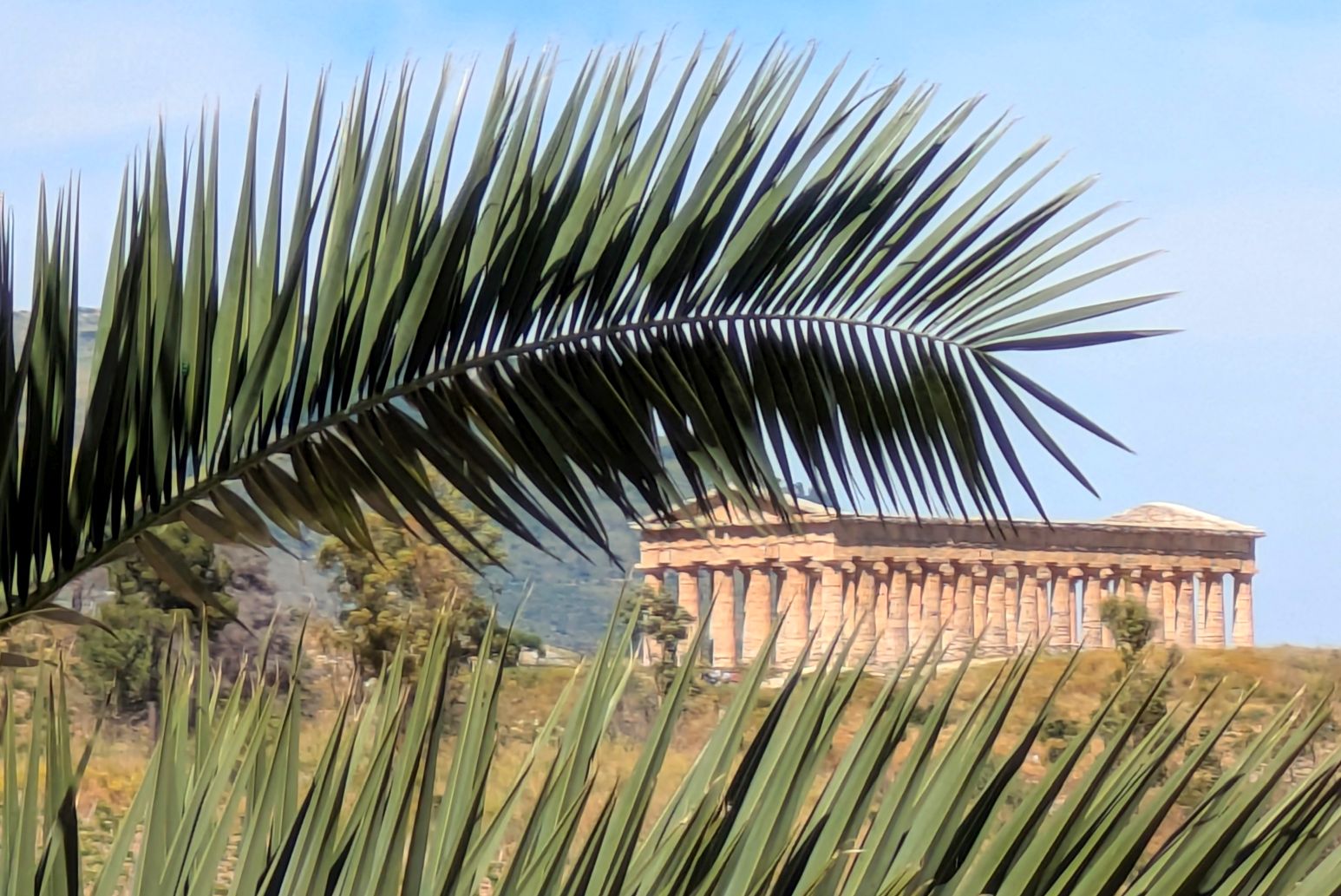
Off in the distance, we could see the columns of a well preserved (but unfinished) Doric temple that was believed to be built in the 420s BC. Here, then, are the scenes I captured during this most enjoyable hike:
(For all photos, click on the image for a full screen view.)
After regrouping on the bus, we continued our journey overland to Mazara del Vallo, the subject of my next post.
Coming up next: SICILY & AMALFI COAST #8: MEANDERING AROUND THE MAZARA KASBAH.
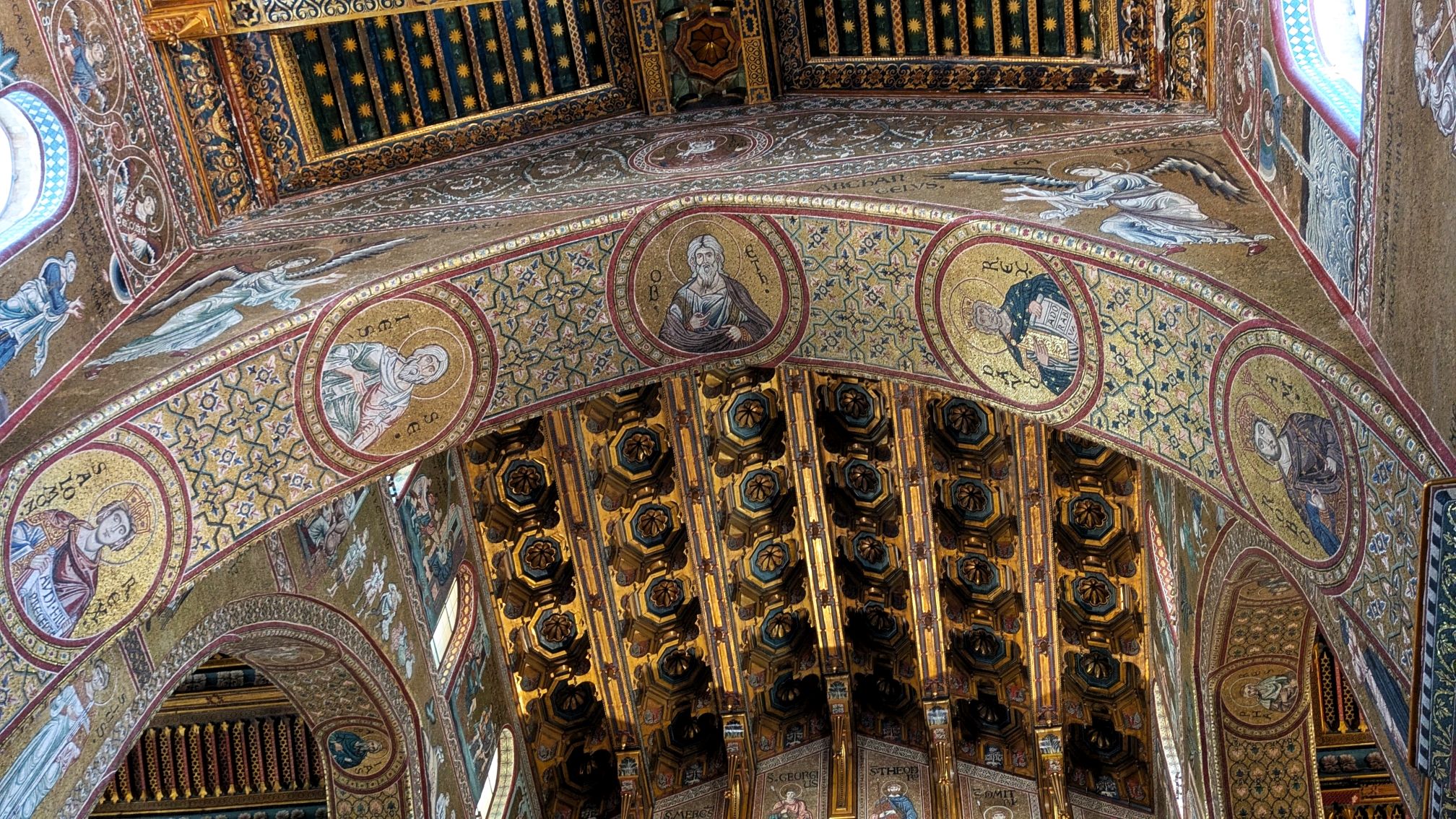
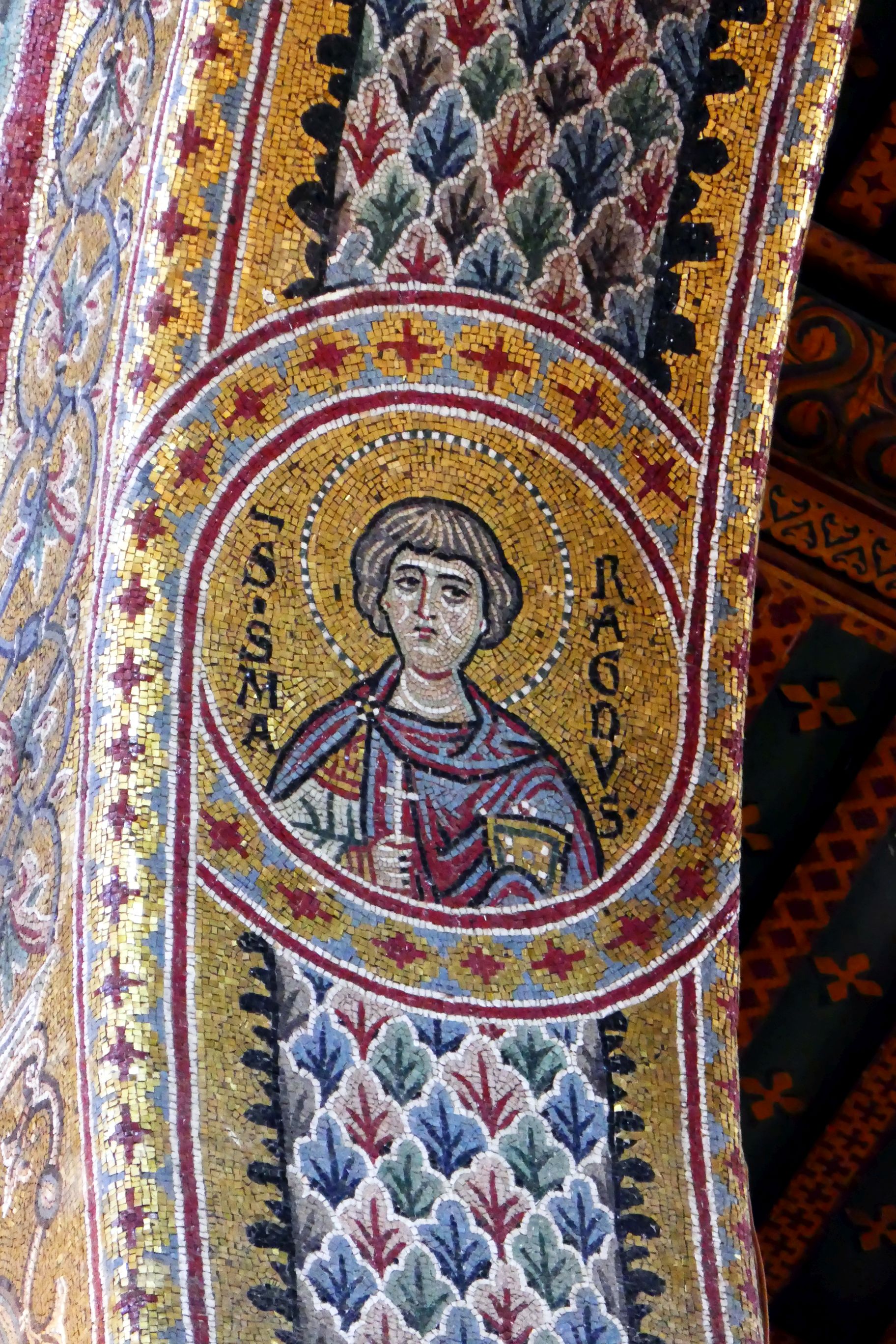
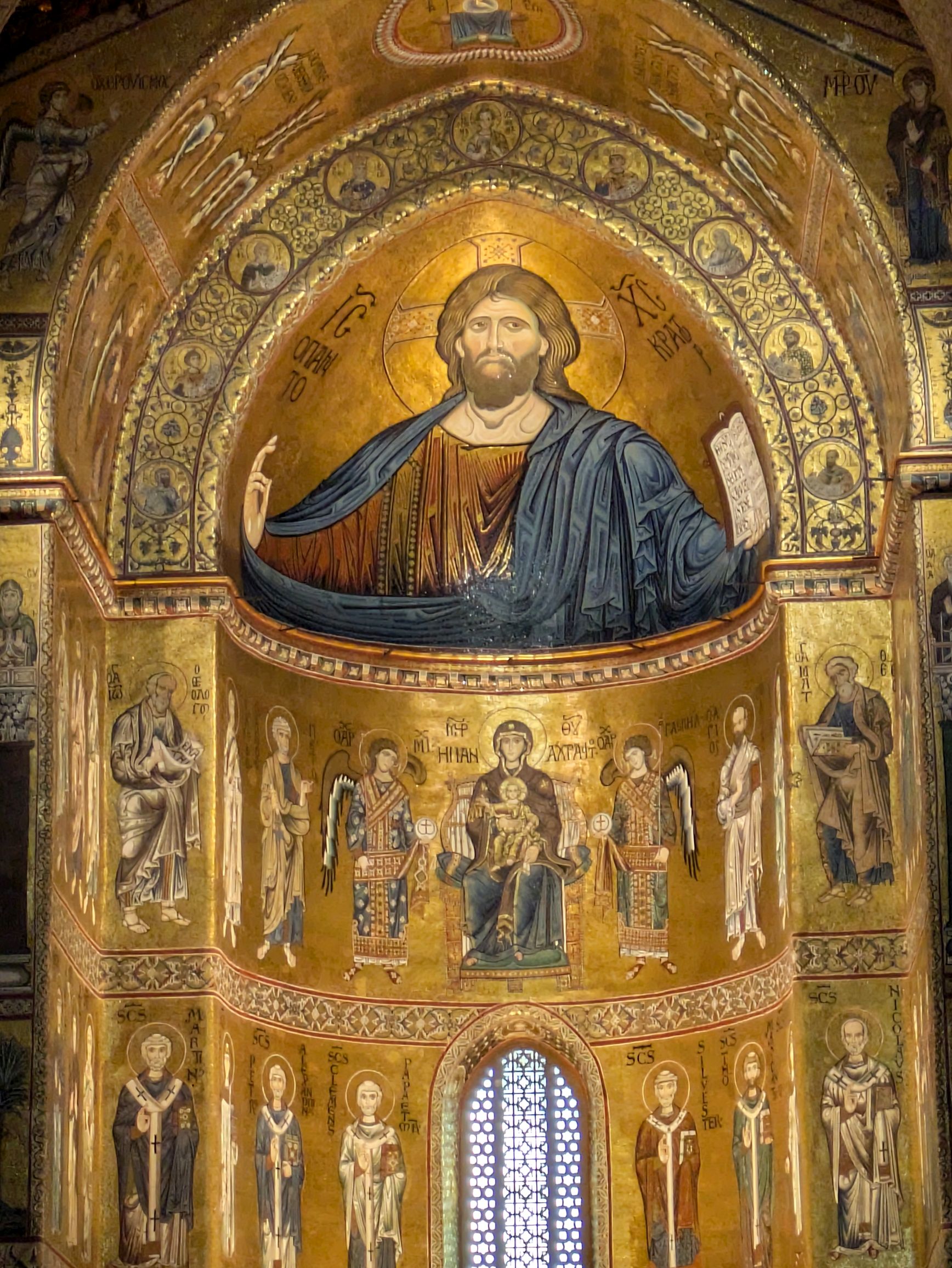
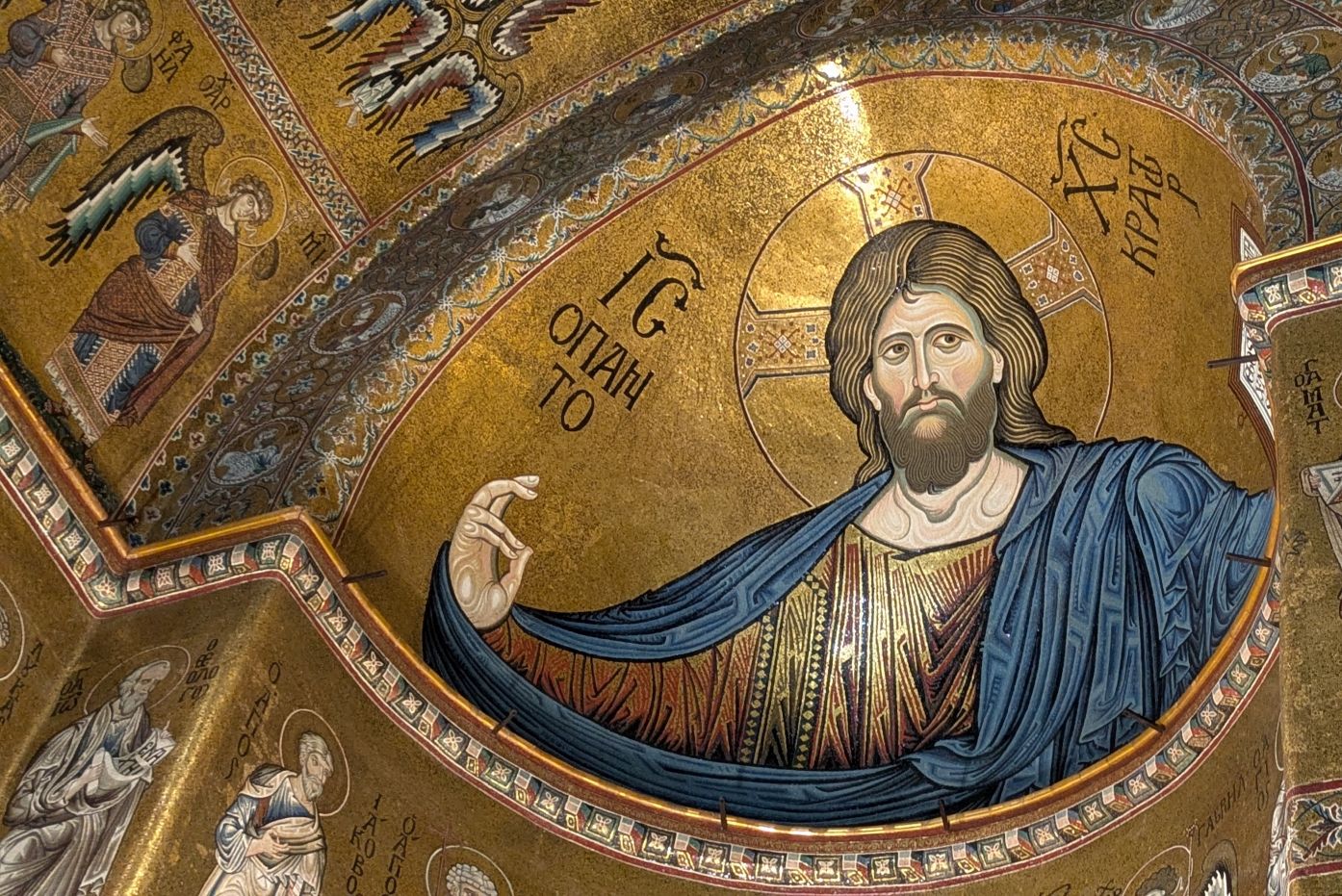
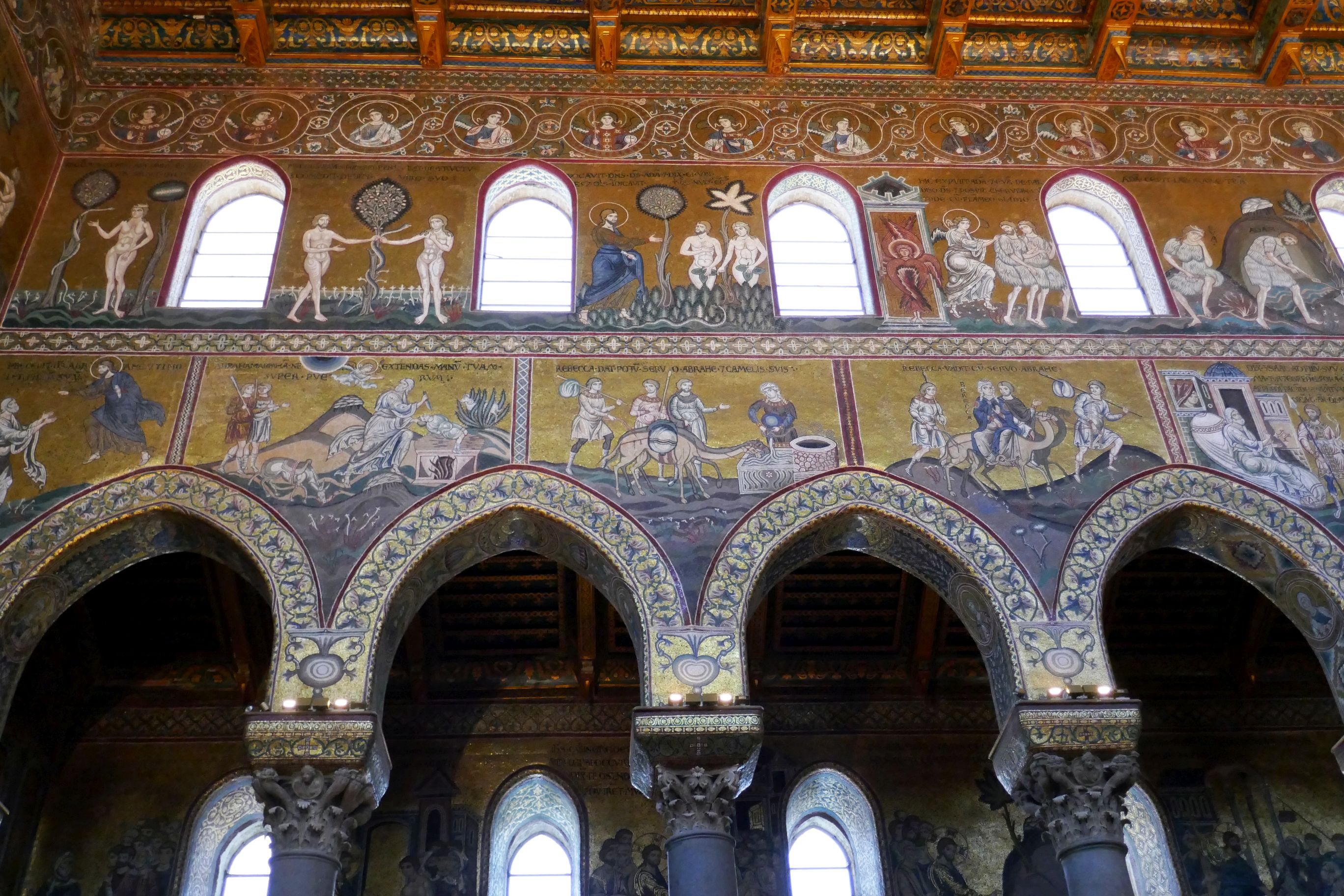
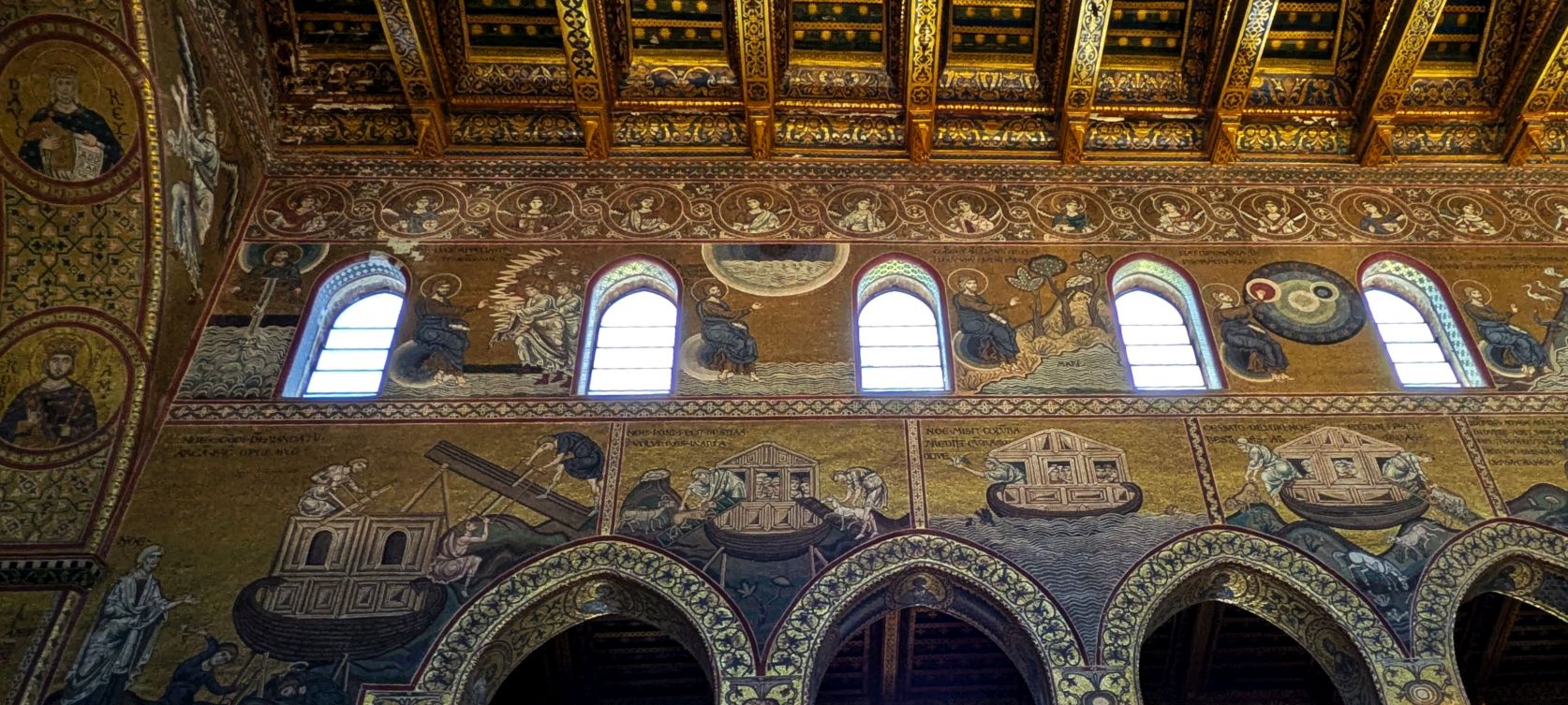
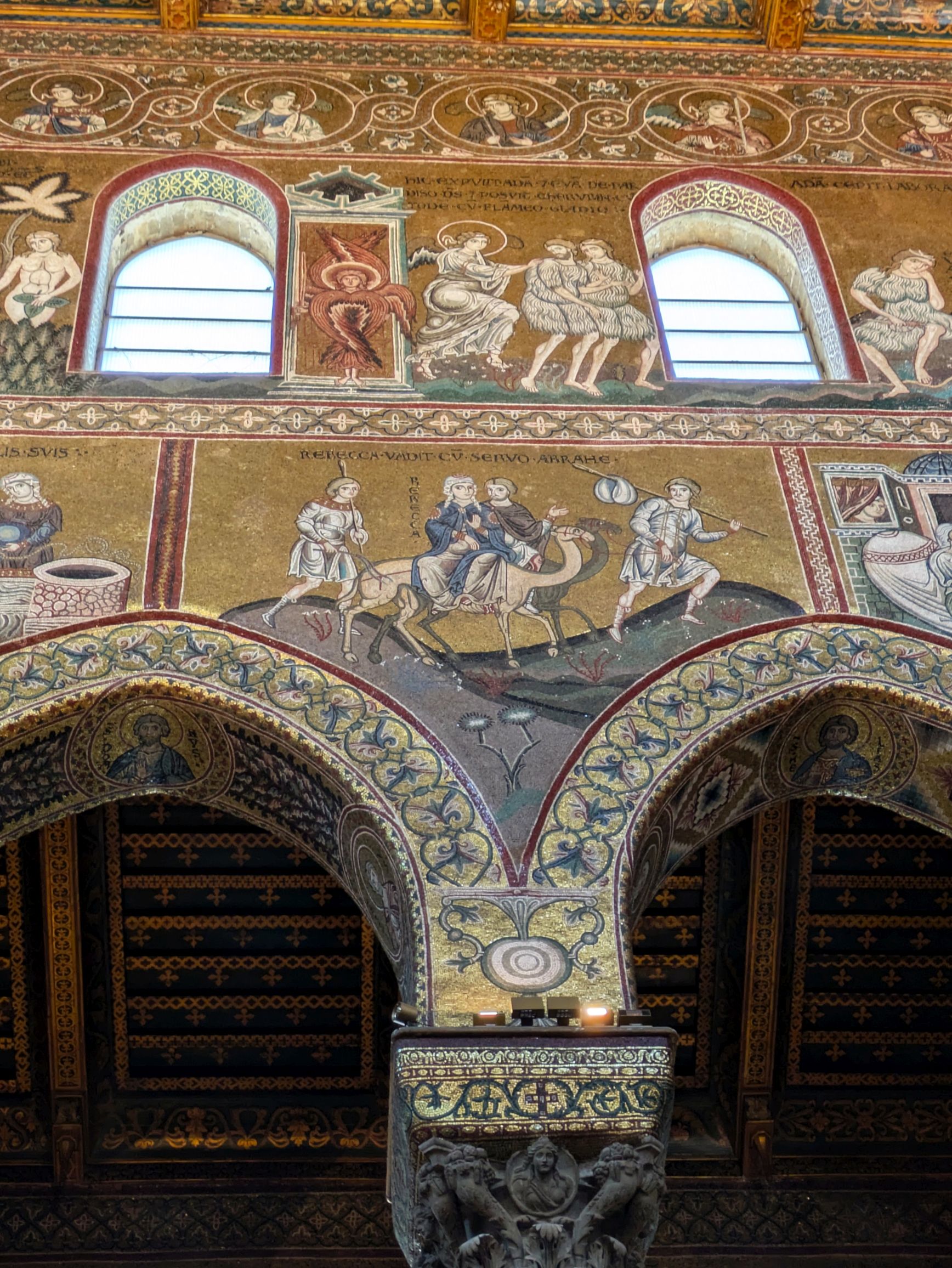
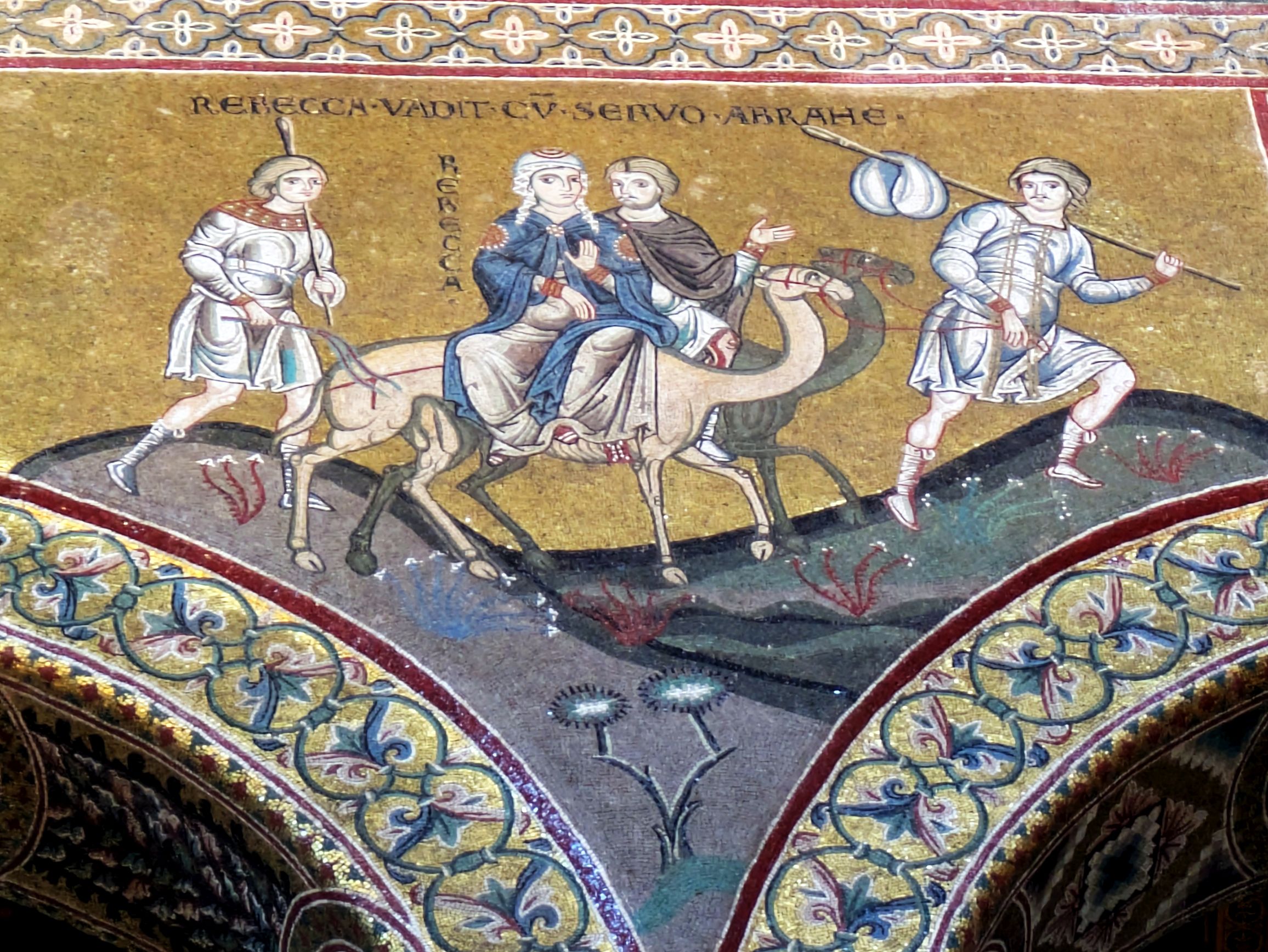
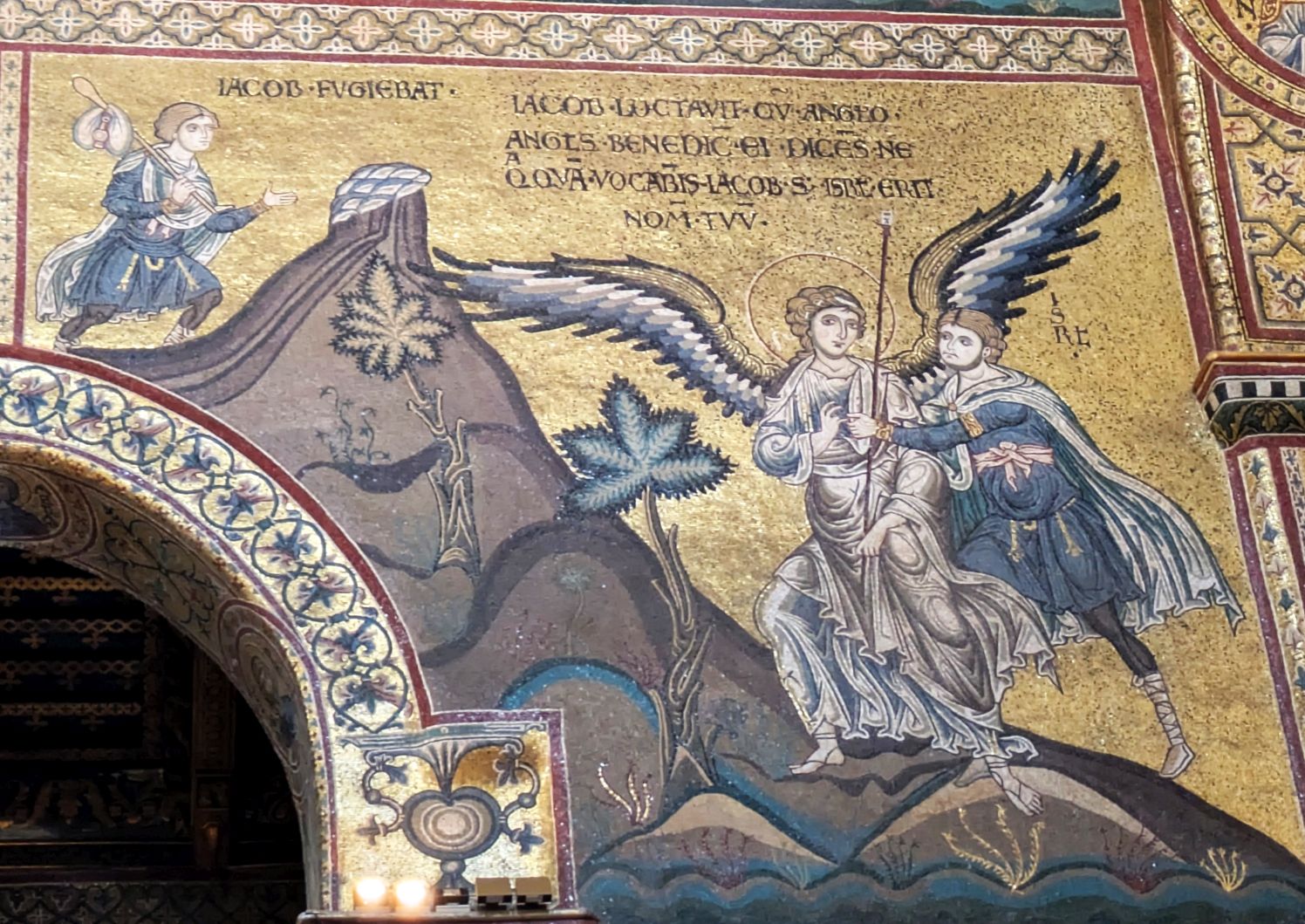
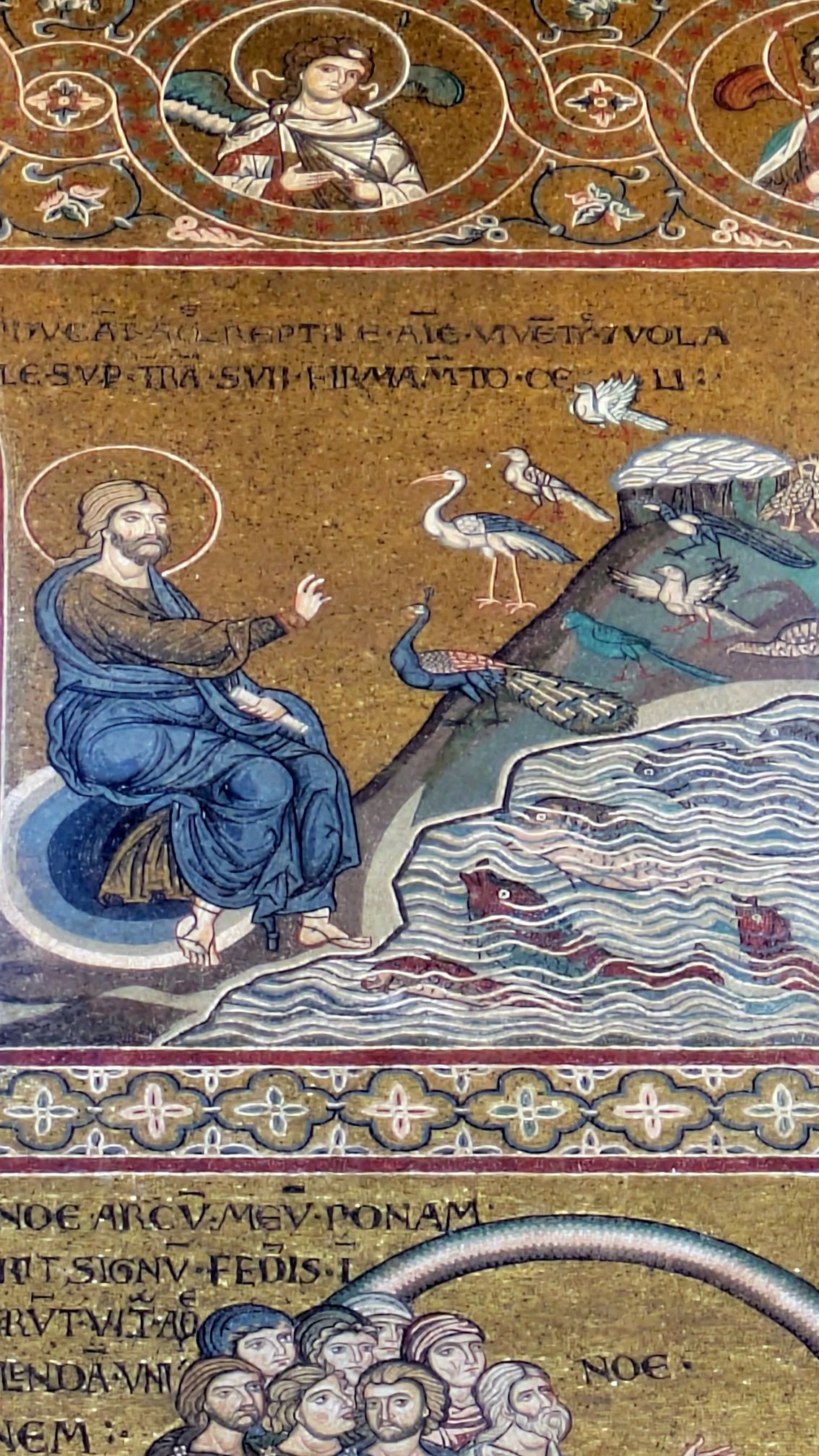
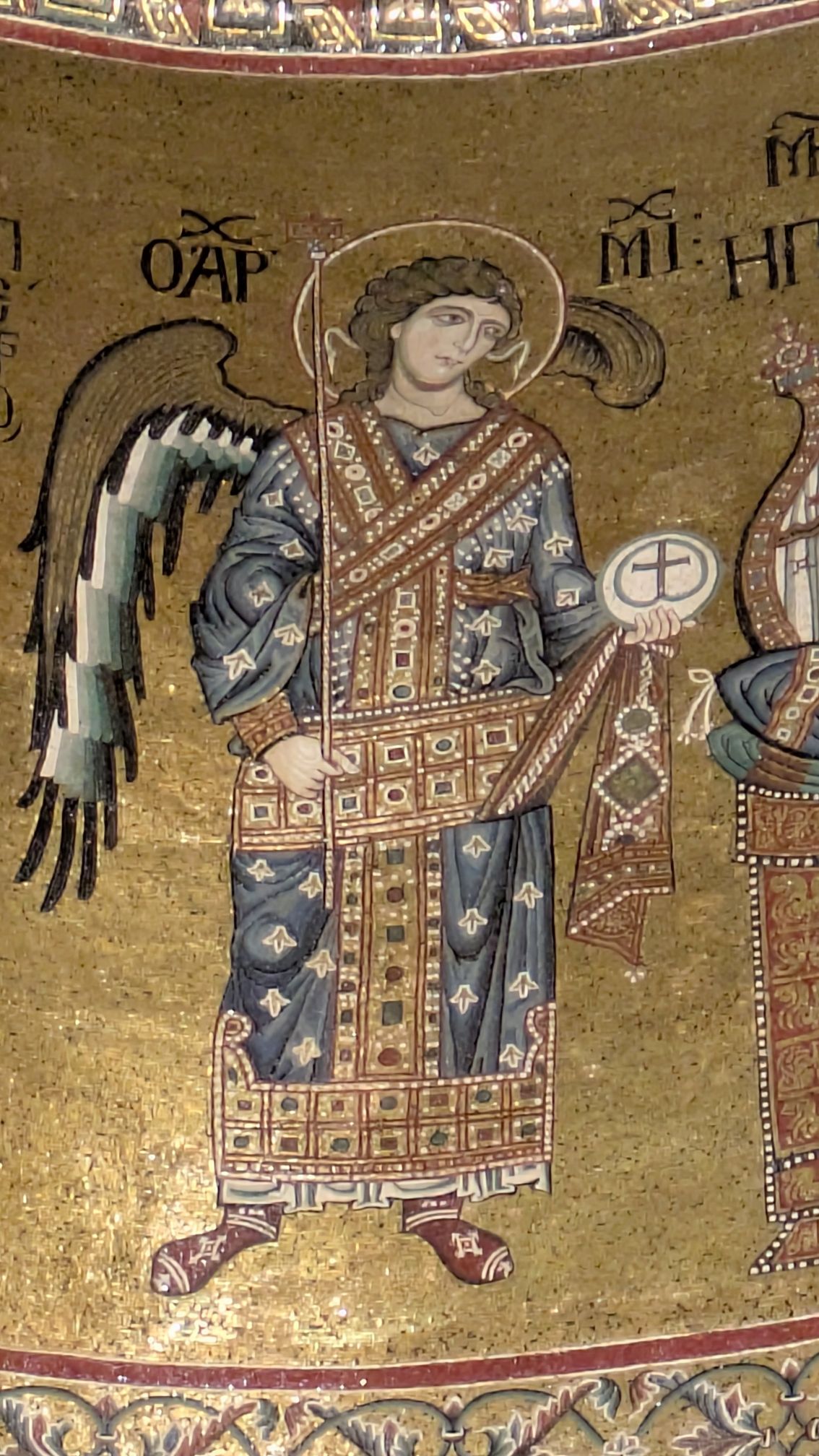
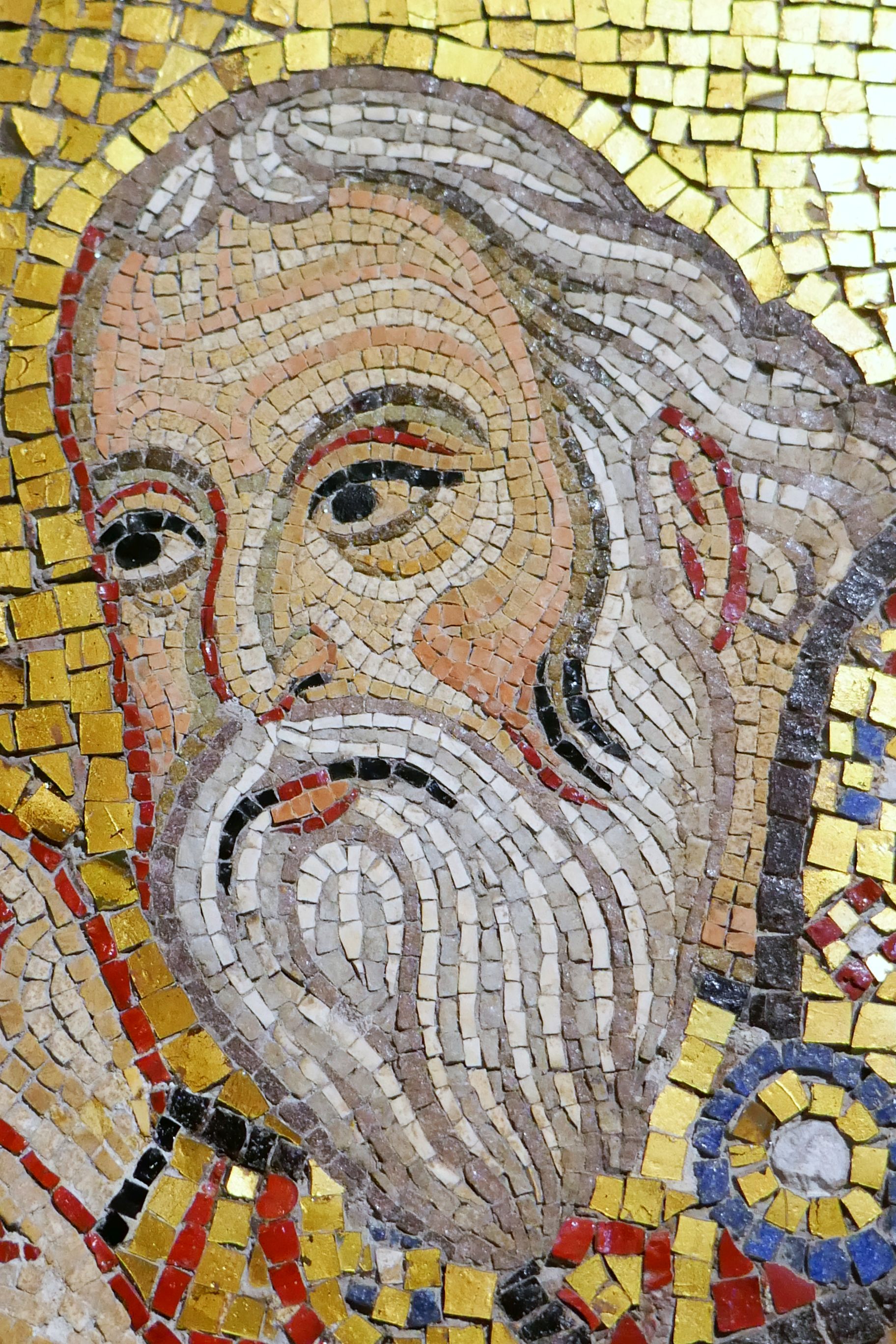
“Amazing” doesn’t begin to describe the enormous mosaics inside Monreale Cathedral, in Palermo, Sicily. One step inside, and we were all in awe. Our local tour guide did a fabulous job detailing the history and explaining the stories depicted in the mosaic scenes throughout the huge cathedral.
Considered one of the greatest examples of Norman architecture, construction of the cathedral began in 1172 and was completed in 1267. It is just one of many UNESCO World Heritage Sites in Sicily.
The Byzantine-style glass mosaics, totaling 70,000 square feet, were created between the late 12th and the mid-13th centuries by both local and Venetian masters. These 24 carat gold leaf mosaics are the largest in the world.
The cathedral is incredibly well preserved thanks to it being built on a hill away from the sea and not being a military target.
(For all photos, click on the image for a full screen view.)
This is just a part of the cathedral and doesn’t include most of the sides and huge area behind me.
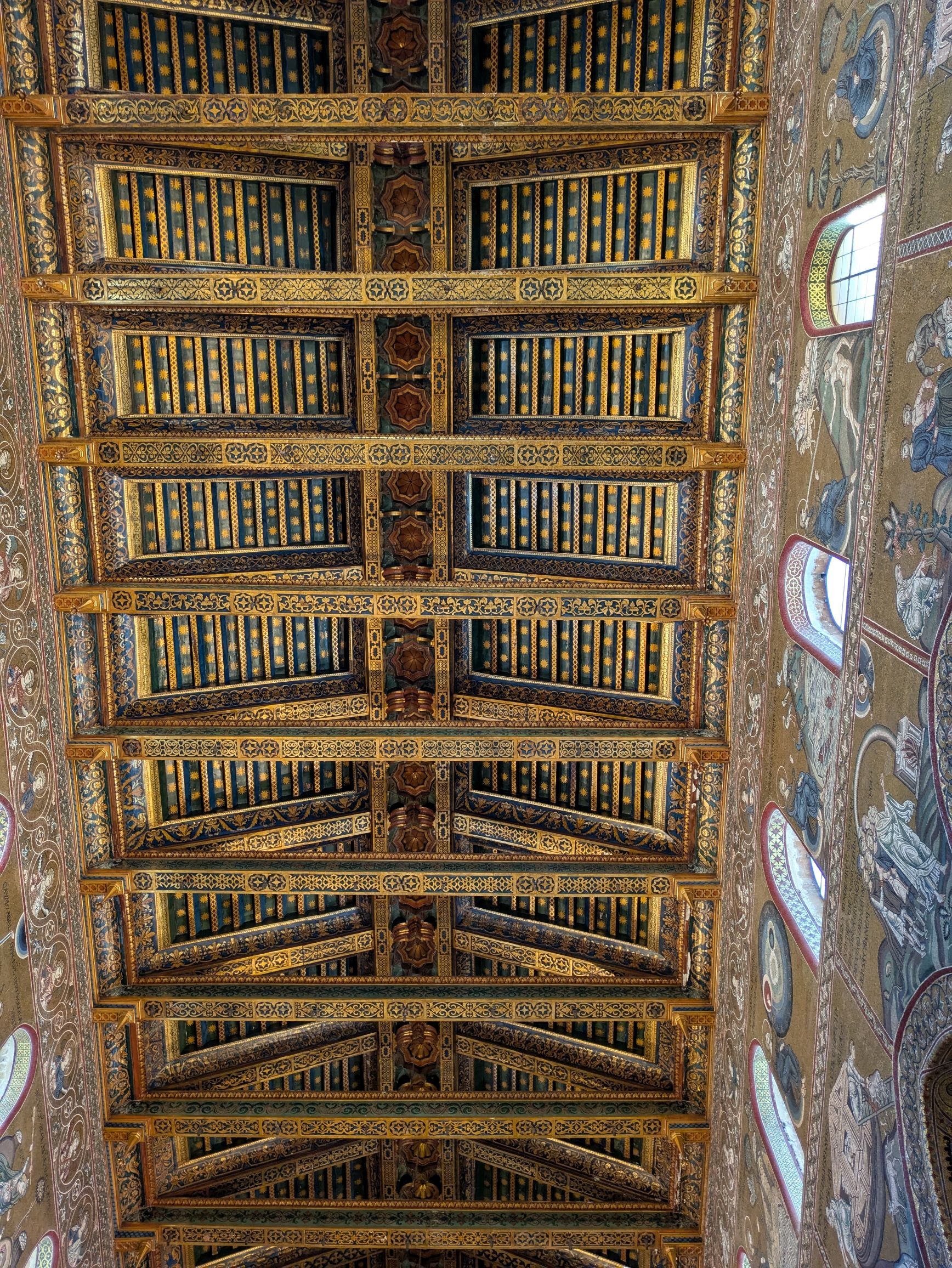
Celling
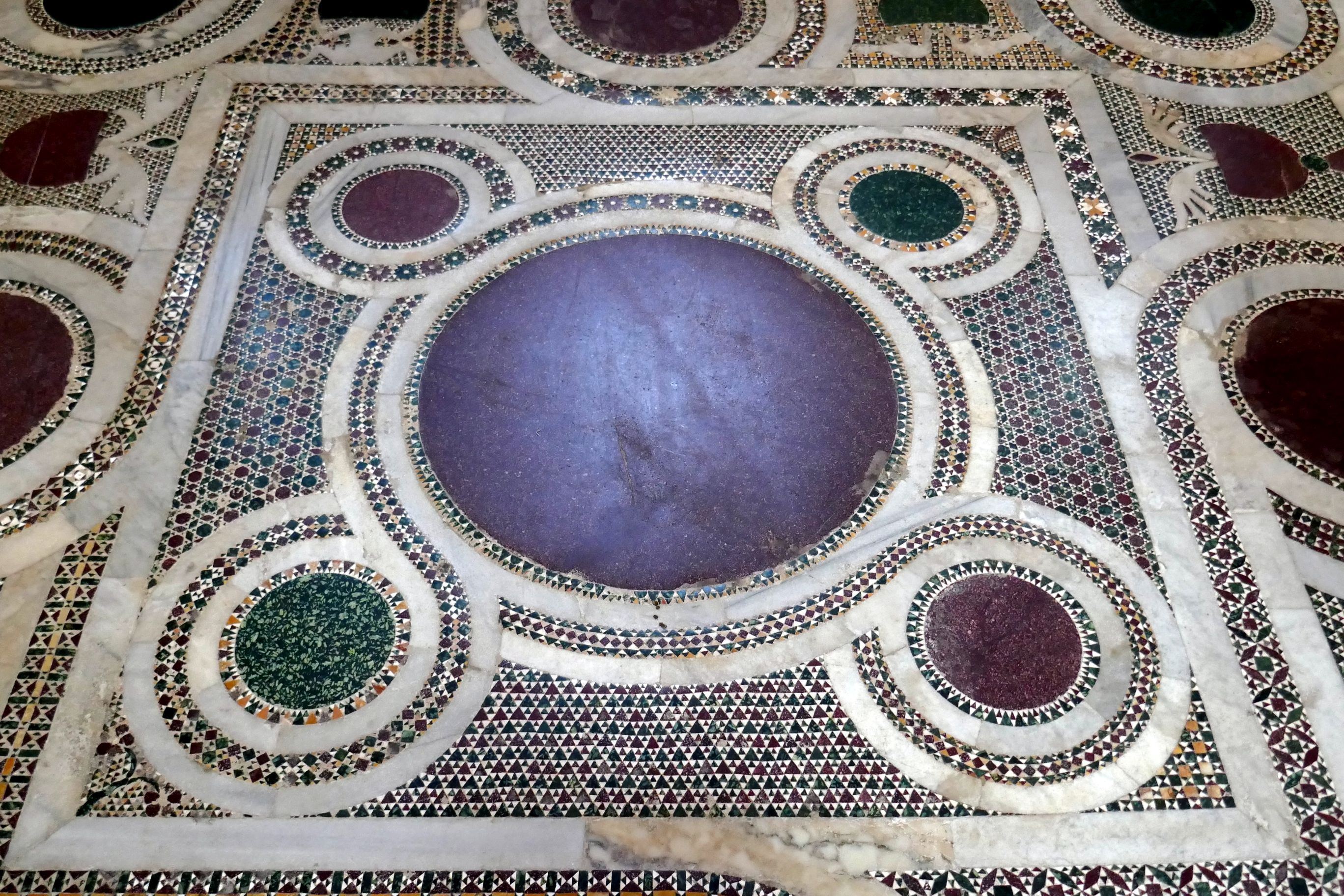
Floor mosaic
Following our excellent tour, we had time on our own to explore the streets surrounding the cathedral.
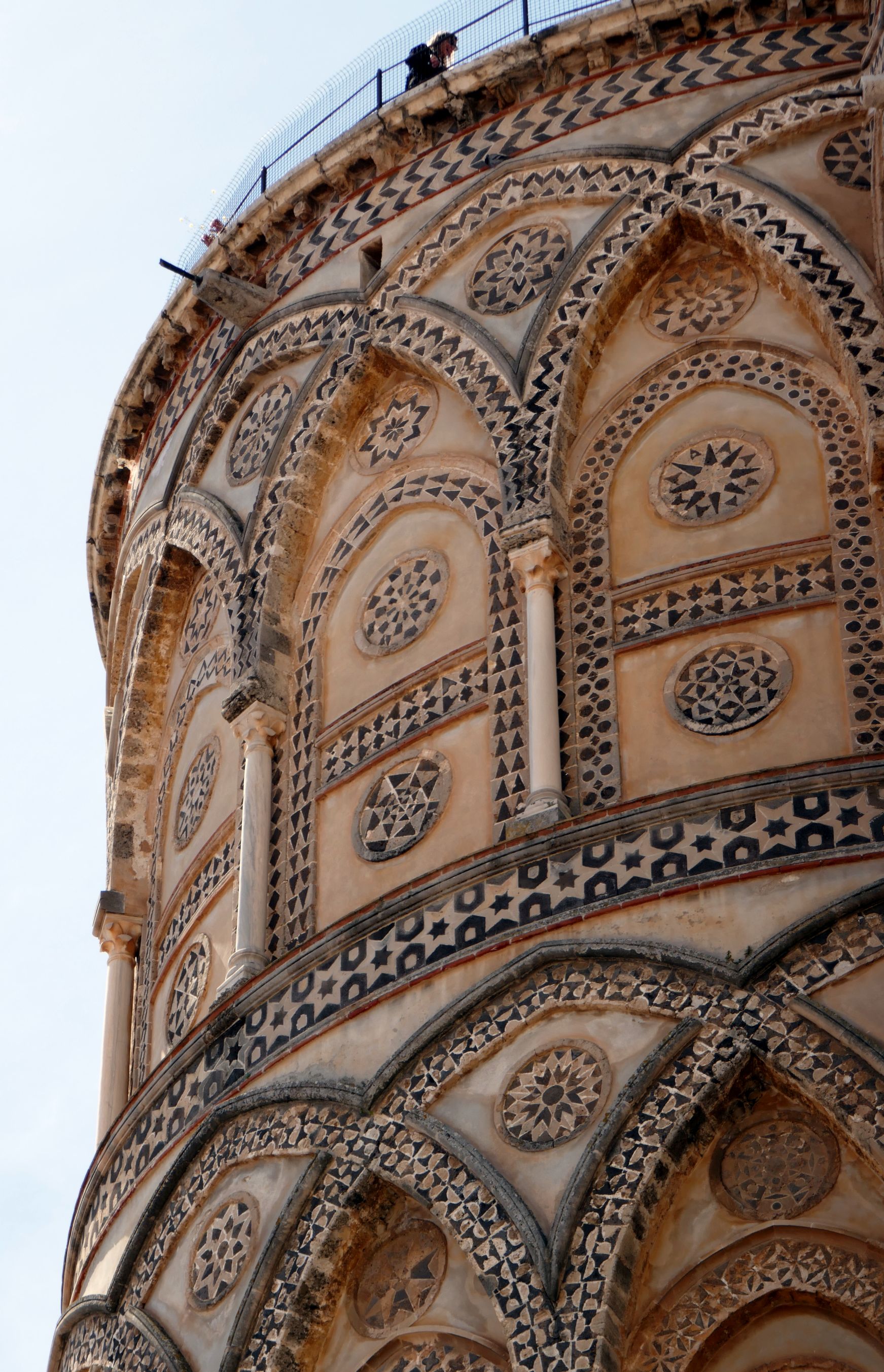
Looking up at a very small portion of the cathedral’s exterior
View from outside the cathedral.
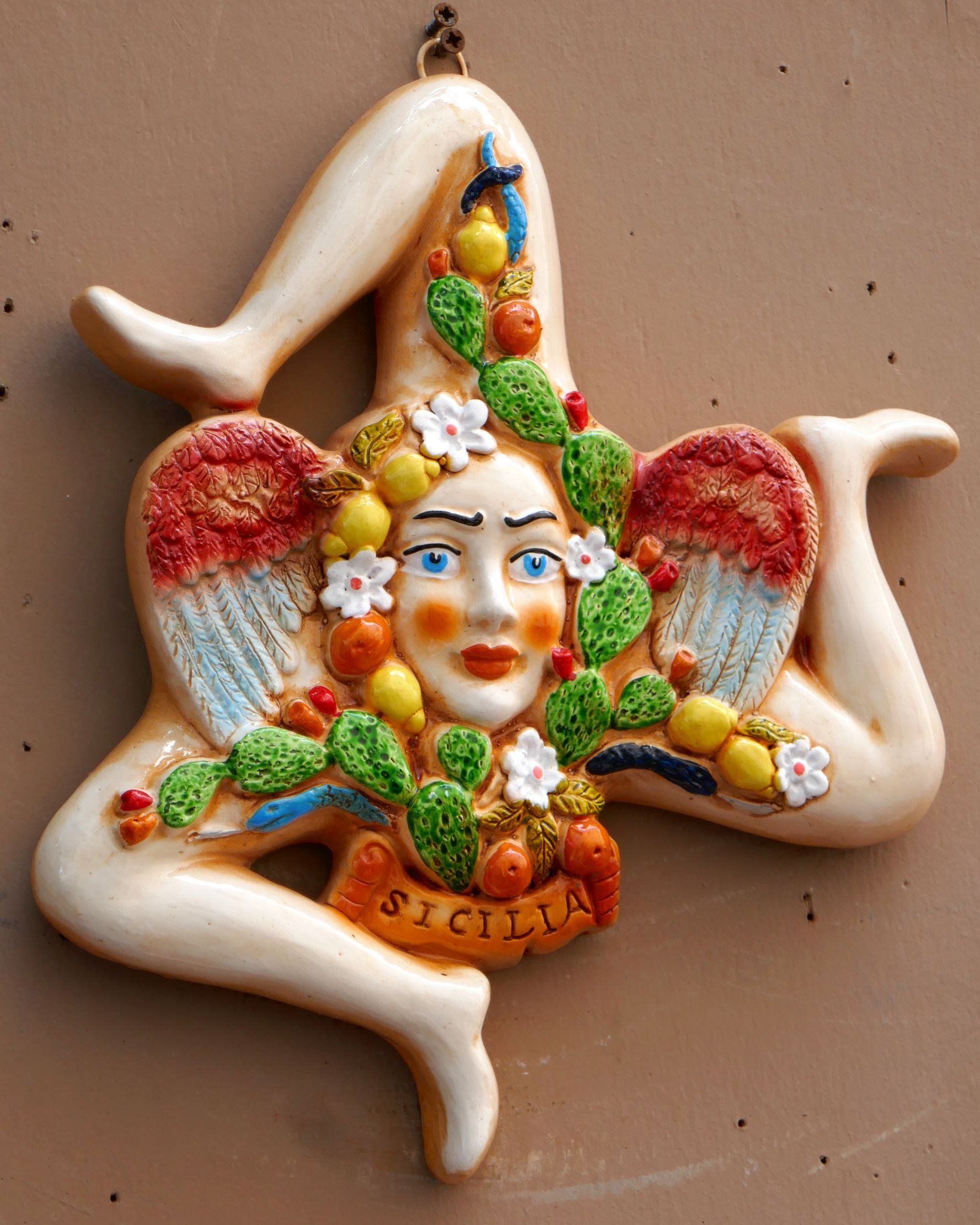
This is Trinacaria (meaning 3 points), the symbol of Sicily. It represents the shape of the island, which resembles a triangle. Click here to read more.
In the afternoon, we continued to Segesta, the topic of my next post.
Next up: SICILY & AMALFI COAST #7: SCENES OF SEGESTA
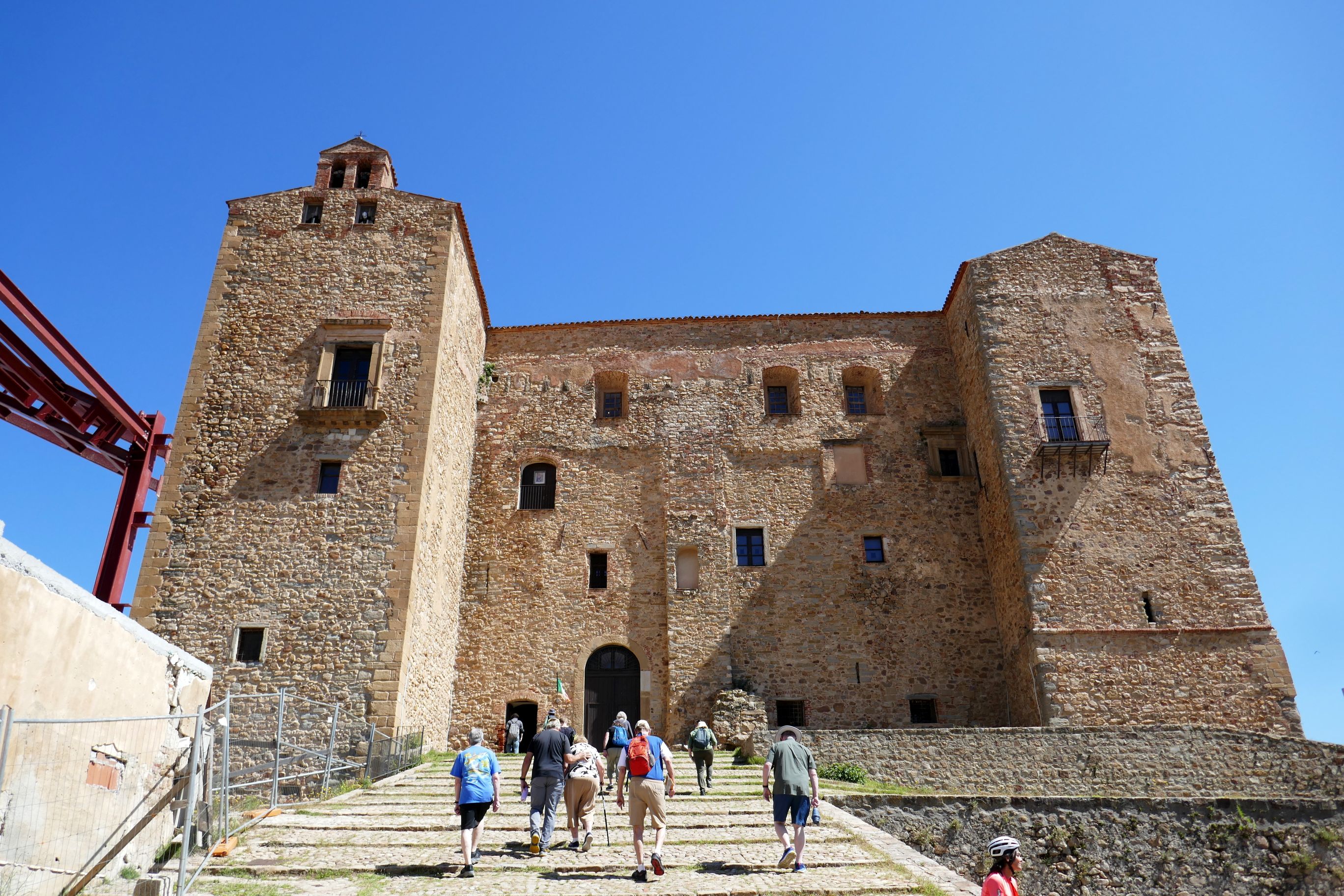
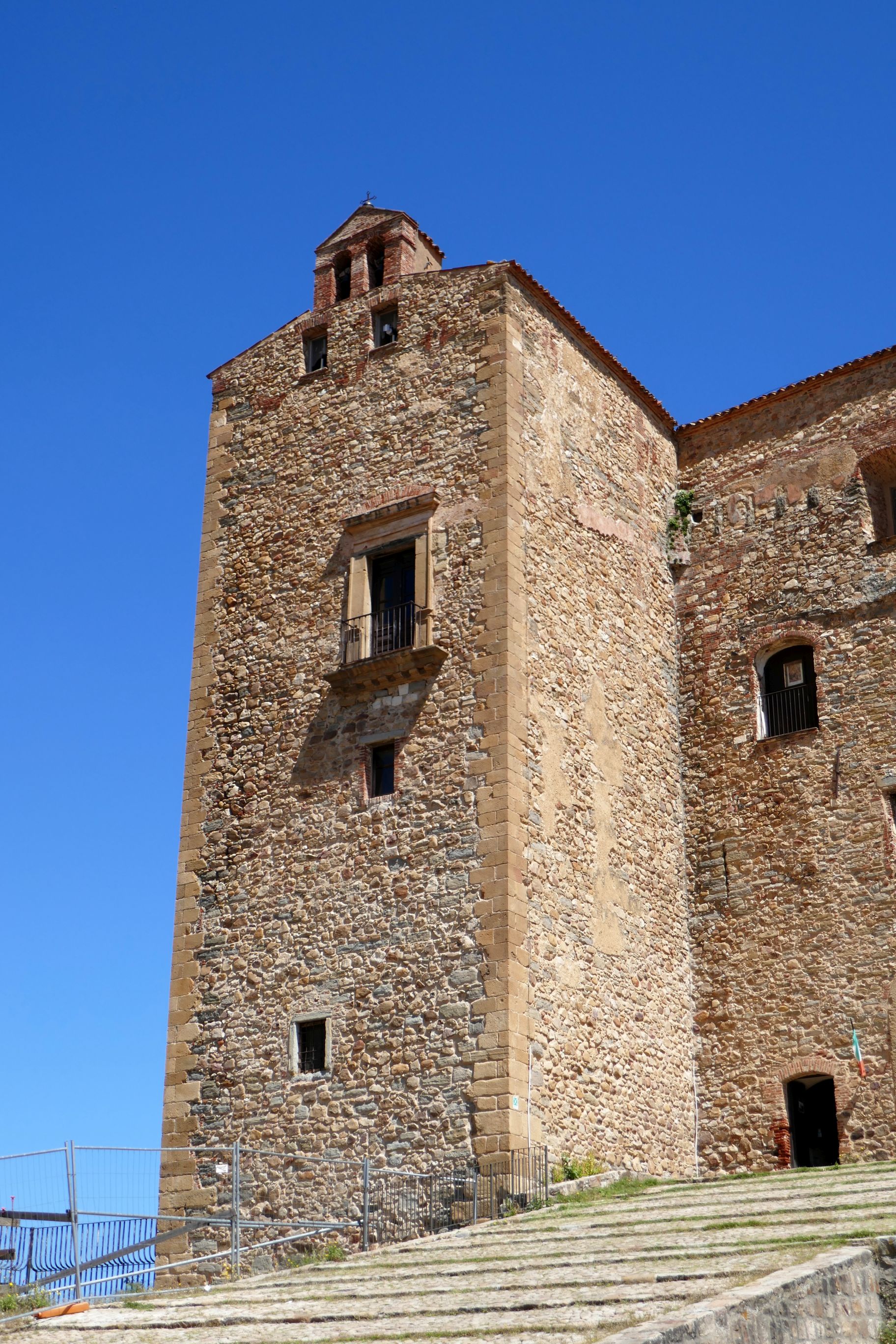
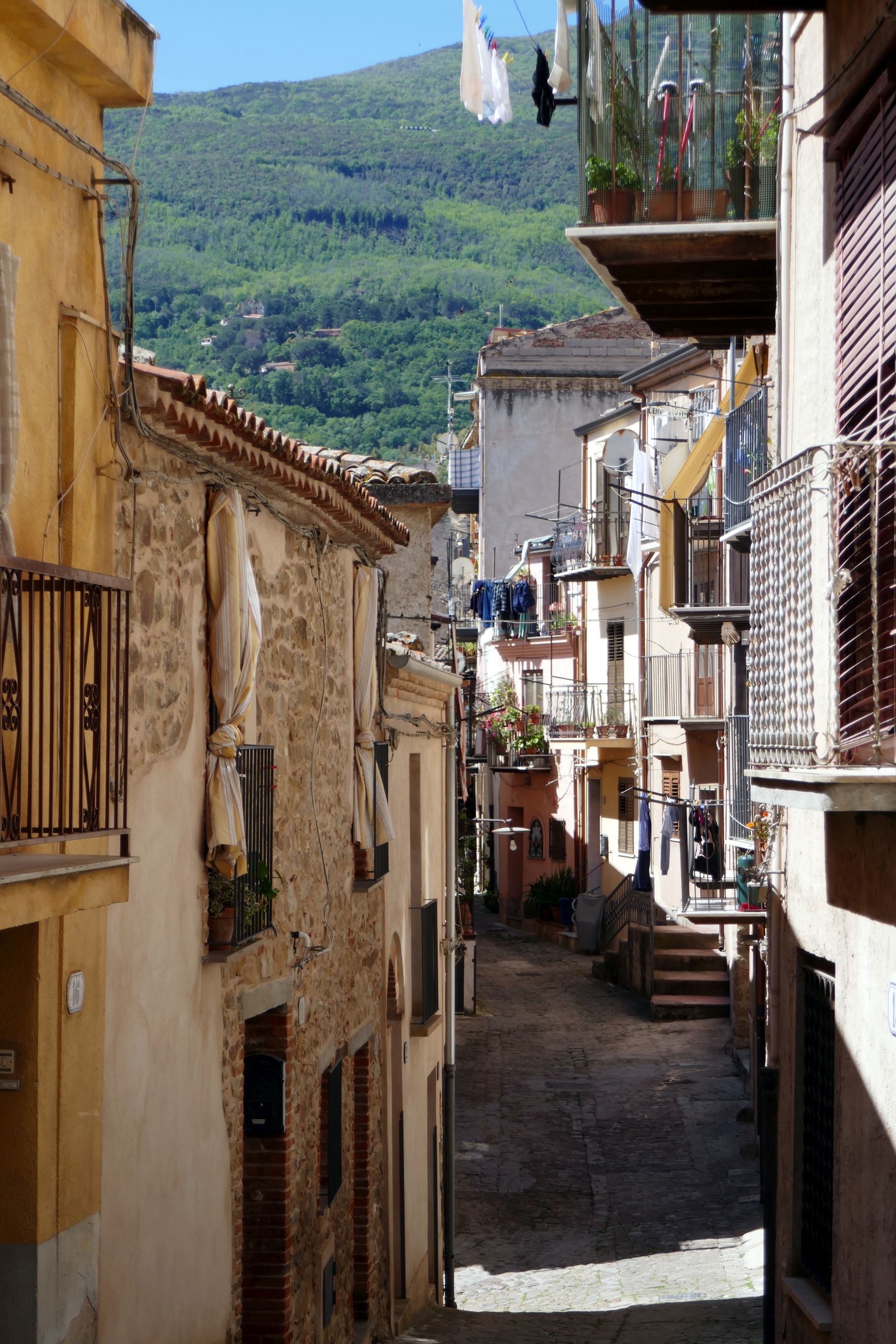
On a hilltop of the Madonie Mountains lies the small medieval village of Castelbuono. The centerpiece of the town is its castle of the same name, which we visited with our group. Owned by the Ventimiglia family, construction began in 1316 and underwent several changes and additions over the years. Currently, the castle houses the Castelbuono Civic Museum and a chapel.
(For all photos, click on the image for a full screen view.)
Ceiling
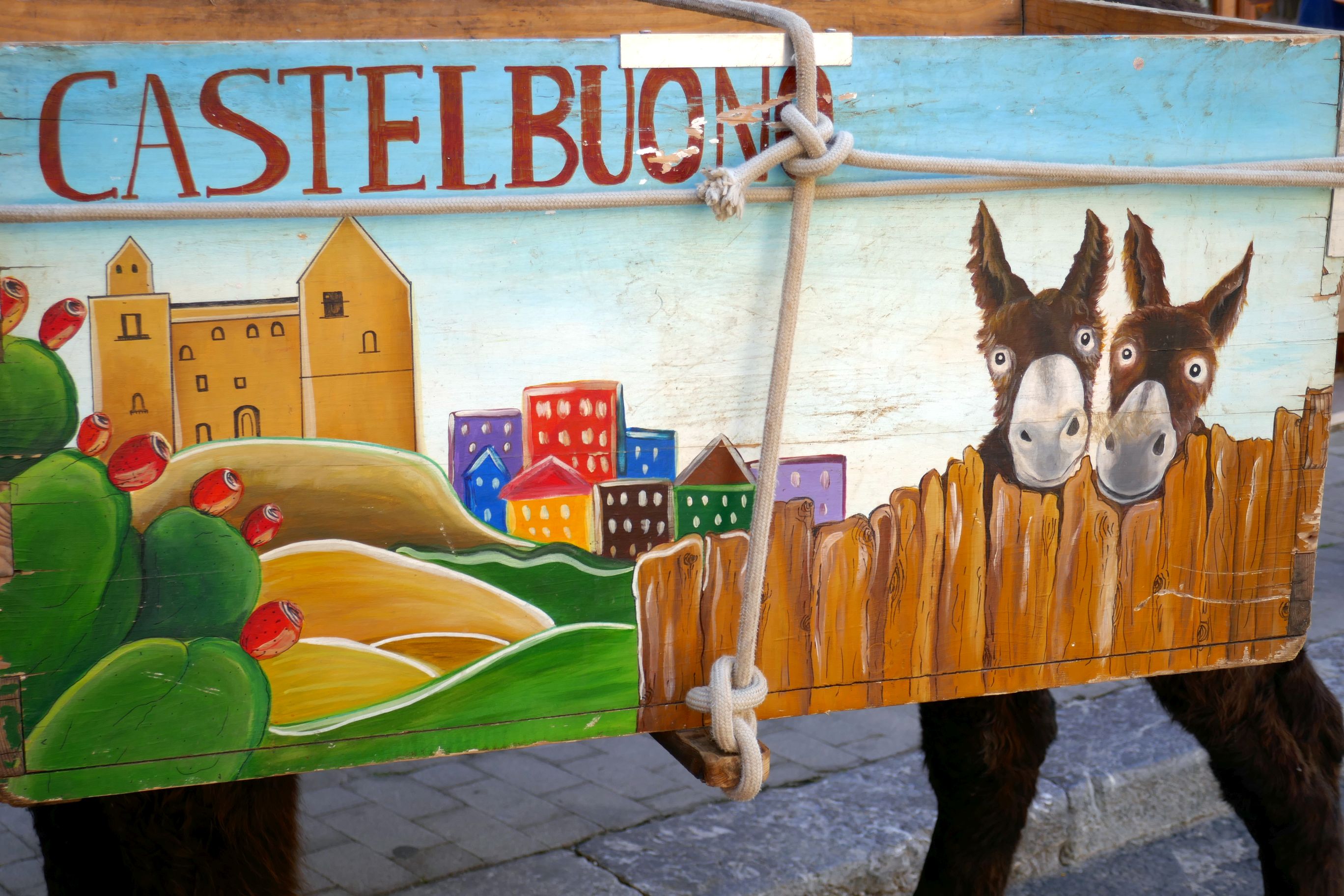
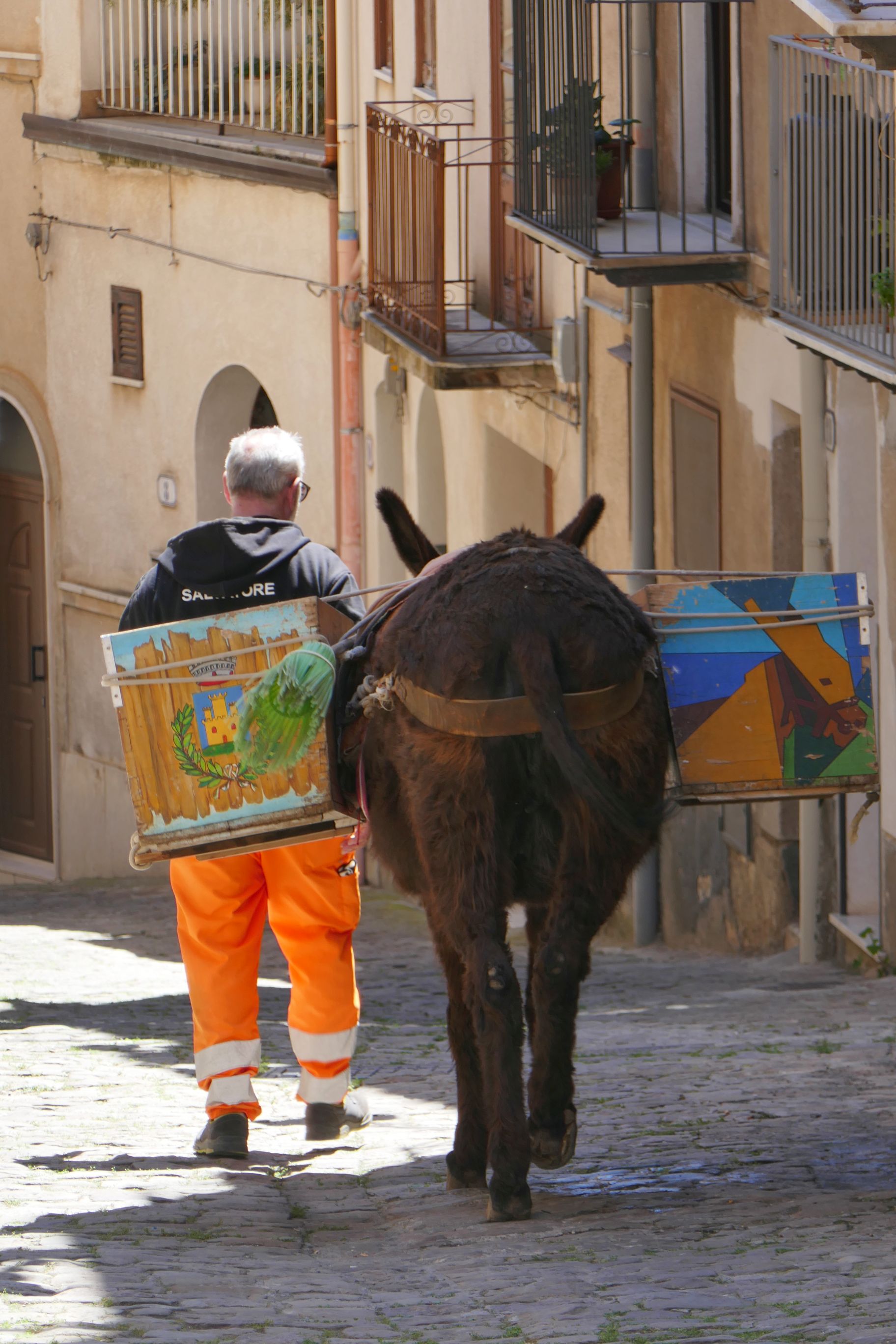
The village is also known for its working donkeys, used to collect garbage and recycling since the medieval alleys are too narrow for cars. This donkey is 22 years old and has been working with its partner for 18 years.
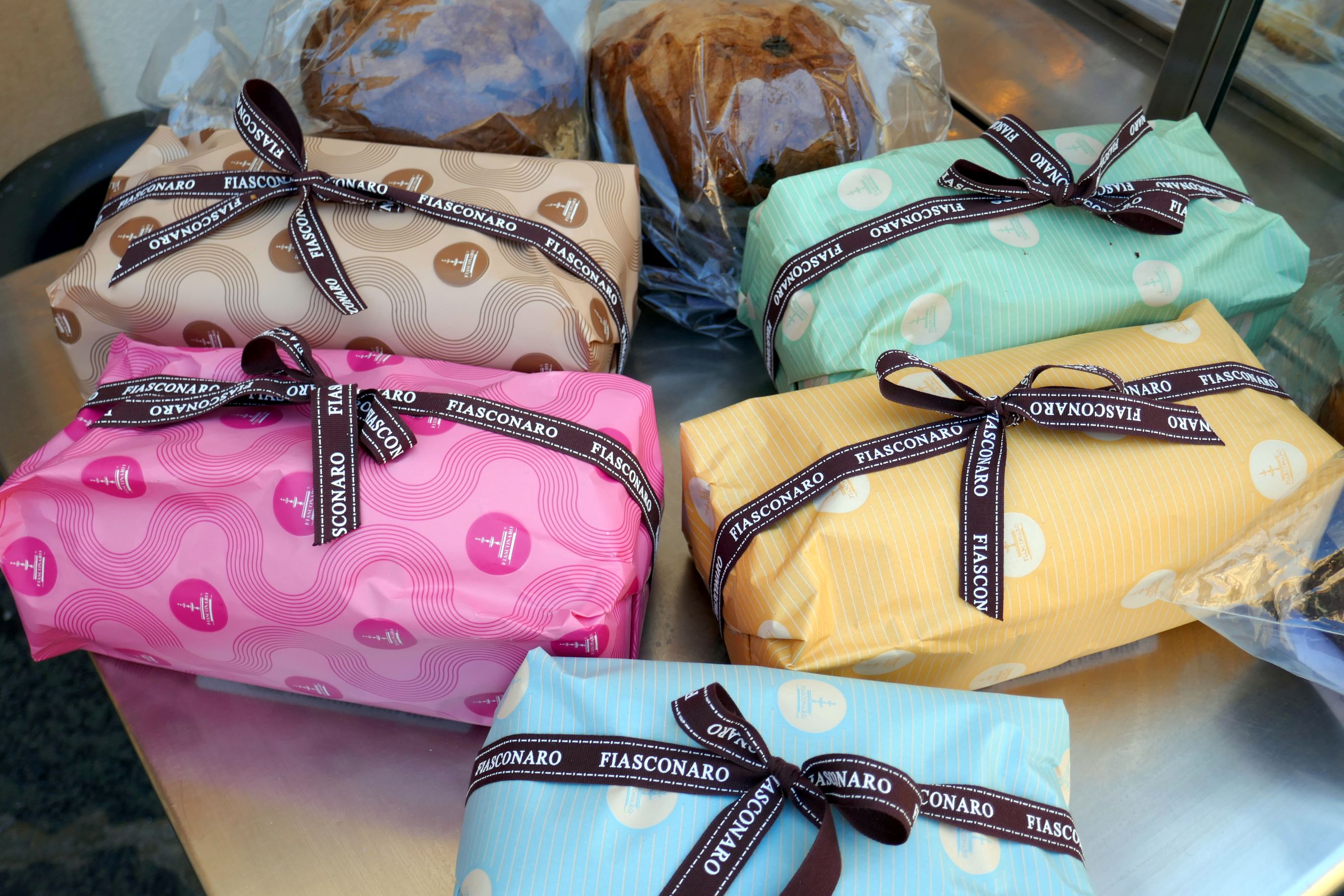
At Piazza Margherita, the town square, we enjoyed a tasting of locally made panettone, the fruit cake (more like bread) that Italians enjoy at Christmas and other celebrations. Castelbuono panettone is special, because it is made with manna, a sweet sap that comes from nearby ash trees. Not a past fan of panettone, I was a quick convert, because it was right out of the oven and so fresh and moist.
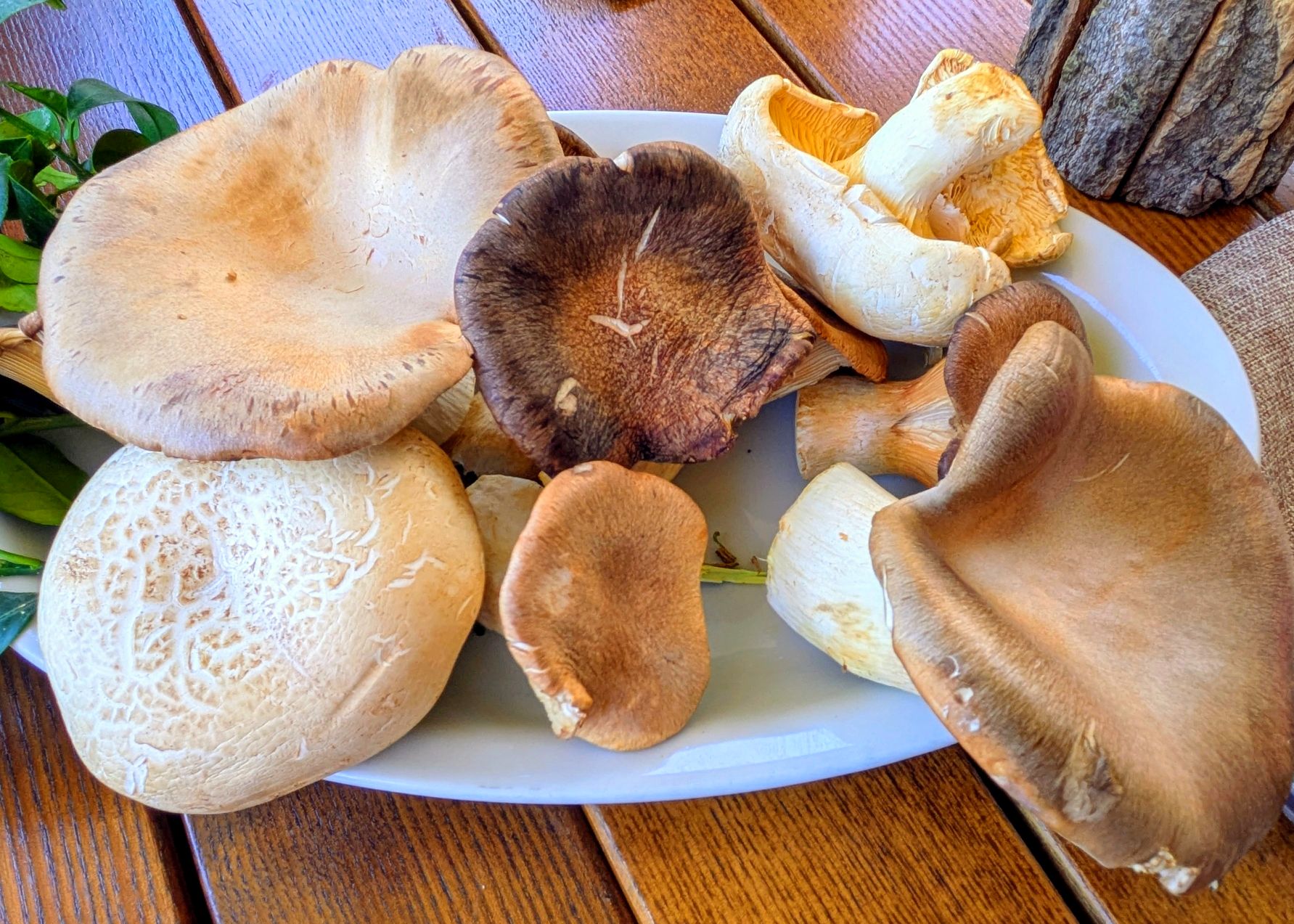
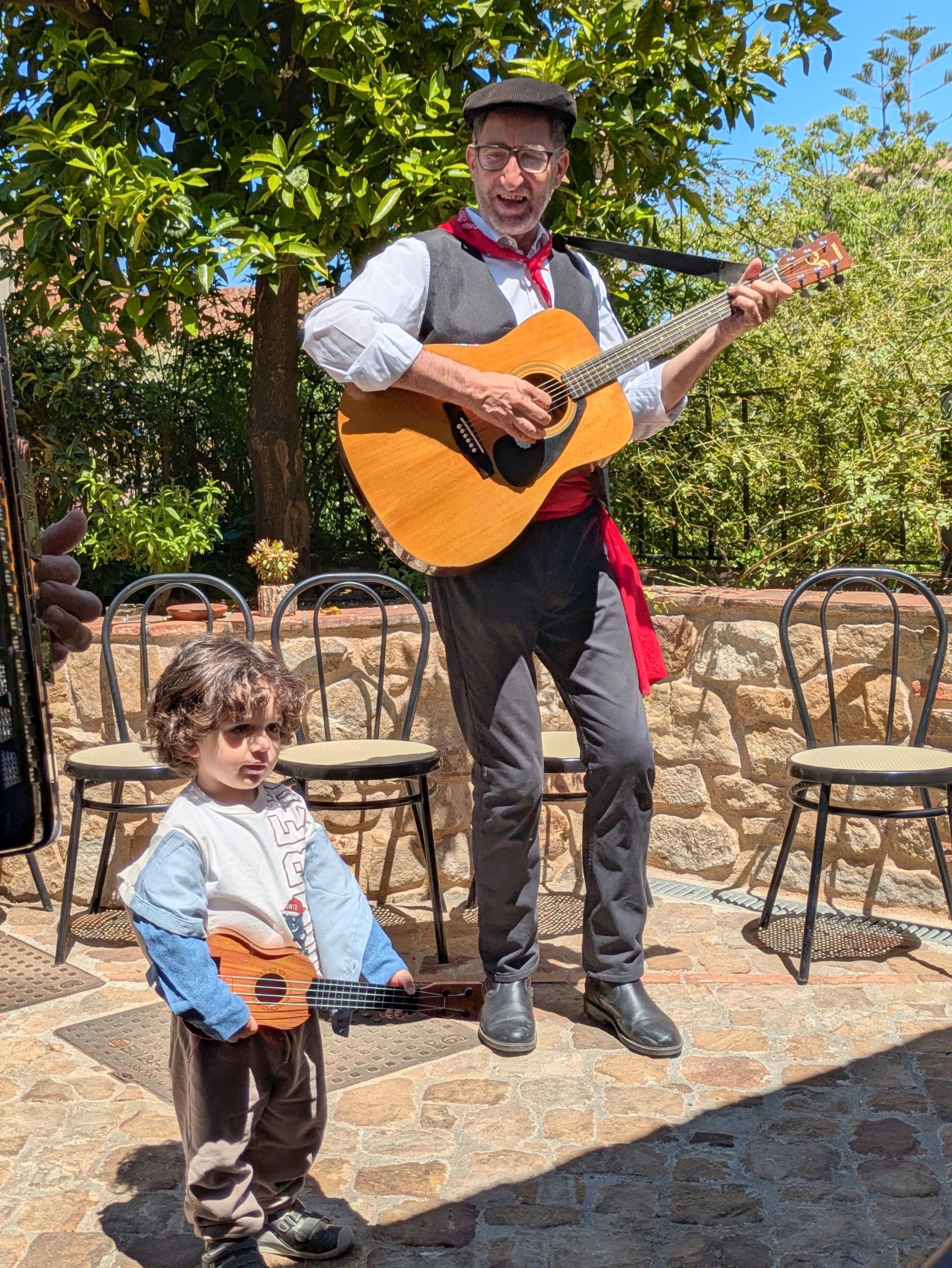
After having time to explore the village on our own, we regrouped for lunch on the patio of Ristorante Nangalaruni, which specializes in dishes with various locally grown mushrooms. The food was fabulous, and the music quite entertaining, especially as performed by the owner’s grandson! He is getting an early start…
Centerpiece display of the mushrooms used in their cooking
Next up: SICILY & AMALFI COAST #6: THE AMAZING MOSAICS OF MONREALE CATHEDRAL
There is so much more to Sicily than the Mafia, but the first thing that comes to mind for many Americans when they think of Sicily is the Mafia. This is especially true for those who saw “The Godfather” movies. (I am probably one of the few in the 60’s and older age groups who have not seen any of them.)
Since the Mafia is such a big part of Sicily’s history and current reality, Overseas Adventure Travel (OAT) chose the Mafia for its “Controversial Topic” and had guest speakers share their stories and knowledge with us.
This is where it got very interesting. The first speaker, Gino, was very much against the Mafia, because his father, a tailor, was forced to make suits for Dr. Michele Navarra, the head of the Navarra crime family, in Corleone, Sicily. (If Gino’s father had refused, there would have been a BIG problem. When the Mafia says to do something, you do it.)
The second speaker, Angelo, was the son of Bernardo Provenzano, chief of the Sicilian Mafia clan, Corleonesi, who backed mob boss “Lucky” Luciano Leggio in the ambush and murder of Dr. Navarra. After a failed hit in 1963, Provenzano became a fugitive for 43 years before being captured in 2006. He died in prison 10 years later.
Meanwhile, Angelo became a tour guide, speaking about the Sicilian Mafia, much to the dismay of Mafia victims, such as Gino. Check out that link, because the article talks about Angelo being hired in 2015 by Overseas Adventure Travel to speak about the Mafia. And, by the way, members of the Costra Nostra (Italian for “Mafia”) don’t refer to themselves as “Mafia” because they are “offended” by that term. (I have so much I could say about that alone!)
So, we now have two men with us, Gino, who despises everything the Mafia represents, and Angelo, the son of a Mafia crime boss (who is not in the Mafia himself). They are are not only in the same building, but the same room, setting up audiovisual equipment to speak with us. They were together only briefly for the preparation, but they never looked at each other. You could cut the tension with a knife. Not wanting to be obvious (and not even knowing if I was permitted to do so), I shot this quick photo of the two, with our tour leader, Francesco, in the middle:
Angelo, Francesco, and Gino
After Angelo left the room, Gino began his talk. Corleone, as we learned, became the headquarters of Costra Nostra, because it was a strategic location for the grain trade and is located between two strategic cities.
Corleone wasn’t big enough for two crime families to coexist, so the families of Dr. Navarra and “Lucky” Luciano Liggio went to war. (At the same time, “Lucky” was also setting up a sister organization in New Orleans, U.S.A., which was more profitable.) If you were in Corleone at the time (or anywhere in Sicily when all hell broke loose), you either decided to leave Sicily or show allegiance to the Mafia. If you joined, you became a murderer.
In 1958, the war between the two crime families finally ended when Dr. Navarra was murdered and his family was no longer #1 in Sicily. The war had left 200 dead.
Fast-forward to the 1980’s, 475 Mafia members were arrested and put on trial, resulting in 338 convictions. The Maxi Trial, which took place in Palermo, lasted for six years and was considered the most significant trial ever against the Sicilian Mafia as well as the biggest trial in world history.
It wasn’t over. The Mafia retaliated two years later by murdering a Palermo judge and his son, as well as others in the coming years. It has gone on and on, and the devastation and crime inflicted on innocent people never stops. In 2007, it was estimated that the total income of illegal Mafia activity was approximately 44 BILLION euros.
Currently, the most influential Mafia is in the Calabria region, in the south of Italy’s mainland. These are some of their criminal activities: protection rackets (protection from theft by non-Mafia, protection from competition, protection of territories), vote buying, smuggling, contract bid rigging, loan sharking; and, of course, murder, when they see fit.
I have only scratched the surface of the Sicilian Mafia, but this gives you an idea. After listening to Gino, it was fascinating to hear Angelo’s story of what it was like to grow up with his father, the crime boss. Several of us doubted how he could have grown up with his father being a fugitive crime boss and not understood why they were in hiding, but he was a child at the time and now seemed sincere enough. Angelo also made it clear that he didn’t support or condone the Mafia in any way. Still, there was no tolerance for him by Gino, and that was palpable.
Coming up next: SICILY & AMALFI COAST #5: CHARMING CASTELBUONO
After another day of poking around Palermo on our own and getting adjusted to the seven-hour time difference, our tour with Overseas Adventure Travel began. We met our tour leader, Francesco, and the other fourteen members of our tour group, before setting out on a walking tour of the city. Although Francesco is a Palermo native and knows his city like the back of his hand, Italy requires separate tour leaders and tour guides, each being licensed in a separate classification. So, our tour guide met us at our hotel and led the group through the city, with Francesco bringing up the rear.
Palermo is the fifth-largest city in Italy, so our walking tour covered just some of the highlights—a few which I wrote about in my previous posts; so, I will skip those and show you what was new for us.
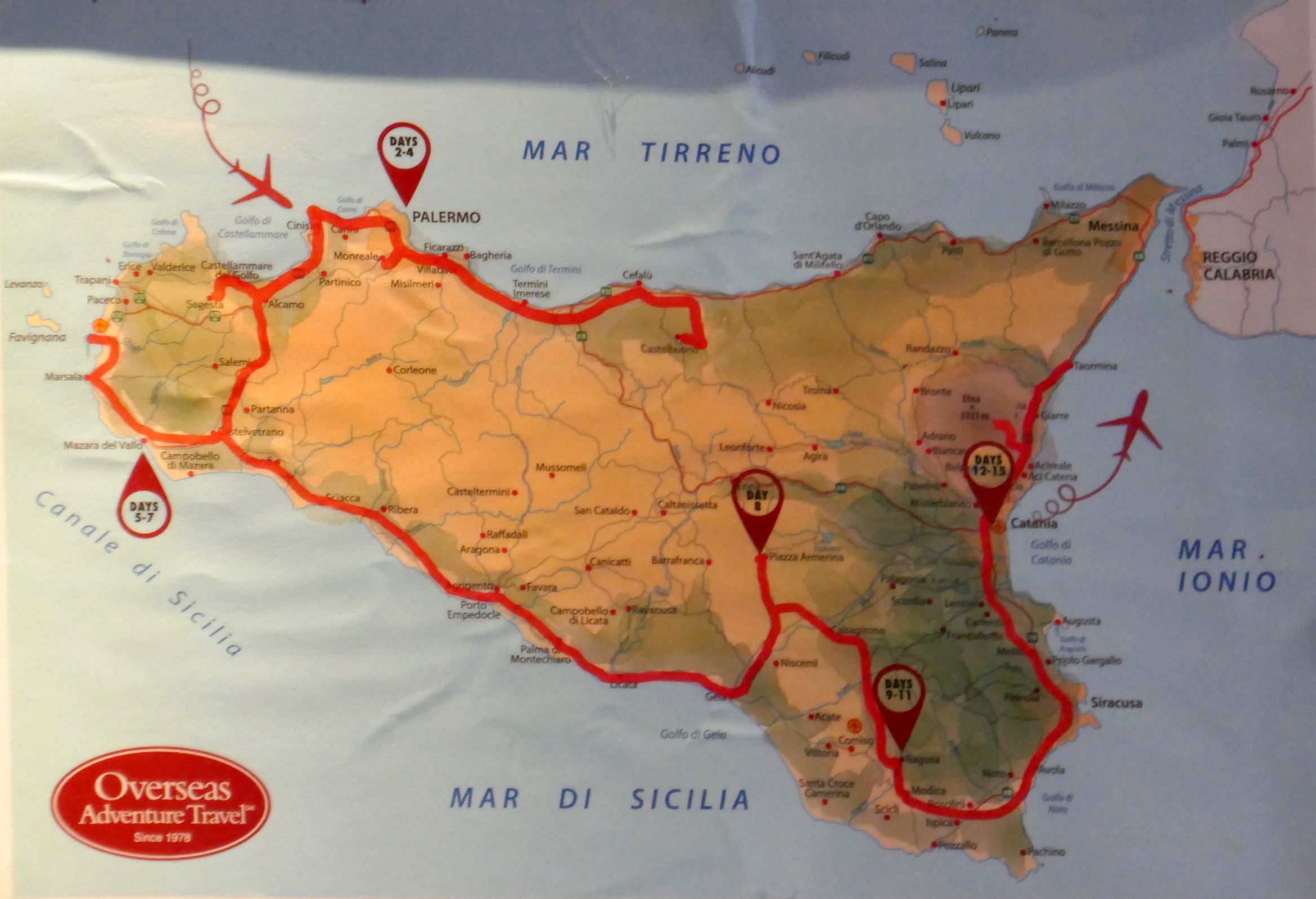
First, a little bit about Sicily and Palermo. This map highlights the itinerary of our tour in red:
(For all photos, click on the image for a full screen view.)
Sicily, located off the peninsula of mainland Italy, is an island of 4.7 million people in the Mediterranean Sea. First and foremost, although Sicilians are Italian and the island is part of Italy, the locals think of themselves as Sicilians first, and Italians second. They are very proud to be Sicilian and even have their own dialect, which they speak in addition to Italian.
Another thing Sicilians are clear about: They aren’t fond of northern Italians (and the feelings are mutual), which has its roots dating back to the 1860’s. Government power, including the police and army, shifted from southern Italy to the north, and economic wealth was (and still is) centered there as well. The south, including Sicily, is poor, which created a vacuum for the mafia to step in.
One of the reasons Sicily is poor is because Sicilian government is corrupt. Politicians get paid more in Sicily than anywhere else in Italy or the rest of Europe. Basically, they are ripping off the taxpayers, so the politicians and mafia (often the same) are the only Sicilians making out financially. If you get elected to parliament in Sicily, it’s like winning the lottery. You would serve a 2-year term but get paid for the rest of your life. The bottom line is the system doesn’t work for the benefit of the people, only for the politicians. One example of this is the money distributed to Italy and Sicily by the European Union. The politicians skim off the top before the rest trickles down in a way that benefits the common Sicilian.
The unemployment rate in Sicily is also steep—38% for the 18-35 age group. In contrast, it is only 2.9% in Switzerland. Overall, Italian unemployment is the highest in Sicily and the Calabria region, also located in the south.
It is most difficult to get a job in the private sector, because they will only hire experienced workers. New college graduates don’t have experience, but they don’t want to work outside of their field of study; so, they won’t work. Many go on earning additional advanced degrees and live with their parents.
Now, a bit about Palermo: Located in northwest Sicily, it was founded in 735 B.C., and the current population is around 626.000 with its metropolitan area totaling about 1.2 million. The city is Sicily’s economic and cultural capital, full of UNESCO World Heritage Sites.
The city has quite a complicated history. Due to its strategic location in the Mediterranean, it was the victim of a succession of invaders: The Phoenicians, Carthaginians, Greeks, Romans, Normans, Swabians, and French all conquered Palermo at one time or another. Fast forward to World War II, the city was heavily bombed. Sheesh! The poor city couldn’t catch a break.
One of the things I enjoyed about Palermo was the way vehicle traffic was diverted away from the main streets of the old city center until late at night. Pedestrians could walk down the middle of the streets without the noise, pollution, and chaos of traffic. It didn’t stop the e-bikes and scooters from whizzing past, though, at times nearly colliding with pedestrians stopping to take a photograph or to talk with each other. I’m guessing that all of us in the group had a close call at one time or another!
Following our walking tour and free time in the afternoon, we regrouped for our “Controversial Topic,” one of OAT’s features on each tour. I’ll give you one guess as to what that topic would be… I’ll tell you all about it in my next post!
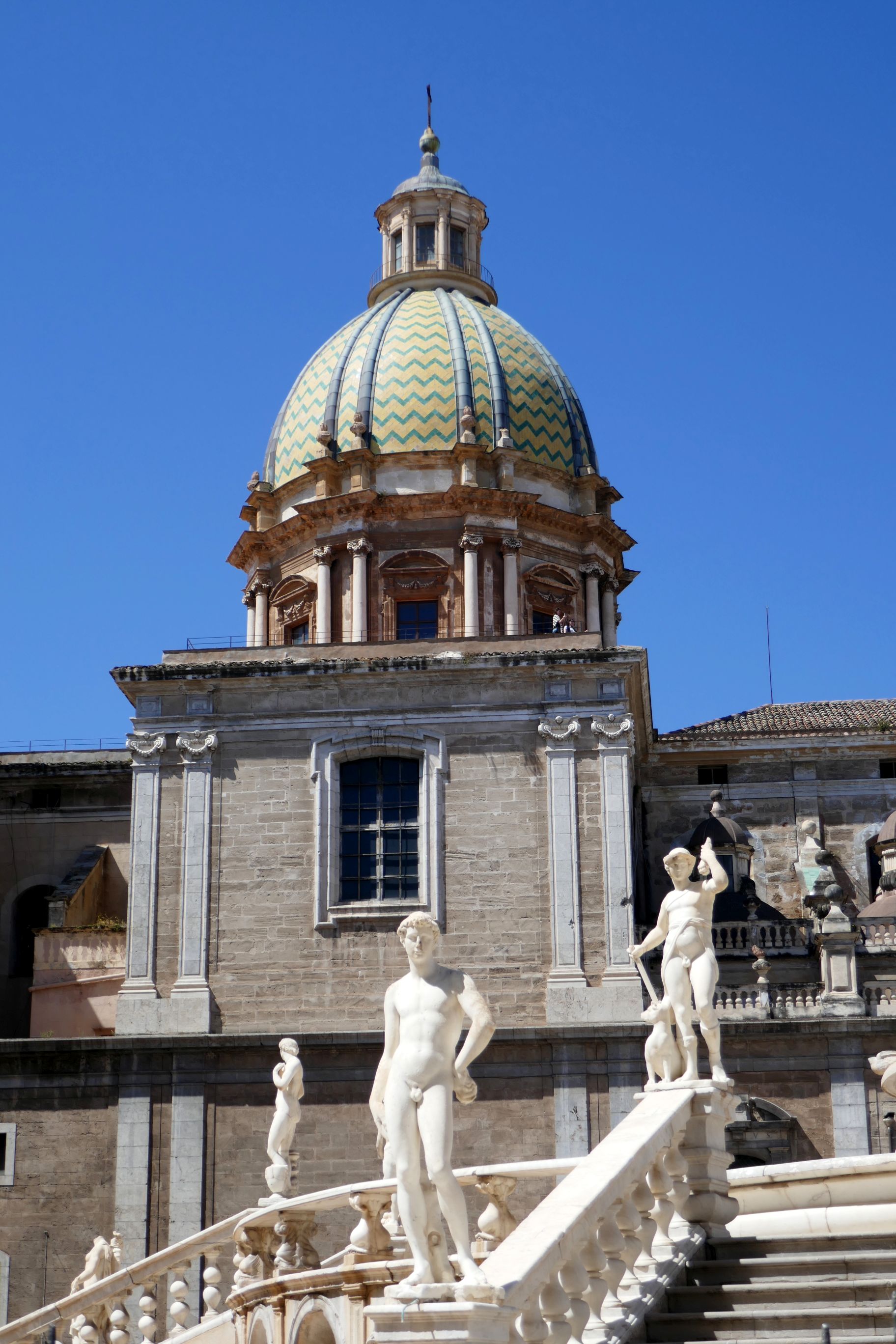
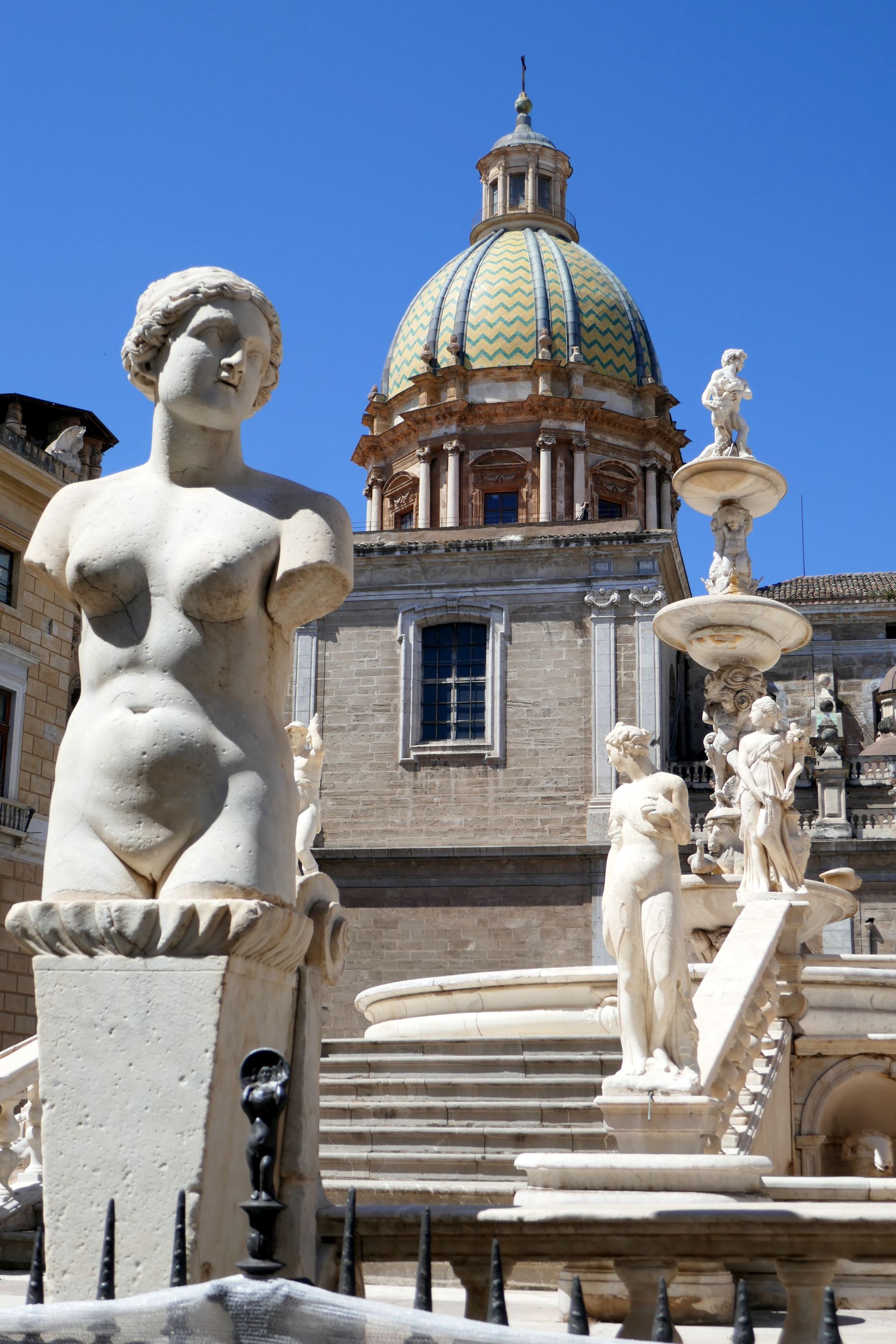
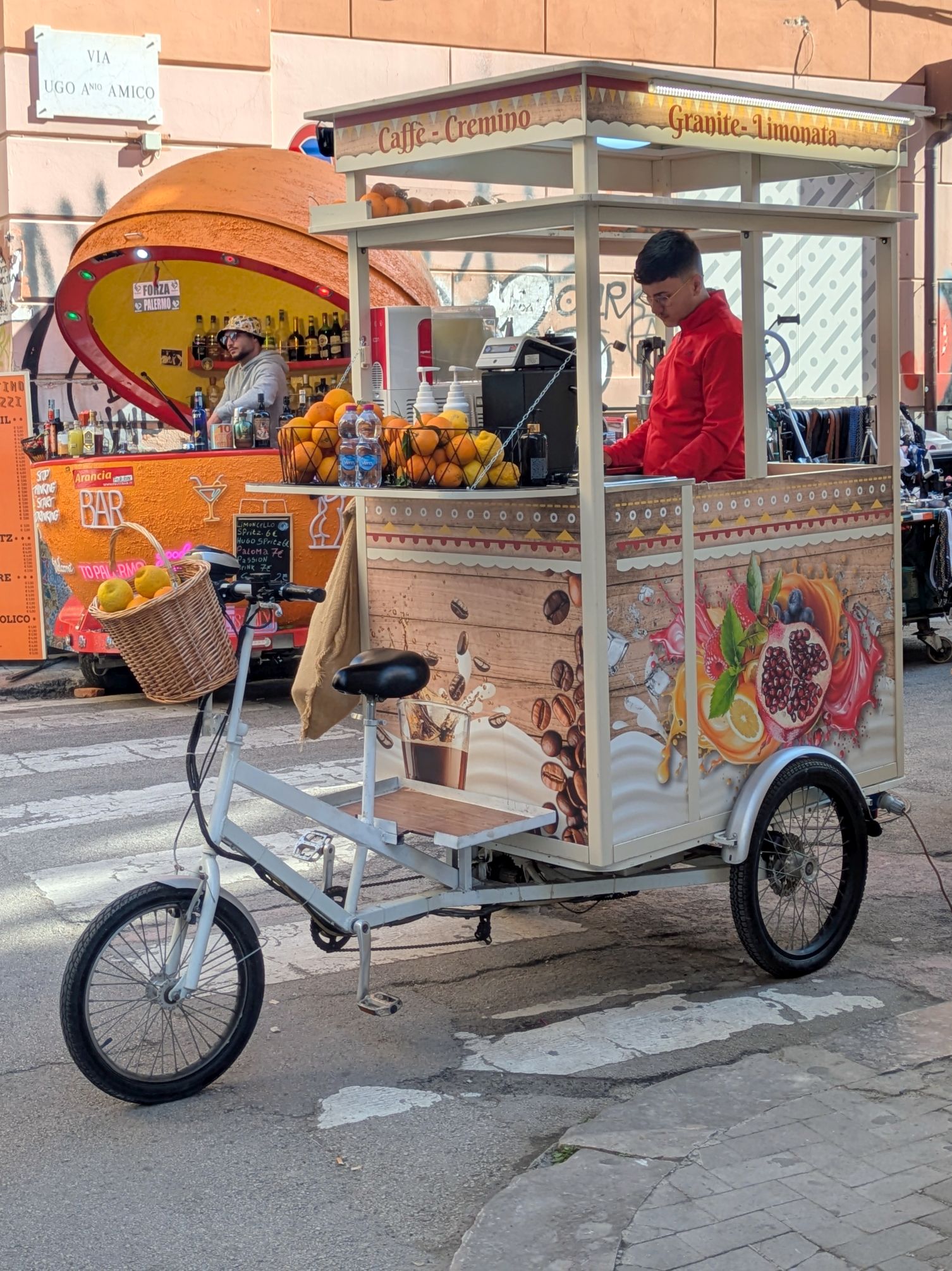
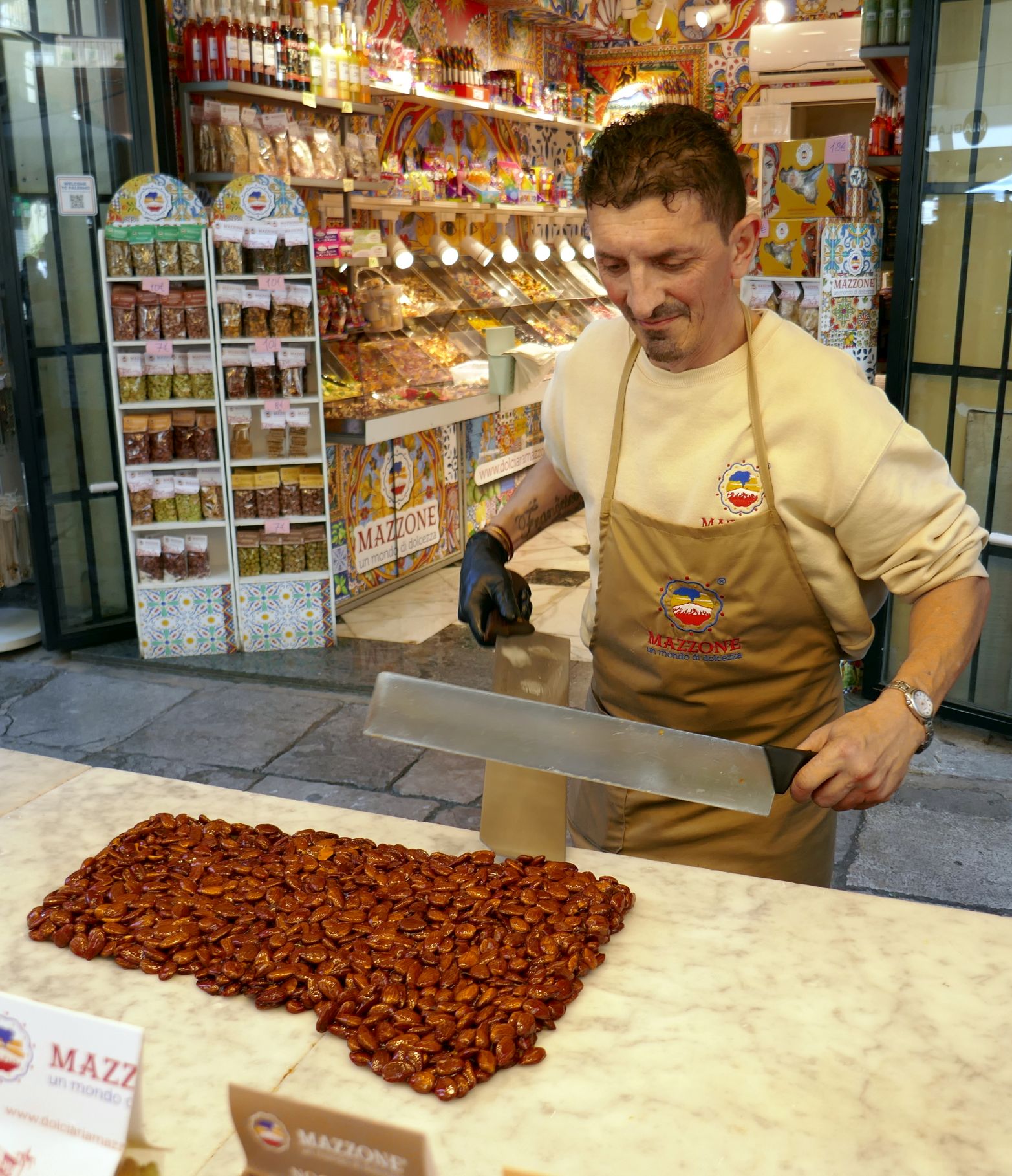
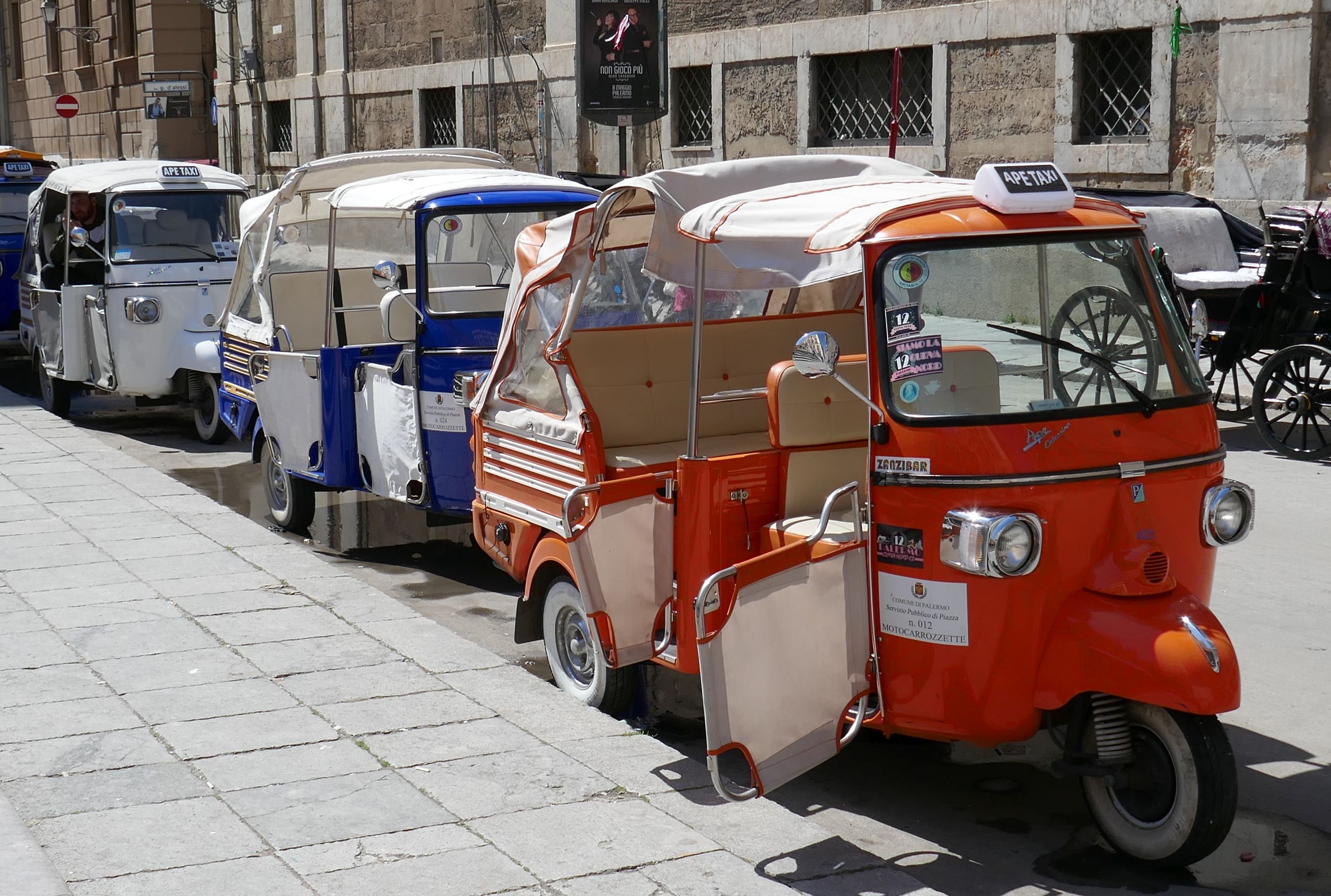
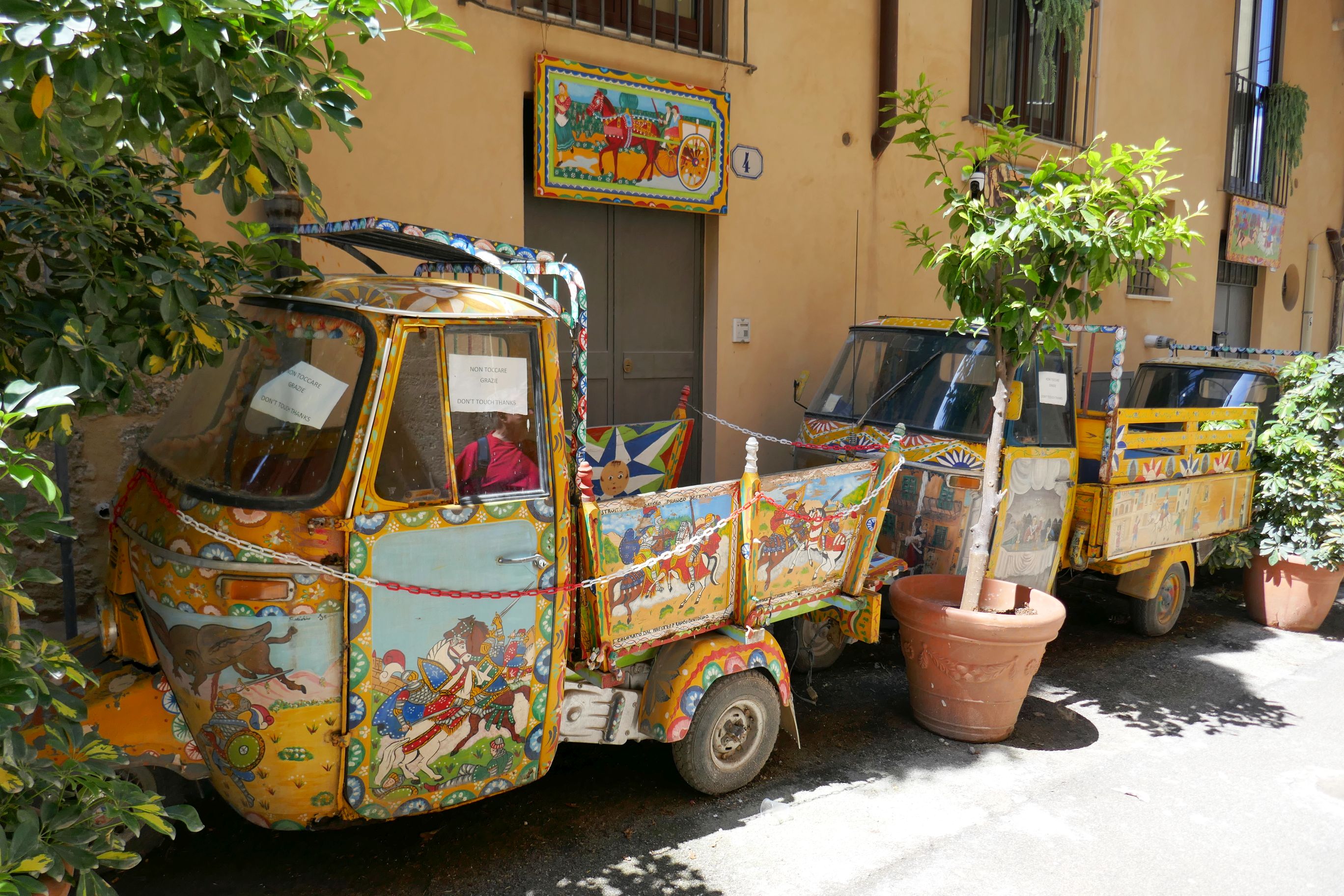
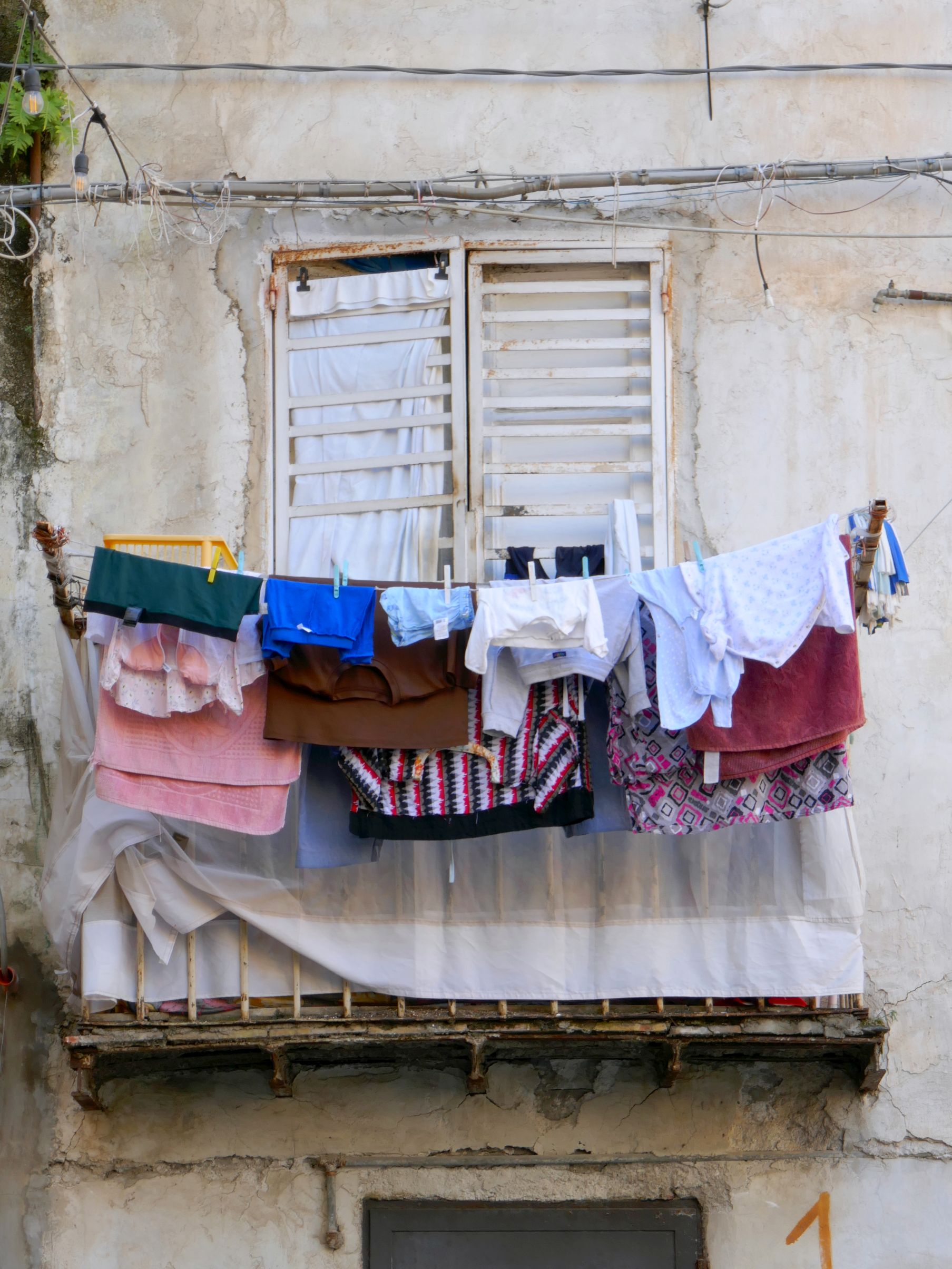
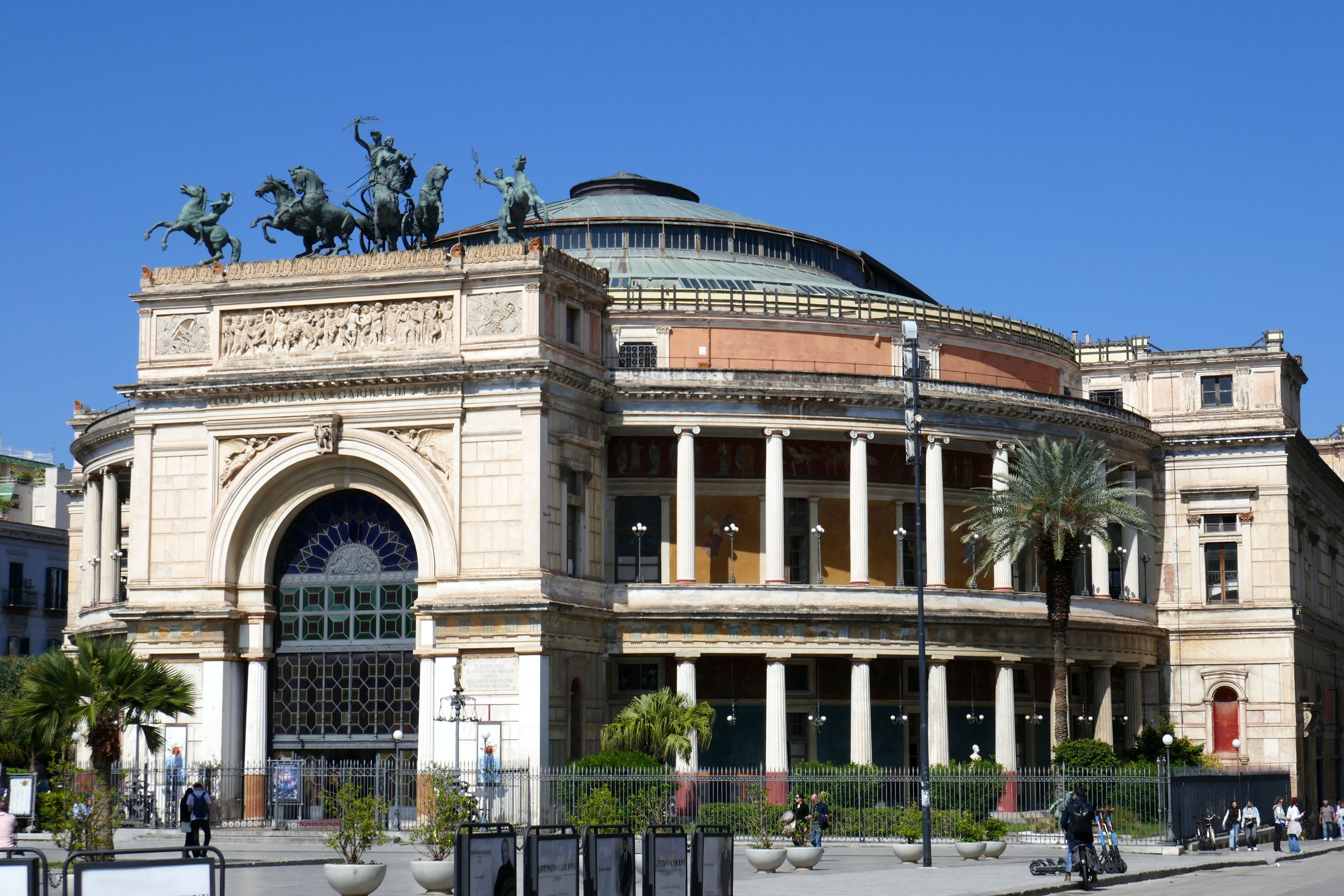
Meanwhile, here are some photos shot around Palermo:
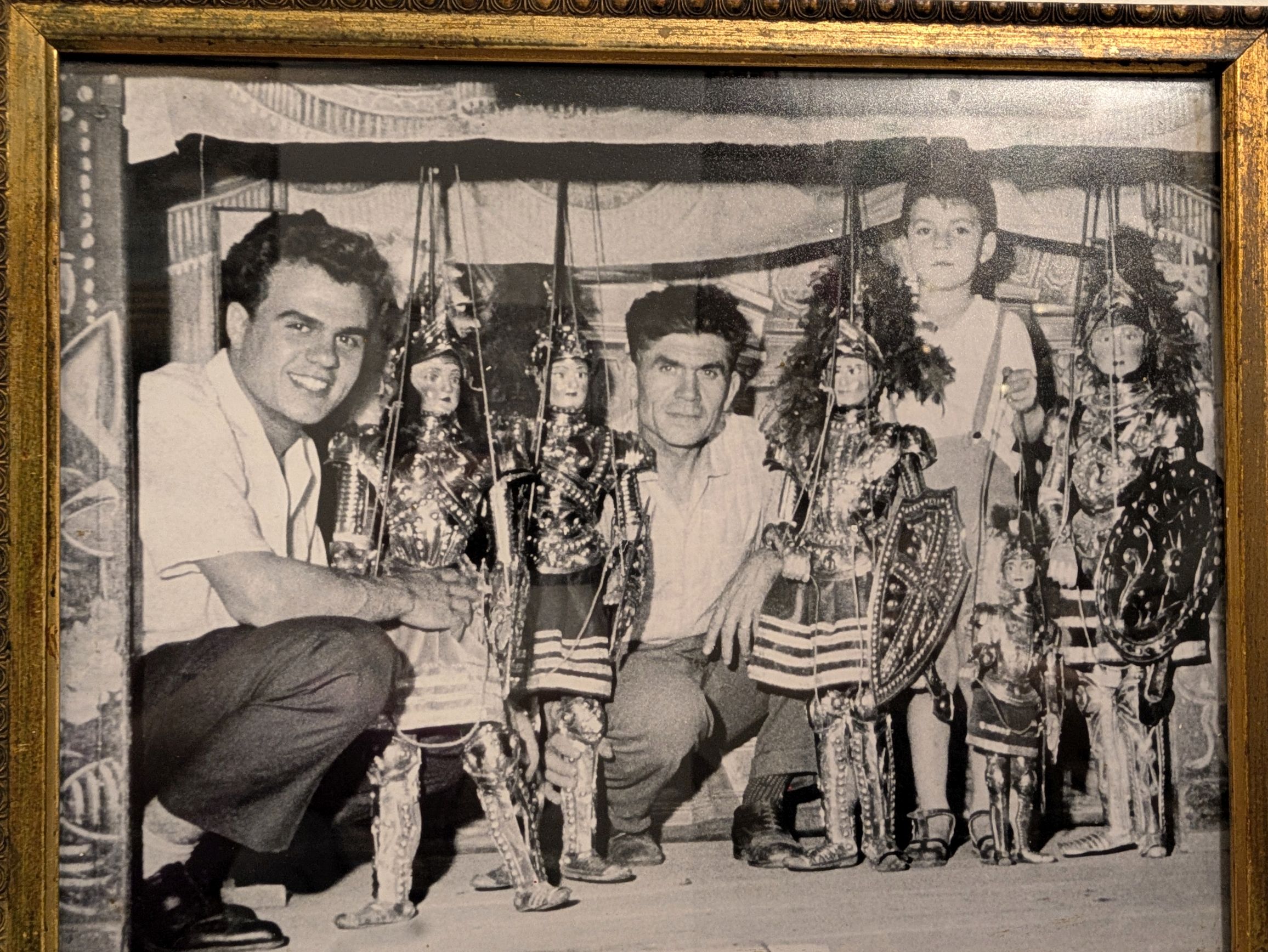
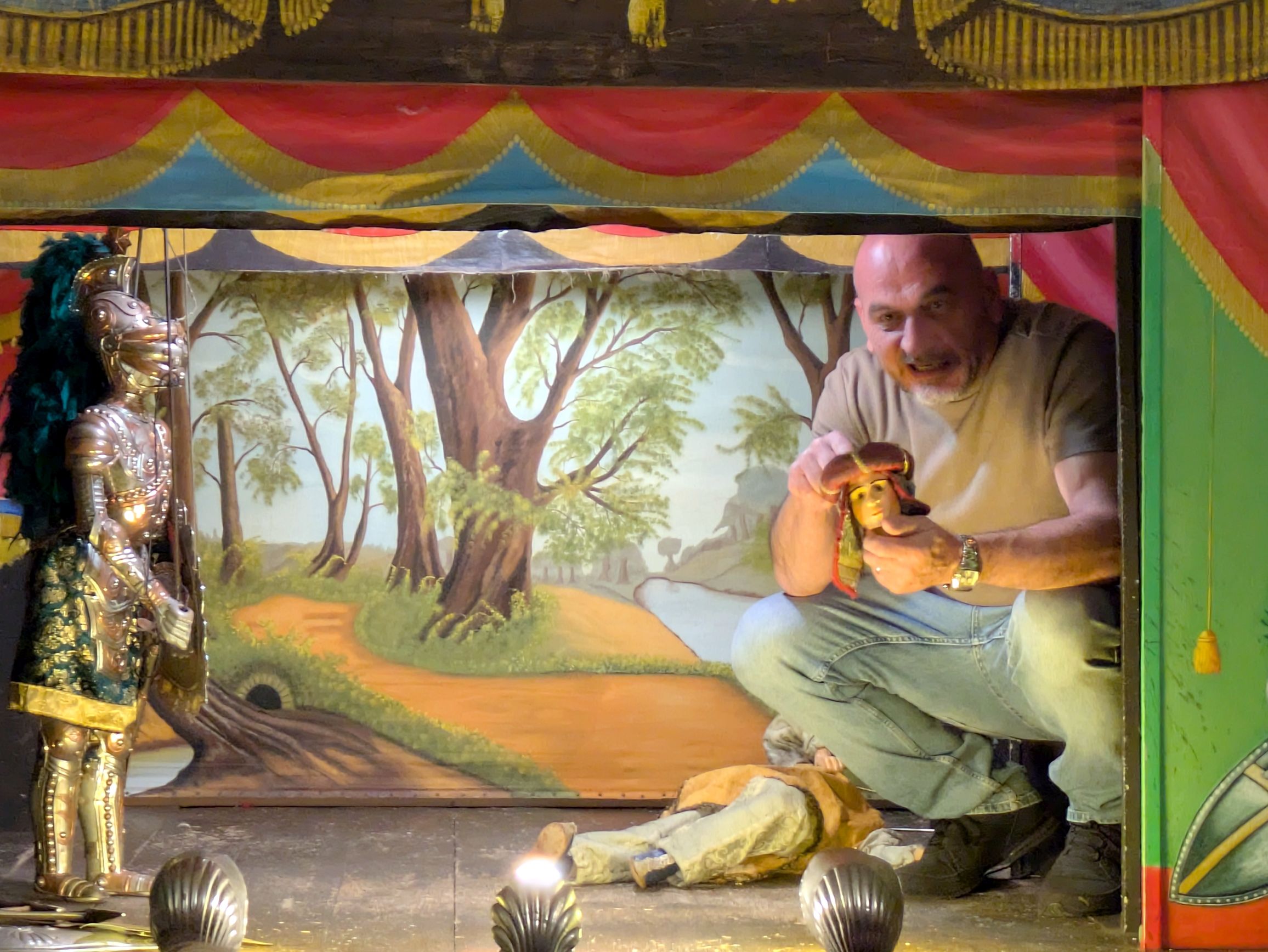
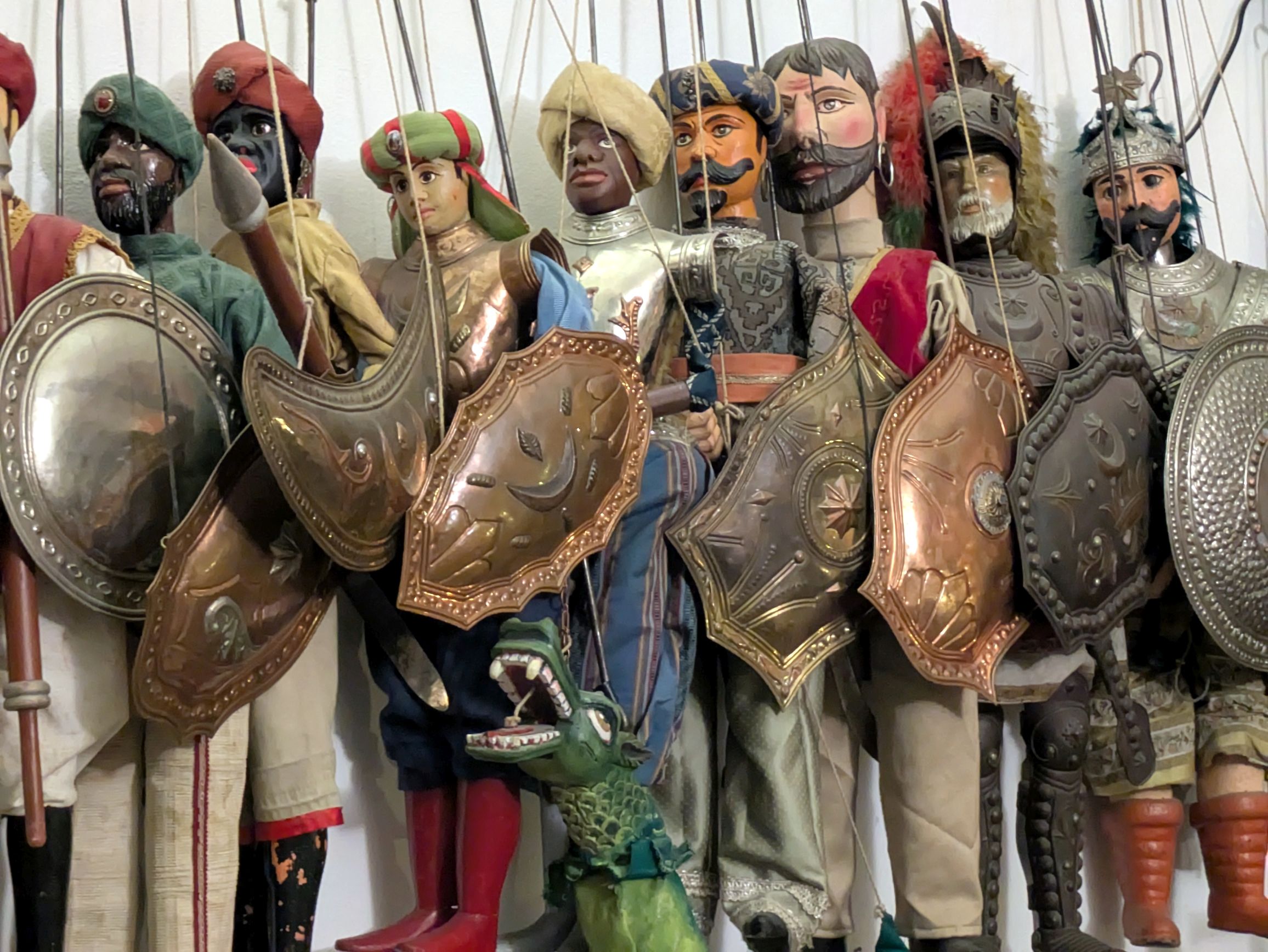
Our group had a private visit at the wonderful Opera Dei Pupi, a family-run puppet theater that has been passed down through the generations:
Our private demonstration and Q&A session with the owner was hilarious!
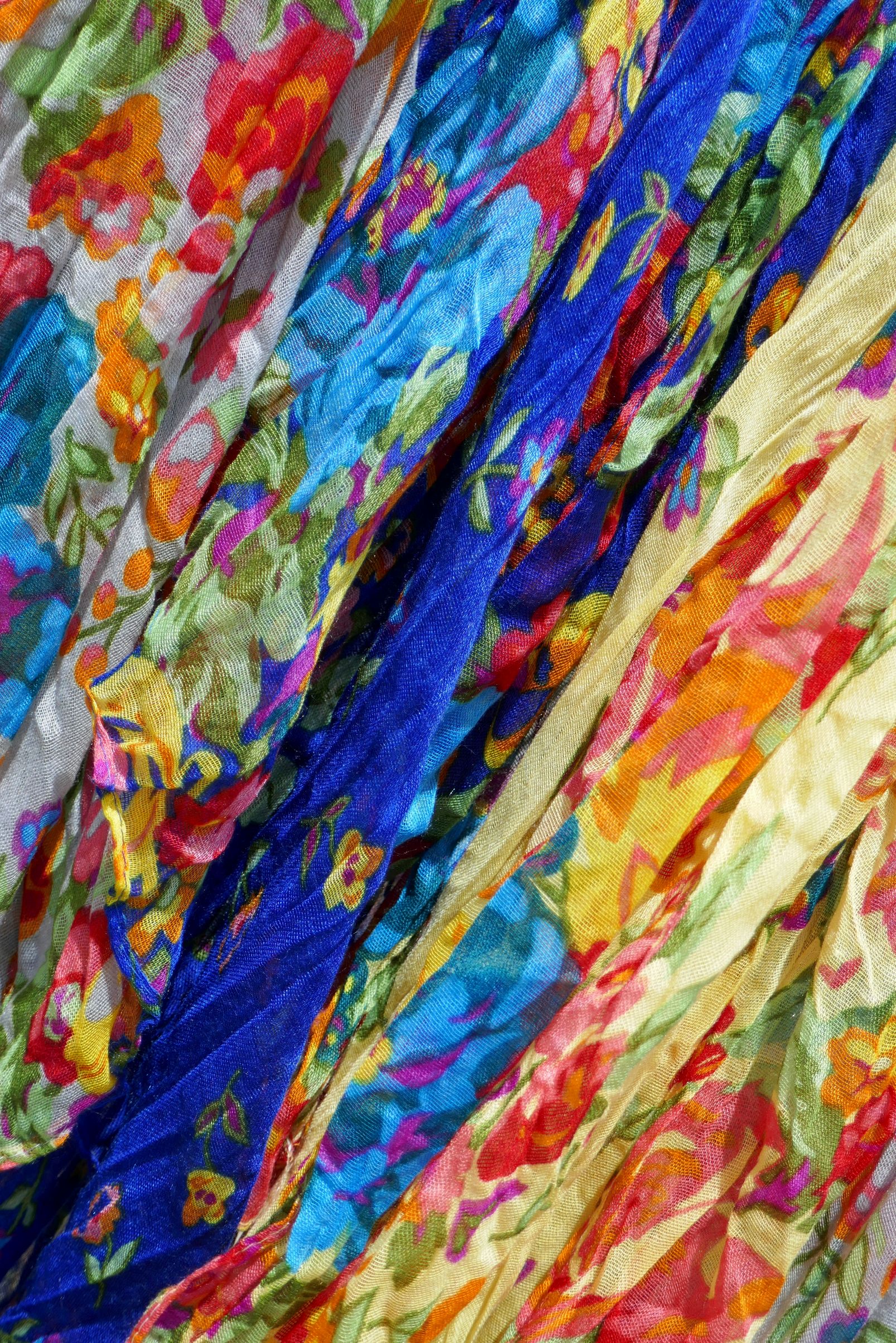
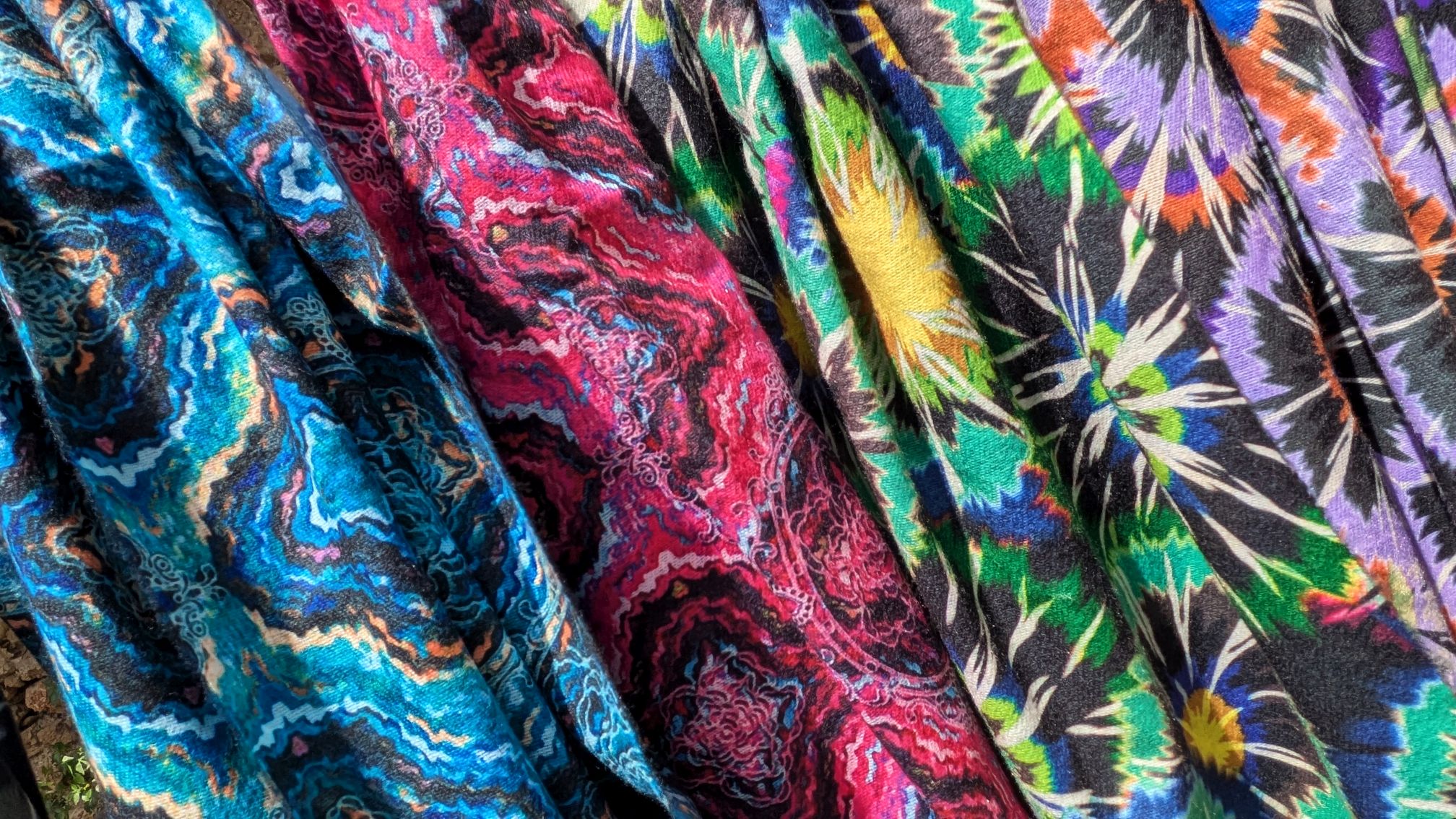
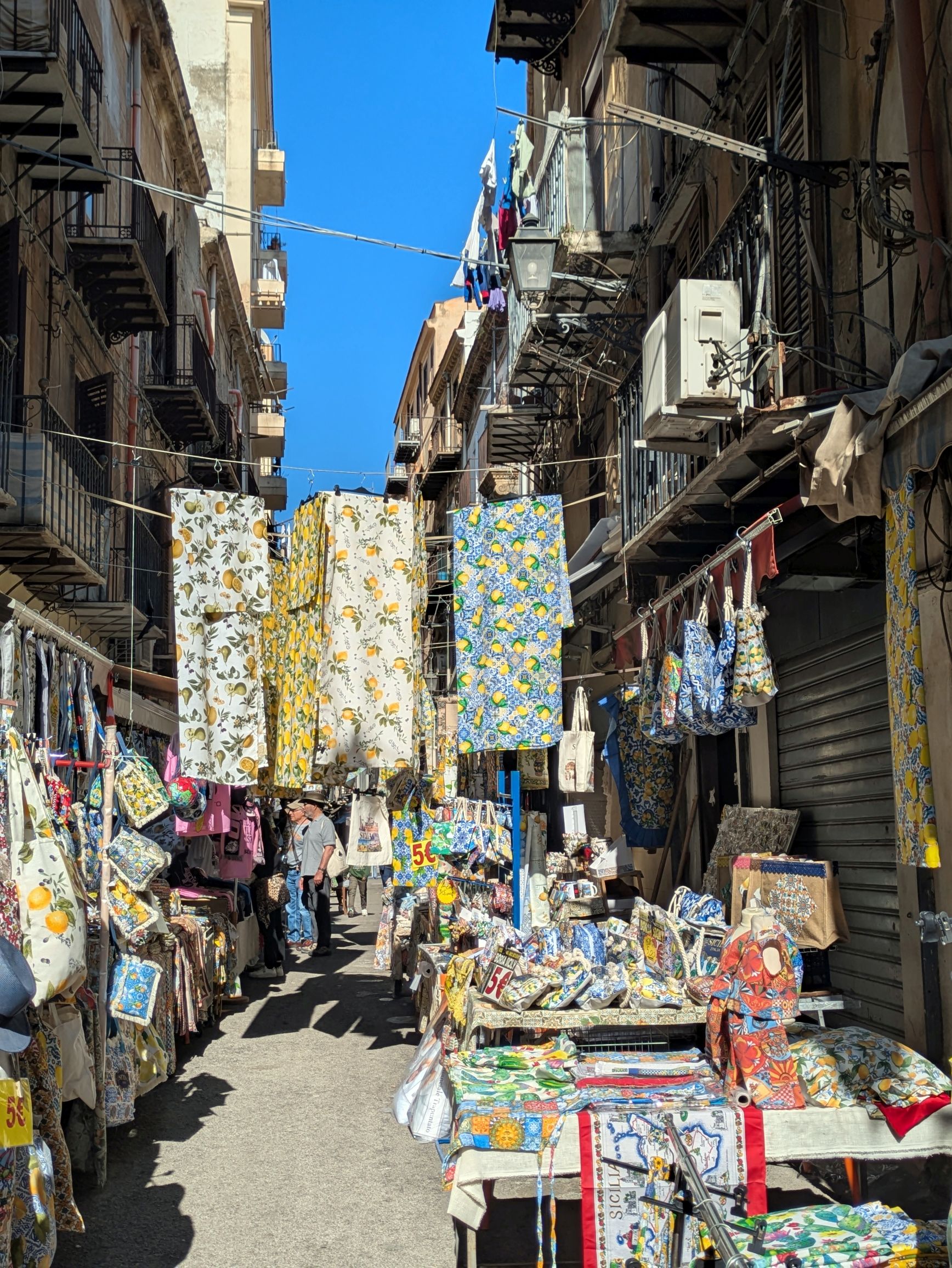
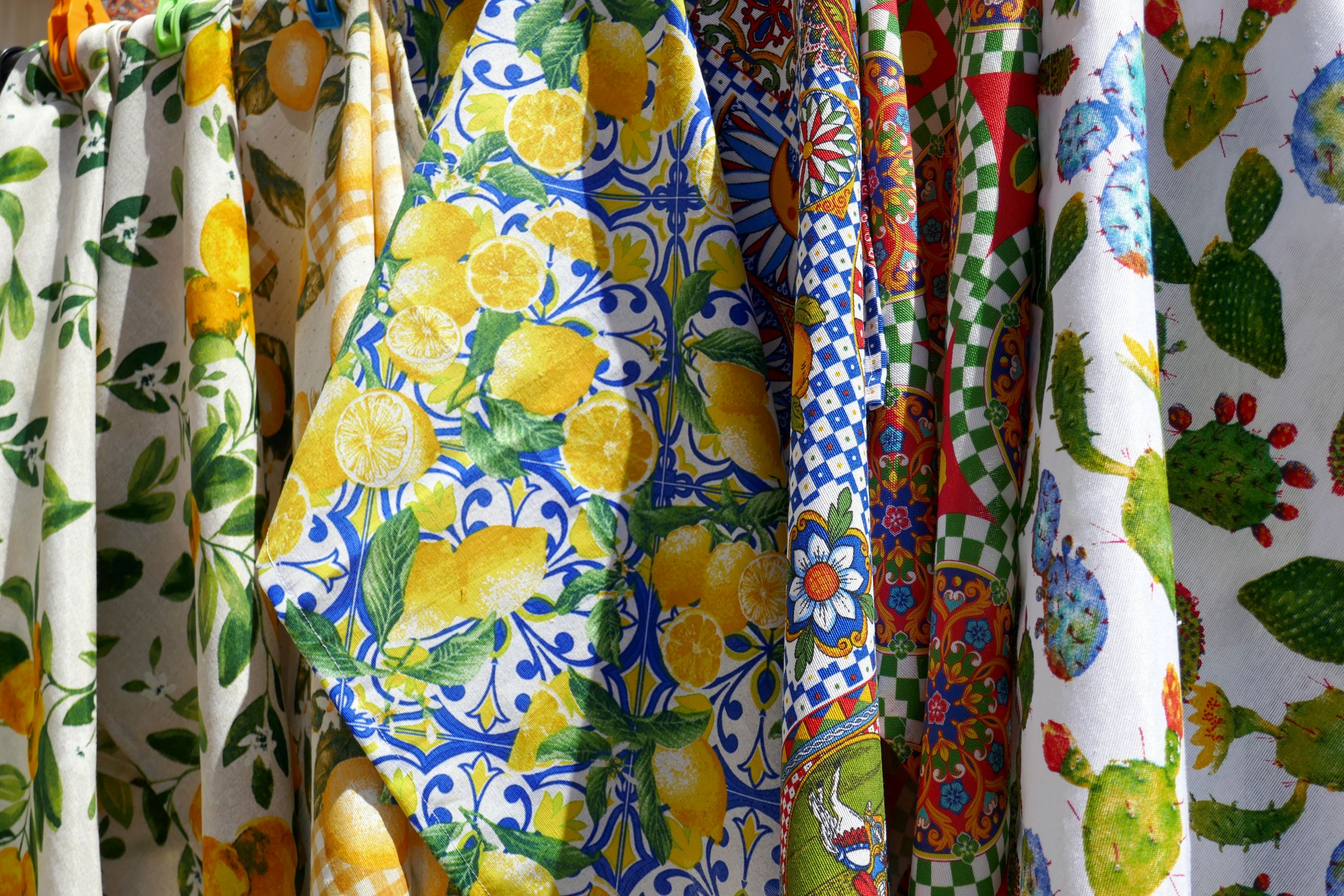
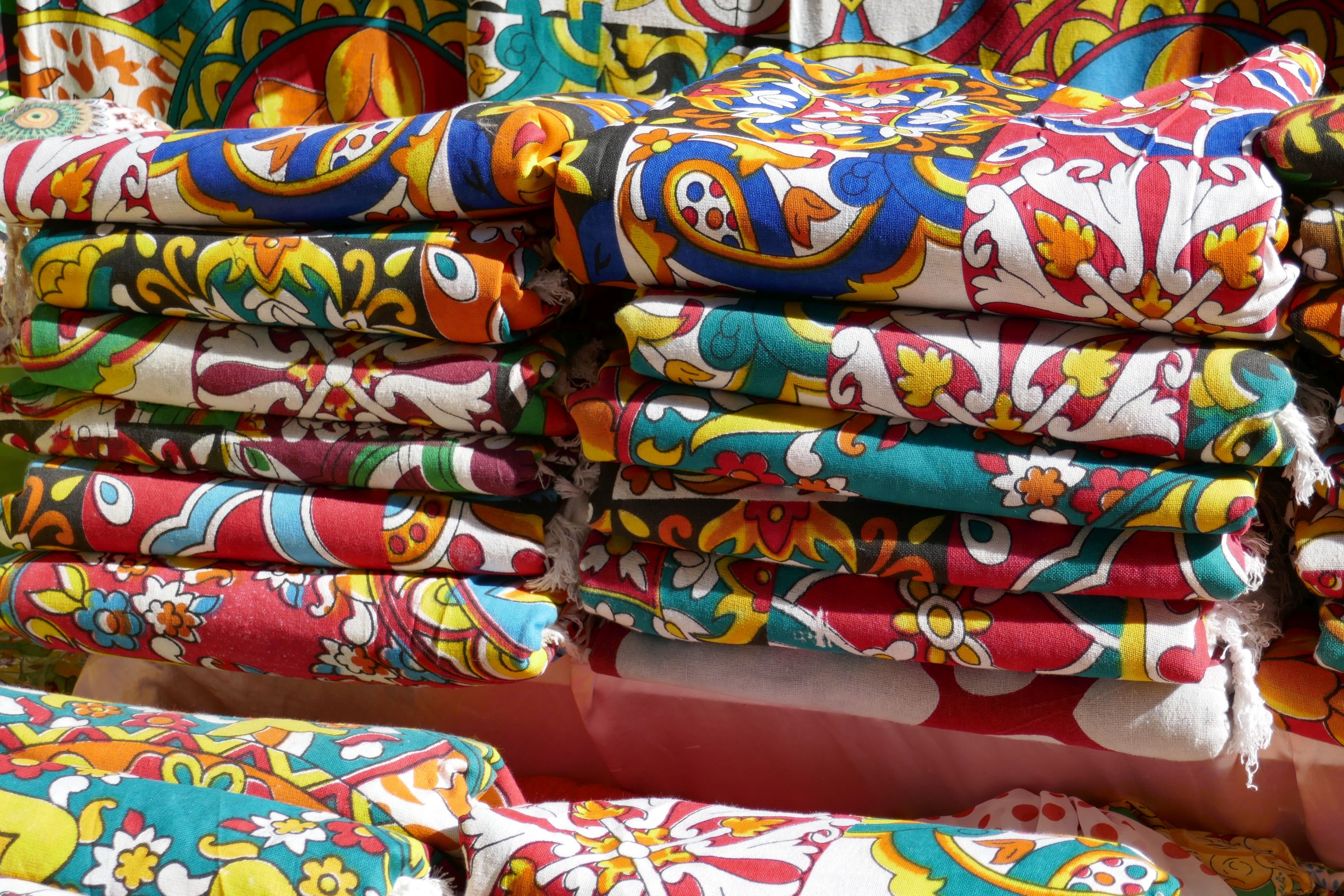
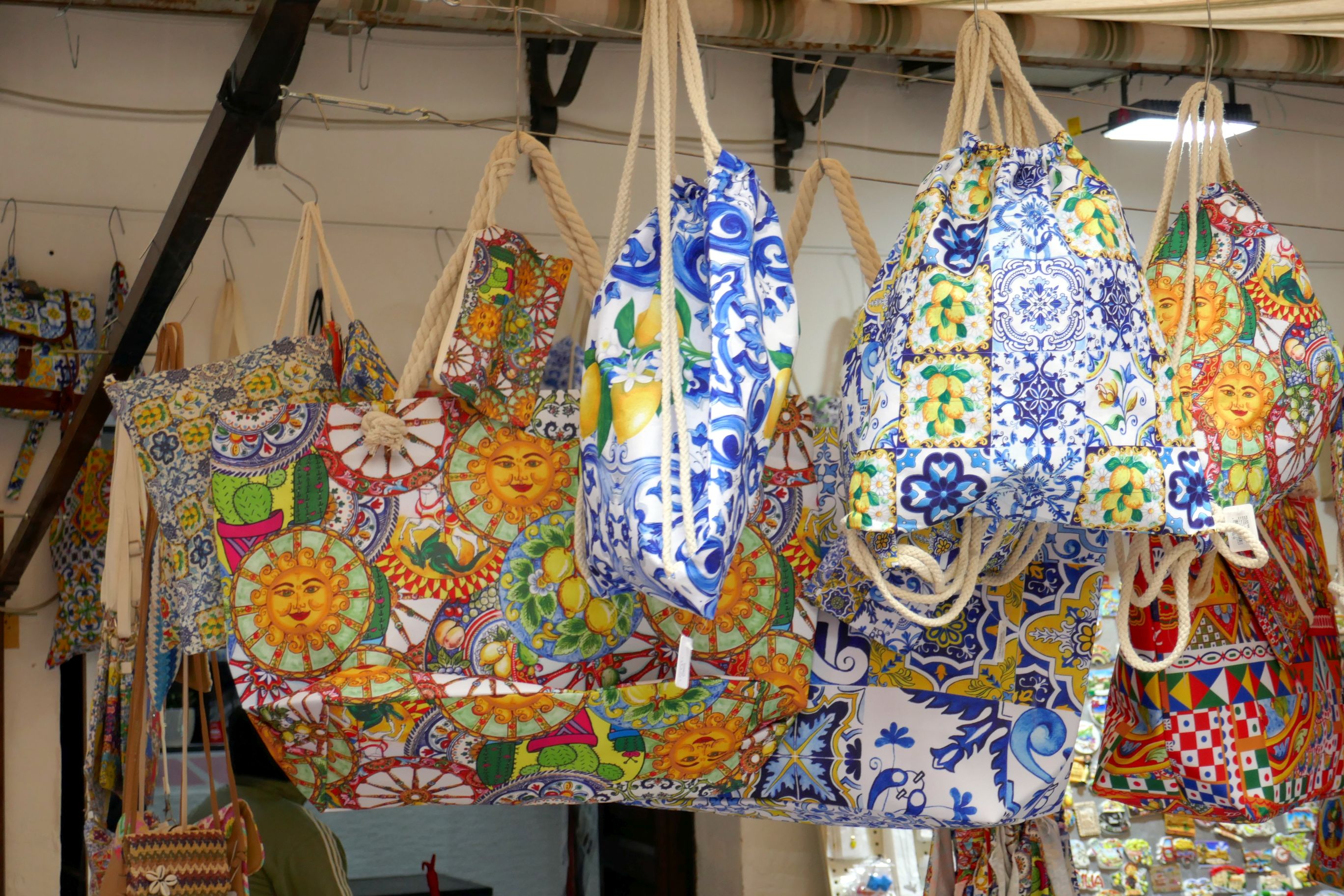
During my free time, I stumbled upon a street lined with shop after shop of seamstresses sewing table cloths and other items made from bolts of colorful fabrics– many with a lemon motif, which is a symbol of Sicily. There are lemon trees everywhere on this island!
Next up: SICILY & THE AMALFI COAST #4: THE SAVAGE SICILIAN MAFIA
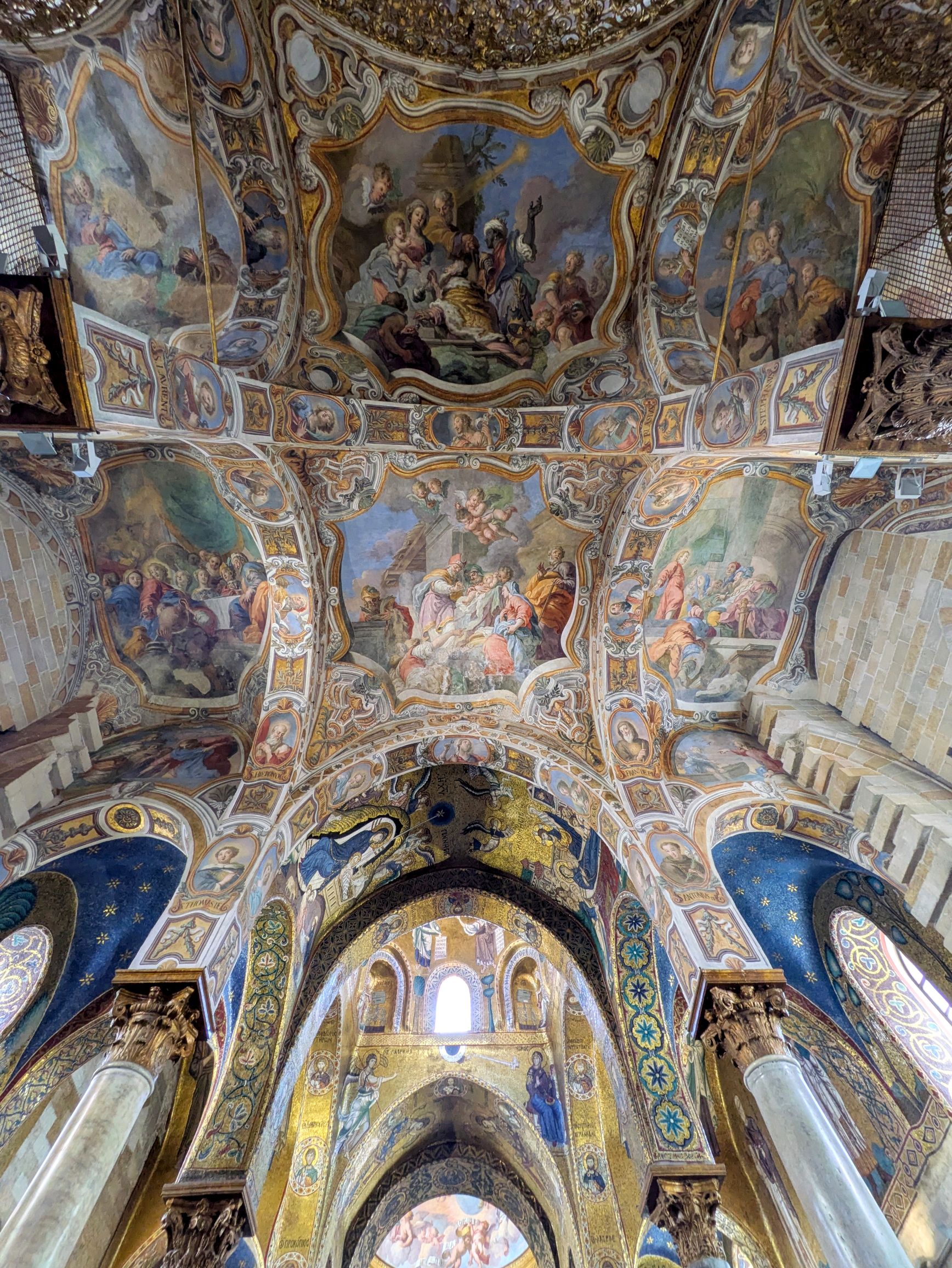
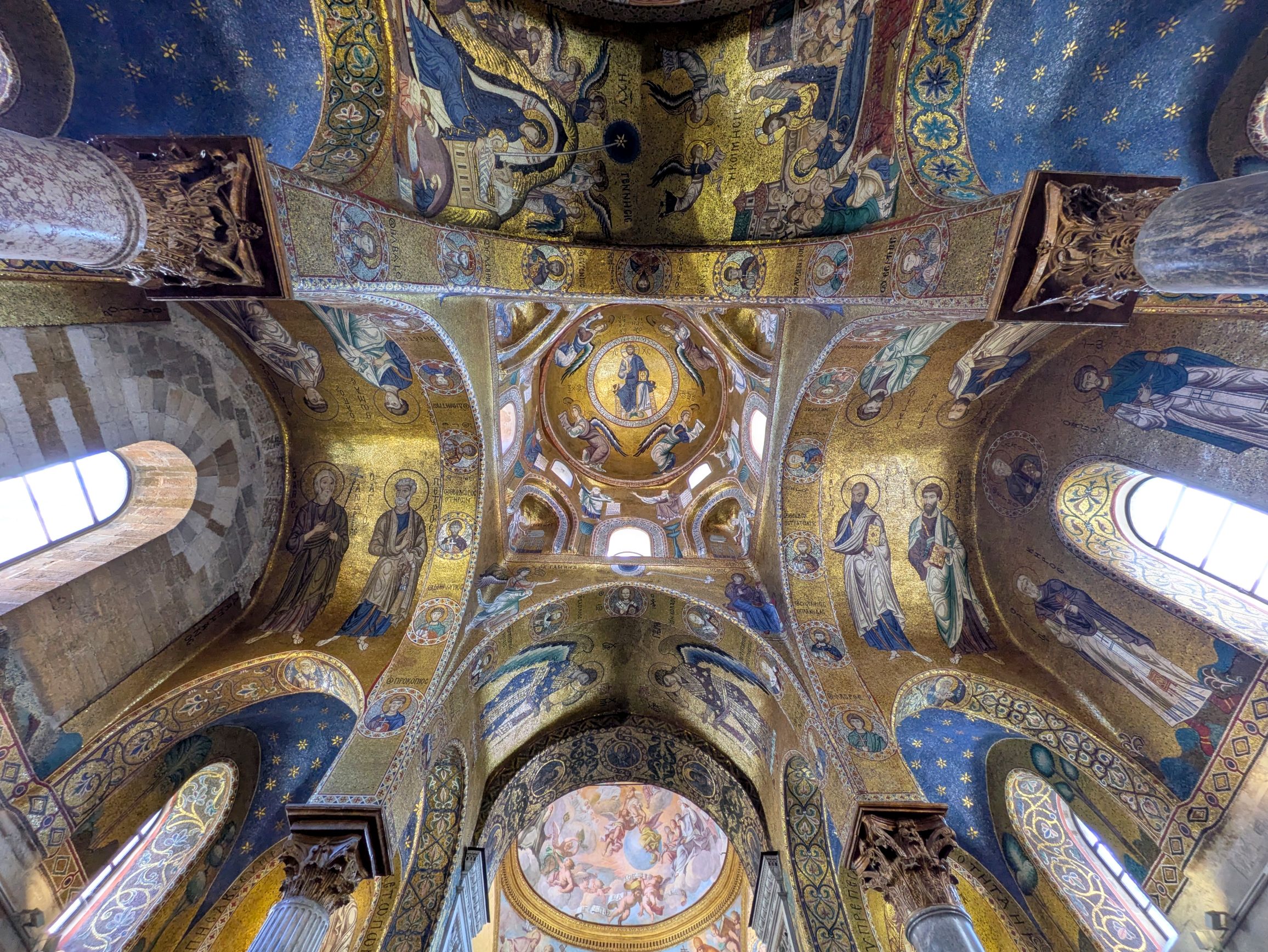
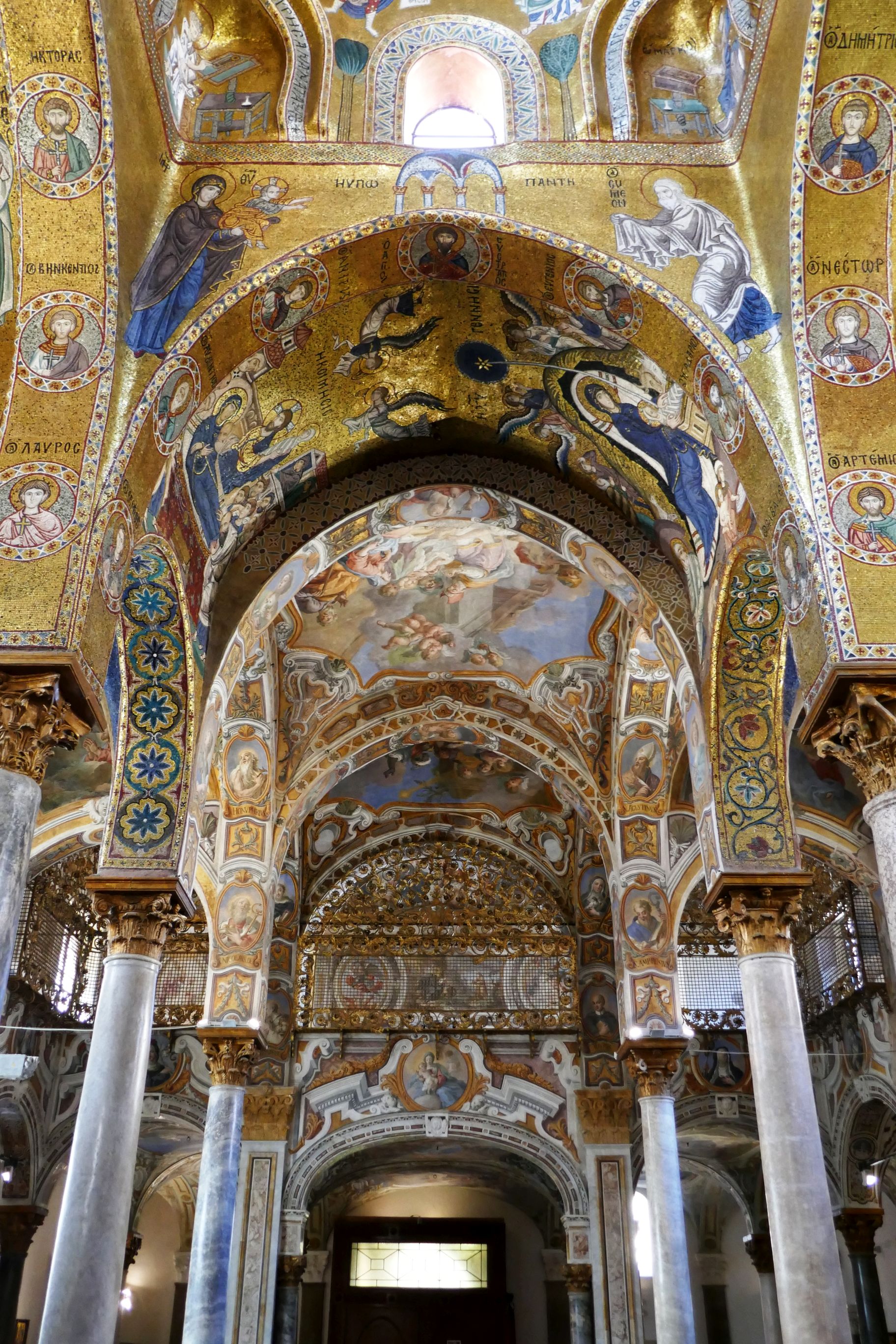
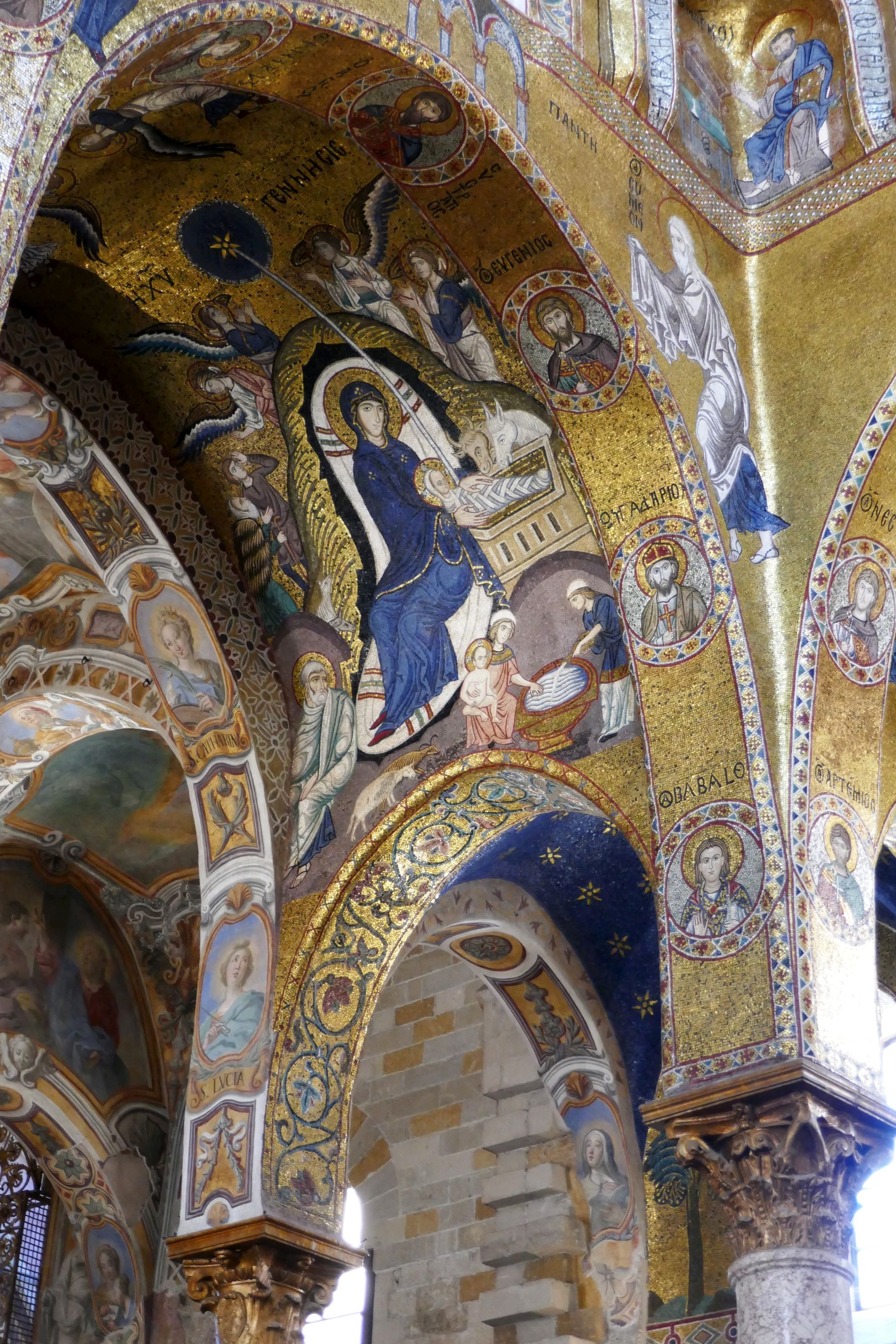
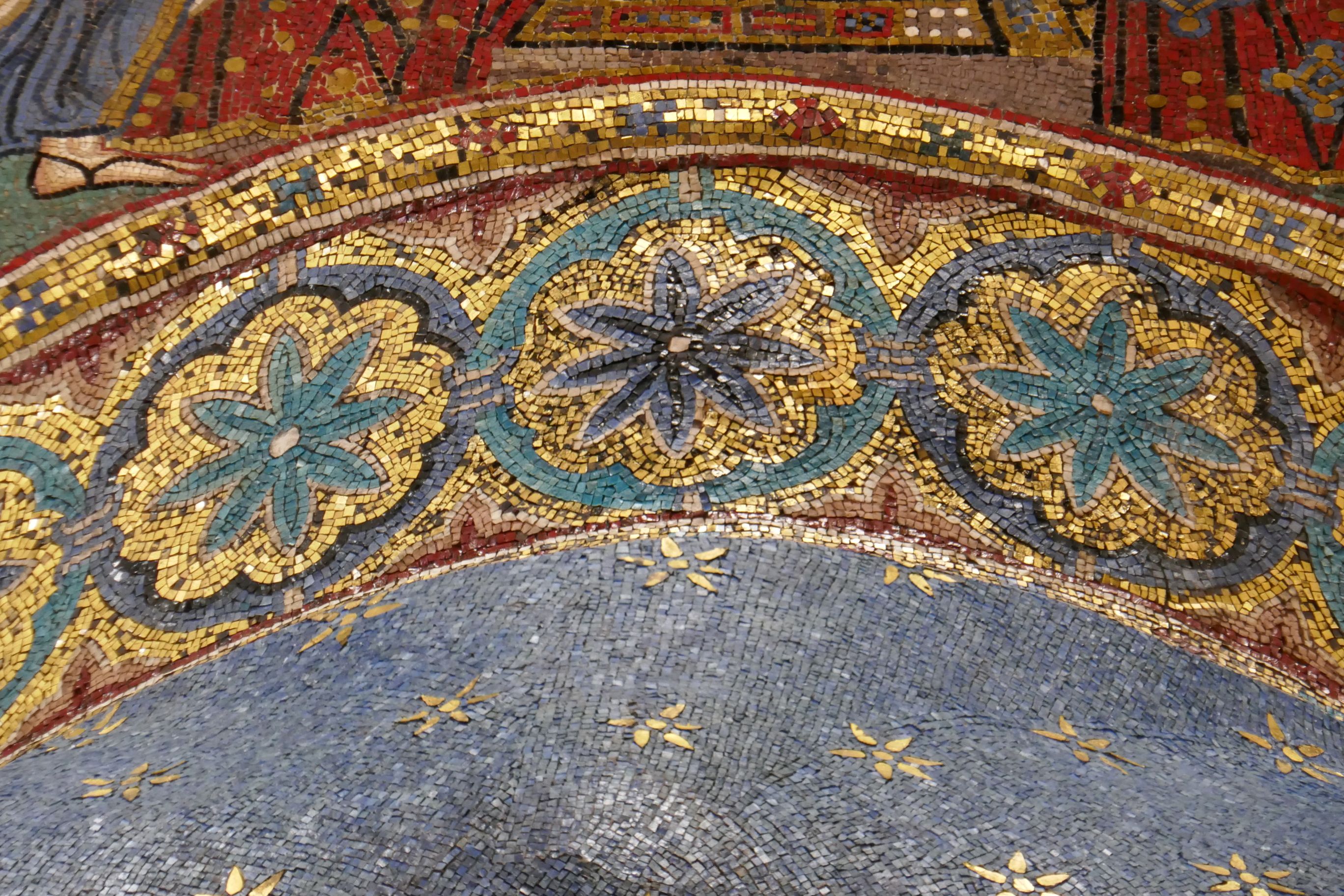
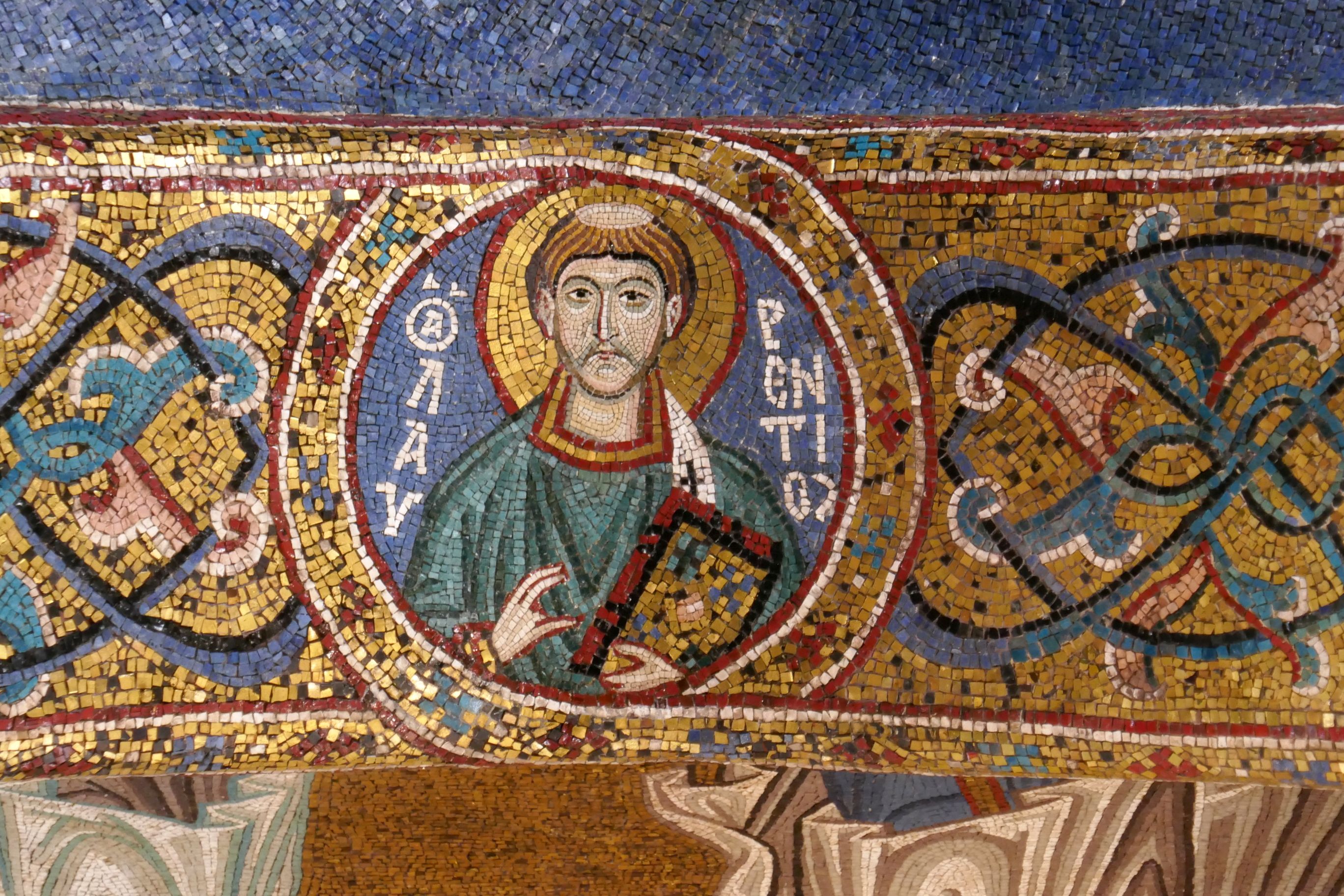
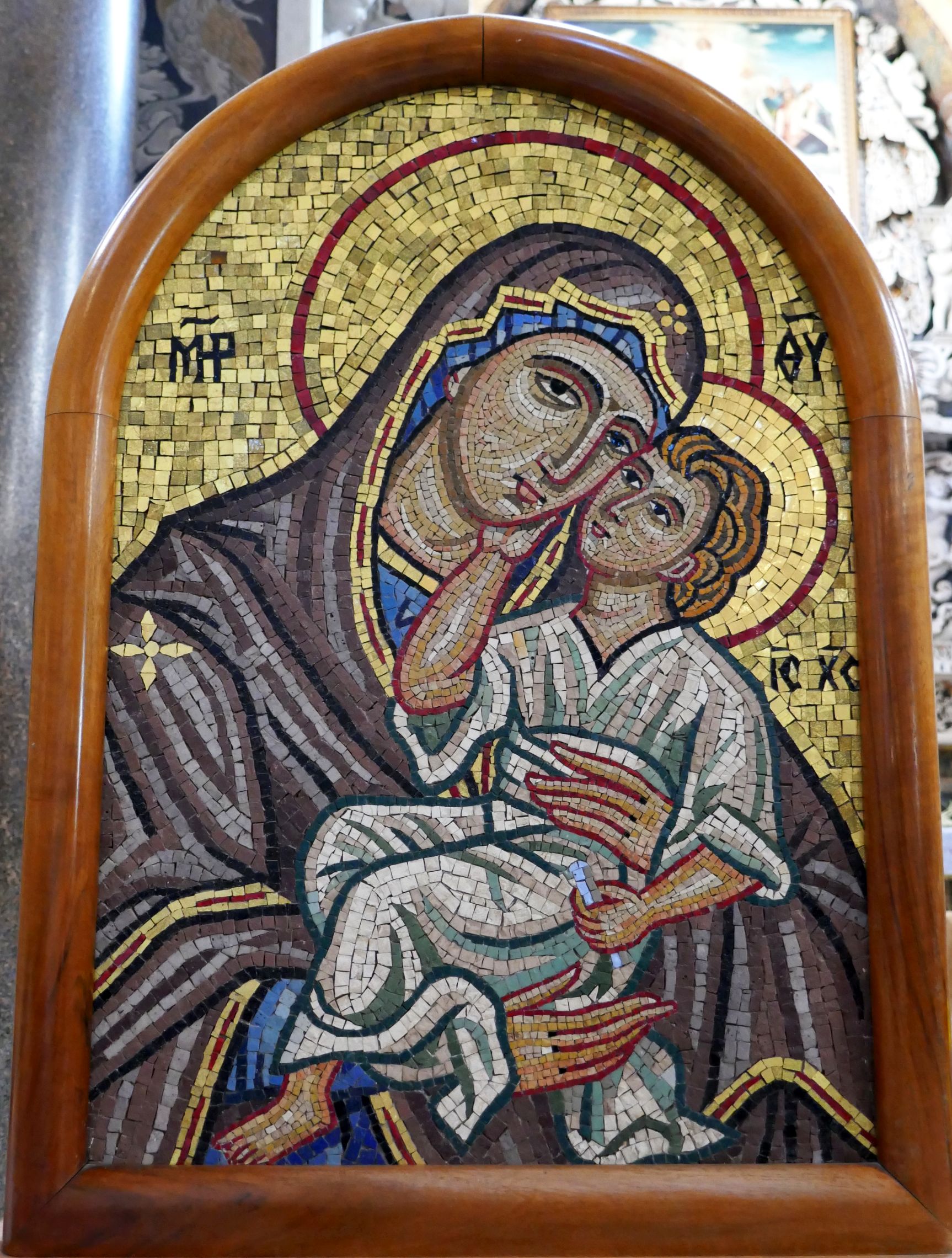
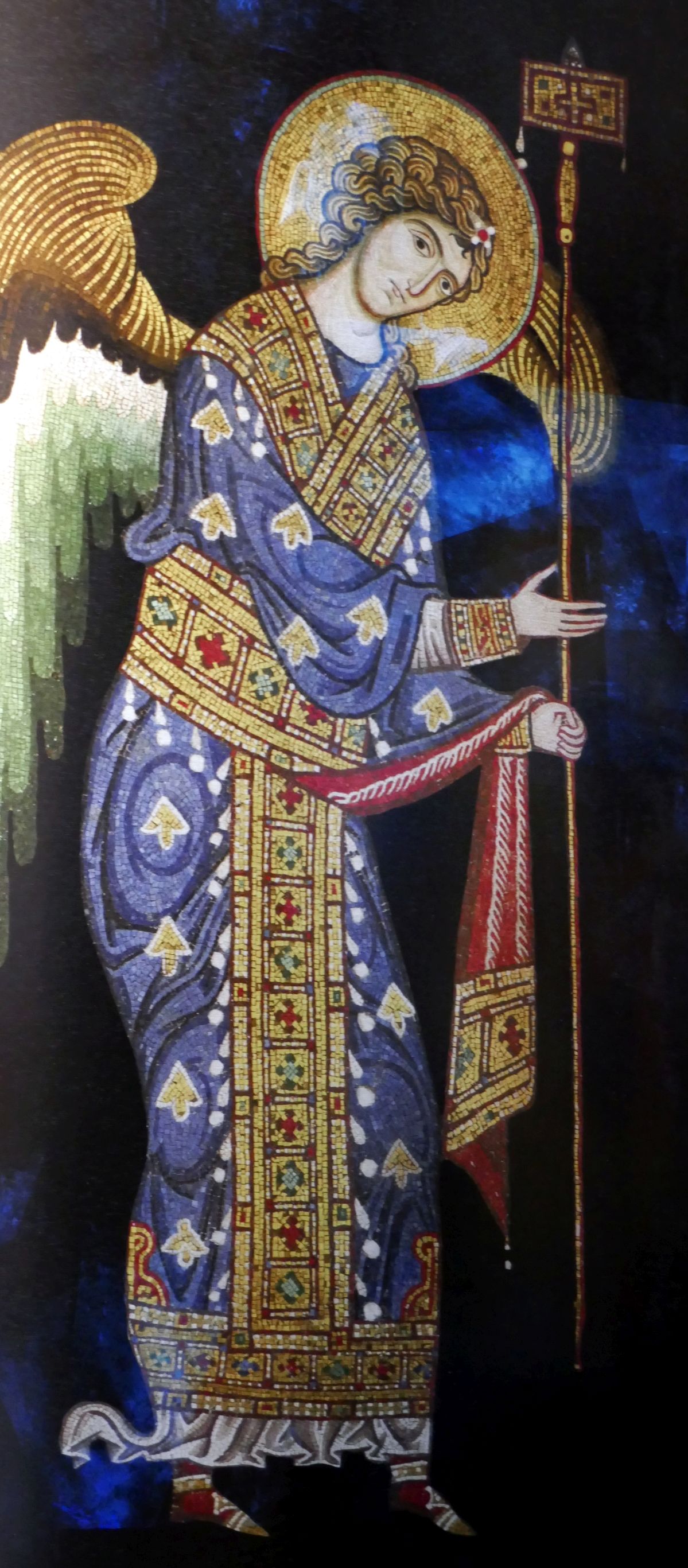
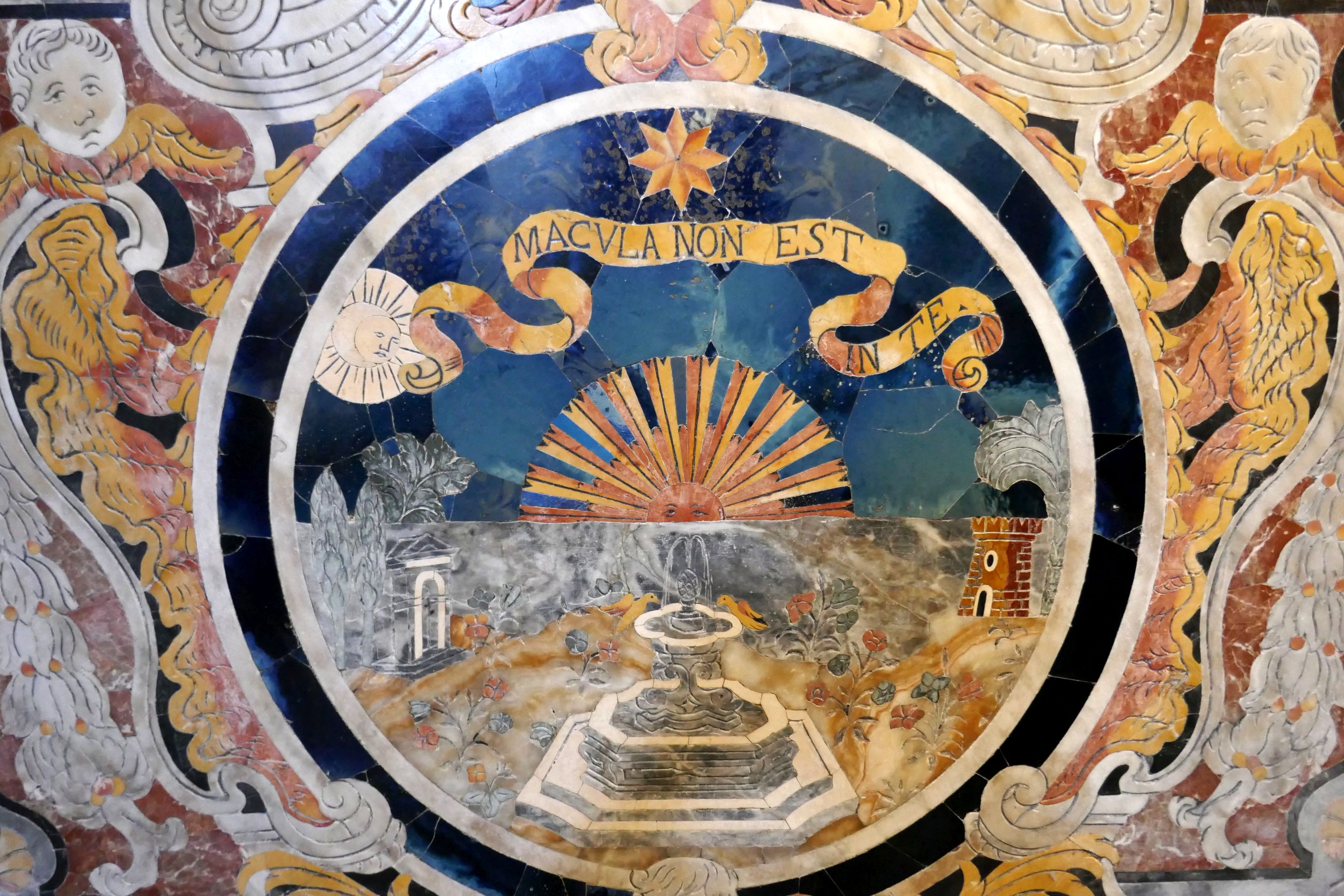
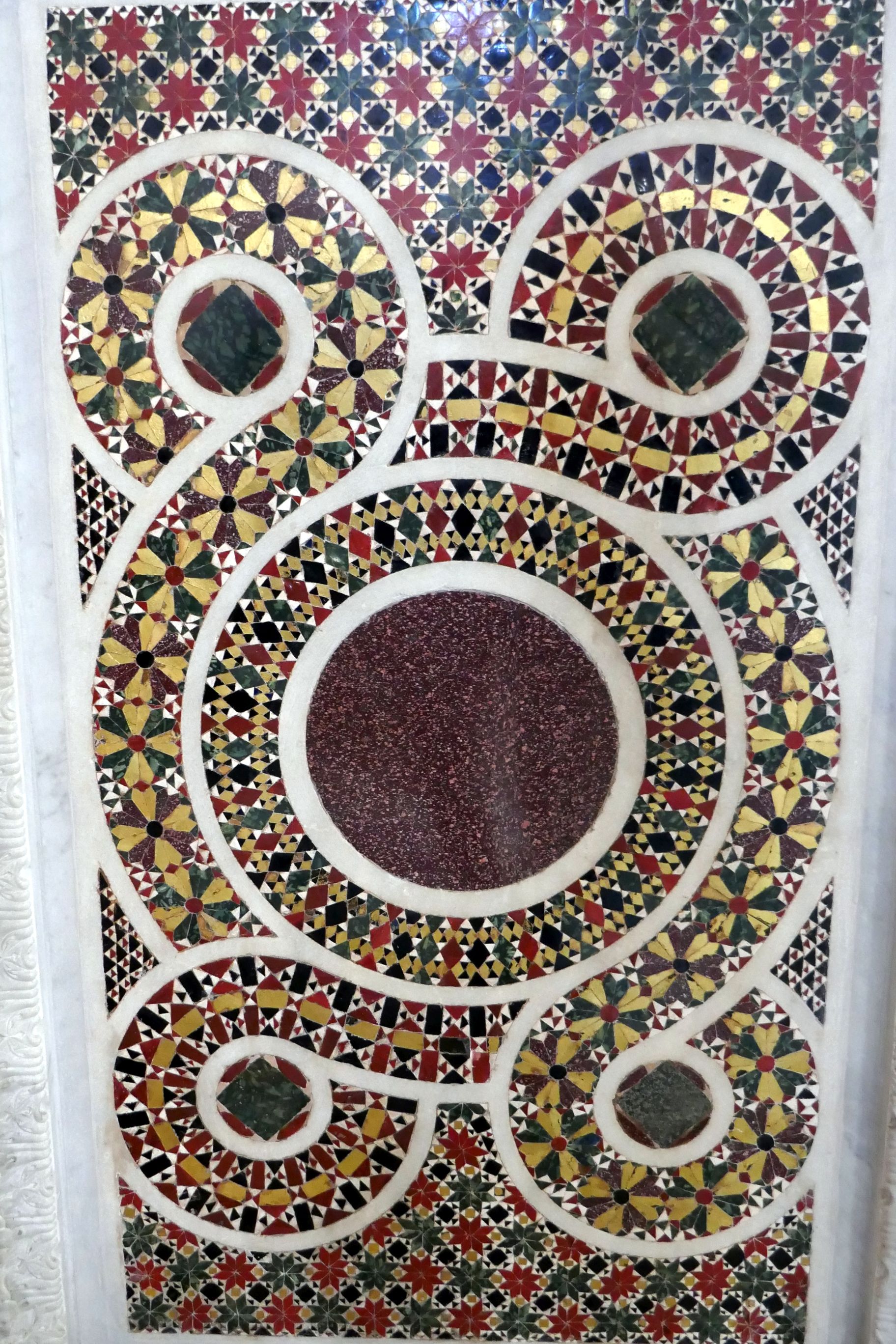
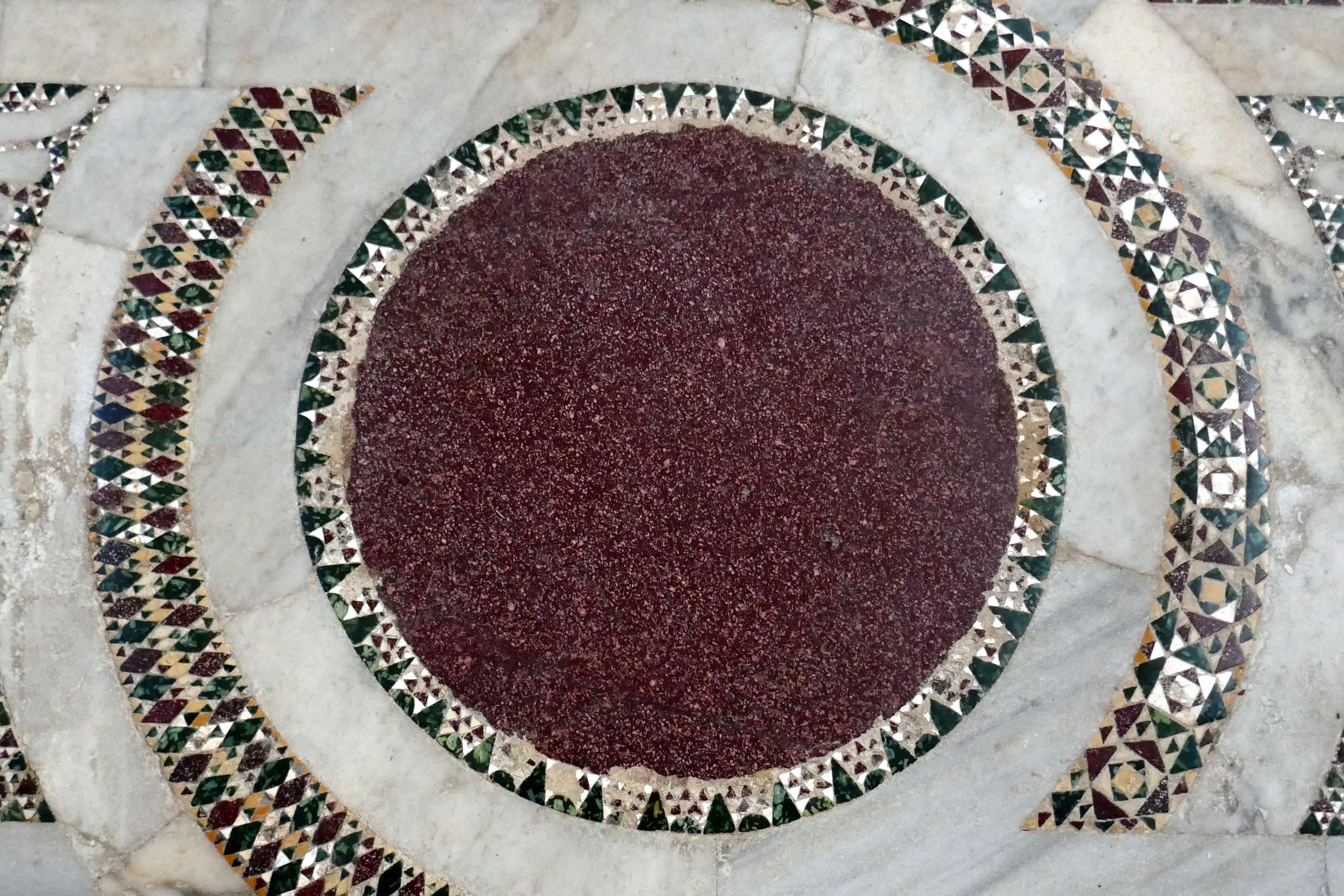
We had another day to explore Palermo on our own, so Bruce and I set out to walk the streets of the city. Our first stop was to visit the Church of Santa Maria dell’ Ammiraglio (also called Martorana), known for its Byzantine mosaics that date back to the 1140’s. The craftsmanship of these mosaics, many in gold, was stunning, as were the floor and wall tile designs.
(For all photos, click on the image for a full screen view.)
Looking up at the ceiling
Ceiling mosaic
This mosaic was difficult to photograph, due to the dark lighting and roped-off location. The detail in this mosaic was amazing!
This was a wall design all done in various types of stone.
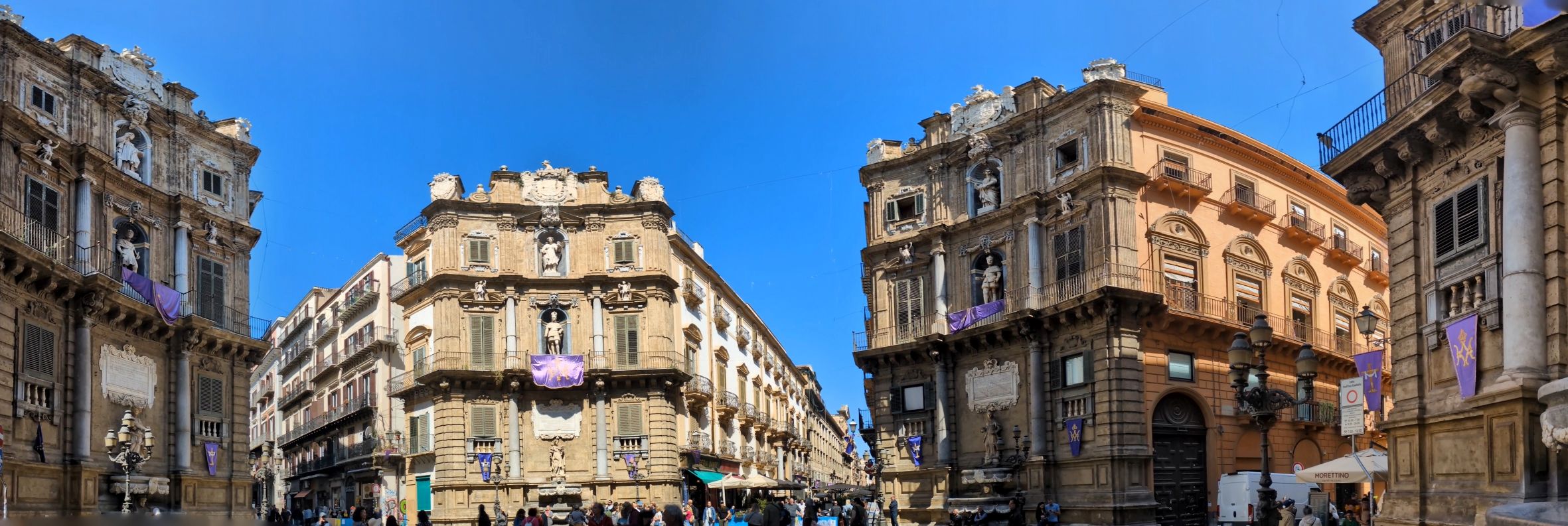
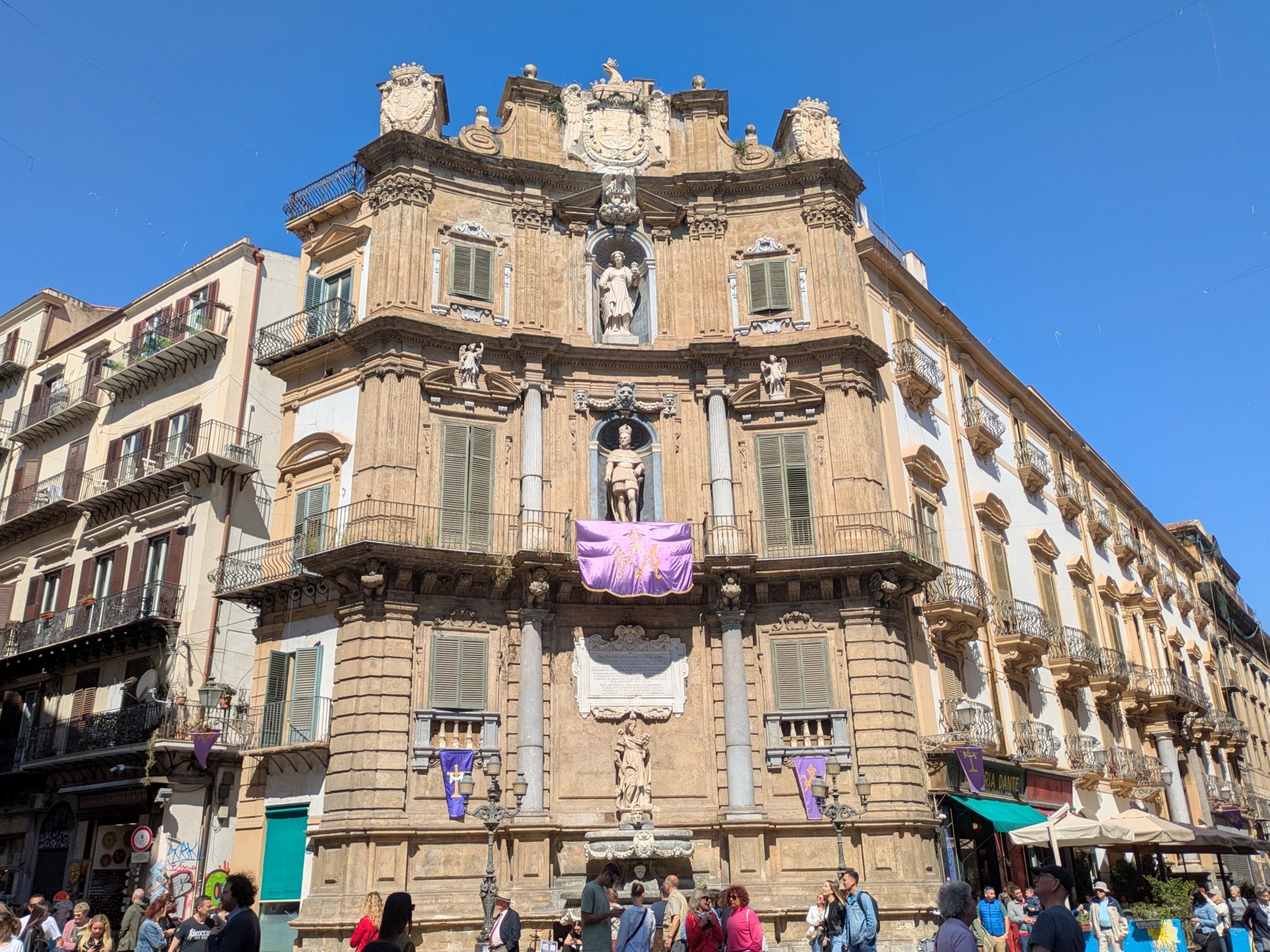
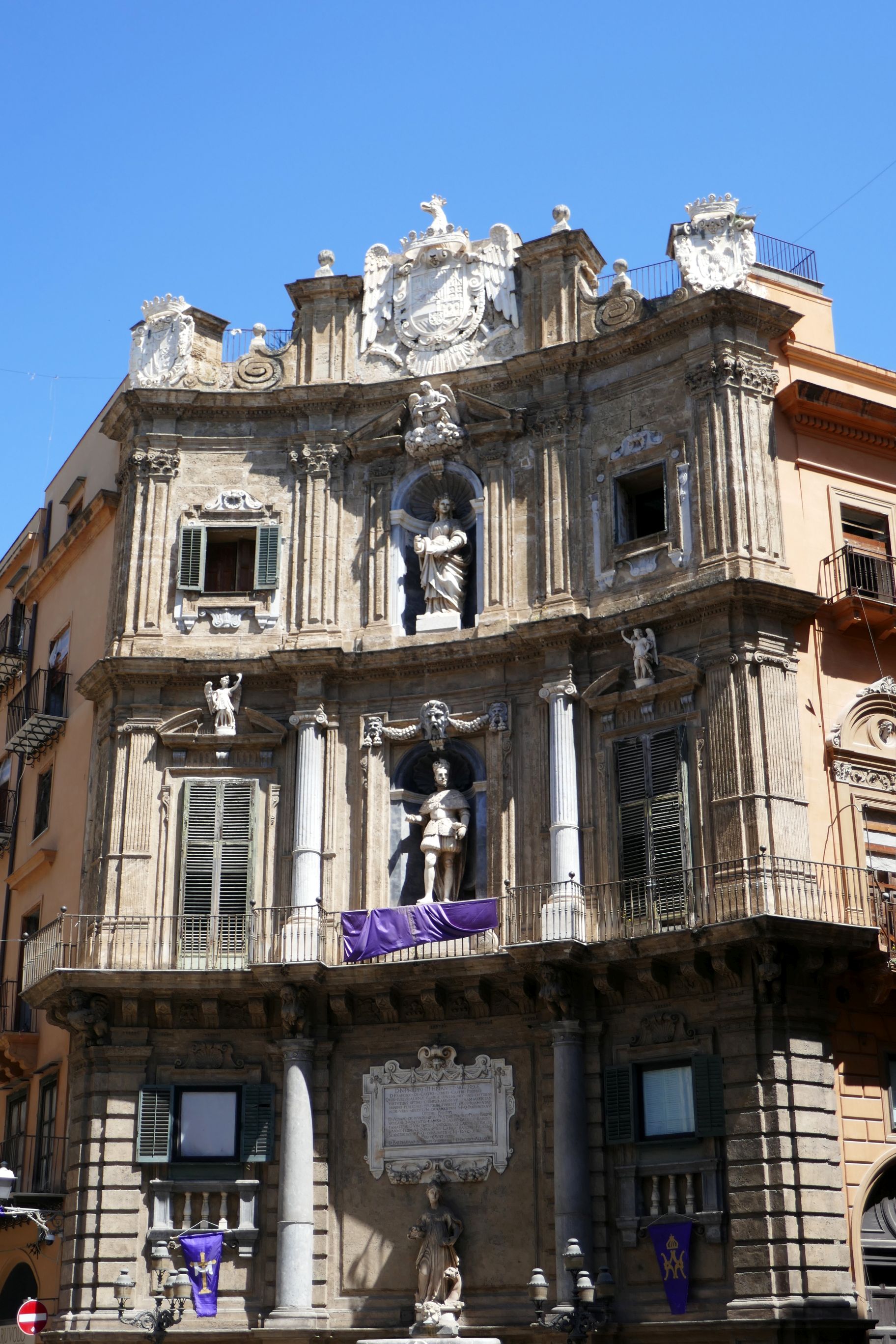
Very close to the church was Piazza Vigliena, also known as “Quattro Canti” (Four Corners). The most beautiful architecture I had ever seen on four corners of an intersection, it was obvious others agreed; it was packed with tourists when we visited the following day with our tour group. This day was relatively quiet, at least at the time of our visit.
Commissioned by the Senate of Palermo and designed by Giulio Lasso, the four corners were built between 1608 and 1620. By 1663, the buildings were complete with sculptures and decorations.
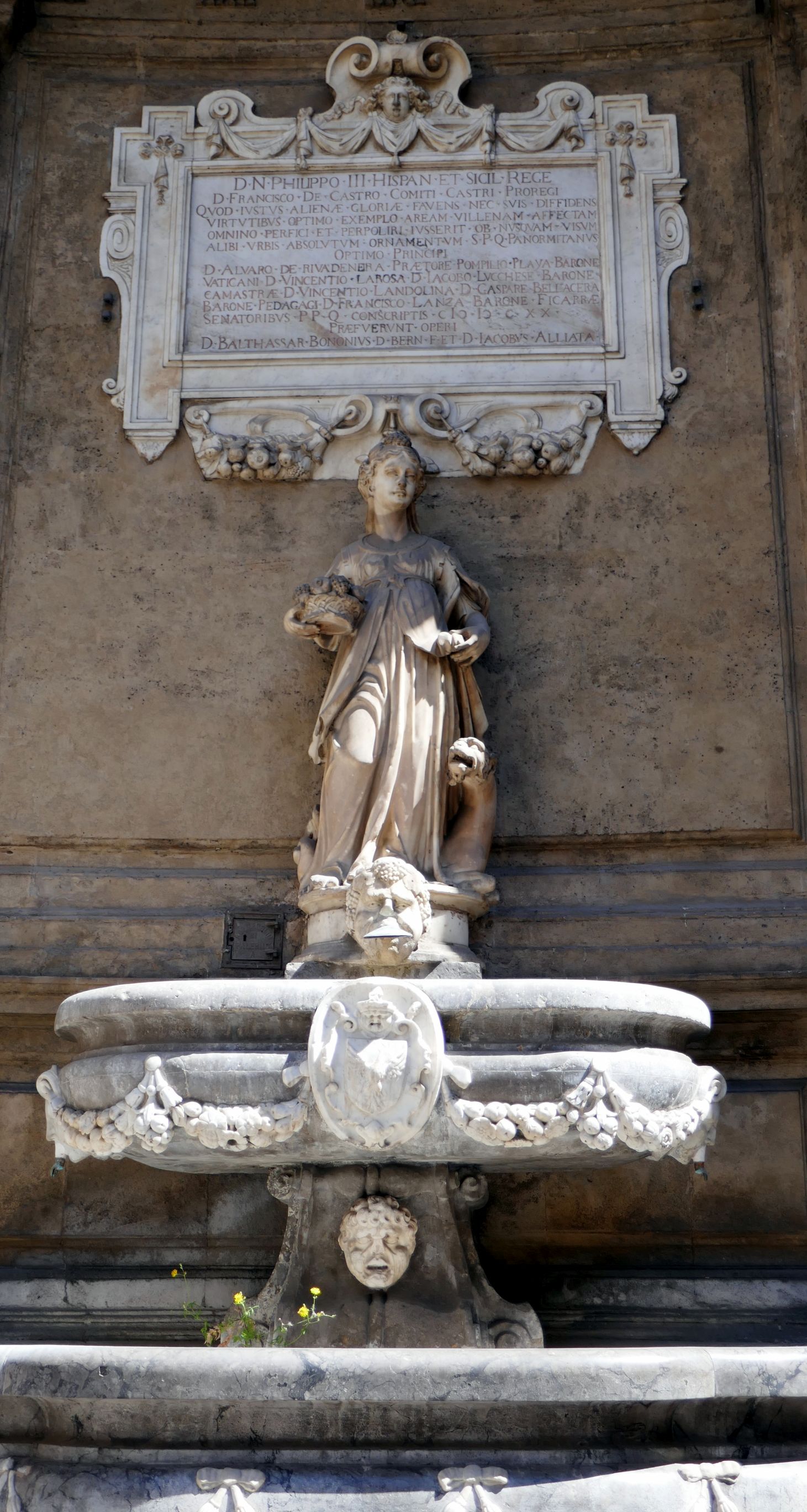
The fountain of each corner represents a different season. Pictured below is the north-west corner, representing the Seraldcadio/Capo district and the summer season. The sculptures are of Philip II, king of Spain, and patron Saint Santa Ninfa.
This north-east corner represents Autumn, and the sculptures depict King Philip III and patron Saint Oliva de Palermo.
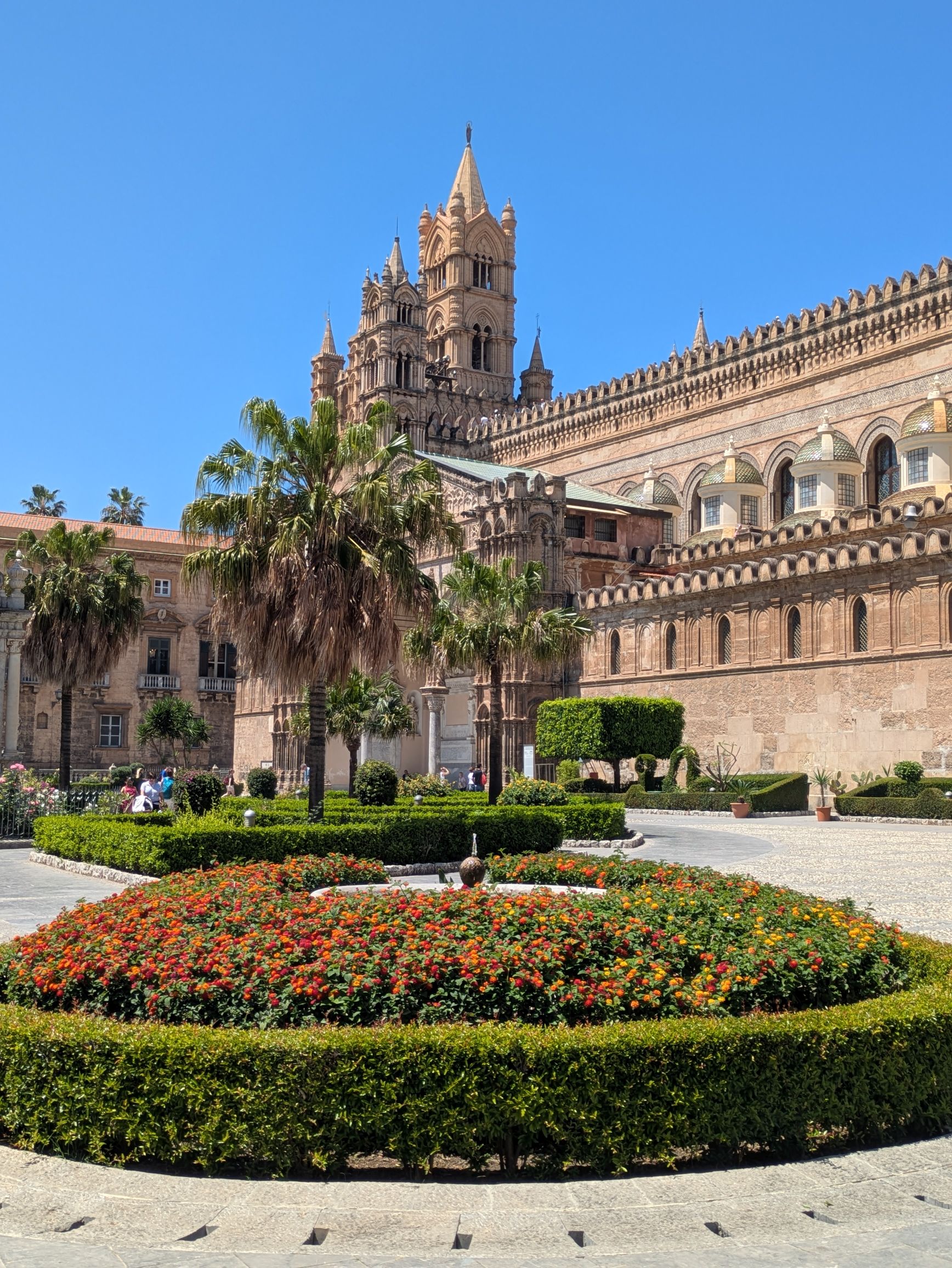
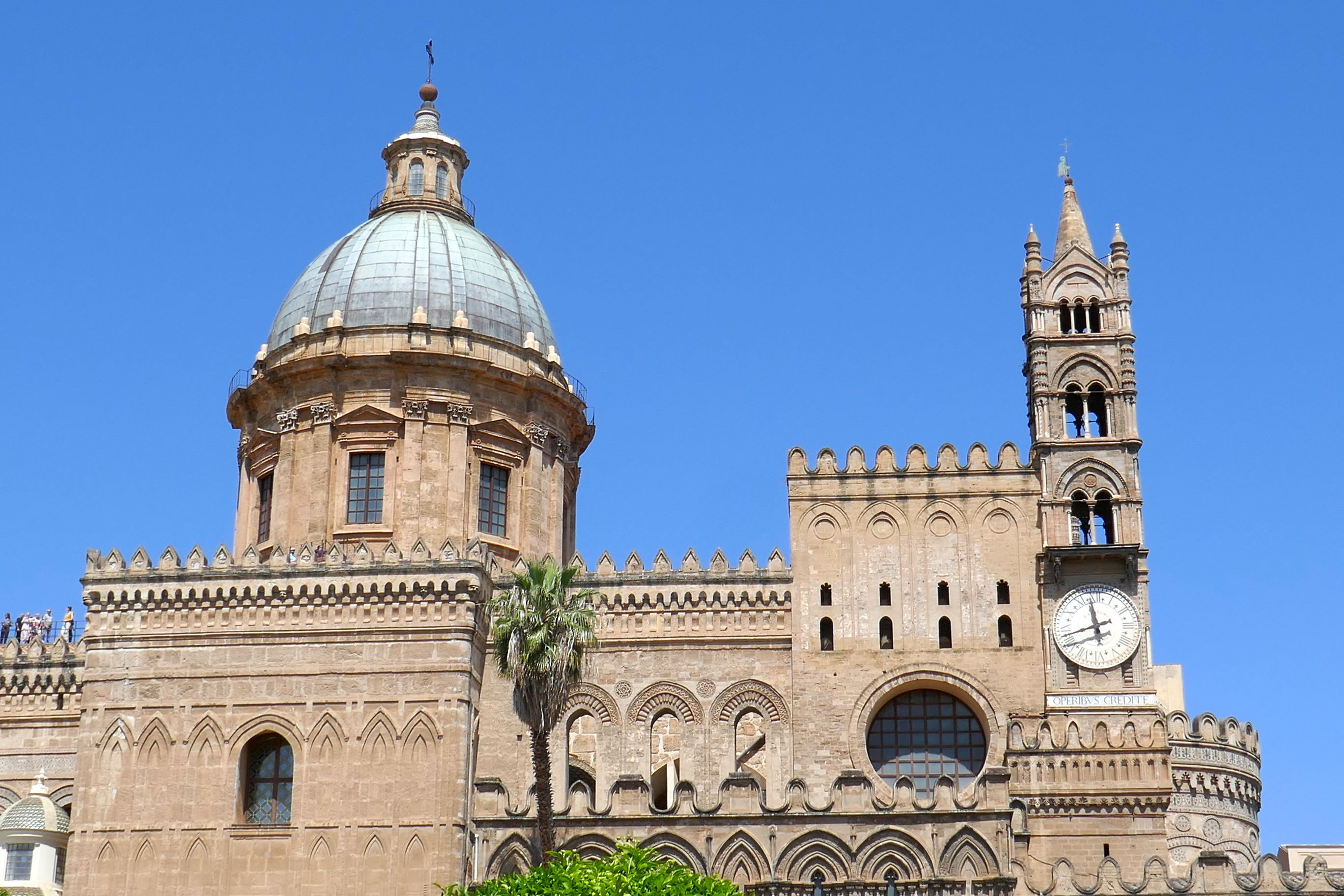
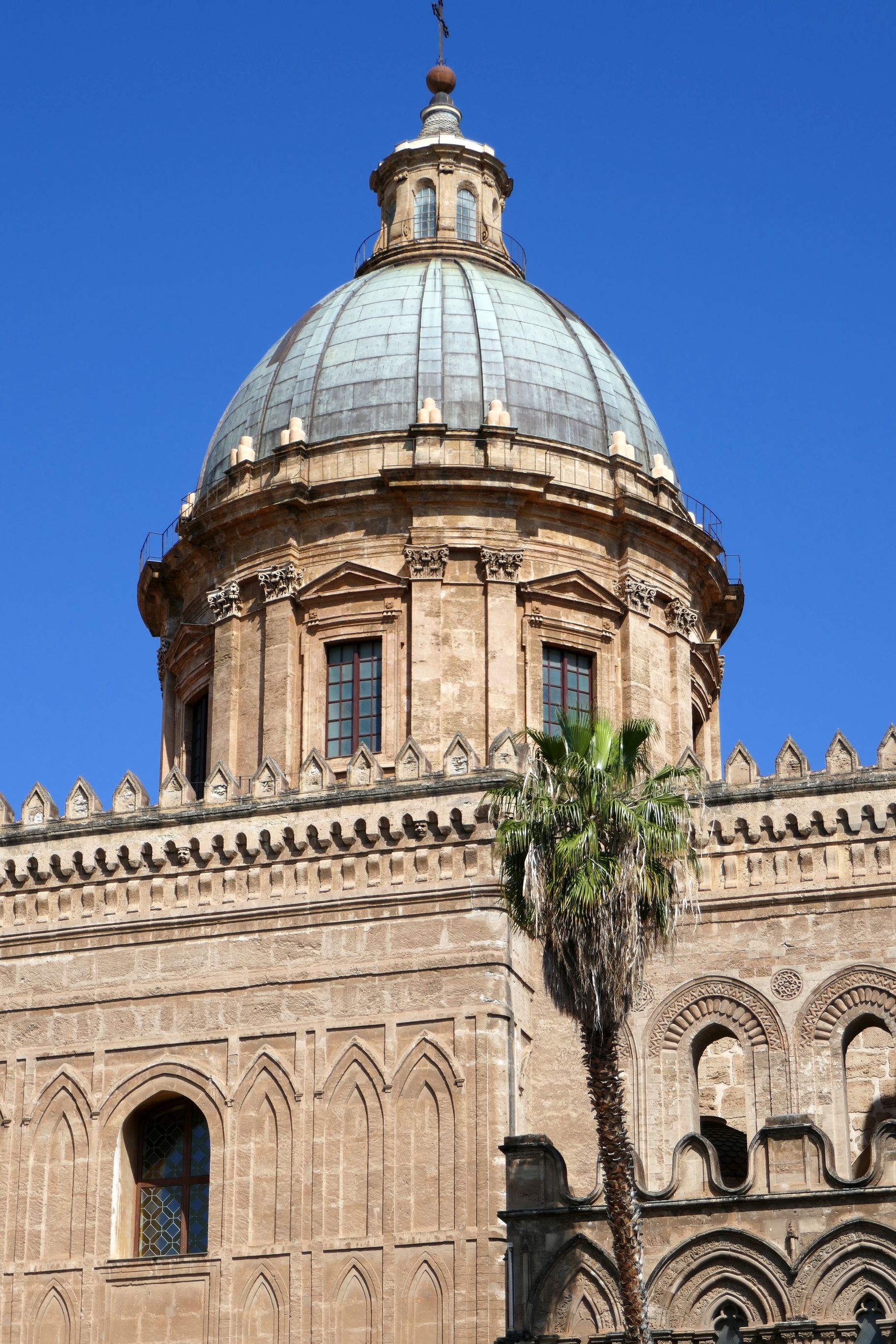
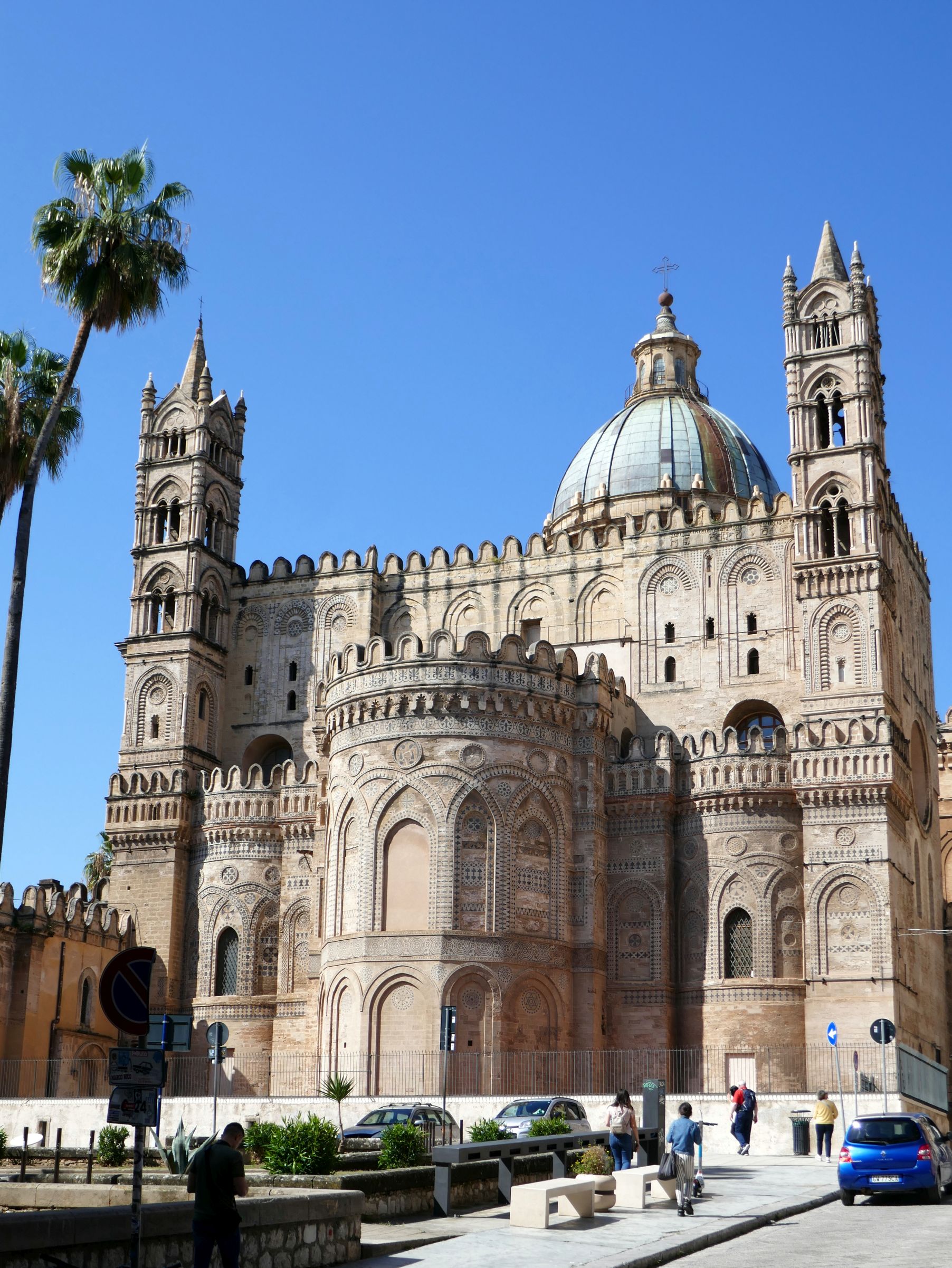
Continuing our walk along Via Vittorio Emanuele, one of the main streets of historic Palermo, we arrived at Palermo Cathedral, just one-third of a mile away. Construction of this Roman Catholic church began in 1185, but it wasn’t completed until the 18th century, after several additions and renovations. As a result, the complex has many architectural styles and a long, detailed history!
Back of the cathedral
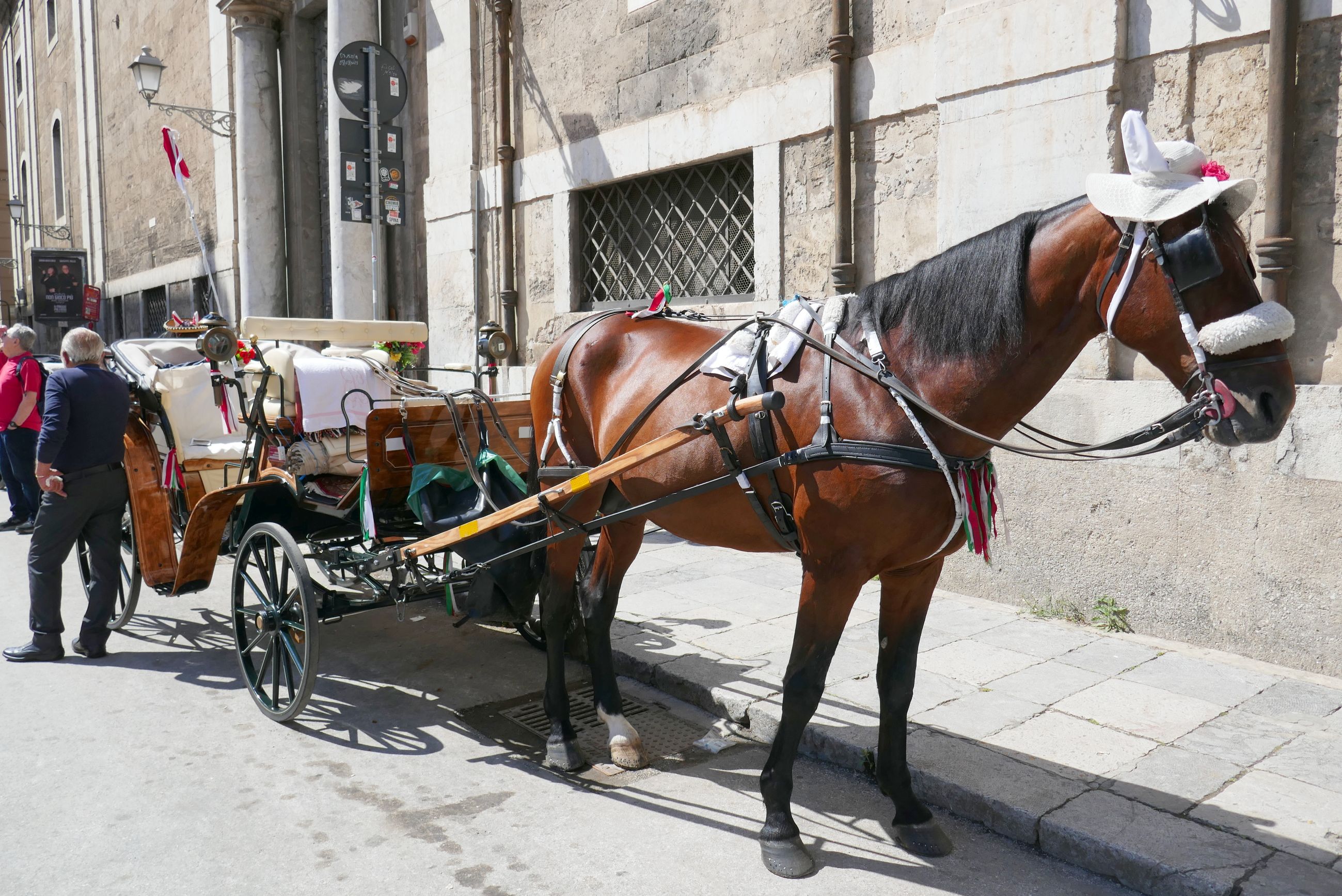
Old Palermo was easy to see on foot, so we enjoyed wandering the streets, taking in the sights and sounds of the sidewalk cafes and shops, stopping for delicious gelato along the way.
It was wonderful to be back in Italy! This was my sixth time in the country and my fourth with Bruce. After visiting Calabria with friends, we returned to Italy on our first OAT tour to Tuscany and Umbria, with a pre-extension to Parma and Bologna. Last year, we traveled with OAT to the Dolomites in northern Italy, following a pre-extension to Switzerland. Now, we were beginning our journey through Sicily, eager to see what adventures awaited us.
Coming up next: SICILY & THE AMALFI COAST #3: PALERMO ON TOUR
As usual, we chose to arrive early to allow ourselves to adjust to the time change. Although we knew the tour would include a visit to Capo Market, Bruce and I decided to go on our own after settling into our hotel room upon arrival.
We love visiting markets; it’s one of our favorite things to do when we travel. Markets always present wonderful photo opportunities, they’re a great place to grab some fresh and tasty food, and it’s fun to watch the locals doing transactions with the vendors. Never a dull moment.
Although I had Euros left over from our previous trip, we took advantage of having access to the ATM along the way and picked up some more Euros. Before we leave the country, I always look up my bank’s website to see if it has a partner bank in the country I’m visiting. It does have a partner in Italy, so using their ATM saved us some money on fees.
Since we were going to walk to the ATM, followed by the market, and possibly some other stops on the way back to the hotel, Google Maps came in handy. I was thankful to have an Airalo e-SIMM for my phone, so I could switch it on when I was away from the hotel’s WIFI, and use the step-by-step route instructions for our walk.
Now, for a shameless promo: If you decide to try Airalo, you will receive $3 off and I will receive $3 off my next order if you use my referral code: ELAINE7474. I spent $66 to get 20 GB of data, and it’s good for one year. Since purchasing it last July, I have used it in Peru, England, Ireland, Sicily, and Turkiye. It was well worth the $66 just for using Google Maps for walking routes! Besides, you can set it up at home before you leave town, so you won’t have the same hassles some of our Turkiye group members had when they purchased an E-SIMM at the airport in Istanbul. They paid A LOT more, it didn’t work, and it was a nightmare for them—long story.
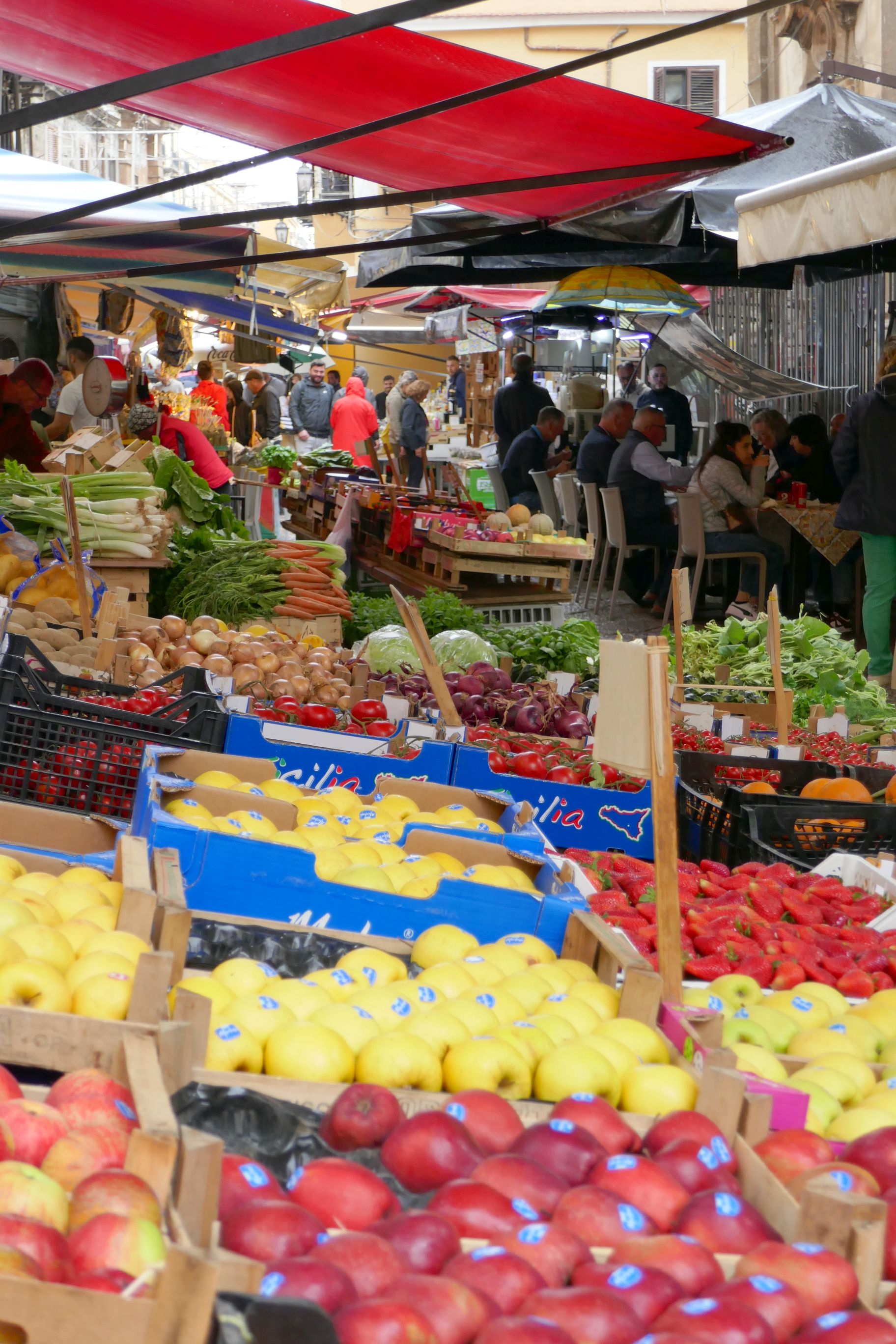
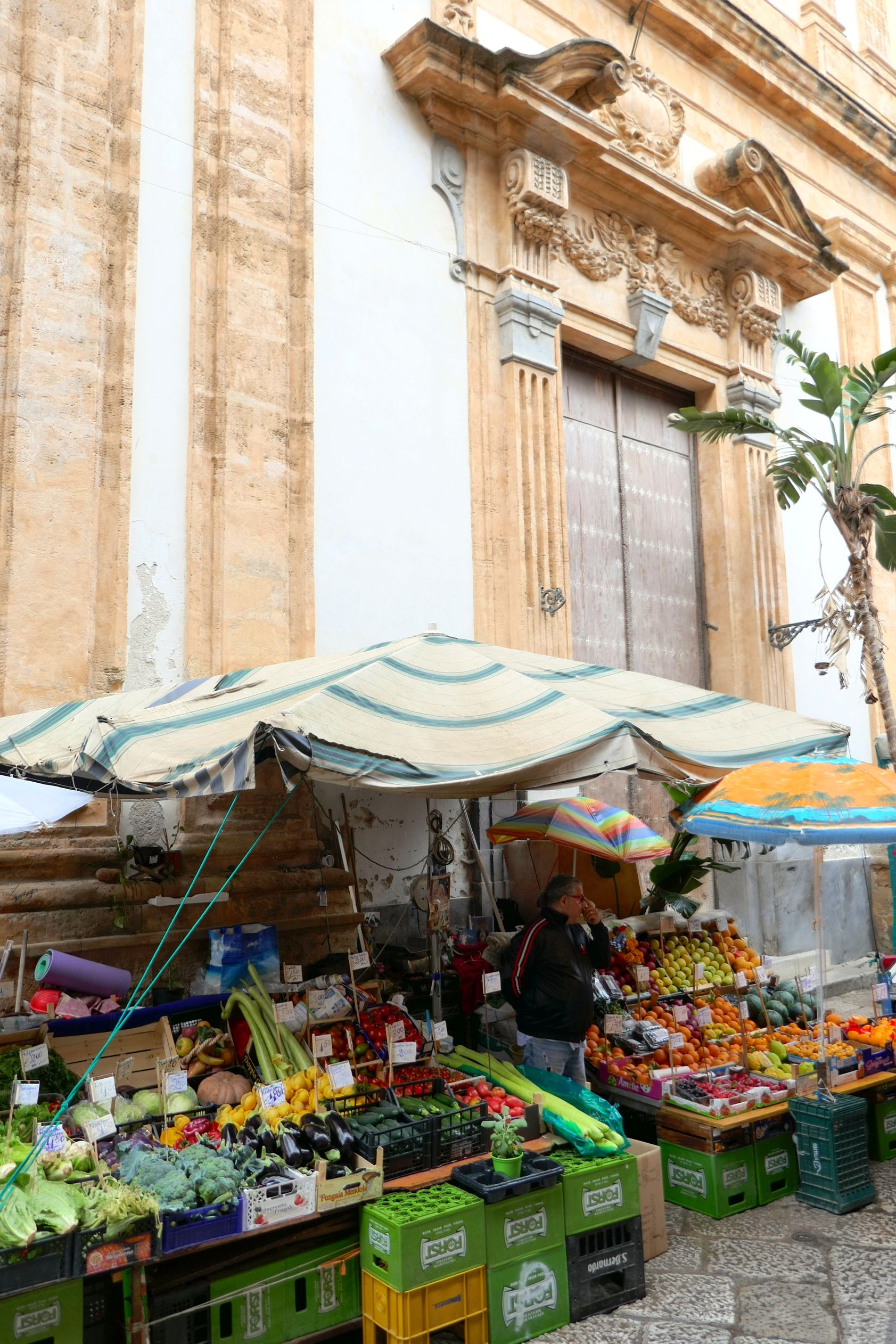
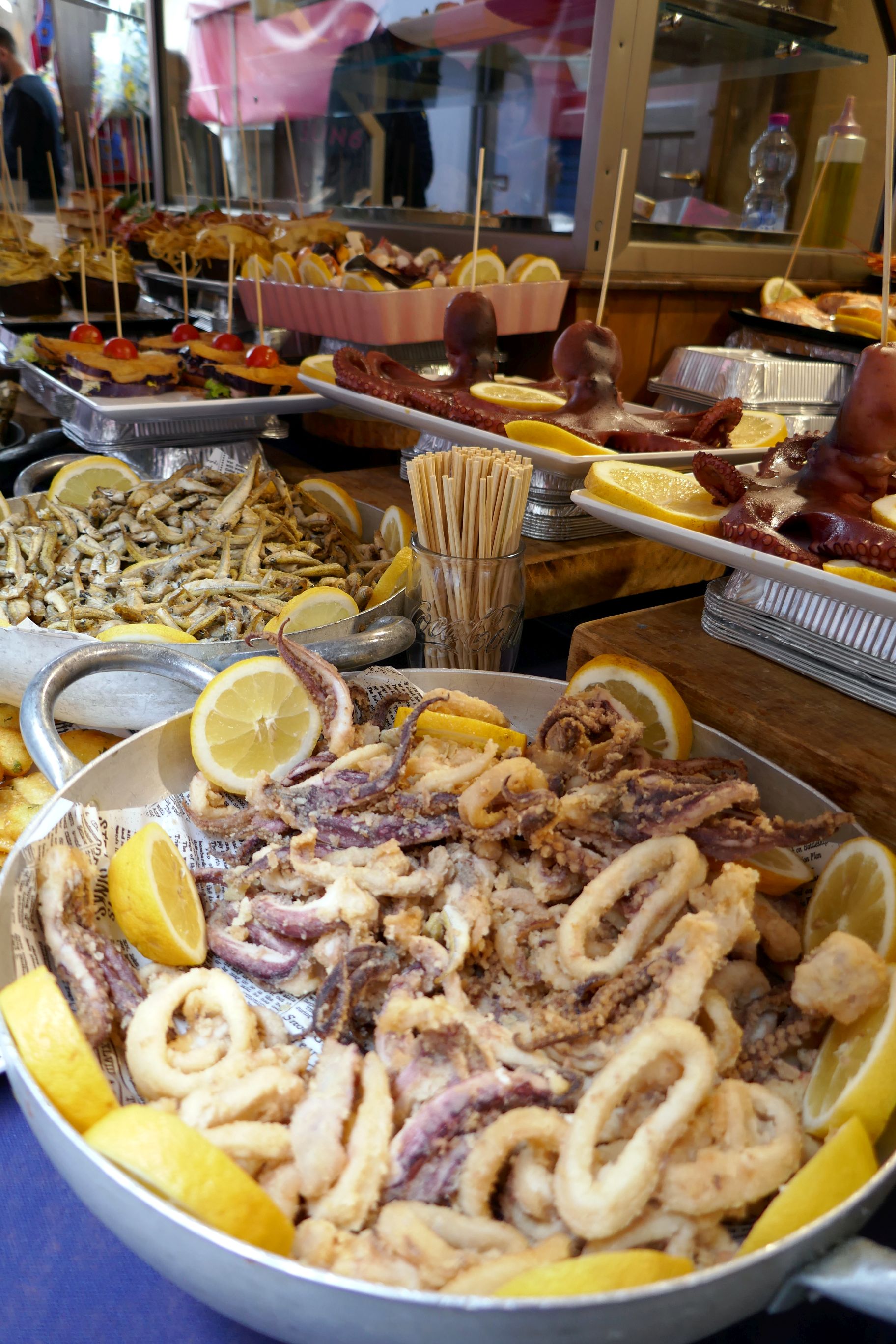
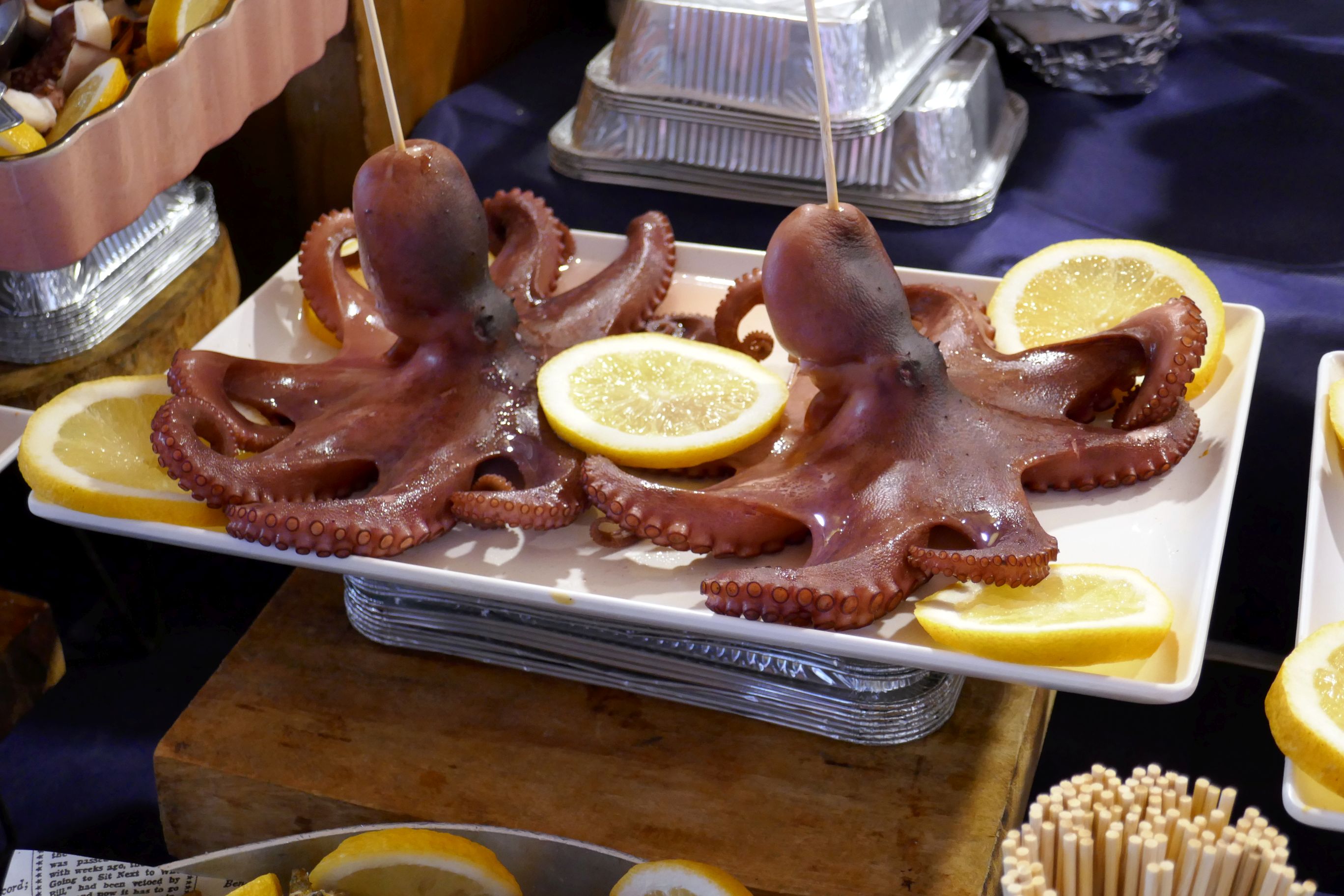
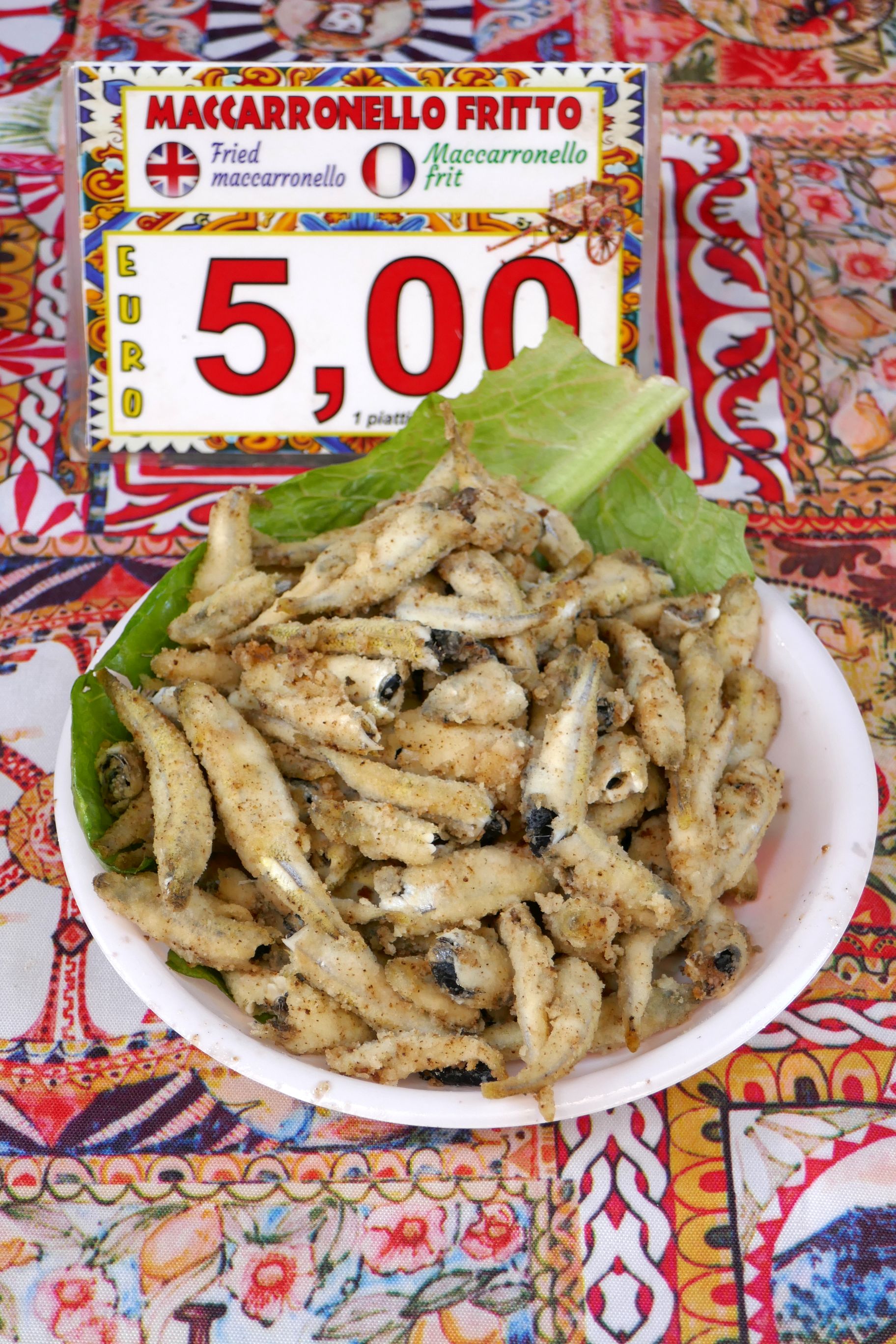
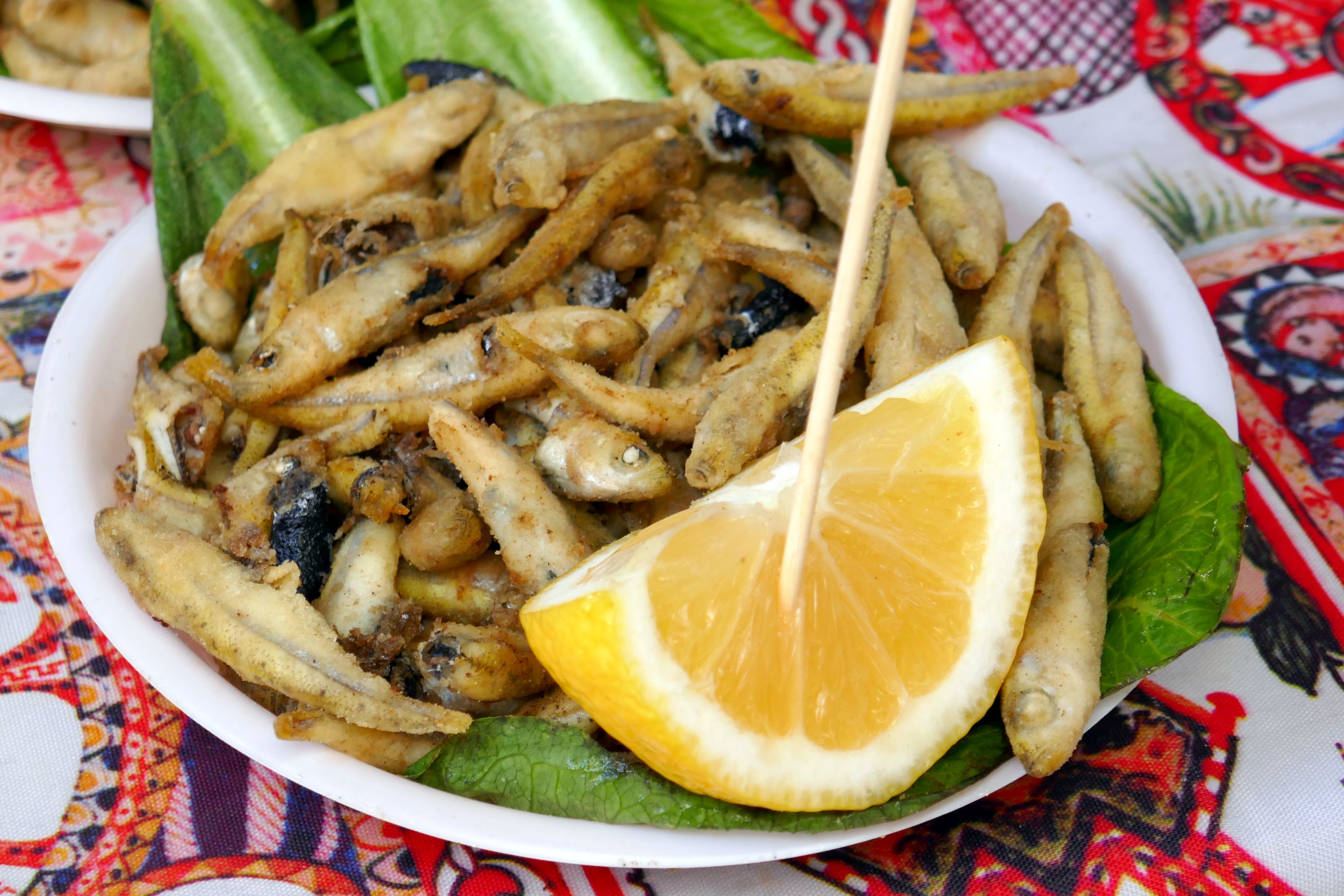
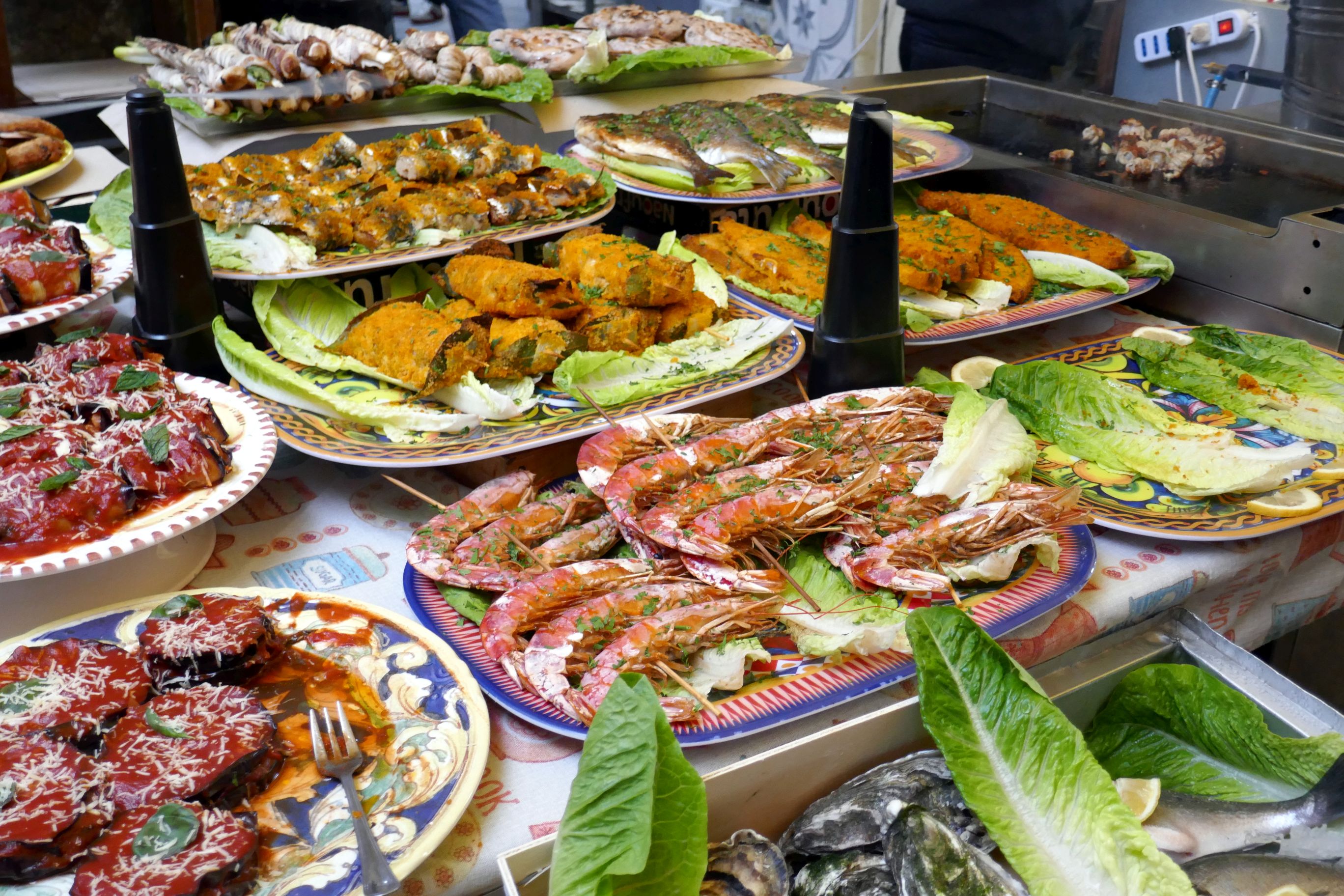
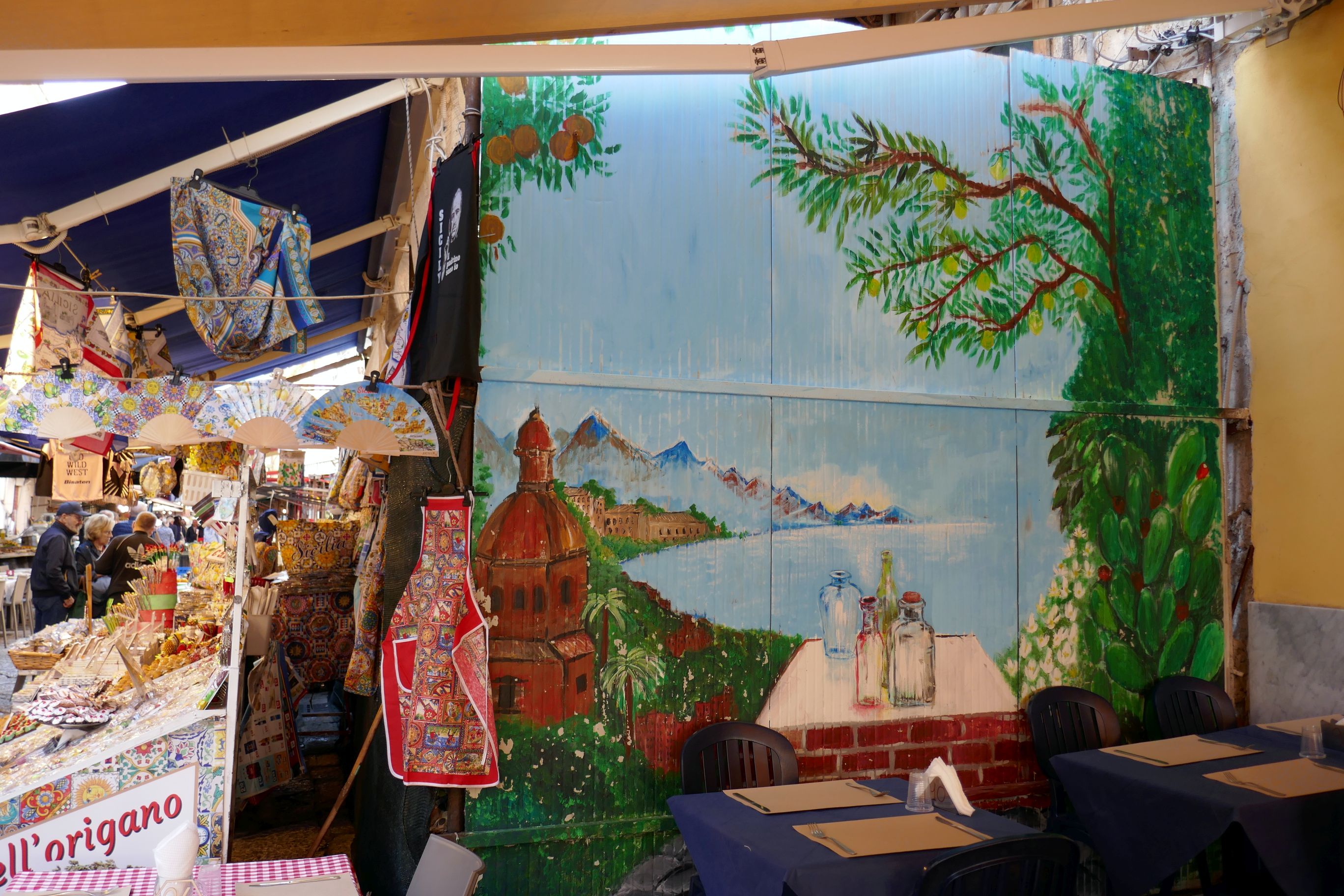
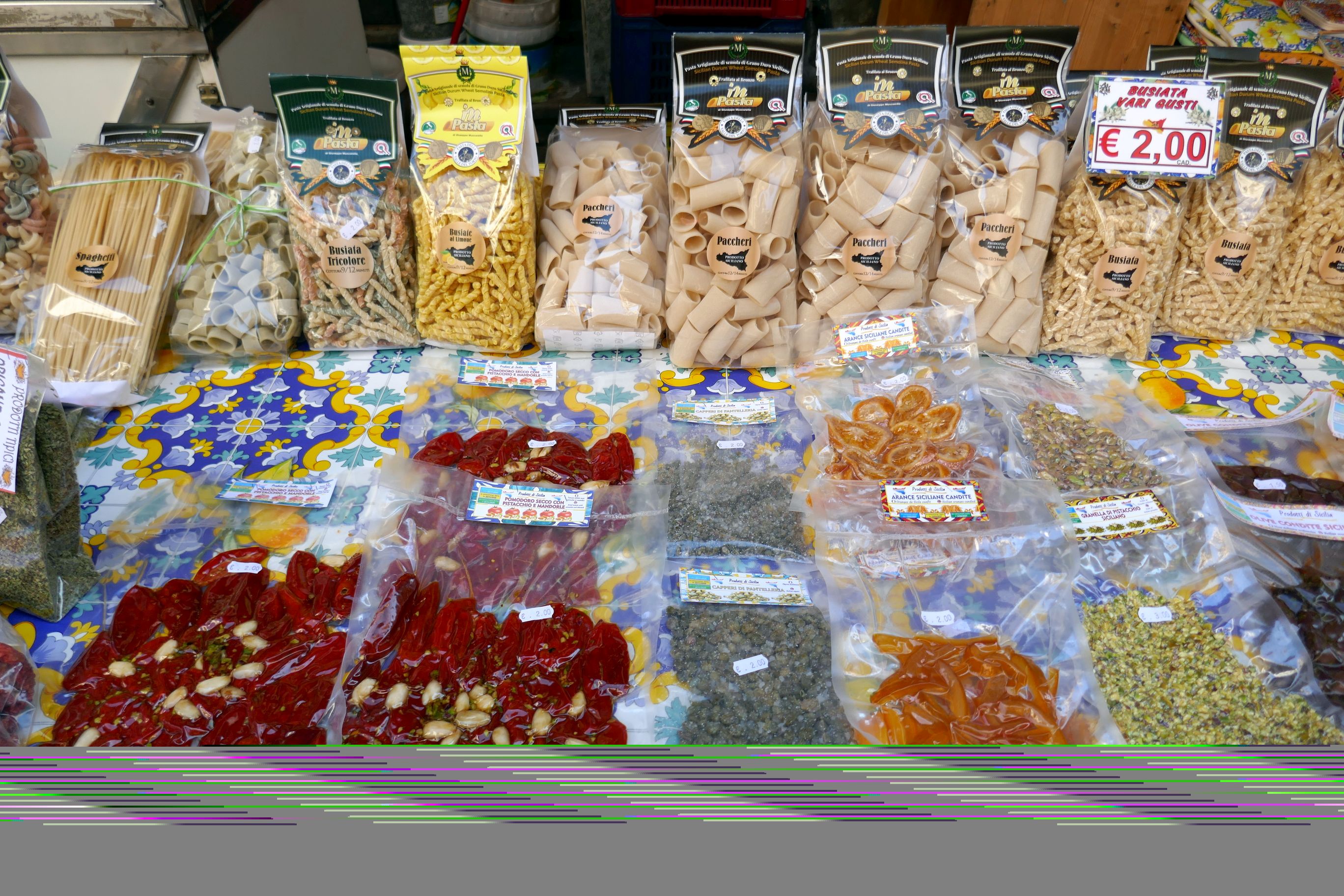
Airalo switched on, and more Euros tucked away, we continued to the market. Capo Street Market (Mercato del Capo), has been in existence for many years and was historically famous for its meat trade. Currently, fresh fish, produce, Sicilian products, and tourist souvenirs are sold at the market. We enjoyed scoping out the various street food options we looked forward to tasting while traveling throughout Sicily!
(For all photos, click on the image for a full screen view.)
During our visit, it started to rain hard, leaving us looking like drowned rats by the time we returned to our hotel. Thankfully (gratefully!), that was the last of any significant rain during the entire tour. Although it rained a couple of other times, it never impacted us; we were either indoors or on a bus. We were fortunate to have beautiful weather!
Next up:SICILY & THE AMALFI COAST #2: POKING AROUND PALERMO
(For all photos, click on the image for a full screen view.)
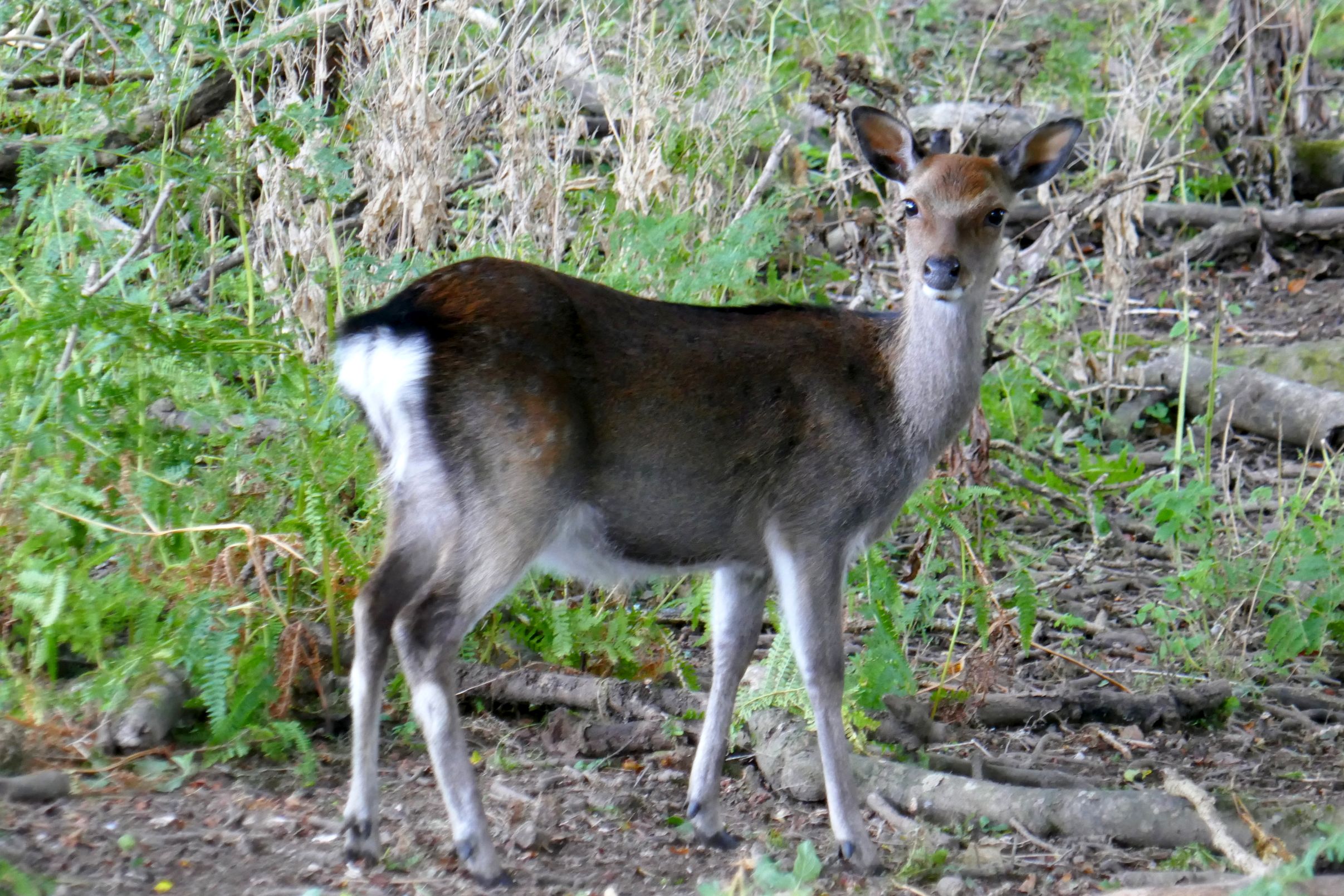
It was good timing to go through the park in the morning, because we were able to see dozens of red deer grazing.
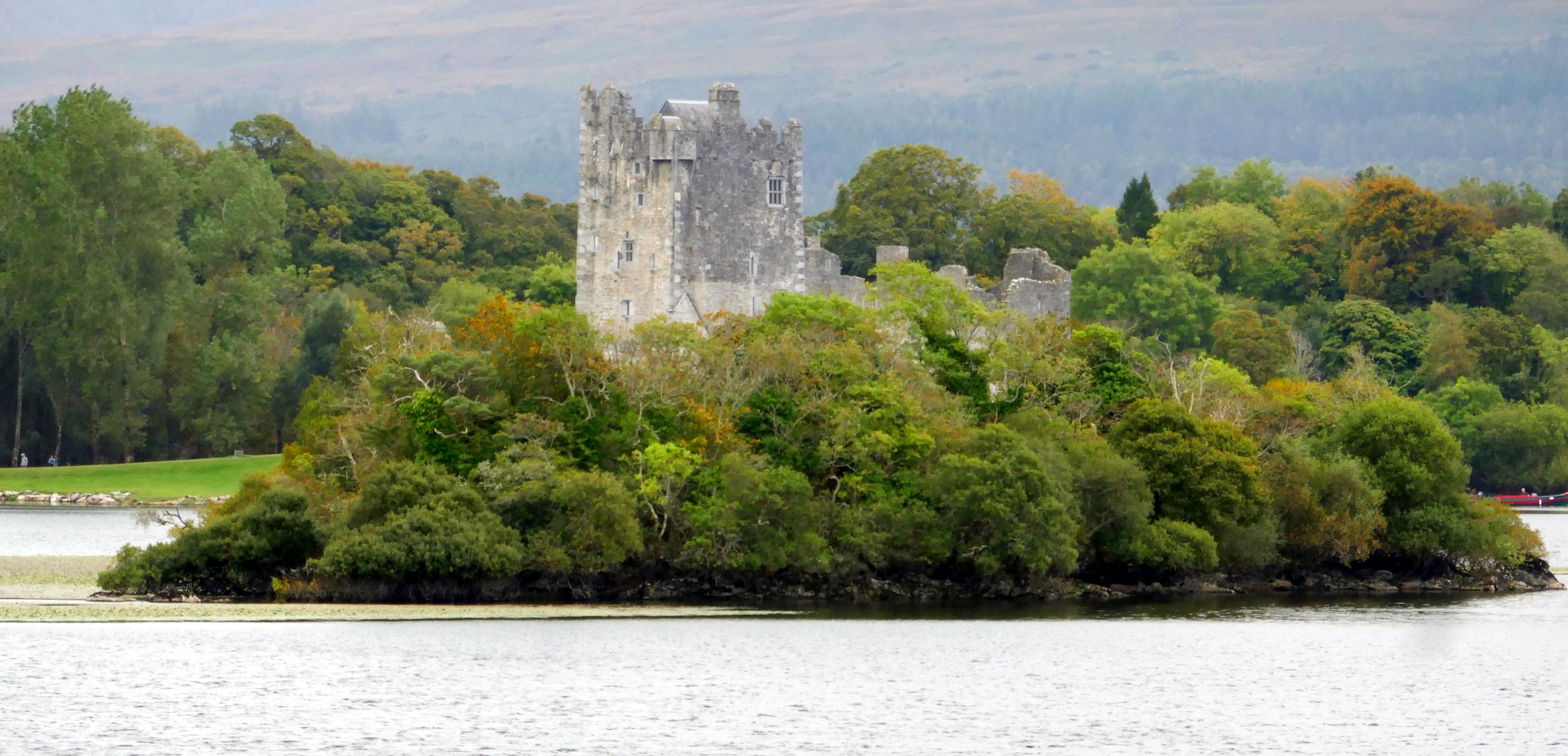
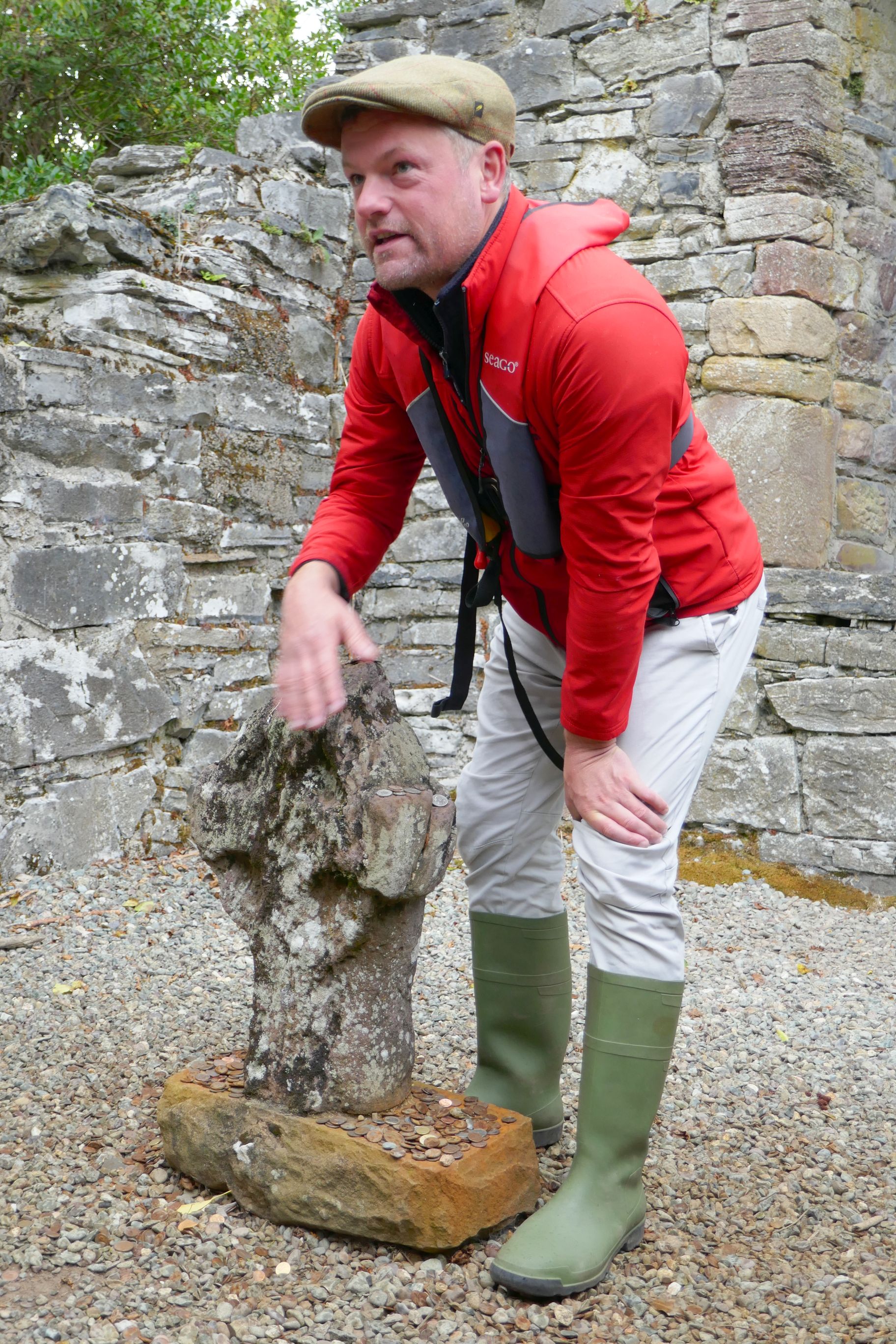
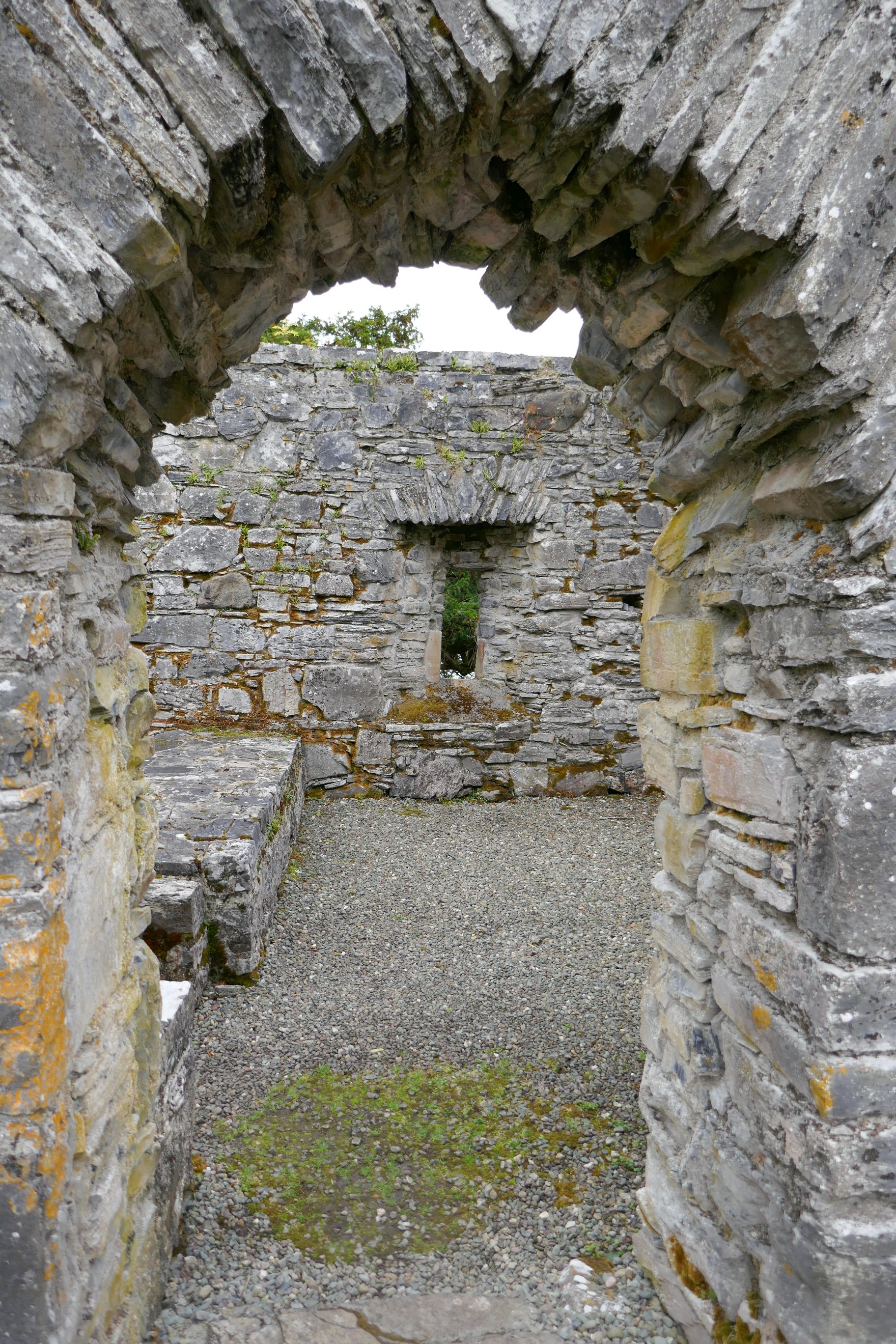
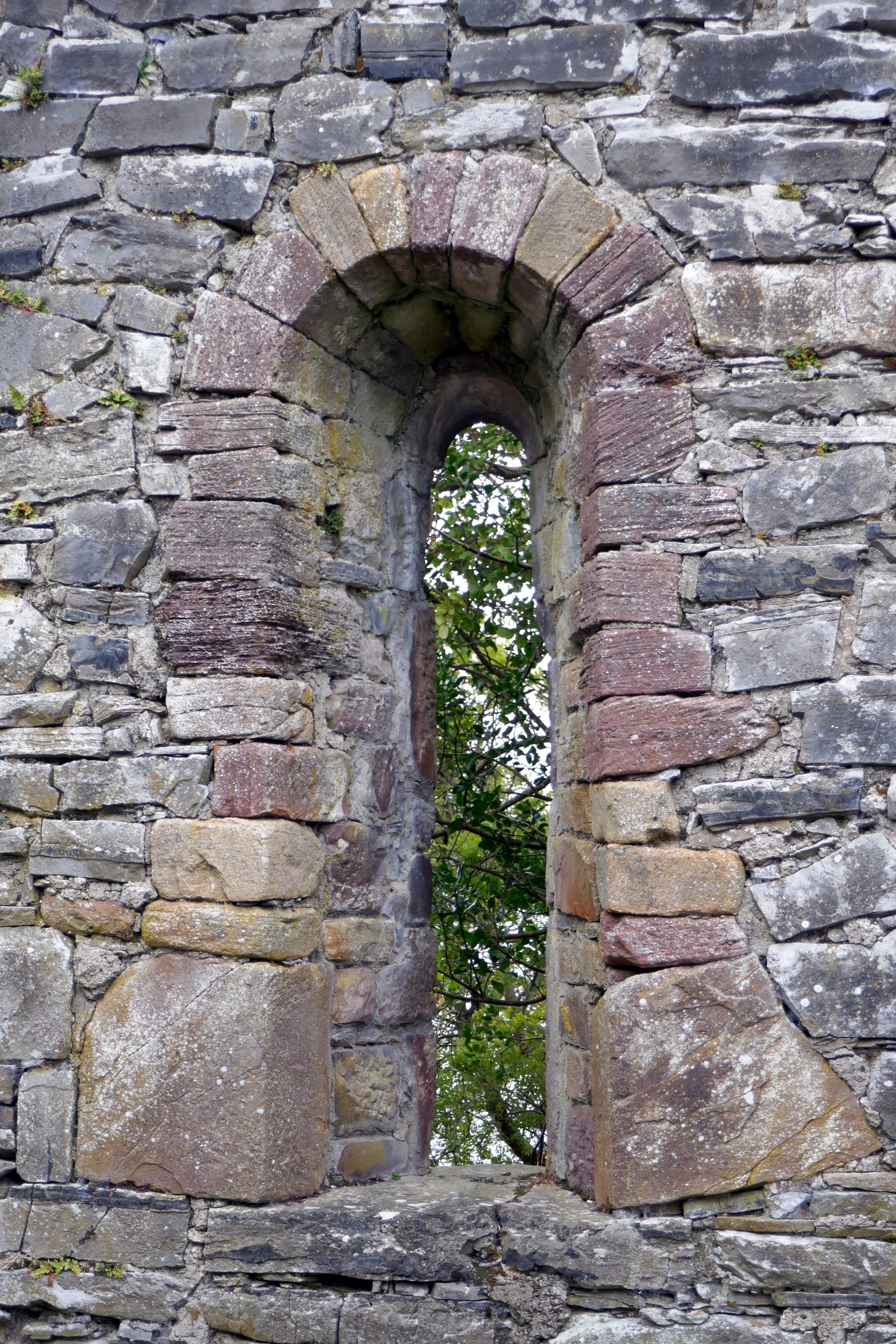
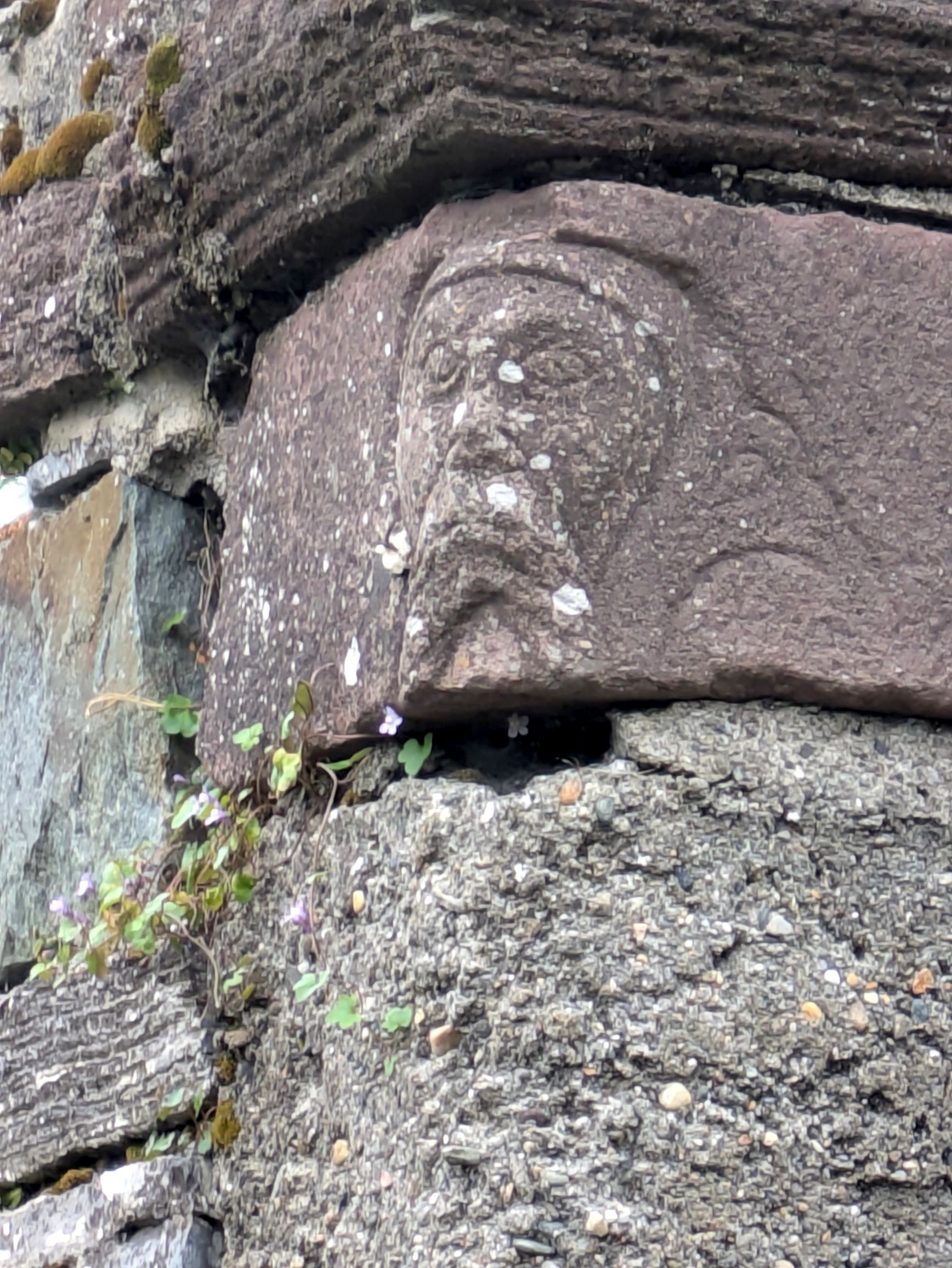
At the lake, we boarded a small boat for a guided tour to Innisfallen Island. On the island, our group learned about the ruins of the 7th century Innisfallen Abbey. When we arrived, there were several deer grazing around the ruins. They didn’t seem too bothered by us; they have become used to the tourists coming to their island on a regular basis.
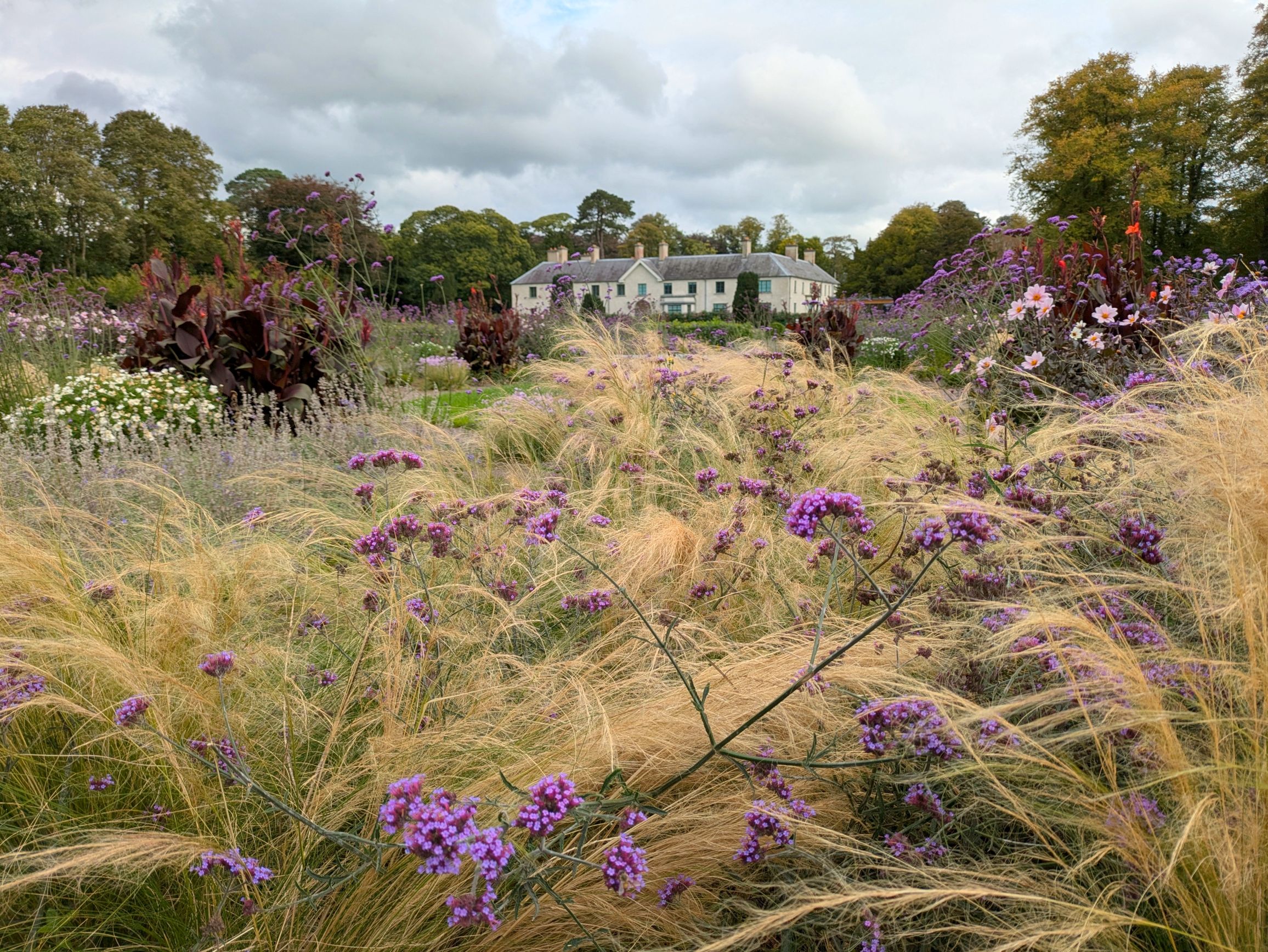
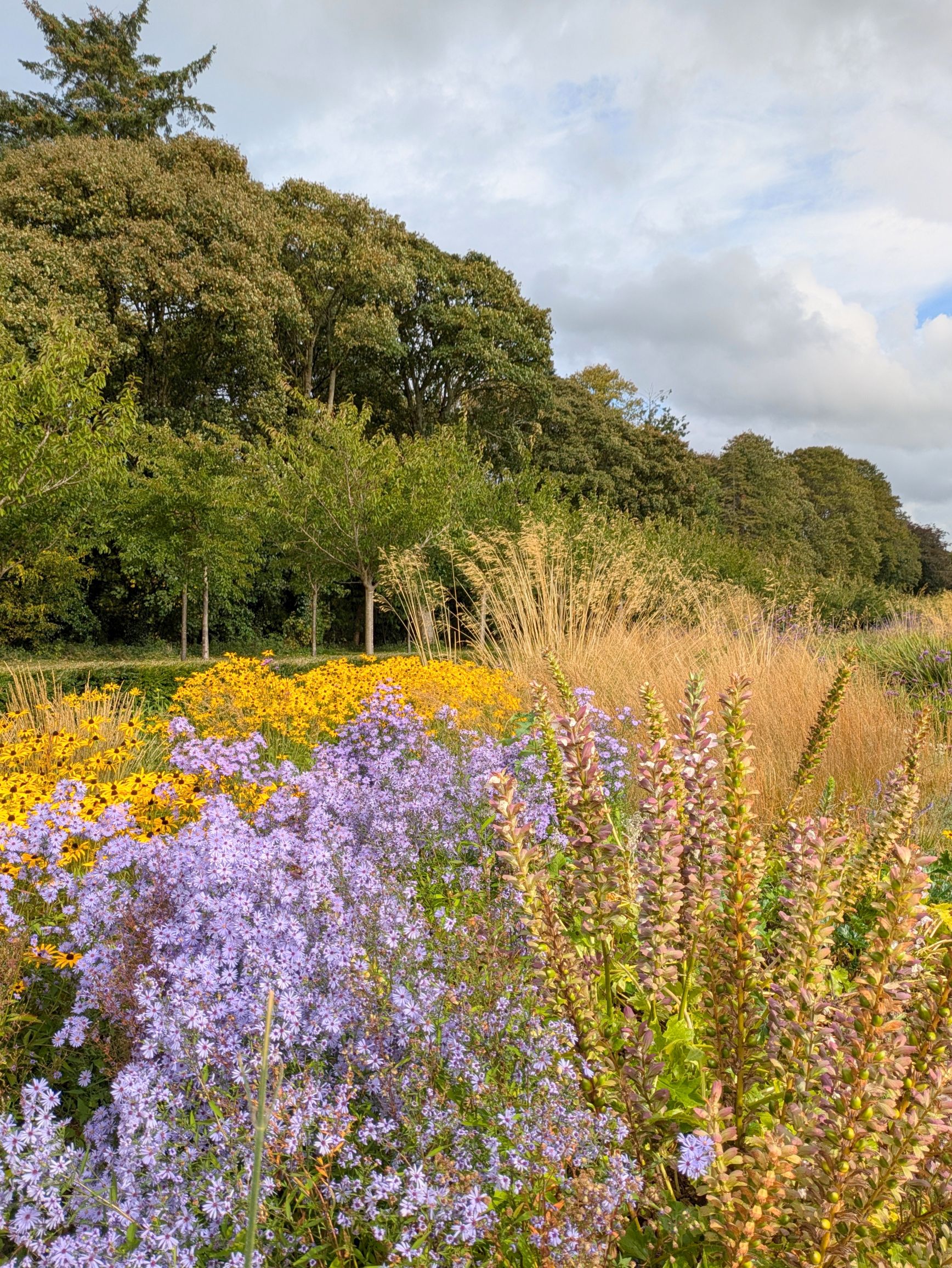
Following our boat tour, we visited Killarney House and Gardens, which are also part of Killarney National Park. Originally, the house was the stable block of the Kenmare House, a French chateau style mansion, built by Valentine Browne in 1726.
The morning had been quite gloomy, but the skies cleared for our final afternoon in Ireland.
Well, folks, that about wraps up this Irish adventure—finally! (We returned home from our six weeks in the U.K. in early October!)
Later this year, we will be traveling to Sicily and Turkey, and then Spain and Portugal. In between, I will be competing in swimming at the National Senior Games, in Des Moines, Iowa. Stay tuned!
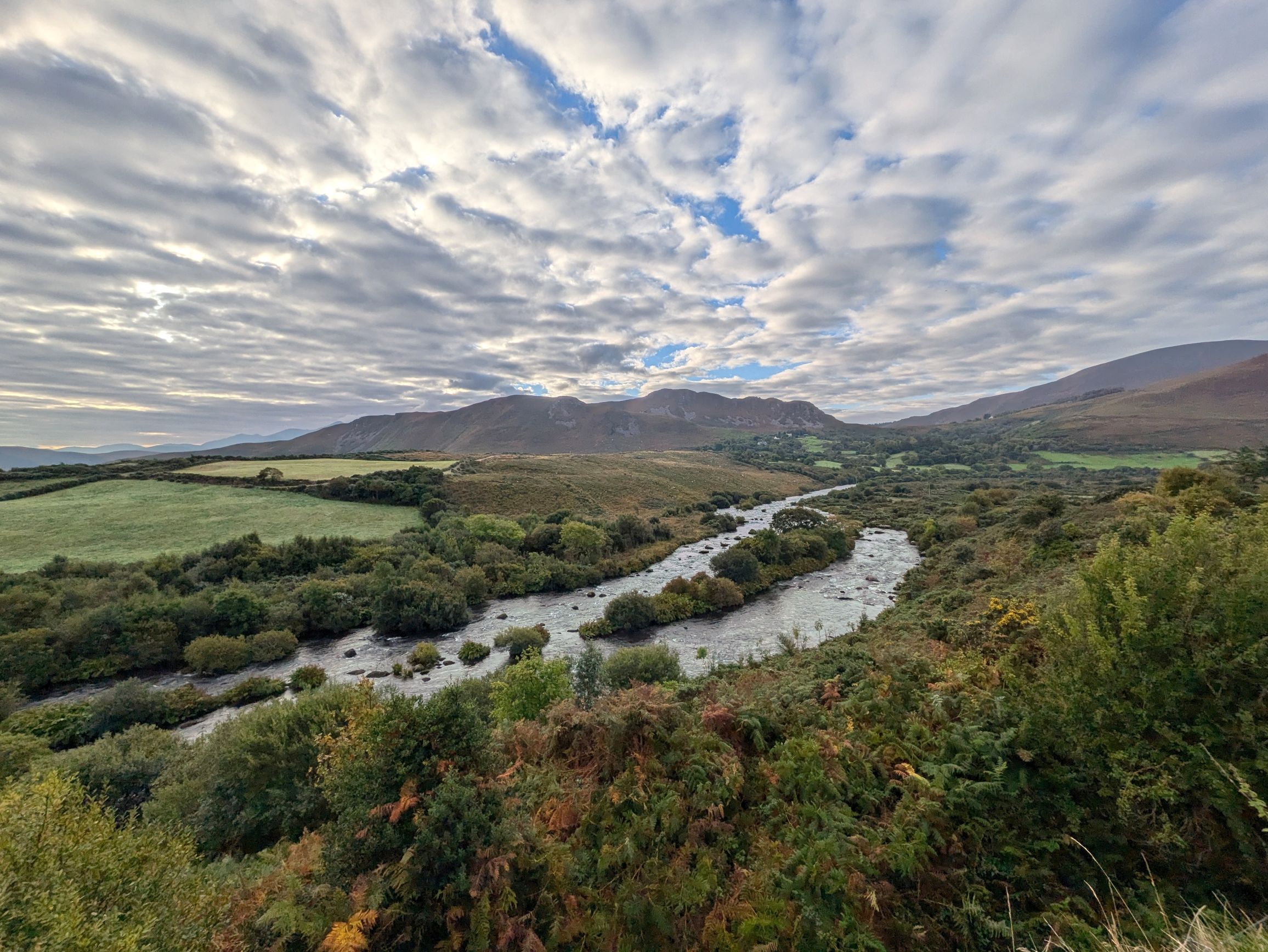
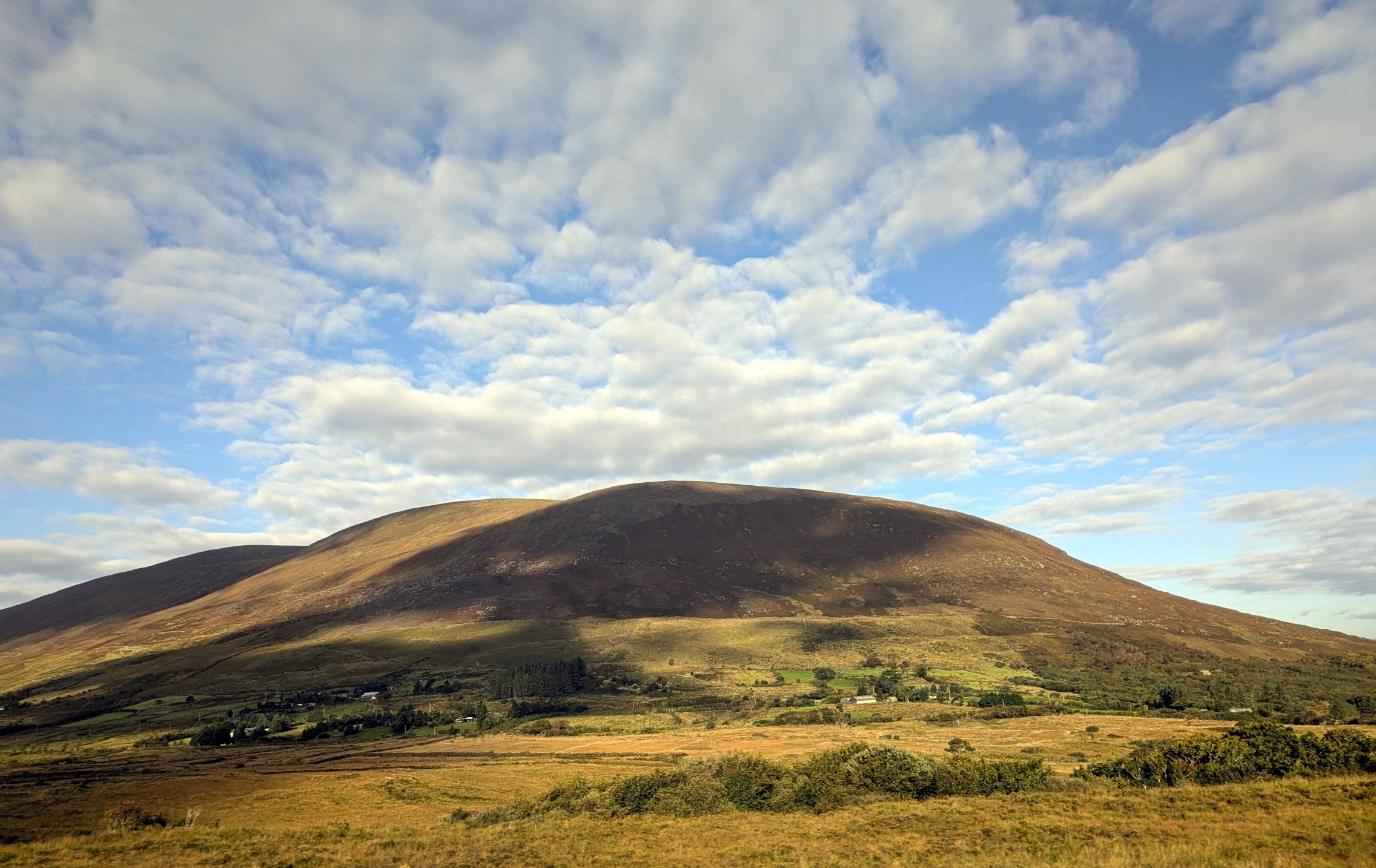
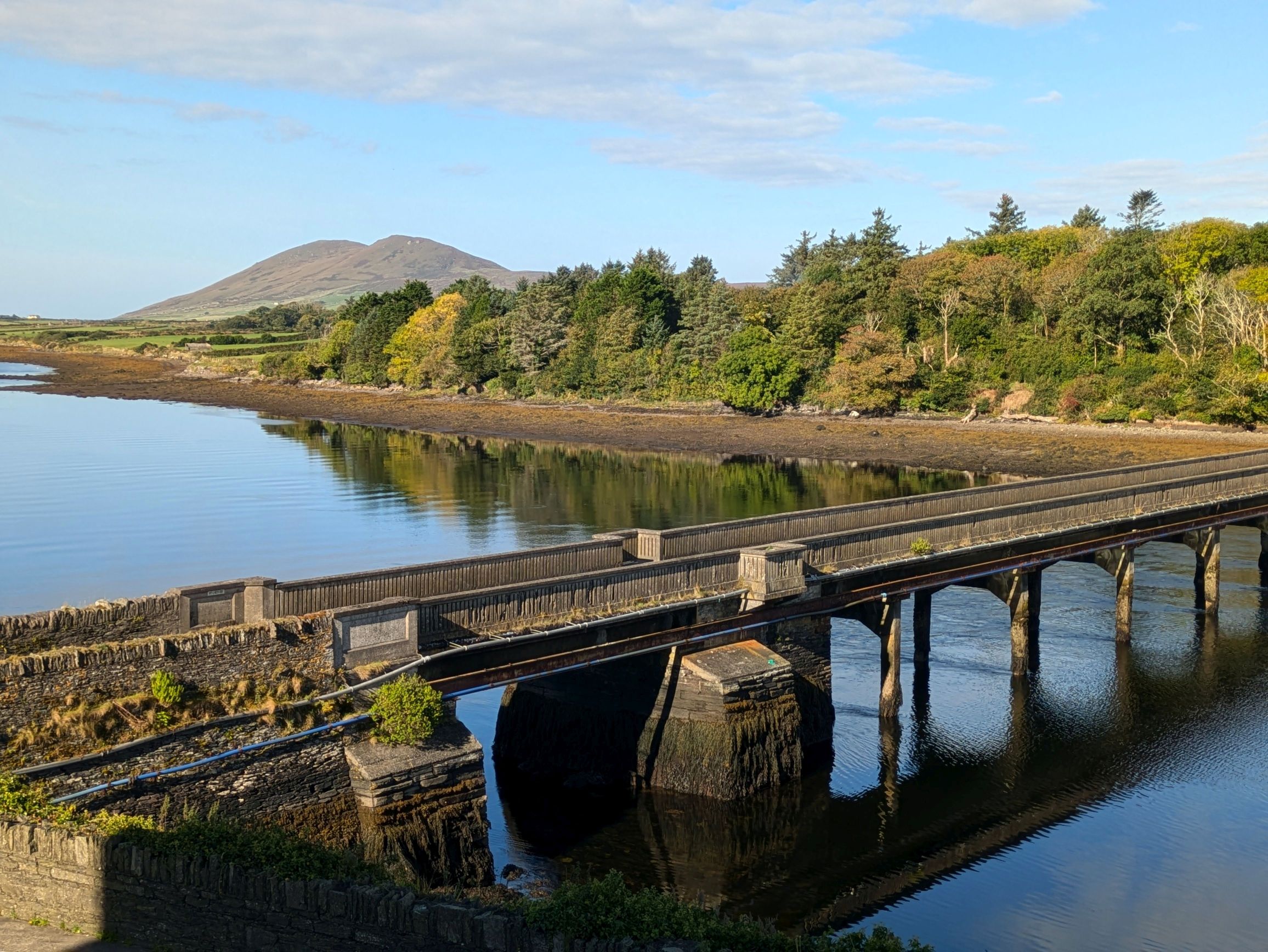
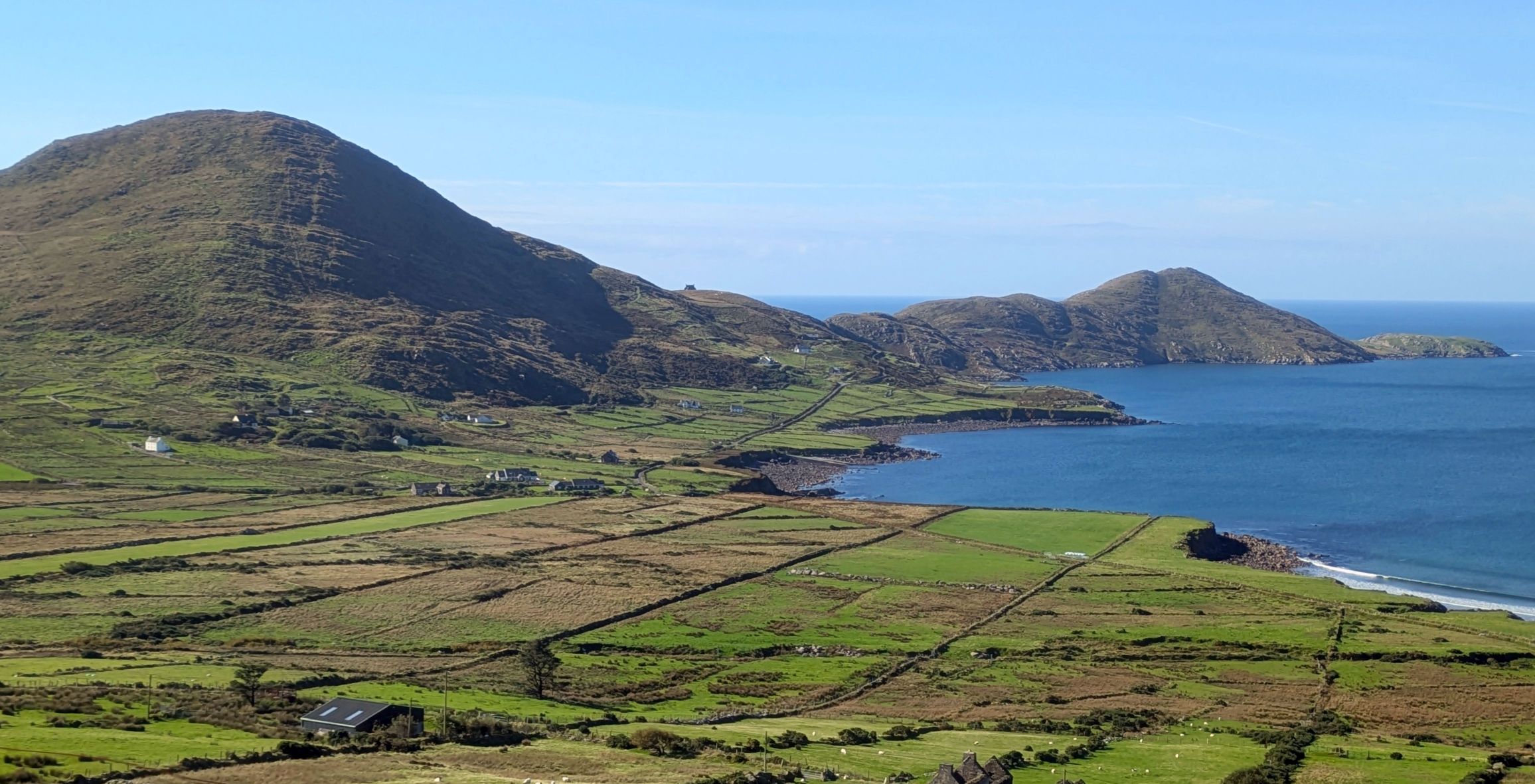
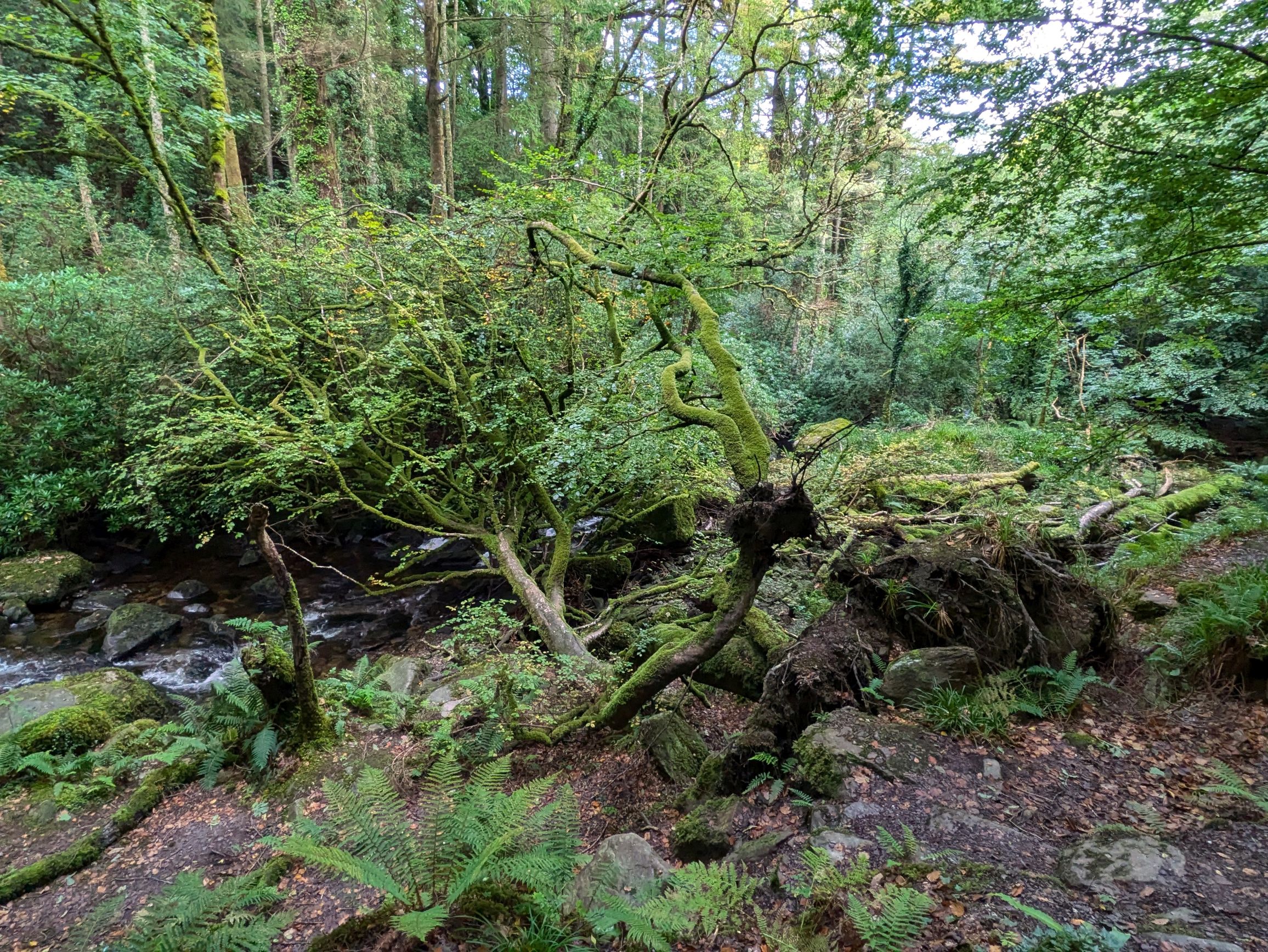
This is such a beautiful, green region of Ireland! The Ring of Kerry, in the southwest area of the country, is a 111-mile long circular scenic route popular with tourists. The roads are windy, the cliffs along the coast are rugged, and the sloping valleys and rolling hills are dotted with sheep.
(For all photos, click on the image for a full screen view.)
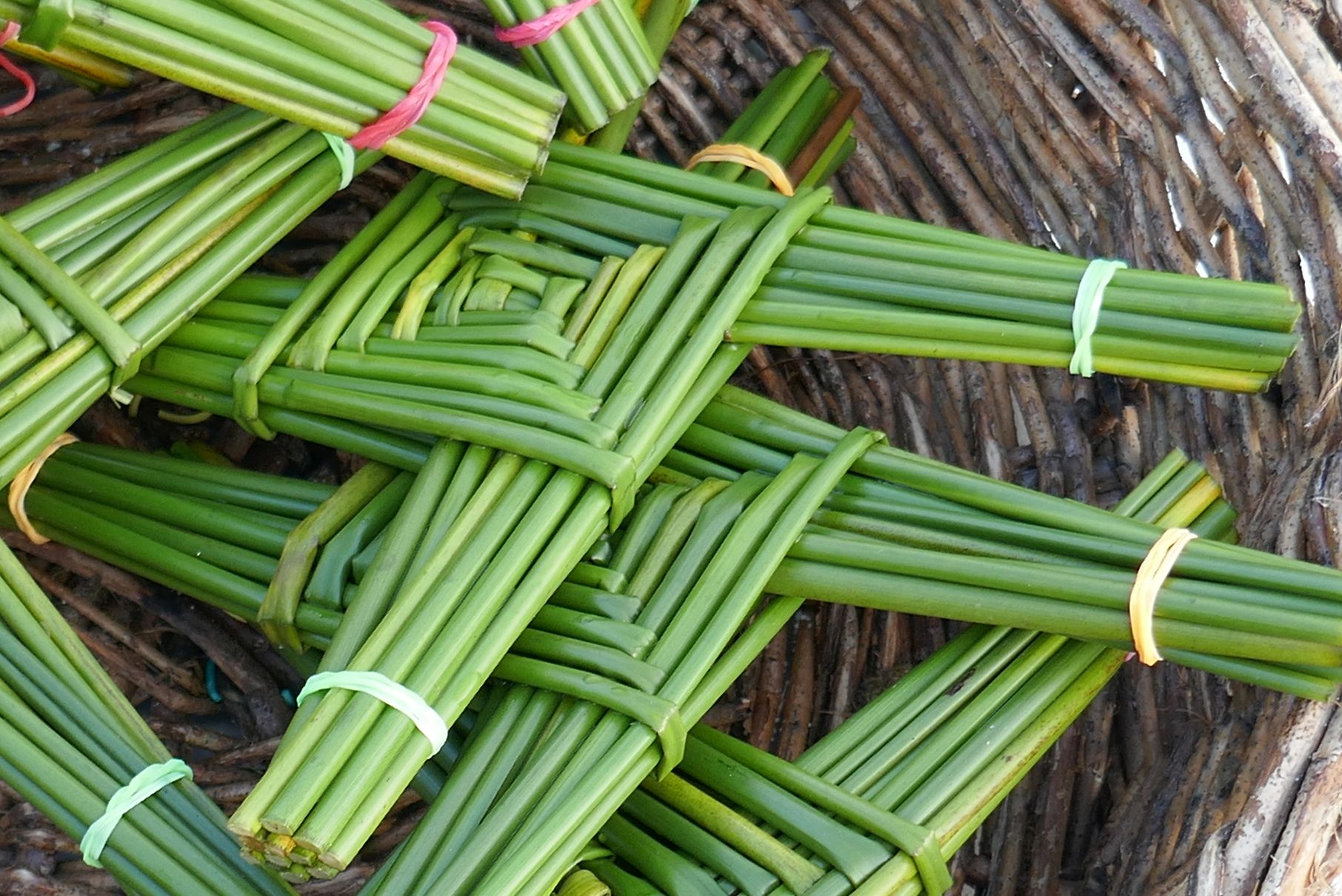
This man was making and selling St. Bridget’s Crosses (see below). Set one over your doorway or window, and it will protect your home from any harm (or so they say…)
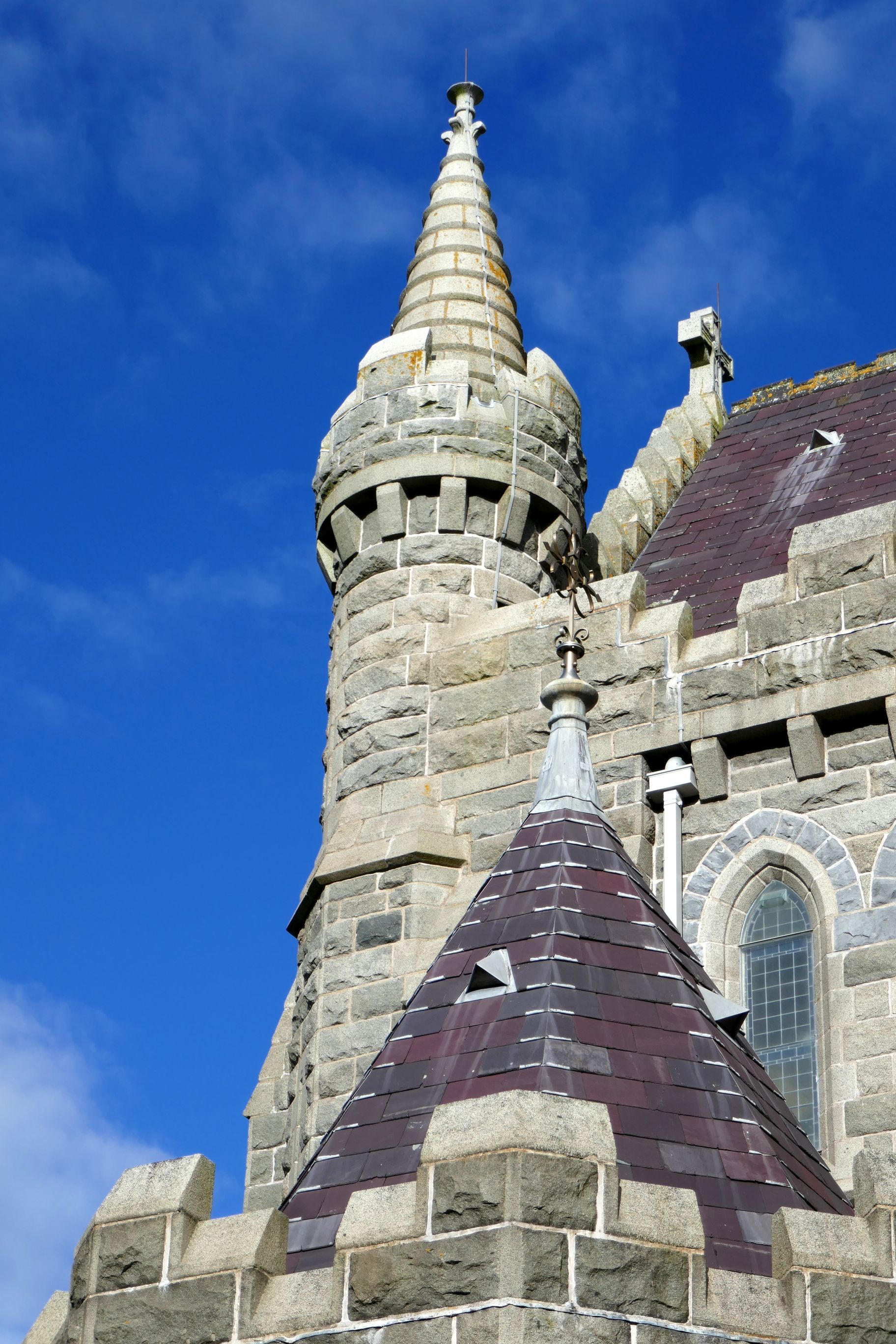
Along the route are small villages, considered some of the most traditional in Ireland.
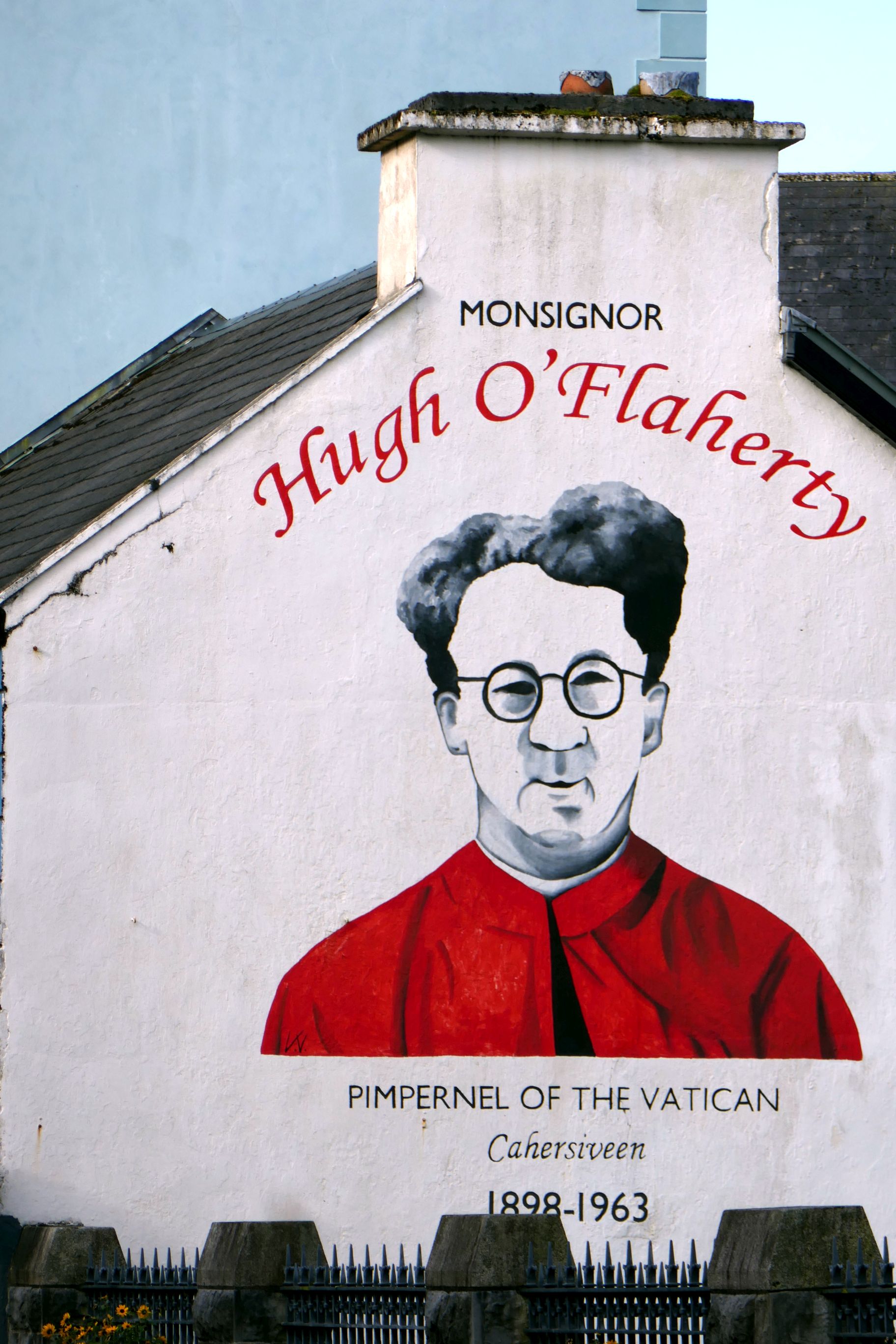
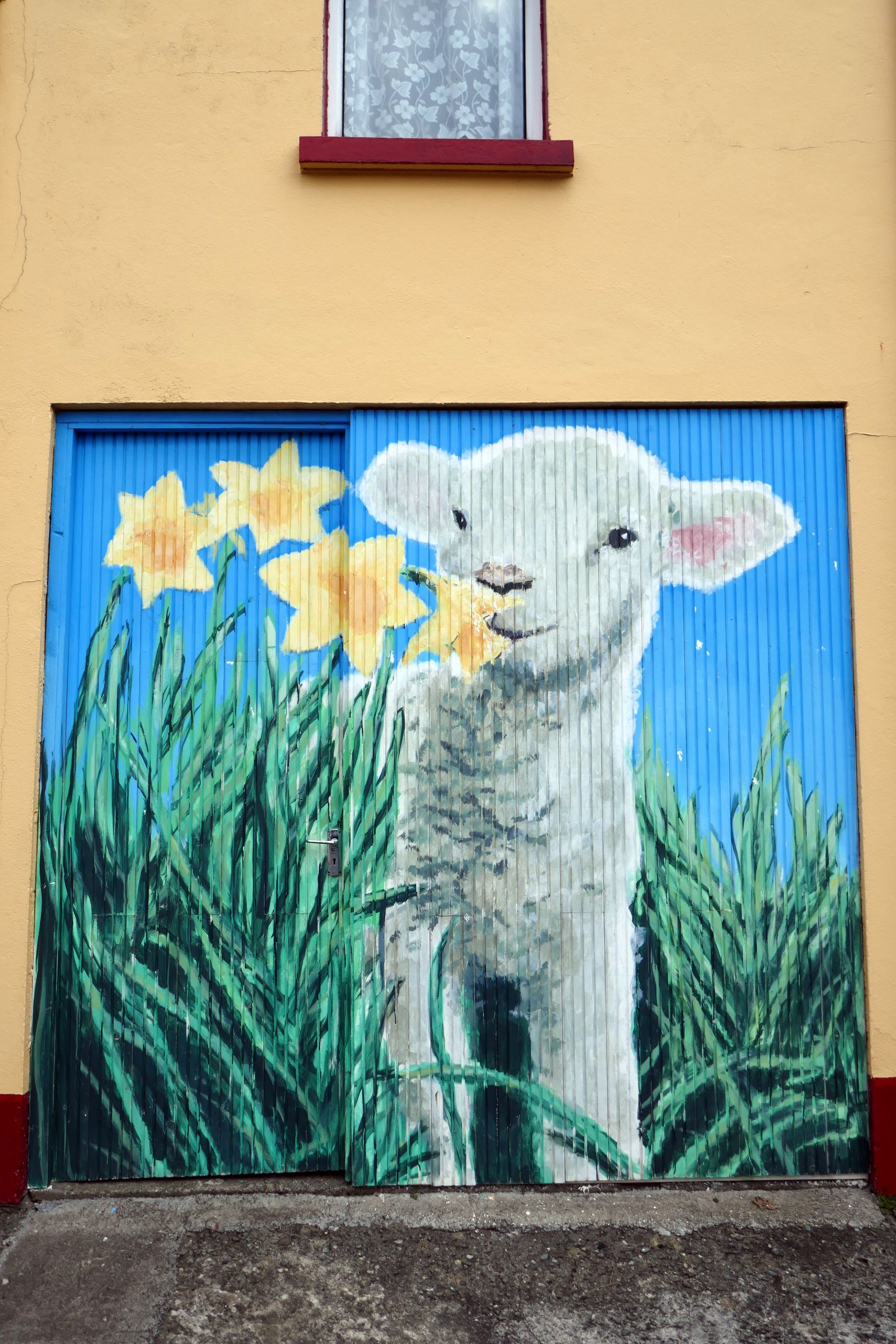
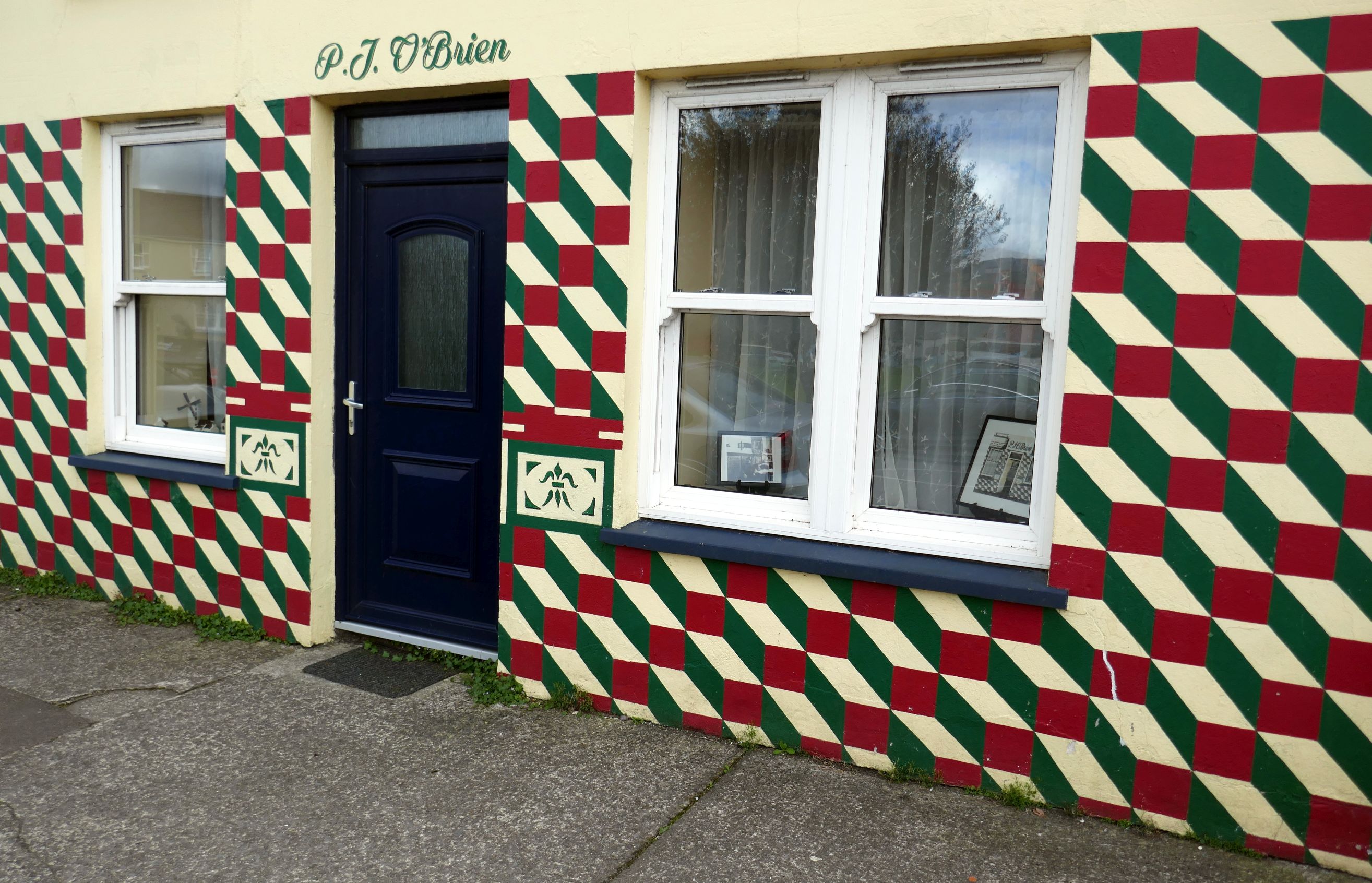
One of the villages we stopped at had the funniest name: Sneem. It’s small; there are less than 400 people who call Sneem home. We enjoyed walking around, though, and taking a few photos.











































































 Elaine-iaK's Travels: A Traveler's Tales of People, Places, Photos, Pools... and CHOCOLATE!