INJURIES AND OBSTACLES: MAKING THE BEST OF BOTH AS A SOLO SWIMMER

Note:  This article can also be found at Swimspire.com.  This is the fourth in a series dedicated to the solo swimmer.

Just when you have gotten into a great groove with your swimming, you get injured in a bicycle accident or it’s time to embark on that ocean cruise you booked last year. Your routine is disrupted—again. Don’t let injuries or obstacles derail your swimming. Make the best of both!

Making the Best of Your Injury

The advantage of being a solo swimmer when you have an injury is that you don’t have to worry about not being able to do the coach’s dictated workout or keeping up with lane mates. Instead, you get to call the shots. Following are tips and ideas to keep you in the pool.

First, before you swim another lap with that injury, visit a doctor for an accurate diagnosis, and follow your doctor’s orders. Your doctor may allow you to swim with waterproof bandages covering open wounds, but make sure to ask about this and any other work-around ideas you may have for your injury.

For many types of injuries, such as those involving muscles and joints, a visit to a physical therapist for an evaluation may be recommended by your doctor. If not, ask if it would be appropriate for you. After a physical exam of the injury, a physical therapist can show you strengthening exercises that will not only get you healed and back in the pool again, but could prevent further injury. Make sure to follow your prescribed exercise program to the letter! Then, even after you are fully recovered, keep doing the exercises as part of a regular dryland routine to help avoid reinjury.

If you are not sure whether it would be safe for your particular injury to do some of the proposed adaptive swimming ideas outlined below, do a Google or YouTube search and show a video clip of it to your doctor or physical therapist for approval. For example, after my stitches were removed following a hip labral tear repair and hip flexor release, my doctor didn’t want me to do any kicking for two months. I showed him a video clip of swimming with a pull buoy, and he approved it for easy freestyle and sculling drills, but no pushing off the walls. I was also given the strict order, “Let pain be your guide!” My swimming was severely restricted; however, I was back in the pool two months earlier and was able to keep my healthy shoulders strong while my hip healed.

Four Limbs, Four Strokes, Unlimited Possibilities!

Aren’t you glad you’re a swimmer rather than a runner? As a runner, you won’t get too far with a lower limb injury; however, (most of) us swimmers have four limbs, four (competitive) swimming stroke options, and unlimited possible combinations.

A pull buoy became my best friend following hip surgery, and it can become yours, too, if you have a lower limb injury. For proper usage, search “pull buoy swimming drills” on YouTube. Just keep in mind that eliminating your kick in swimming will put increased reliance and stress on your shoulders; so, leave the paddles at home, use proper stroke technique, and reduce yardage throughout your recovery to avoid other injuries. The same applies with any injury and any adaptive swimming you do to compensate. Again, let pain be your guide, and don’t overdo it! You won’t know how much your body can withstand of your new routine, so stay flexible with your workout plan, yardage, and duration.

For an upper limb injury, this will be the time to focus on incorporating kick sets with lap walking in the shallow end of the pool mixed in. Using a kickboard puts stress on the shoulders, so opt instead for a front-mounted snorkel and kicking with your arms relaxed by your side (or out in front if your injury allows). If you are like me and dislike snorkels, roll to one side to breathe or take a quick breath in front. (Note:  A snorkel is your best option for neck injuries.)
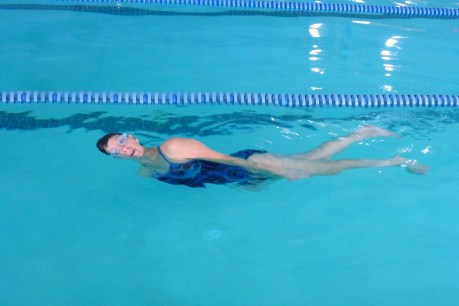
Kicking-BreatheSide-Edit.JPG

Kicking-BreatheFront-Edit

Kicking options include flutter or dolphin kicking face down, on your side facing to the left, facing to the right, or on your back. Breaststroke can be kicked face-down or on your back with your arms either above your head or by your side. To avoid overdoing it, try mixing them up in various combinations for each set. An example would be kicking a 100 Individual Medley on the first and third repeat, and flutter kick face down, to the left, to the right, and on your back on the second and fourth repeats, resting for a set interval in between each 100. Mixing in one-minute egg beater kicking in the deep end or water walking (forward and side steps) in the shallow end can give your legs much-needed variety as they get fatigued.

You may also be able to swim some one arm drills, depending on your injury.  Show the following video, “Swimming—Freestyle—Single Arm Variations” to your doctor or physical therapist to see if this would work for you.

Another option is to combine the upper half of one stroke with the lower half of another. When my hip flexor gets fatigued, I like to swim breaststroke pull with an easy dolphin “kick”—more like keeping my legs together and letting them flow behind me, keeping my hips loose.

Again, if you have any question about whether these ideas would work for you, bookmark videos of swimming drills on your phone ahead of your doctor or physical therapy appointment, and run the videos by them for approval.

In addition, if you are reading this prior to sustaining an injury, go ahead and get somebody to shoot some video of your swim strokes. Not only could you use the videos for stroke technique analysis, but they might come in handy someday if you need to show them to your doctor or therapist for clearance to swim with your injury!

Overcoming Obstacles

Rather than an injury, perhaps you have been faced with an obstacle that is conspiring to keep you out of the pool. Maintaining consistency is important for fitness, well-being, and staying race-ready (if you are a competitive swimmer). If your regular pool has been closed for maintenance or you are going to be traveling, a terrific resource for locating an alternate pool is Swimmers Guide. According to their website, “Swimmers Guide contains the only international, descriptive directory of publicly-accessible, full-size, year-round swimming pools you will ever need…” I utilized this site to successfully locate pools throughout the northeast United States, so I could swim throughout a seven-week road trip I did with my husband.

What if you have access to a pool during your travels, but it’s tiny like this riverboat pool?
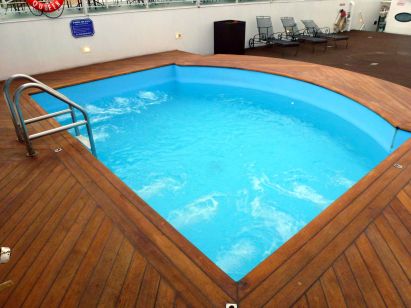
AQPool

If the pool is too small for stretch cords, you can still get a great workout by kicking face down with you hands up against the side. For breaststroke, push off with your hands, allow yourself to float backwards, and then do a kick back to the wall. Repeat several times before switching to flutter kick again.

I worked on strengthening my hips by pushing off underwater and streamlining to the other side, and then quickly turning around underwater and pushing off again. Going back and forth underwater not only worked my legs, but it worked my lungs as well! Mixing in vertical streamlined jumps off the bottom added variety.

For an arm workout, I stood facing the side with my feet on the bottom and toes up against the side. Leaning back slightly, I did fast repetitive breaststroke pulls, going as quickly as I could for one minute. This is a great way for improving turnover speed and aerobic endurance. Doing all of these drills in fast succession, I was out of breath as if I had done a sprint workout!
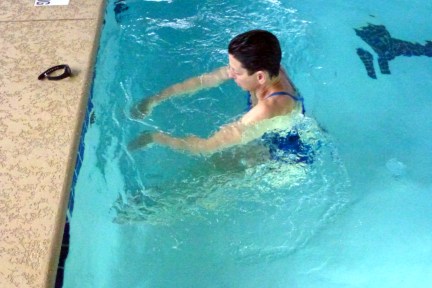
BreastPulls-FastReps-Edit.JPG

Where there’s a will, there’s a way, and these tips and ideas can help! The swimming routine you have developed is too important to let injuries and obstacles keep you from the fitness, well-being, and endorphin rush that swimming provides. Next time an injury or obstacle conspires against you, get creative and make the best of it!

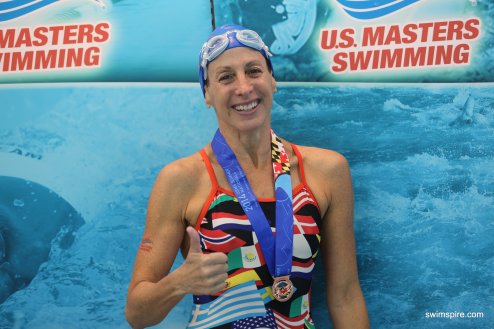
ElaineKrugman


SIX SUGGESTIONS FOR THE SOLO SWIMMER

Note:  The following article appeared on Swimspire.com in September of 2016 and was adapted for the Georgia Masters Newsletter in December, 2016:

936

Are you a solo swimmer?  If so, welcome to my world!  For many of us, swimming solo rather than with a workout group or team isn’t a preference; it’s dictated by circumstances.  In my case, the nearest U.S. Masters Swimming (USMS) team is located quite a distance away, so the community pool just one mile away is the more convenient option.

Although swimming solo may have its disadvantages, I have discovered ways during my six years as a lone Masters swimmer to overcome them and make the most of my swimming experience.  Hopefully, the following suggestions will do the same for you.

  1. No coach? No problem!  Learn to coach yourself with video.

The most frustrating thing for me training solo was not having a coach on deck to evaluate my strokes on a regular basis, so I bought a waterproof camera and enlisted the help of my husband to periodically shoot video of all four strokes. Having to kneel down on the deck to record underwater views was a knee and back buster, so I rigged up a camera mount on a PVC pipe.  Now, my husband can stand up straight to shoot underwater video.  He simply twists the pipe to pan the camera as I swim by, or he holds it still at the end of the pool for front views.

In order to shoot video myself, I use reusable rubber-coated twist ties (available at Home Depot) to attach the PVC pipe to the pool ladder or railing.

Next, I upload the videos to my computer, and compare them to instructional videos right here on Swimspire.  I also compare my stroke videos to “Go Swim” and “Total Immersion” videos viewed on YouTube.

Alternatively, the U.S. Masters Swimming Discussion Forums (www.usms.org) are a great place to have your stroke video evaluated by other Masters swimmers.  Just upload your video to YouTube, and post the link on the Forums.  (You don’t have to be a member to sign up for a free account.)  Every time I have done so, other “Forumites” have responded with great advice.  Often these online “coaches” have been actual swim coaches or world-class Masters swimmers!

  1. Are you lost as to how to design your own workout plans? Check out the Internet!

The USMS website is THE place to find a variety of excellent workouts to suit your needs.  Sign up for that free account, and check out “Workouts” in the “General” section of the Forums.  Swimming workouts are posted on a daily basis by top-level Masters swimmers that are geared for sprinters, long-distance swimmers, triathletes, stroke specialists, and more.  There are even swim workouts specifically written for expectant mothers and those with limited mobility!

There are plenty of other options for swim workout ideas, too.  Google “swim workouts,” and there will be numerous options for ideas.

I copy and pasted my favorite workouts into Word Documents, custom-formatted them in larger font for easy reading through goggles, and printed them out.  They are kept in a three-ring binder in plastic sleeves, and I place a selected one in a jumbo Ziploc bag to keep it dry at the pool.

I also record my results (such as my practice “race” times) on a plastic SCUBA slate using a pencil.  After recording the information online in my USMS Fitness log, I use toothpaste and water to scrub it clean.

ElaineKrugman.JPG

  1. Be a sociable solo swimmer.

Many swimmers love the solitude of swimming solo, and escape to the pool to alleviate stress.  If you’re an extrovert like me, though, I enjoy being around people; so, I make an effort to be sociable when I’m at the pool.

Regardless of your personality type, there are advantages to getting to know others where you swim.

Over the years my friendliness towards others at the pool has come back around in ways I had never expected.  I get asked about upcoming competitions, receive a lot of encouragement, and get congratulated when I return to the pool following a meet.  There are several people who even offer to move (or just automatically do it) if they are using my favorite lane when I arrive for my workout.  (The other narrow swim lane has two ladders that are not built into the wall—painful for my fingers if the butterfly recovery isn’t timed perfectly.)

Striking up conversations with others at the pool has led to some wonderful friendships, too.  We already had one thing in common when we met; we loved to swim!

  1. Become a “Forumite” on the USMS Discussion Forums.

Joining USMS, and being active on the Discussion Forums has also led to cherished friendships over the years.  One “Forumite” (a FINA World Record breaststroker) who had viewed my posted stroke videos and responded with advice did something for me I will never forget.  At my first USMS Short Course Nationals, just two months after joining USMS, he surprised me by watching me race, and then meeting me at my lane to provide stroke feedback.  Hearing what I did well and how I could improve helped me going into my next race.  This “Forumite” has been my valued online coach ever since, and I am one of his biggest fans!

At another national swim meet the following year, my husband and I got to know the guys from another team sitting next to us in the bleachers.  When it came time for my 200 breaststroke race, I heard a booming, “Go, Elaine!” echo from the bleachers as I stepped up onto the starting block.  That jolt of inspiration propelled me to swim a personal best time!

Besides learning a lot from the other Forum contributors, many of them have become real friends—unlike the so-called “friends” many people make on Facebook (that they may never meet face-to-face).  When I compete at swim meets—especially USMS National Championships—I get to see and spend time with my Forum friends.  One of them even traveled across the country to visit me in Georgia, and participate with me at an upstate meet.  It was a blast!

Overall, the swimming community is a friendly, open, and supportive one.  Become a part of it, and you will be happy you did!

  1. Volunteer.

Are you a non-competitive fitness/recreation swimmer?  You will be welcomed with open arms if you go to a local swim meet, and volunteer to time races, count laps during distance events, or assist the meet director!  It’s a great way to meet other swimmers, and become a part of your local swim community, even if you never swim a race.

When I was unable to compete following hip surgery, I timed races at a meet.  I had so much fun cheering my teammates on and socializing with the others.

Are you considering becoming a competitive swimmer, but a lack of self-confidence in your abilities is stopping you? Do you feel intimidated by the thought of competition?  Volunteering at a local Masters or Senior Games meet is a great opportunity to see what it’s really like.  Watch the other swimmers, and see how you compare.  At a recent local swim meet, there were swimmers of all levels; from a three-time 1980’s Olympian to a swimmer who appeared to struggle with completing the race.  Nobody paid particular attention to either one; we were all there to race against the clock and achieve our personal goals.  As always, the atmosphere was fun, friendly, and supportive.

  1. Share your skills.

Related to the last suggestion, sharing your skills with other swimmers will bring joy in unpredictable ways.  When I complimented a new resident at my community on her freestyle stroke, she lamented the fact she hadn’t been coached since her age-group swimming days; so, she wasn’t sure how her stroke looked.  I offered to shoot topside and underwater video of her stroke, so we met up the following day for a video session, and I recorded her stroke from several angles.  I then uploaded the videos to YouTube and sent her the links.  She was so appreciative that she treated me to lunch!  We had a great time, and a new friendship was formed.

I also write a monthly “Swimmer Profile” column for the Georgia Masters Newsletter and contribute photos I shoot at swim meets.  In addition, I periodically submit meet recap articles.  I enjoy the writing process, and interviewing profile subjects has been a great way to get to know other area swimmers.  Friendships I’ve formed have deepened, and the compliments on my writing have been gratifying!

Think about your skills and how they could benefit other swimmers at your pool or your local swim club.  It will be a rewarding experience!

Putting these six suggestions into action is sure to make your solo swimming experience more enjoyable.  Give them a try and see for yourself!